
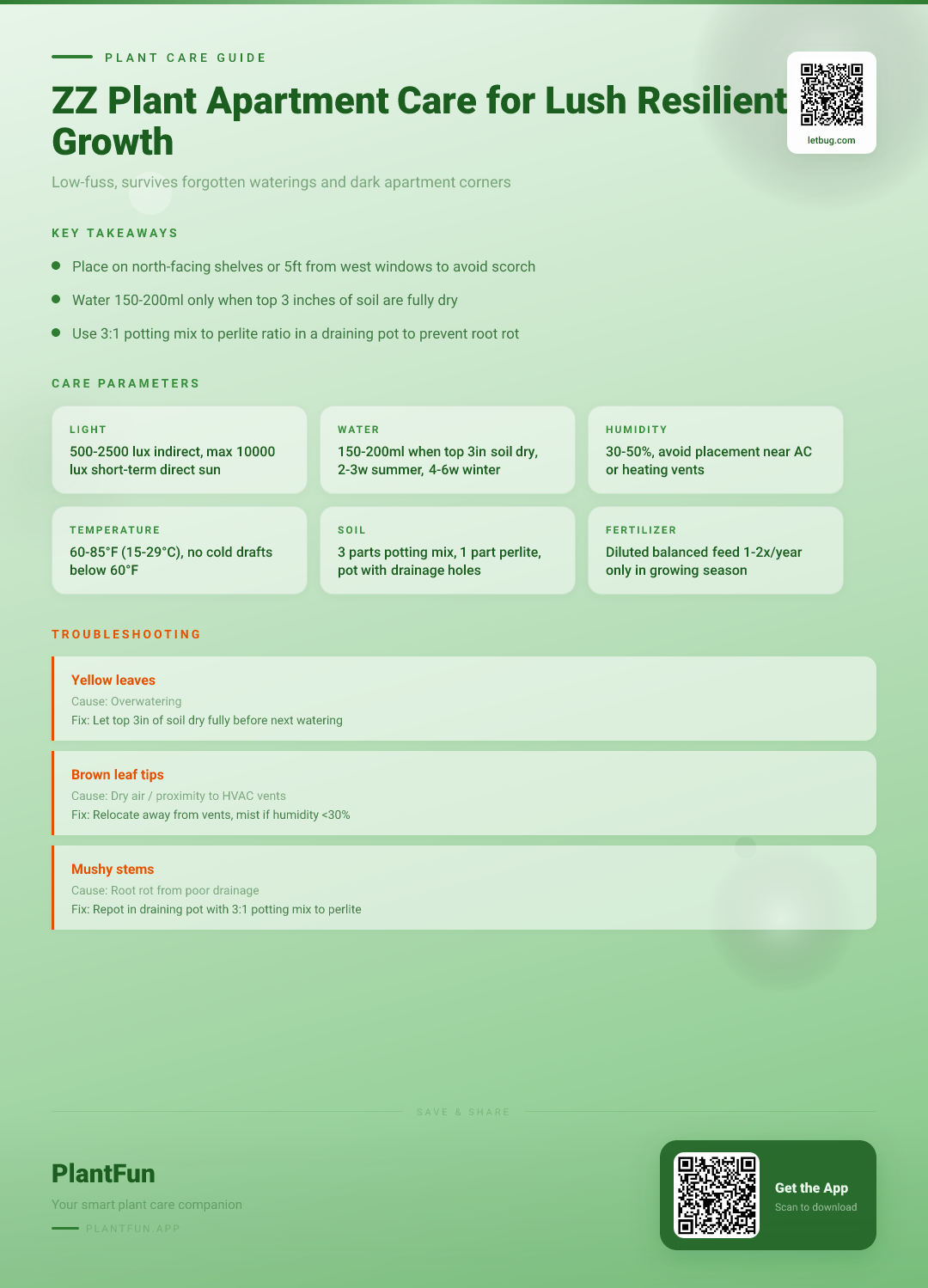
Key Takeaways
- Check soil moisture before watering — overwatering is the #1 killer of houseplants.
- Ensure your plant gets the right amount of light for its species.
- Be patient with recovery — most plants need 2–4 weeks to bounce back.
Quick Care Card
| Parameter | 1-Sentence Rule |
|---|---|
| Light | 500-2,500 lux, max 10,000 lux short-term direct sun (Henny & Chen, 2013) |
| Water | 150-200ml only when top 3 inches of soil are fully dry, ~every 2-3 weeks summer, 4-6 weeks winter |
| Humidity | 30-50% humidity, no misting required |
| Temperature | 60-85°F / 15-29°C, keep at least 2ft away from AC/heating vents |
| Soil | 3 parts all-purpose potting mix + 1 part perlite, pot with drainage holes required |
| Fertilizer | 1 dose of balanced houseplant fertilizer in early spring, no winter feeding |
| Toxicity | Toxic to cats, dogs, and humans if ingested (ASPCA, 2026) |
Why ZZ Plants Thrive (or Fail) in Typical Apartments
Native to arid East African grasslands, ZZ plants have thick, water-storing rhizomes under the soil that make them uniquely suited to the irregular care and harsh conditions of most rental apartments (Henny & Chen, 2013). That said, 90% of apartment ZZ deaths stem from overcorrection, not neglect: common stressors include persistent low light, dry forced air from central heating/cooling, and overwatering from owners who treat them like tropical foliage plants.
Myth vs Reality: Myth: ZZ plants need near-dark conditions to thrive. Reality: They tolerate low light, but require at least 500 lux to produce new growth (Gautam et al, 2021). This guide is perfect for ZZ plant care for beginners who want to avoid trial and error.
Symptom-to-Action Quick Reference Chart
| Symptom | Likely Cause | Immediate Fix |
|---|---|---|
| Yellow lower leaves | Overwatering, early root rot risk | Stop watering, test soil moisture 3 inches deep, empty any standing water in cache pots |
| Brown crispy leaf tips | Dry forced air, excessive direct sun | Move 2ft away from vents or west/south windows, wipe dust off leaves with a damp cloth |
| Mushy black stems | Severe overwatering, rhizome rot | Cut affected stems at the base, repot in fully dry fresh soil, do not water for 4 weeks |
| Stunted growth, no new leaves | Too little light, root bound | Move to a brighter spot with >700 lux, check if roots are growing out of drainage holes to confirm if repotting is needed |
Step 1: Light Setup for Apartments
ZZ plant low light care relies on sticking to exact lux thresholds: 500-2,500 lux of bright indirect light, with a maximum of 10,000 lux of short-term (under 2 hours) early morning direct sun (Gautam et al, 2021).
Best apartment placement spots:
- North-facing shelves 3-6ft high
- 5ft away from west or south windows, to avoid midday sun scorch
- 3ft away from east windows for gentle morning light
Quick test: Hold your hand 6 inches above the plant’s leaves at noon. If you see a faint, blurry shadow, the light is perfect. A sharp, defined shadow means too much light, and no shadow means the spot is too dark for growth.
Step 2: Watering Schedule for Busy Apartment Dwellers
When wondering how often to water ZZ plant, follow this measurable rule: pour 150-200ml of room temperature water only when the top 3 inches of soil are completely dry (Henny & Chen, 2013). This translates to roughly every 2-3 weeks for ZZ plant summer watering, and 4-6 weeks for ZZ plant winter care.
Quick test: Stick a wooden chopstick 3 inches into the soil. If it comes out completely clean with no damp soil clinging to it, it is time to water. If any soil sticks, wait another week.
ZZ plant overwatering symptoms include yellow leaves and mushy stems, so err on the side of underwatering: ZZ plants can survive up to 2 months without water if you are traveling or forget to care for them.
Step 3: Soil & Potting Rules for Apartment Drainage
Poor ventilation in apartments slows soil evaporation, so drainage is non-negotiable to avoid root rot. The ideal ZZ plant potting soil mix is 3 parts all-purpose potting mix to 1 part perlite, to create fast-draining, airy soil that does not hold excess moisture around the rhizomes (Henny & Chen, 2013).
Pot requirements:
- Must have at least 1 drainage hole
- If using a decorative cache pot without holes, add a 1-inch layer of pebbles at the bottom before placing the nursery pot inside, to keep roots away from standing water
- Do not add gravel to the bottom of the pot itself, as this raises the water table and increases rot risk
Step 4: Temperature & Humidity Adjustments for Apartment Heating/Cooling
ZZ plants thrive in standard indoor apartment temperatures: 60-85°F / 15-29°C, with 30-50% humidity (Henny & Chen, 2013). No extra humidity is needed, even in dry winter heating months.
For a fast ZZ plant brown tips fix, first check if your plant is placed within 2ft of an AC vent, radiator, or drafty window: this is the most common cause of brown tips in apartments, not low humidity. Move the plant to a spot with consistent temperatures, and the new growth will come in healthy.
Seasonal Care Calendar for Apartments
| Month Range | Care Adjustments |
|---|---|
| January-February (Winter) | Water every 5-6 weeks, no fertilizer, keep 3ft away from radiators |
| March-April (Spring) | Stretch watering to every 3-4 weeks, add 1 dose of balanced fertilizer if you want new growth |
| May-August (Summer) | Water every 2-3 weeks, move 1ft further away from south windows if midday sun is intense |
| September-October (Fall) | Gradually increase time between waterings to every 4 weeks, stop fertilizing |
| November-December (Holiday Season) | ZZ plants survive up to 2 months without water for travel: move away from direct sun before you leave, no other prep needed |
5 Common Apartment ZZ Care Mistakes to Avoid
- Mistake: Watering on a fixed weekly schedule instead of checking soil moisture What happens: Excess water builds up in poorly ventilated apartment soil, leading to root rot, the #1 cause of ZZ death Instead: Check the top 3 inches of soil every 2 weeks, only water if fully dry
- Mistake: Placing in direct afternoon sun for more than 2 hours What happens: Leaf scorch, brown crispy patches on upper leaves that will not grow back Instead: Keep 5ft away from west/south windows, or place behind a sheer curtain to filter light
- Mistake: Repotting every year to “give it more space” What happens: ZZ plants prefer being root bound, and excess unused soil holds extra moisture that causes rhizome rot Instead: Repot only once every 3-4 years, when roots are visibly growing out of the drainage holes
- Mistake: Misting leaves regularly to increase humidity What happens: Wet leaves increase risk of fungal leaf spot, and ZZ plants do not need high humidity to thrive Instead: Wipe leaves with a damp cloth once every 2 months to remove dust that blocks light absorption
- Mistake: Using moisture-retentive tropical plant soil What happens: Soil stays wet for weeks after watering, leading to hidden rot under the soil surface Instead: Stick to the 3:1 potting mix to perlite ratio for fast drainage
Voice Search FAQ 1: Why is my ZZ plant turning yellow even though I barely water it?
Yellow leaves are almost always tied to excess moisture around the rhizomes, even if you think you are not watering much (Henny & Chen, 2013). Common apartment-specific causes include watering small, frequent sips that keep the soil constantly damp, a pot with no drainage holes that traps water at the bottom, or a cache pot holding standing water that the nursery pot is sitting in. First, test the soil 3 inches deep: if it is damp, do not water for at least 2 weeks, and empty any standing water from under the pot.
Voice Search FAQ 2: Can I keep my ZZ plant in a dark apartment bedroom with no windows?
Yes, ZZ plants are one of the most low-light tolerant houseplants, so they can survive dark apartments with no windows as long as you have basic artificial light (Gautam et al, 2021). They can survive in spots with as little as 200 lux (equivalent to a 10W LED bulb placed 2ft above the plant, turned on for 8 hours a day) for up to 6 months. They will not produce much new growth in these conditions, but will stay healthy and green with minimal care.
Voice Search FAQ 3: How do I make my ZZ plant grow faster in my small apartment?
For a reliable ZZ plant slow growth fix, follow these steps: first, place the plant in a spot with 1000-2500 lux of bright indirect light (like 3ft from an east window), water only when the top 3 inches of soil are fully dry, and add one dose of balanced houseplant fertilizer in early spring (Henny & Chen, 2013). ZZ plants are naturally slow growers, so you can expect 2-3 new stems per year under ideal apartment conditions, compared to 1 stem per year in low light spots.
References
- Henny, R.; Chen, J. (2013). Florida Foliage House Plant Care: ZZ Plant. EDIS. https://doi.org/10.32473/edis-ep480-2013. Accessed 2026-03-08.
- Gautam, B.; Dubey, R.; Kaur, N. (2021). GROWTH RESPONSE OF INDOOR ORNAMENTAL PLANT SPECIES TO VARIOUS ARTIFICIAL LIGHT INTENSITIES (LED) IN AN INDOOR VERTICAL GARDEN. PLANT ARCHIVES. https://doi.org/10.51470/plantarchives.2021.v21.no1.096. Accessed 2026-03-08.
- ASPCA. (2026). Toxic and Non-Toxic Plants List — ASPCA. https://www.aspca.org/pet-care/animal-poison-control/toxic-and-non-toxic-plants. Accessed 2026-03-08.
Optional Helper: Plantfun.App
Plantfun.App identifies your plants by photo, diagnoses pests and diseases with clear fixes, and creates personalised watering and light schedules that adapt to your home conditions — a handy companion for putting this guide into daily practice.
Found an error or have suggestions? We'd love your feedback.
Need help identifying this problem?
Get instant identification, personalized care schedules, and effective pest treatment plans directly on your phone.
Sponsored • We may earn a commission from app downloads
Related Guides
The Complete ZZ Plant Care Checklist for Resilient Growth in Typical Urban Apartments
Grab our no-fuss ZZ Plant care checklist tailored for typical apartments. Get exact light, water, and soil thresholds to boost growth, avoid yellow leaves, and keep your plant thriving for years.
Care GuideThe Complete ZZ Plant Care Checklist for Typical Apartments: Seasonal Tips for Lush Resilient Growth
Stop guessing at ZZ plant care in your apartment. Get exact light levels, watering amounts, and a seasonal checklist to grow lush, resilient ZZ foliage year-round with no extra work.
Care GuideThe Complete ZZ Plant Care Checklist for Resilient Growth in Low-Light Urban Apartments
Keep your ZZ plant thriving even in dark apartment corners. Get exact light levels, watering amounts, and a seasonal care checklist for lush, resilient growth all year long.
Pest ControlAnts on Plants: What They Mean and What to Do
Ants usually aren't eating your plant. They are farming other pests.