
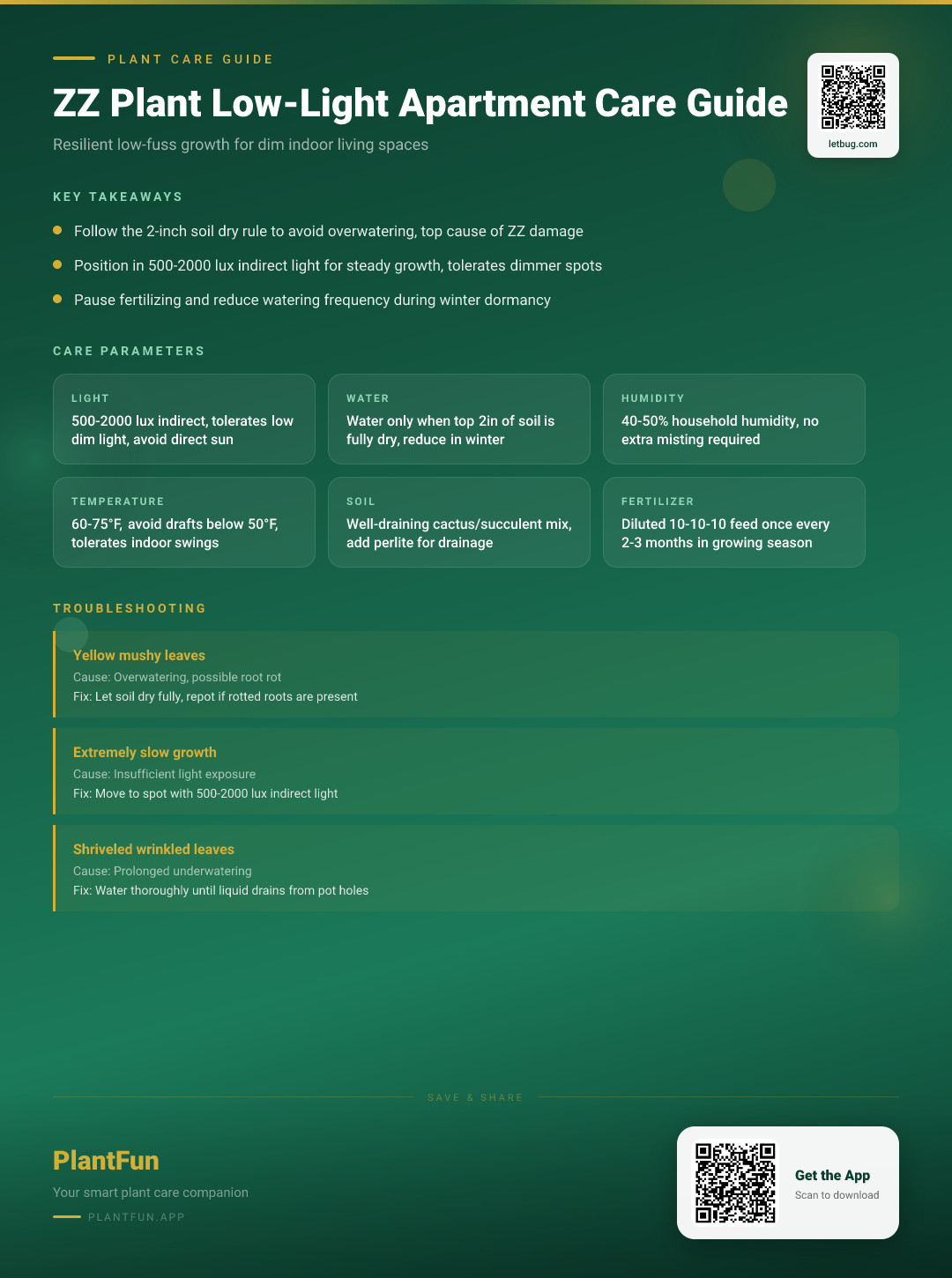
Key Takeaways
- Check soil moisture before watering — overwatering is the #1 killer of houseplants.
- Ensure your plant gets the right amount of light for its species.
- Be patient with recovery — most plants need 2–4 weeks to bounce back.
TL;DR: The ZZ Plant Survival Strategy
The Zamioculcas zamiifolia (ZZ plant) is the quintessential apartment plant because it stores water in bulbous, underground rhizomes. To help it thrive, mimic its dry native habitat: keep it in temperatures between 65–75°F (18–24°C), provide indirect light, and—most importantly—let the soil dry out completely between waterings. Avoid “death by kindness” by watering only when the top 2 inches of soil feel bone dry. It is a slow grower that prefers stability over constant attention.
Quick Care Card: Essential Parameters
| Feature | Requirement |
|---|---|
| Light | 500–2,000 lux (Bright indirect to low light) |
| Water | Every 3–4 weeks (When soil is dry) |
| Humidity | 30–50% (Average home levels) |
| Temperature | 65–75°F (18–24°C) |
| Soil | Well-draining, succulent-based mix |
| Fertilizer | Balanced liquid feed, diluted, 1-2x/year |
| Toxicity | Toxic to cats and dogs (ASPCA, 2026) |
My Experience: The “Set and Forget” Trap
When I first brought home my ZZ plant, I fell for the “set it and forget it” marketing. I tucked it into a dark corner and ignored it for four months. While it survived, it became leggy and stunted. I eventually realized that while ZZ plants tolerate low light, they actually thrive when given enough light to photosynthesize properly. I moved mine to a spot where it receives a soft glow from a nearby window, and the growth rate doubled. I also learned the hard way that “low maintenance” doesn’t mean “no maintenance”; it means “low-frequency maintenance.”
Why the ZZ Plant is the Ultimate Apartment Survivor
The ZZ plant is biologically engineered for resilience. According to the NC State Extension (2026), these plants are native to Eastern Africa, where they have evolved to withstand prolonged dry periods. Their specialized rhizomes act as water reservoirs, allowing them to thrive in typical indoor environments where human comfort—and erratic watering habits—prevail.
Understanding the Low-Light Tolerance Myth vs. Reality
Many gardeners claim the ZZ plant can live in a windowless closet. While it won’t die immediately, it won’t grow either. Recent research into LED light intensities confirms that providing specific light levels is essential for long-term health rather than just survival (Gautam, Dubey, & Kaur, 2021). Aim for 500–2,000 lux. If you cannot read a book comfortably in the spot where the plant sits, it is too dark for structural growth.
Step-by-Step Watering: The 2-Inch Rule for Root Health
Overwatering is the primary cause of decline for Zamioculcas zamiifolia. Follow this watering guide to protect the rhizomes:
- The Finger Test: Insert your index finger 2 inches into the soil. If you feel any moisture, wait one week.
- Drainage Check: Ensure your container has drainage holes. Never let the plant sit in a decorative cachepot filled with water.
- Flush: When you water, do it deeply until water exits the bottom. Dump the excess liquid from the saucer immediately.
- Frequency: In low light, this might only be once every 4-5 weeks. In brighter conditions, once every 3 weeks is standard.
Optimizing Your Apartment Lighting (Targeting 500-2,000 lux)
Position your plant 3–5 feet away from a window. Avoid direct sunlight, which can scorch the waxy leaves, especially if you have south-facing glass. If your apartment is consistently dark, rotating the plant occasionally helps it grow evenly rather than leaning toward the singular light source.
Temperature and Humidity Management for Typical Living Spaces
ZZ plants are quite comfortable in the same temperature range as humans (65–75°F). Avoid placing your plant near AC vents or radiators, as dry, forced air can cause the leaves to lose moisture too quickly. Humidity levels of 30–50% are perfectly adequate for this species (Henny & Chen, 2013).
Seasonal Care Calendar: Adjusting for Winter Dormancy
- Spring/Summer: Growth phase. If the plant shows new shoots, you may increase water frequency slightly, but only if the light levels have increased.
- Autumn/Winter: Dormancy phase. Reduce water significantly. Growth slows or stops; the plant requires less “fuel” (Henny & Chen, 2013).
Common Mistakes: Avoiding the ‘Death by Kindness’ Syndrome
- Mistake: Frequent, small watering sessions.
- What happens: The soil surface stays moist, promoting fungus gnats and root rot.
- Instead: Water thoroughly, then ignore it until it is truly dry.
- Mistake: Over-fertilizing.
- What happens: Fertilizer burn on the roots.
- Instead: Feed only during the peak of the growing season with a diluted, balanced fertilizer.
Troubleshooting ZZ Plant Problems
Yellowing Leaves
Symptom: Leaves at the base of the stem turn yellow and mushy.
Likely cause: Overwatering leading to rhizome rot.
Fix:
- Stop watering immediately and check if the rhizome is firm or soft.
- If soft, remove the rot with a sterile blade and repot into fresh, dry soil.
Dropping Leaflets
Symptom: Small, individual leaflets falling off the stem.
Likely cause: Severe underwatering or rapid temperature fluctuations.
Fix:
- Check the soil dryness; if it is bone dry for months, increase water slightly.
- Move the plant away from drafty doors or heaters.
Frequently Asked Questions
Can I keep my ZZ plant in a windowless bathroom? It is not recommended. While the humidity is fine, the lack of light will eventually cause the plant to exhaust its energy stores and fail. It needs at least ambient light to photosynthesize.
Why is my ZZ plant growing so slowly in the corner? Growth rate is directly tied to light intensity. If it’s in a dark corner, the plant is likely in a state of survival, not growth. Move it to a brighter spot.
Is my ZZ plant toxic to my cat? Yes. According to the ASPCA (2026), the ZZ plant contains calcium oxalate crystals, which can cause irritation if ingested by pets or children.
References & Scientific Sources
- Henny, R.; Chen, J. (2013). Florida Foliage House Plant Care: ZZ Plant. https://doi.org/10.32473/edis-ep480-2013. Accessed 2026-03-12.
- Gautam, B.; Dubey, R.; Kaur, N. (2021). GROWTH RESPONSE OF INDOOR ORNAMENTAL PLANT SPECIES TO VARIOUS ARTIFICIAL LIGHT INTENSITIES (LED) IN AN INDOOR VERTICAL GARDEN. Plant Archives. https://doi.org/10.51470/plantarchives.2021.v21.no1.096. Accessed 2026-03-12.
- ASPCA. (2026). Toxic and Non-Toxic Plants List — ASPCA. https://www.aspca.org/pet-care/animal-poison-control/toxic-and-non-toxic-plants. Accessed 2026-03-12.
- NC State Extension. (2026). ZZ Plant — NC State Extension Gardener Plant Toolbox. https://plants.ces.ncsu.edu/plants/zamioculcas-zamiifolia/. Accessed 2026-03-12.
Optional Helper: Plantfun.App
Plantfun.App identifies your plants by photo, diagnoses pests and diseases with clear fixes, and creates personalised watering and light schedules that adapt to your home conditions — a handy companion for putting this guide into daily practice.
Found an error or have suggestions? We'd love your feedback.
Need help identifying this problem?
Get instant identification, personalized care schedules, and effective pest treatment plans directly on your phone.
Sponsored • We may earn a commission from app downloads
Related Guides
ZZ Plant in Low-Light Apartments: The Only Care Guide for Resilient, Sturdy Growth
Master ZZ plant care in your apartment with this 5-step blueprint. Get precise light lux, watering cycles, and recovery tips to ensure lush, deep-green growth.
Care GuideZZ Plant Care Checklist for Urban Apartments: 7 Tips for Resilient, Lush Growth
Stop guessing at ZZ Plant care. Grab our apartment-specific checklist with exact light, water, and soil parameters to avoid yellow leaves and grow lush, resilient fronds year-round.
Care GuideZZ Plant in Low-Light Apartments: The Essential Guide for Resilient, Sturdy Growth
Revive your ZZ plant with precise light and water protocols. Learn how to maintain 500-2,000 lux for steady growth and avoid the 3 biggest apartment mistakes.
Pest ControlAnts on Plants: What They Mean and What to Do
Ants usually aren't eating your plant. They are farming other pests.