
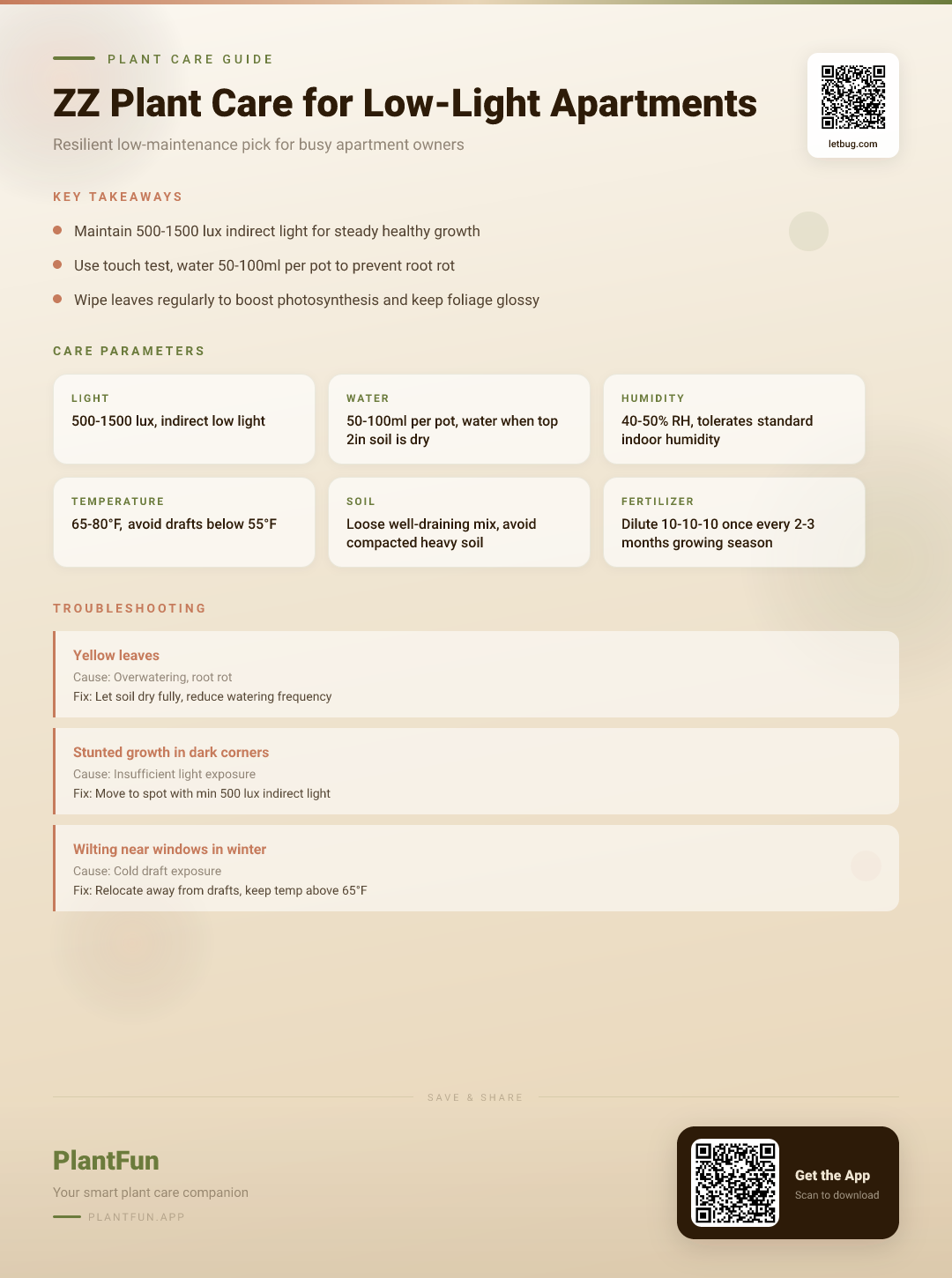
Key Takeaways
- Check soil moisture before watering — overwatering is the #1 killer of houseplants.
- Ensure your plant gets the right amount of light for its species.
- Be patient with recovery — most plants need 2–4 weeks to bounce back.
Quick Care Card: Essential Thresholds for Apartment Success
| Feature | Requirement |
|---|---|
| Light | 500–1,500 lux (Indirect/Low) |
| Watering | Every 3–4 weeks (Touch-test dry) |
| Humidity | 40–50% (Standard home levels) |
| Temperature | 65–80°F (18–27°C) |
| Soil | Well-draining, succulent-mix base |
| Fertilizer | Balanced liquid feed, diluted by half, twice a year |
| Toxicity | Toxic to cats and dogs (ASPCA, 2026) |
TL;DR: The ZZ Plant’s Strategy for Low-Light Survival
Zamioculcas zamiifolia thrives in apartments because it is an evolutionary master of resource management. It uses subterranean rhizomes to store water, allowing it to survive long periods of drought and low light. In a dim apartment, your primary goal is to avoid overwatering, which triggers rot. If the soil is damp, do not water. Wait until the substrate is entirely dry, then provide a small, targeted soak.
Why This Matters: Understanding the Rhizome’s Water-Storage System
When I first started collecting plants, I assumed the ZZ plant was essentially a plastic prop that enjoyed being ignored. I quickly learned that while the Zamioculcas zamiifolia is remarkably resilient, it is not invincible. Its secret weapon is the rhizome—a thick, potato-like structure beneath the soil that acts as a water reservoir (NC State Extension, 2026).
Understanding this anatomy is vital for proper indoor plant maintenance. If you water too frequently, those rhizomes sit in stagnant moisture, leading to systemic decay. My experience taught me that the “unkillable” label is a double-edged sword; owners often neglect them to the point of dehydration or over-love them with a watering can, both of which stress the plant’s metabolic rhythm.
Step 1: Assessing Light Levels (Targeting 500-1,500 lux)
Many apartment dwellers believe ZZ plants can grow in a closet. While they can survive in very low light, they will not thrive. Aim for a spot that receives 500–1,500 lux (Henny & Chen, 2013).
- The Hand Test: If you can read a book comfortably in the corner without straining, that’s likely sufficient light.
- Optimization: If your ZZ plant is stalled in growth, move it a few feet closer to a window. Avoid harsh, direct afternoon sun, which can scorch the glossy, waxy cuticle of the leaves.
Step 2: The Watering Protocol (The ‘Touch-Test’ method: 50-100ml depending on pot size)
Learning how to water a ZZ plant correctly is the difference between a lush plant and a yellowing one.
- The Finger Test: Insert your finger at least 2 inches into the soil. If you feel any moisture, step away.
- The Dosage: When the soil is bone dry throughout the pot, apply 50–100ml of water. For a 6-inch pot, a modest “sip” is safer than a full saturation unless you have excellent drainage holes.
- Drainage: Always ensure the pot has drainage to prevent water pooling (Halawa & Aisuwarya, 2023).
Step 3: Maintaining Ideal Apartment Temperatures (65-80°F)
Zanzibar gems are tropical plants that appreciate consistency. They grow best between 65–80°F (18–27°C) (NC State Extension, 2026). In my experience, the biggest threat in an apartment isn’t the temperature itself, but the fluctuation. Keep your plant away from heating vents or air conditioning units, which can cause leaf drop and moisture stress.
Step 4: Humidity Needs (40-50% RH is perfect for indoor health)
Unlike ferns, which demand high moisture, the ZZ plant is quite happy at standard indoor humidity levels (40–50%). You do not need a humidifier. If your apartment is exceptionally dry, simply wiping the leaves with a damp cloth will manage dust and provide the minimal moisture the plant requires to keep its stomata clear for gas exchange.
Step 5: Managing Seasonal Dormancy in Winter
During winter, light levels drop and the plant’s metabolism slows down (Henny & Chen, 2013). This is the time for strict winter plant care. I cut my watering frequency in half during the months of November through February. If the plant looks slightly shriveled, leave it be—it is likely just pulling energy from its rhizomes to survive the shorter days.
Common Mistakes to Avoid: From Overpotting to Soil Compaction
- Mistake: Using a pot that is too large for the root ball. What happens: Excess soil holds too much water, leading to root rot. Instead: Use a pot only 1–2 inches larger than the existing root system.
- Mistake: Using standard garden soil. What happens: It compacts and suffocates the rhizomes. Instead: Use a well-draining succulent mix with added perlite or pumice.
FAQ: Why is my ZZ plant yellowing?
Yellowing is usually a sign of overwatering. If the base of the stems feels mushy, the rhizomes may be rotting. Stop watering immediately and check the roots for signs of decay (brown/slimy texture).
FAQ: How often should I water my ZZ plant in a dark corner?
In low-light conditions, a ZZ plant may only need water once every 5–6 weeks. Always prioritize the “touch-test” over a calendar schedule.
FAQ: Can I leave my ZZ plant near a drafty window?
I advise against this. Sudden cold drafts can cause leaf drop or cellular damage. Move it a few feet away from the glass during winter months.
Expert Tips: Cleaning Leaves for Better Photosynthesis
Because ZZ plants often live in low-light, their ability to photosynthesize is already at a premium. Dust buildup blocks light absorption. Every month, I gently wipe my ZZ leaves with a microfiber cloth and tepid water. This keeps them glossy and ensures the plant operates at maximum efficiency.
References
- Henny, R.; Chen, J. (2013). Florida Foliage House Plant Care: ZZ Plant. https://doi.org/10.32473/edis-ep480-2013. Accessed 2026-03-17.
- Halawa, H.; Aisuwarya, R. (2023). Smart Plant Pot Robot with IoT Integration for Indoor Ornamental Plants Care. Journal of Information Technology and Computer Engineering. https://doi.org/10.25077/jitce.7.2.97-106.2023. Accessed 2026-03-17.
- ASPCA. (2026). Toxic and Non-Toxic Plants List — ASPCA. https://www.aspca.org/pet-care/animal-poison-control/toxic-and-non-toxic-plants. Accessed 2026-03-17.
- NC State Extension. (2026). ZZ Plant Care — NC State Extension Gardener Plant Toolbox. https://plants.ces.ncsu.edu/plants/zamioculcas-zamiifolia/. Accessed 2026-03-17.
Optional Helper: Plantfun.App
Plantfun.App identifies your plants by photo, diagnoses pests and diseases with clear fixes, and creates personalised watering and light schedules that adapt to your home conditions — a handy companion for putting this guide into daily practice.
Found an error or have suggestions? We'd love your feedback.
Need help identifying this problem?
Get instant identification, personalized care schedules, and effective pest treatment plans directly on your phone.
Sponsored • We may earn a commission from app downloads
Related Guides
ZZ Plant in Low-Light Apartments: The Essential Guide for Resilient, Sturdy Growth
Revive your ZZ plant with precise light and water protocols. Learn how to maintain 500-2,000 lux for steady growth and avoid the 3 biggest apartment mistakes.
Care GuideZZ Plant Care in Low-Light Apartments: 7 Rules for Resilient, Sturdy Growth
Revive your ZZ plant with 7 precise care rules. Learn exact light lux levels, watering schedules, and drainage secrets for lush, apartment-grown stems today.
Care GuideZZ Plant Care Checklist for Urban Apartments: 7 Tips for Resilient, Lush Growth
Stop guessing at ZZ Plant care. Grab our apartment-specific checklist with exact light, water, and soil parameters to avoid yellow leaves and grow lush, resilient fronds year-round.
Pest ControlAnts on Plants: What They Mean and What to Do
Ants usually aren't eating your plant. They are farming other pests.