
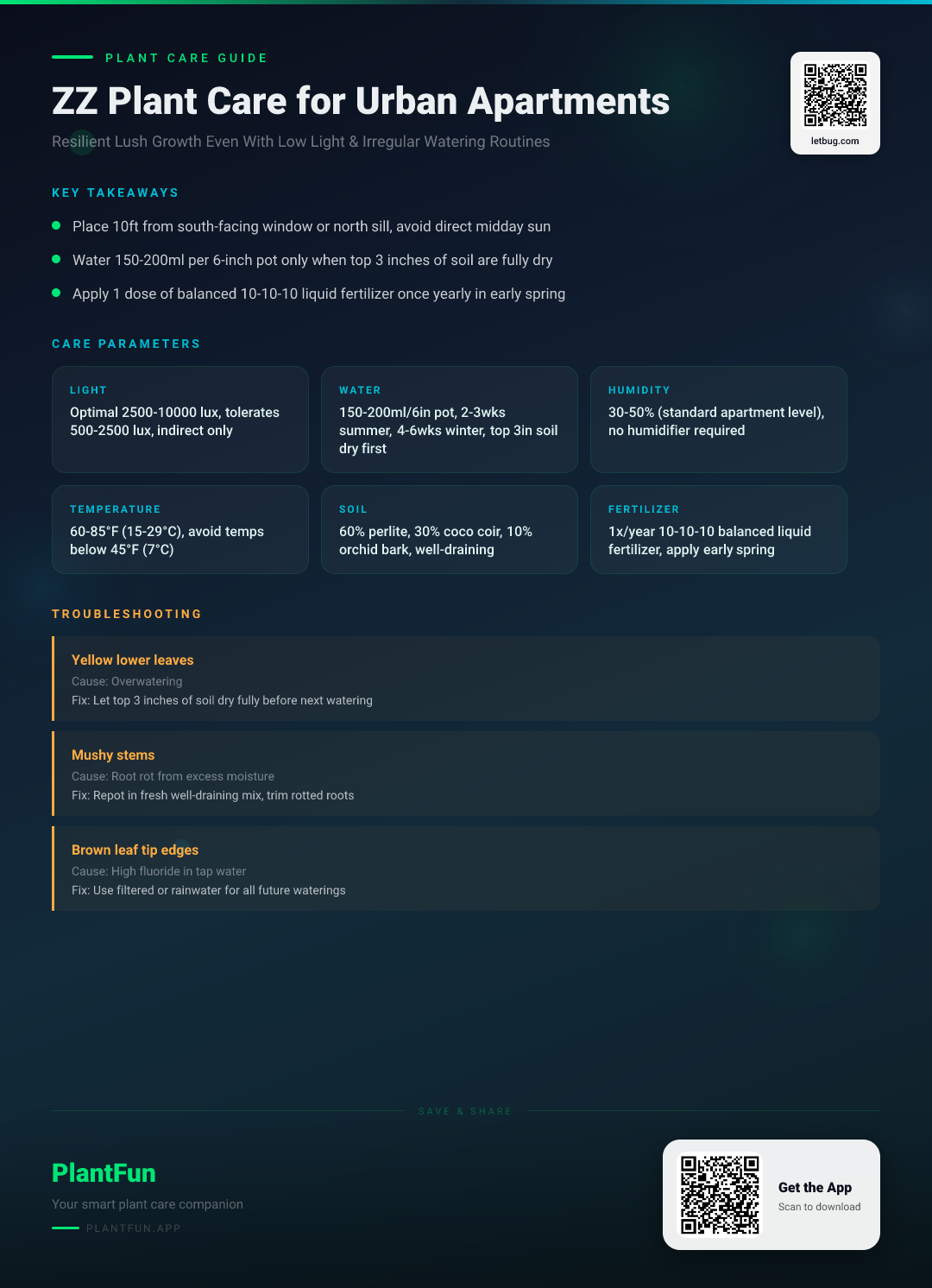
Key Takeaways
- Check soil moisture before watering — overwatering is the #1 killer of houseplants.
- Ensure your plant gets the right amount of light for its species.
- Be patient with recovery — most plants need 2–4 weeks to bounce back.
Quick Care Card
| Parameter | Apartment-Specific Threshold |
|---|---|
| Light | 500-2,500 lux (tolerable), 2,500-10,000 lux (optimal); no direct midday sun |
| Water | 150-200ml per 6-inch pot, only when top 3 inches of soil are fully dry; 2-3 weeks (summer), 4-6 weeks (winter) |
| Humidity | 30-50% (standard apartment humidity, no humidifier needed) |
| Temperature | 60-85°F (15-29°C); never below 45°F (7°C) |
| Soil | 60% perlite, 30% coco coir, 10% orchid bark (well-draining aroid mix) |
| Fertilizer | 1 dose of balanced 10-10-10 liquid fertilizer, applied once per year in early spring |
| Toxicity | Toxic to cats, dogs, and humans if ingested (ASPCA, 2026) |
Why ZZ Plants Thrive (and Struggle) in Typical Urban Apartments
ZZ plants (Zamioculcas zamiifolia) are built for apartment life: their thick, underground rhizomes store water for months, making them tolerant of missed waterings and low-light conditions common in 500-800 sq ft urban units (Henny & Chen, 2013). That said, they still struggle with three frequent apartment stressors:
- Persistent low light below 500 lux, which slows growth to a halt over time
- Cold drafts from old windows or hot blasts from AC/heat vents that damage leaf tissue
- Infrequent but overzealous watering that leads to root rot, the most common ZZ killer for busy renters If you’re new to plant parenthood, this ZZ plant care for beginners guide removes all guesswork with symptom-linked fixes that require no permanent rental modifications. For more space-friendly plant picks, check out our curated list of low-light indoor plants for apartments.
Symptom-to-Action Cheat Sheet
Match your ZZ’s visible signs to immediate, renter-friendly fixes:
Yellow Lower Leaves
Symptom: Older, lower fronds turn pale yellow and fall off without spots or mushy tissue.
Likely cause: Natural aging, or extended drought leading the plant to reabsorb nutrients from older growth (Henny & Chen, 2013).
Fix:
- Pluck yellow leaves to redirect energy to new growth
- Test soil moisture; if the top 3 inches are dry, water with 150-200ml per 6-inch pot
Mushy Stems
Symptom: Stems turn soft, translucent, and collapse at the base, with a foul smell coming from the soil.
Likely cause: Root rot from overwatering or poorly draining soil.
Fix:
- Remove the plant from its pot, cut away all mushy black roots with sterile scissors
- Repot in fresh, well-draining ZZ plant soil mix, and hold off on watering for 4 weeks
Brown Tip Edges
Symptom: Crisp, light brown edges on otherwise healthy green leaves, no yellowing or spots.
Likely cause: High fluoride in tap water, or close proximity to hot heat vents in winter.
Fix:
- Switch to rainwater or distilled water for future waterings
- Move the plant at least 3 feet away from heat or AC vents
Stunted Growth
Symptom: No new fronds grow for 6+ months, even during spring and summer growing seasons.
Likely cause: Light levels below 500 lux, or complete lack of annual fertilizing.
Fix:
- Move the plant to a brighter spot, or add a no-drill clip-on grow light for 12 hours per day
- Apply one dose of 10-10-10 liquid fertilizer in early spring
Drooping Fronds
Symptom: ZZ plant drooping with limp, bent stems, no mushy tissue present.
Likely cause: Severe underwatering, or exposure to temperatures below 45°F (7°C) (Henny & Chen, 2013).
Fix:
- If soil is bone dry, water with 150-200ml per 6-inch pot; stems will perk up within 48 hours
- Move the plant away from drafty window sills, and add a removable window insulation film if needed (no drilling required)
Yellow New Growth
Symptom: Fresh, young fronds emerge pale yellow instead of deep green.
Likely cause: Overfertilization, or root burn from excessive fertilizer salts in soil.
Fix:
- Flush the soil with 3x the pot volume of distilled water to wash away excess salts
- Skip fertilizing for 1 full year after flushing
Step 1: Light Placement for Apartments
ZZ plant light requirements are highly flexible for apartment spaces: they tolerate 500-2,500 lux (low to medium artificial light) and thrive in 2,500-10,000 lux (bright indirect light) (Henny & Chen, 2013). Ideal renter-friendly spots include:
- 10 feet away from a south-facing window (avoids scorching midday sun)
- Directly on a north-facing window sill (consistent soft light year-round)
- 3 feet away from an east-facing window (gentle morning sun only) Myth vs Reality: Myth: ZZ plants can survive forever in complete darkness. Reality: While they tolerate low light better than most houseplants, they will stop growing and slowly decline after 3 months in light below 300 lux. For super dark units, use a no-drill clip-on LED grow light set to 12 hours per day for consistent growth.
Step 2: Exact Watering Schedule for Irregular Routines
Wondering how often to water ZZ plant when you work long hours or travel frequently? Follow these measurable rules:
- Quick moisture test: Stick a wooden chopstick 3 inches deep into the soil. If no soil clings to it when you pull it out, it’s time to water (Halawa et al, 2023).
- Apply 150-200ml of water per 6-inch pot, enough to moisten the top 4 inches of soil without soaking the rhizome.
- ZZ plant summer watering frequency: Every 2-3 weeks in warm months when the apartment stays above 75°F.
- ZZ plant winter care watering frequency: Every 4-6 weeks in cold months when heating dries out air but soil takes longer to dry.
- Avoid tap water with high fluoride or chlorine, which causes brown tips. For more watering hacks for forgetful plant parents, check out our guide to low-maintenance houseplant watering schedules.
Step 3: Soil & Potting Rules for Small Spaces
Use this renter-approved ZZ plant soil mix for optimal drainage: 60% perlite, 30% coco coir, 10% orchid bark. This mix prevents root rot even if you accidentally overwater once. Follow these potting rules:
- Only use pots with drainage holes. To avoid water marks on your rental floors, place the drainage pot inside a decorative cache pot, and empty any excess water from the cache pot 10 minutes after watering.
- Never repot more than once every 2-3 years. ZZs prefer tight root systems, and repotting too frequently causes stress. For step-by-step soil mixing instructions, see our complete guide to aroid soil mixes for indoor plants.
Step 4: Temperature & Humidity for Drafty Apartments
ZZs are perfectly adapted to standard apartment conditions:
- Maintain temperatures between 60-85°F (15-29°C). Never expose them to temperatures below 45°F (7°C), which causes leaf damage and drooping (Henny & Chen, 2013).
- They tolerate 30-50% humidity, the average level in heated or air-conditioned apartments. No humidifier is required, saving you space and money.
- Renter hack: If your windows are drafty in winter, place a thick towel along the window sill edge to block cold air from reaching your ZZ, no permanent modifications needed.
Step 5: Fertilizing for Slow, Steady Growth
ZZs are very light feeders, so overfertilizing is a far bigger risk than underfertilizing:
- Apply only 1 dose of balanced 10-10-10 liquid fertilizer, diluted to half strength, once per year in early spring.
- No extra feeding is required at any other point in the year. Excess fertilizer causes yellow new growth and root burn.
Seasonal Care Calendar for Apartments
Follow this month-by-month guide adjusted for urban apartment conditions:
- January-February (Winter): Water every 4-6 weeks, move plants at least 3 feet away from heat vents, wipe fronds with a damp cloth to remove dust from heating systems.
- March-April (Spring): Apply your single annual fertilizer dose, check if the plant is root-bound (roots growing out of drainage holes) and repot only if needed.
- May-August (Summer): Water every 2-3 weeks, move plants 3 feet away from AC vents, avoid placing them in direct midday sun that comes through south-facing windows.
- September-October (Fall): Gradually reduce watering frequency, stop fertilizing, wipe fronds to remove dust before closed windows trap indoor air pollutants.
- November-December (Holiday Season): ZZs can go up to 6 weeks without water, so no plant sitter is needed for short holiday trips. Move plants away from cold entry doors if you expect frequent guests.
Common Apartment-Specific Mistakes to Avoid
- Mistake: Hiding ZZs in windowless closets for months at a time. What happens: Light levels below 300 lux cause stunted growth, leaf drop, and eventual plant death after 6 months. Instead: If you want a ZZ plant for windowless rooms, add a clip-on grow light set to 12 hours per day, or rotate it to a brighter spot for 2 weeks every month.
- Mistake: Placing ZZs directly in front of AC or heat vents. What happens: Rapid temperature fluctuations cause brown tips, drooping fronds, and leaf drop. Instead: Keep ZZs at least 3 feet away from all heating and cooling vents.
- Mistake: Overfertilizing to encourage faster growth. What happens: Excess fertilizer salts burn roots, cause yellow new growth, and can kill the plant. Instead: Stick to one annual dose of fertilizer in early spring for slow, steady growth.
- Mistake: Watering on a fixed schedule instead of checking soil moisture in winter. What happens: Cold, slow-drying soil leads to root rot, the most common cause of ZZ plant death. Instead: Always test soil moisture with a chopstick before watering, and extend watering intervals to 4-6 weeks in winter.
Voice Search Optimized FAQ
Why is my ZZ plant turning yellow even when I don’t water it much?
Yellow leaves on ZZ plants that get infrequent water are usually caused by one of two issues: either you’re giving too much water at once when you do water, leading to root rot, or the plant is exposed to cold drafts from windows or AC vents that damage leaf tissue. To fix it, check the roots for mushy black rot, adjust your watering to 150-200ml per 6-inch pot only when the top 3 inches of soil are dry, and move the plant away from drafty spots.
Can I keep a ZZ plant in my windowless apartment office?
Yes, as long as you provide supplemental light. ZZs can live in low light (500 lux) which is equivalent to bright office overhead lighting, but if your office has no windows and only dim artificial light, add a no-drill clip-on grow light set to 10-12 hours per day to keep it healthy. Without supplemental light, your ZZ will stop growing and start dropping leaves after 2-3 months.
How do I make my ZZ plant grow faster?
To encourage faster growth, provide 2,500-10,000 lux of bright indirect light (10 feet from a south-facing window is ideal), water correctly when the top 3 inches of soil are dry, and apply one dose of diluted 10-10-10 fertilizer in early spring. Under optimal conditions, ZZs grow 2-3 new fronds per growing season, so don’t expect explosive growth: they are naturally slow-growing plants.
References
- Henny, R.; Chen, J. (2013). Florida Foliage House Plant Care: ZZ Plant. EDIS. https://doi.org/10.32473/edis-ep480-2013. Accessed 2026-02-27.
- Halawa, H.; Aisuwarya, R. (2023). Smart Plant Pot Robot with IoT Integration for Indoor Ornamental Plants Care. JITCE (Journal of Information Technology and Computer Engineering). https://doi.org/10.25077/jitce.7.2.97-106.2023. Accessed 2026-02-27.
- ASPCA. (2026). Toxic and Non-Toxic Plants List. https://www.aspca.org/pet-care/animal-poison-control/toxic-and-non-toxic-plants. Accessed 2026-02-27.
Optional Helper: Plantfun.App
Plantfun.App identifies your plants by photo, diagnoses pests and diseases with clear fixes, and creates personalised watering and light schedules that adapt to your home conditions — a handy companion for putting this guide into daily practice.
Found an error or have suggestions? We'd love your feedback.
Need help identifying this problem?
Get instant identification, personalized care schedules, and effective pest treatment plans directly on your phone.
Sponsored • We may earn a commission from app downloads
Related Guides
The Complete ZZ Plant Care Guide for Small 1-Bedroom Apartments: Tips for Lush Resilient Growth
Maximize growth for your low-maintenance houseplant without sacrificing square footage. Get exact light, water, and soil thresholds for ZZ plant care in small 1-bedroom apartments, plus space-saving hacks you can implement today.
Care GuideThe Complete ZZ Plant Care Checklist for Typical Apartments: Seasonal Tips for Lush Resilient Growth
Stop guessing at ZZ plant care in your apartment. Get exact light levels, watering amounts, and a seasonal checklist to grow lush, resilient ZZ foliage year-round with no extra work.
Care GuideZZ Plant Care Checklist for Typical Apartments: 7 Rules for Resilient Lush Growth
Stop guessing at ZZ plant care. Get a free apartment-specific checklist, exact light, water, and soil parameters, and 2-minute fixes for yellow leaves and stunted growth.
Pest ControlAnts on Plants: What They Mean and What to Do
Ants usually aren't eating your plant. They are farming other pests.