
Key Takeaways
- Check soil moisture before watering — overwatering is the #1 killer of houseplants.
- Ensure your plant gets the right amount of light for its species.
- Be patient with recovery — most plants need 2–4 weeks to bounce back.
Quick Care Card
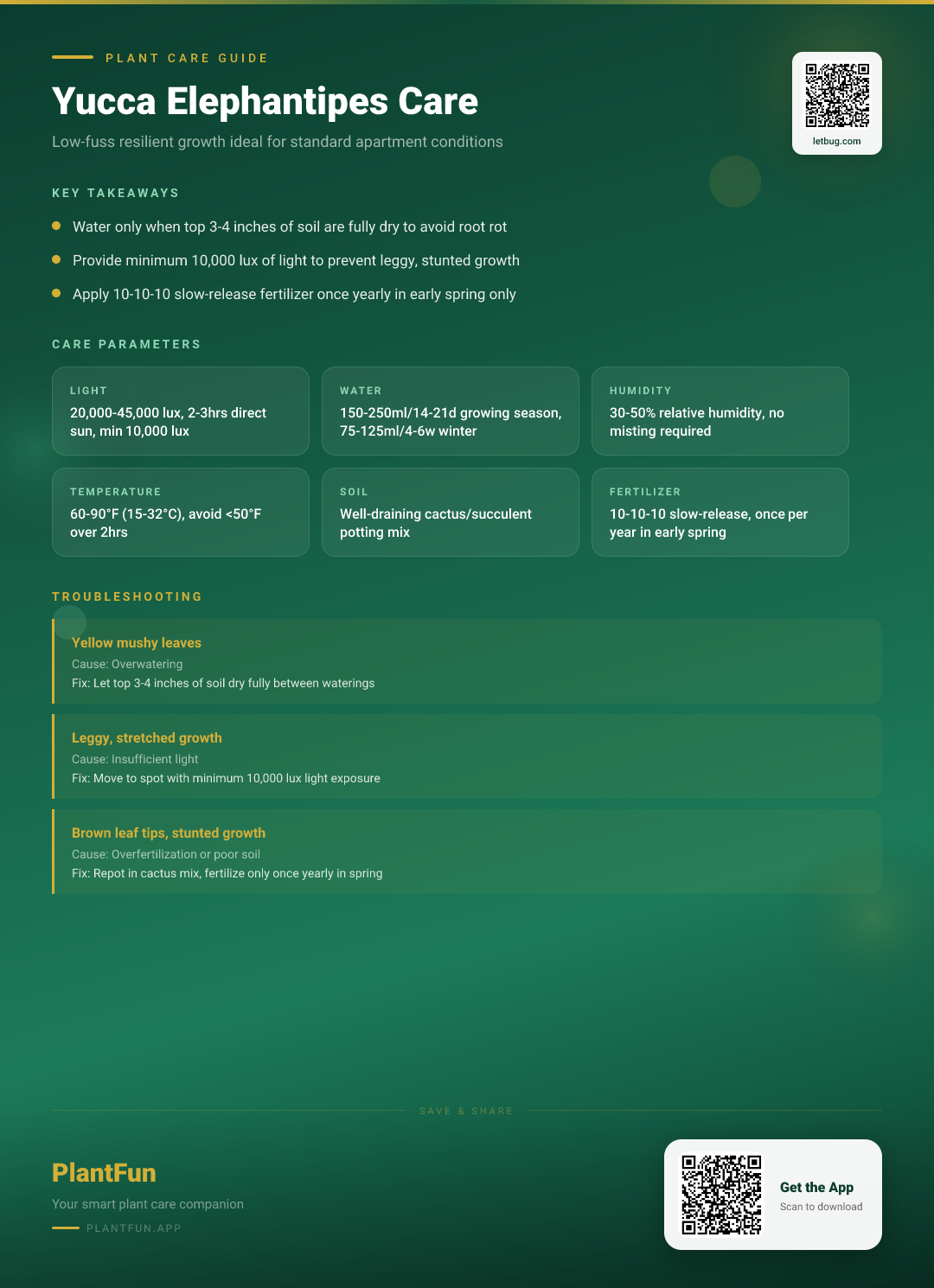
Print this at-a-glance snapshot of measurable Yucca elephantipes care thresholds tailored for standard apartment conditions, perfect for busy renters.
| Care Parameter | Apartment-Specific Threshold |
|---|---|
| Light | 20,000–45,000 lux (bright indirect or 2-3 hours direct sun daily; minimum 10,000 lux to avoid leggy growth) |
| Water | 150–250ml every 14–21 days (growing season, spring/summer); 75–125ml every 4–6 weeks (winter, dormant season) only when top 3–4 inches of soil are completely dry |
| Humidity | 30–50% RH (average apartment humidity; no misting required) |
| Temperature | 60–90°F (15–32°C); never expose to temperatures below 50°F (10°C) for more than 2 hours |
| Soil | Well-draining cactus/succulent mix, with 10% perlite added for extra drainage if needed |
| Fertilizer | 10-10-10 slow-release fertilizer, 1 dose per year in early spring; no additional feeding required |
| Toxicity | Toxic to cats, dogs, and horses (ASPCA, 2026); non-toxic to humans |
Introduction
Yucca elephantipes (spineless yucca) is one of the most popular low-fuss apartment plants for good reason: its tall, architectural stalks and bright green foliage add a tropical vibe to small spaces, and it’s far more drought-tolerant than most common houseplants. But generic yucca care guides often assume ideal growing conditions that don’t match the dry, fluctuating light and busy schedules of standard rental apartments, leading to stunted growth or plant death for many first-time owners. This guide uses a mistake-first framing, with measurable, no-fancy-equipment care parameters and a fast weekly checklist that works even if you work 40+ hours a week.
Step-by-Step 2-Minute Weekly Care Checklist
No special tools required for these 5 simple checks to keep your yucca healthy:
- Stick your index finger 3–4 inches into the soil to confirm if it is completely dry before considering watering.
- Inspect the top and underside of 5–6 lower leaves for tiny brown or white pest spots.
- Verify the plant is not within 1 foot of drafty windows, AC vents, or space heaters.
- Wipe dust off large leaves with a dry microfiber cloth to improve light absorption.
- Note any yellowing or drooping stalks to address immediately.
Measurable Care Thresholds
Light Requirements
Yucca light requirements indoors are 20,000–45,000 lux, equal to bright indirect light or 2–3 hours of gentle morning direct sun daily, with a minimum of 10,000 lux to avoid leggy growth (NC State Extension, 2026). A quick test to confirm adequate light: hold your hand 1 foot from the plant’s foliage at midday. If you see a faint, soft shadow, you’re in the ideal lux range. If you see no shadow at all, your light is too low.
Water Requirements
How often to water yucca depends entirely on soil dryness, not a fixed schedule. Water only when the top 3–4 inches of soil are completely bone dry: 150–250ml every 14–21 days in the spring/summer growing season, and 75–125ml every 4–6 weeks in winter (Abass et al., 2023). Myth vs reality: you don’t need to soak yucca soil like other houseplants; small, targeted waterings are enough to avoid root rot.
Humidity & Temperature
Yucca care humidity levels only need to be 30–50%, which is exactly the average humidity of most heated or cooled apartments, so no misting is required (NC State Extension, 2026). Keep temperatures between 60–90°F (15–32°C), and never expose your yucca to temperatures below 50°F (10°C) for more than 2 hours, as this can cause permanent leaf damage.
Soil & Fertilizer
Use a well-draining cactus/succulent mix to avoid trapping excess moisture around roots (Indian Journal of Natural Products and Resources, 2023). Fertilize only once per year in early spring with a 10-10-10 slow-release fertilizer; no extra feeding is needed, even in the growing season.
7 Common Apartment Yucca Care Mistakes (And Fast Fixes)
- Mistake: Overwatering on a fixed schedule regardless of soil moisture What happens: Leads to root rot, the top cause of yucca death in apartments, with mushy yellow leaves and drooping stalks Instead: Use the finger test to confirm dryness before watering, and discard any standing water in the saucer within 10 minutes of watering for a fast yucca root rot fix
- Mistake: Placing yucca in a low-light corner with no supplemental light What happens: Causes leggy growth, sparse foliage, and stunted development as the plant stretches to reach light Instead: Move to a spot 1–3 feet from a south or west-facing window, or add a clip-on grow light for 12 hours a day for yucca care low light
- Mistake: Repotting your yucca every year even if it’s not rootbound What happens: Shocks the plant, damages its delicate root system, and can lead to stunted growth for 6+ months Instead: Only repot every 3–4 years, when you see roots growing out of the drainage holes at the bottom of the pot
- Mistake: Using regular potting soil that retains too much moisture What happens: Traps water around the roots, increasing risk of root rot even if you follow correct watering schedules Instead: Use a well-draining cactus/succulent mix, per official Yucca elephantipes care guidelines (NC State Extension, 2026)
- Mistake: Fertilizing your yucca multiple times a year to encourage faster growth What happens: Burns the root tips, causes brown leaf tips, and can lead to excessive weak growth that’s prone to breaking Instead: Apply a single dose of 10-10-10 slow-release fertilizer once per year in early spring, no additional feeding required
- Mistake: Placing your yucca within 1 foot of drafty windows, AC vents, or space heaters What happens: Exposes the plant to sudden temperature fluctuations that cause leaf drop and stress Instead: Relocate to a spot with consistent temperatures between 60-90°F, away from all heating and cooling sources
- Mistake: Ignoring tiny brown or white spots on the underside of leaves for weeks What happens: Lets pest infestations (spider mites, mealybugs) spread to the entire plant and even other houseplants Instead: Wipe affected leaves with a cotton swab dipped in rubbing alcohol at the first sign of pests, no harsh chemicals needed
Seasonal Care Calendar for Apartment Yuccas
Adjust your routine to match changing apartment conditions across the year:
- Spring: Apply your annual 10-10-10 slow-release fertilizer, move your yucca back to a sunnier spot if you relocated it for winter, and prune any dead or yellow lower leaves.
- Summer: Follow yucca summer watering guidelines: 150–250ml every 14–21 days, only when the top 3–4 inches of soil are dry. Wipe dust off leaves weekly to maximize light absorption for faster growth.
- Fall: Gradually extend the time between waterings as daylight hours decrease, and move your yucca away from windows that will drop below 50°F at night.
- Winter: Follow yucca winter care rules: water only 75–125ml every 4–6 weeks, when the top 4 inches of soil are completely dry. Keep away from space heaters that dry out foliage, and ensure it gets at least 6 hours of bright light per day.
Troubleshooting Common Yucca Symptoms
Yellow Leaves
Symptom: Soft, mushy yellow leaves that fall off easily, often starting from the lower portion of the plant.
Likely cause: Overwatering leading to early root rot, the most common answer to why is my yucca turning yellow.
Fix:
- Stop watering immediately, and tip the pot slightly to drain any excess standing water from the soil if possible
- Wait until the top 4 inches of soil are completely bone dry before watering again, and adjust your future schedule to only water when the finger test confirms dryness
Brown Leaf Tips
Symptom: Dry, crispy brown tips on the ends of otherwise healthy green leaves.
Likely cause: Overfertilization or exposure to dry, hot air from space heaters in winter.
Fix:
- Trim brown tips off with clean, sharp scissors, leaving a small sliver of brown tissue to avoid damaging healthy foliage
- If you fertilized within the last 3 months, flush the soil with 3x the pot volume of water to remove excess nutrient buildup
Leggy Growth
Symptom: Long, bare stalks with sparse new growth only at the very top, and wide gaps between old leaf nodes.
Likely cause: Insufficient light over a 2–3 month period, as the plant stretches to reach available light.
Fix:
- Move the plant to a brighter spot that meets the 20,000–45,000 lux yucca light requirements indoors
- For how to fix leggy yucca, use a clean sharp saw to cut the top 1/3 of the stalk off; new bushy growth will emerge from the cut point within 2–3 months
Drooping Stalks
Symptom: Firm, green stalks that lean or droop to one side, with no visible leaf yellowing.
Likely cause: Uneven light exposure, or the plant becoming top-heavy as it grows.
Fix:
- Rotate the pot 180 degrees every 2 weeks to encourage even, upright growth
- Repot into a heavier terracotta pot if the plant keeps tipping over, only if it is rootbound
Voice Search FAQ
Why is my yucca getting yellow leaves?
The most common cause is overwatering: if the top 3 inches of your soil are still moist, you’ve watered too frequently, which is the leading cause of root rot in apartment yuccas. If only the oldest, lowest leaves are turning yellow and are dry to the touch, this is normal aging; you can snip these off to keep the plant looking tidy.
Can I keep my yucca in a dark apartment corner?
Only if you add supplemental light. Yucca light requirements indoors are a minimum of 10,000 lux to avoid leggy growth, and most dark apartment corners only get 2,000–5,000 lux even during the day. For yucca care low light, use a clip-on LED grow light placed 1 foot above the foliage, set to run 12 hours per day.
How often do I need to water my yucca in winter?
For standard apartment conditions with central heating, you only need to water your yucca 75–125ml every 4–6 weeks in winter. Yuccas go dormant during short daylight hours, so they use far less water than in the growing season, and overwatering in winter is the second most common cause of yucca death for renters.
Renter-Friendly Pro Tips
- No-drill light solutions for low-light apartments: Skip the hard-to-install ceiling grow lights; use affordable clip-on LED grow lights that attach to window sills, bookshelves, or furniture without drilling holes. Most models have built-in timers, so you can set it and forget it even if you work long hours.
- Pet safety note: According to the ASPCA (2026), Yucca elephantipes is toxic to cats, dogs, and horses due to saponin compounds in the foliage that can cause vomiting, diarrhea, and lethargy if ingested. Keep your yucca on a high shelf or plant stand out of reach of curious pets.
- Propagate yucca pups for free new plants: Yuccas produce small baby plants called pups at the base of the mother plant when they are 3+ years old. Once a pup is 6+ inches tall, gently twist it off the main root system, let the cut end callous over for 3 days, then plant it in a small pot of cactus mix to grow a new yucca with no cost.
- Growth rate note: Wondering how fast do yuccas grow indoors? Under ideal apartment conditions, they grow 6–12 inches per year (NC State Extension, 2026), so you won’t need to repot frequently, making them perfect for renters who don’t want to deal with frequent messy plant projects.
References
- NC State Extension. (2026). Yucca Elephantipes Care — NC State Extension Gardener Plant Toolbox. https://plants.ces.ncsu.edu/plants/yucca-elephantipes/. Accessed 2026-02-27.
- Mohamed Abass, M., Thabet, R., Abdelfattah, M. (2023). Evaluation of Gelling Agent Alternatives during in Vitro Multiplication of Yucca elephantipes L. Journal of Plant Production. https://doi.org/10.21608/jpp.2023.221576.1254. Accessed 2026-02-27.
- Indian Journal of Natural Products and Resources. (2023). Unprecedented extraction and characterisation of Yucca elephantipes silver star plant fibre–An exploratory investigation. https://doi.org/10.56042/ijnpr.v14i4.6931. Accessed 2026-02-27.
- ASPCA. (2026). Toxic and Non-Toxic Plants List — ASPCA. https://www.aspca.org/pet-care/animal-poison-control/toxic-and-non-toxic-plants. Accessed 2026-02-27.
Optional Helper: Plantfun.App
Plantfun.App identifies your plants by photo, diagnoses pests and diseases with clear fixes, and creates personalised watering and light schedules that adapt to your home conditions — a handy companion for putting this guide into daily practice.
Found an error or have suggestions? We'd love your feedback.
Need help identifying this problem?
Get instant identification, personalized care schedules, and effective pest treatment plans directly on your phone.
Sponsored • We may earn a commission from app downloads
Related Guides
The Complete Yucca Elephantipes Care Checklist for Resilient Growth in Typical Small East-Facing Apartments
Skip generic yucca care tips. Get our 12-point actionable checklist, exact light, water and temperature thresholds, and fixes for common mistakes to grow a resilient yucca in your small apartment.
Care GuideThe Only Yucca Elephantipes Care Checklist for Resilient Growth in Typical Apartments
Grow a lush, resilient yucca in your typical apartment. Get exact care thresholds, 7 common mistake fixes, and a seasonal checklist to skip growing stress.
Care GuideThe Complete Yucca Elephantipes Care Guide for Typical Apartments: Resilient Year-Round Growth
Get a seasonally adjusted yucca care checklist made just for typical apartment conditions, with exact light, water, and soil specs to keep your plant lush, healthy, and resilient for years.
Pest ControlAnts on Plants: What They Mean and What to Do
Ants usually aren't eating your plant. They are farming other pests.