
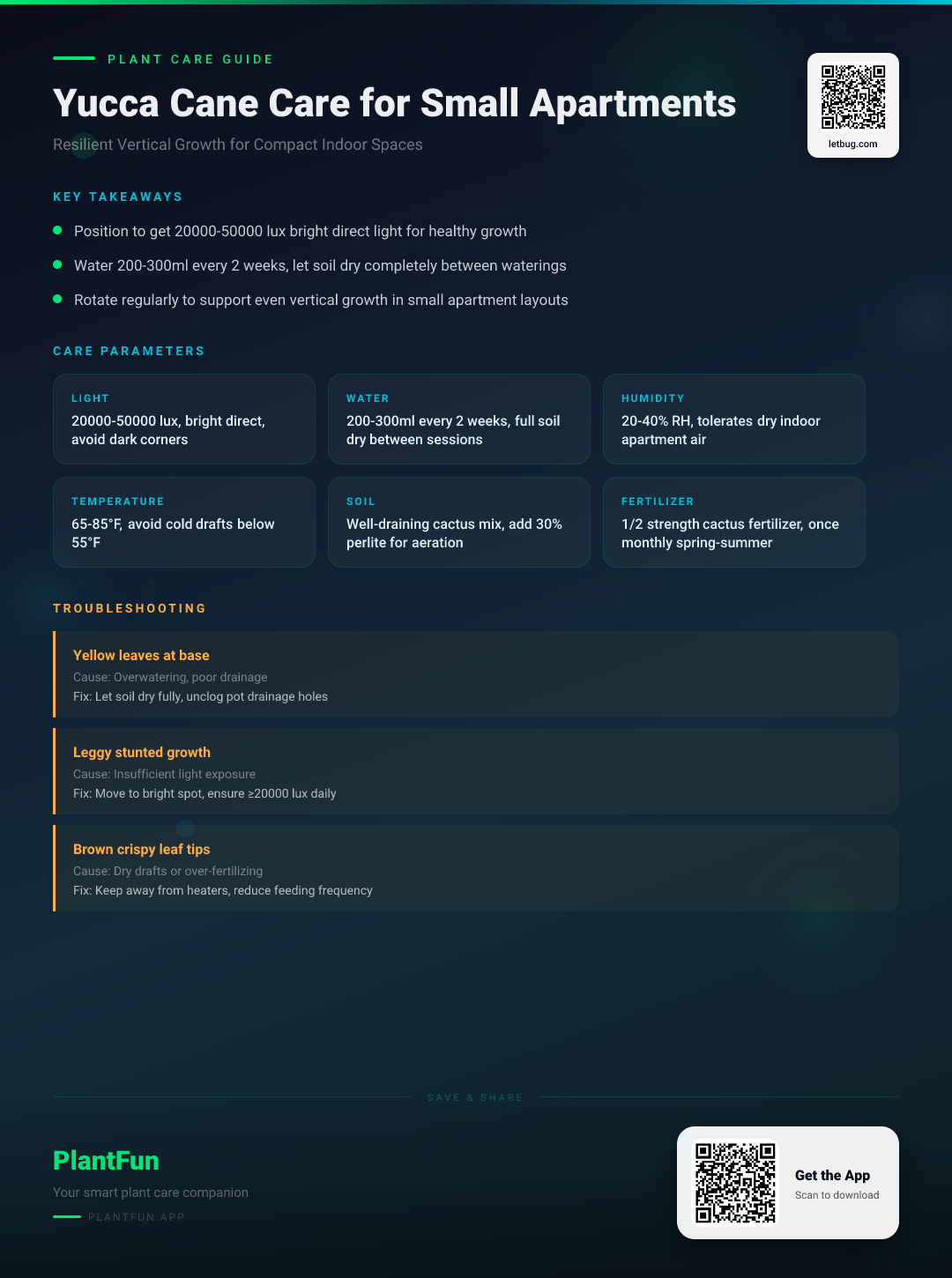
Key Takeaways
- Check soil moisture before watering — overwatering is the #1 killer of houseplants.
- Ensure your plant gets the right amount of light for its species.
- Be patient with recovery — most plants need 2–4 weeks to bounce back.
TL;DR: The 60-second summary for busy apartment gardeners
To keep your Yucca cane thriving, place it in the brightest spot you have—ideally directly in front of a south-facing window. Water sparingly, only when the top 3 inches of soil are bone-dry (NC State Extension, 2026). Use a well-draining cactus mix, never let it sit in standing water, and keep it away from pets as it is toxic (ASPCA, 2026). If the plant leans, it is starving for light.
Quick Care Card: Essential metrics at a glance
| Feature | Requirement |
|---|---|
| Light | 20,000–50,000 Lux (Bright, direct light) |
| Water | 200-300ml per 2 weeks (check soil first) |
| Humidity | 20-40% (Low/Average) |
| Temperature | 65-85°F (18-29°C) |
| Soil | Fast-draining succulent/cactus mix |
| Fertilizer | Balanced liquid feed, monthly in summer |
| Toxicity | Toxic to cats and dogs (ASPCA, 2026) |
Why the Yucca is the ultimate ‘vertical’ solution for small spaces
When I moved into my first studio apartment, I lacked horizontal floor space but had plenty of vertical ceiling clearance. The Yucca cane is my go-to recommendation for this exact scenario. Unlike sprawling tropical foliage, the Yucca offers a clean, architectural silhouette that draws the eye upward, making ceilings appear higher. It is a slow grower, meaning it won’t outgrow your living room corner in a single season.
Natural Habitat vs. Your Living Room: Why light is your most important tool
Yucca plants are native to arid, desert climates where they receive full, unrelenting sun. When I first brought one home, I made the mistake of placing it in a “bright” hallway that was actually 15 feet from a window. Within weeks, the new growth became pale and spindly.
Indoor Yucca light requirements are higher than most common houseplants. If your plant isn’t getting at least 20,000 lux, it will struggle to maintain its cellular structure (Cane, 1990). If you are asking, “is my Yucca getting enough light,” and the answer is that it’s sitting in a corner, the answer is likely no.
The Watering Science: Preventing rot in standard apartment containers
Many gardeners assume ‘indestructible’ means ‘needs nothing.’ However, the most common reason for failure is overwatering. Because apartment air often has lower air circulation, soil stays damp longer than it would outdoors. Use a moisture meter or simply stick your finger 2 inches into the soil; if you feel even a hint of moisture, do not water (NC State Extension, 2026).
- The Golden Rule: When in doubt, wait one more week.
- The Measurement: 200-300ml is usually sufficient for a standard 10-inch pot, but always ensure drainage holes are unobstructed.
Step-by-Step: The ideal soil recipe for drainage and aeration
- Base: Use 50% high-quality potting soil.
- Aeration: Add 25% perlite or pumice to ensure oxygen reaches the roots.
- Drainage: Add 25% coarse horticultural sand or fine gravel.
- Container: Always use a pot with a drainage hole. Avoid decorative cachepots that trap water at the bottom.
Seasonal Shifts: Adjusting your care routine from summer heat to winter heating
Winter poses a unique threat to Yucca cane care. While the plant slows its metabolic growth, apartment heaters dry out the air and can create localized heat stress. I keep mine away from direct furnace vents. During winter, I reduce my watering frequency by half, as the plant’s moisture uptake decreases significantly (Buchanan & Cane, 1978).
Common Apartment Mistakes: Why corner placement kills your Yucca
- Mistake: Placing the plant in a decorative dark corner.
- What happens: Low light causes etiolation (stretching), and stagnant air leads to fungal issues.
- Instead: Use a plant stand with wheels so you can move it into the light during the day.
Voice FAQ
Why is my Yucca cane turning yellow at the base?
This is typically the first sign of root rot caused by overwatering. Check the soil drainage immediately; if the soil is waterlogged, the roots are suffocating.
Can I grow a Yucca in a room with only one small window?
It is difficult. Without supplemental full-spectrum LED grow lights, a Yucca will eventually weaken. If you must, place it directly on the windowsill.
How often should I rotate my Yucca for even growth?
Rotate the pot 90 degrees every time you water to ensure the plant doesn’t lean permanently toward the light source.
References
- ASPCA. (2026). Toxic and Non-Toxic Plants List — ASPCA. https://www.aspca.org/pet-care/animal-poison-control/toxic-and-non-toxic-plants. Accessed 2026-03-18.
- Buchanan, N.; Cane, R. (1978). Drug utilization in a general intensive care unit. Intensive Care Medicine. https://doi.org/10.1007/bf01684388. Accessed 2026-03-18.
- Cane, R. (1990). Hemoglobin. Critical Care Medicine. https://doi.org/10.1097/00003246-199009000-00028. Accessed 2026-03-18.
- NC State Extension. (2026). Yucca Cane Care — NC State Extension Gardener Plant Toolbox. https://plants.ces.ncsu.edu/plants/yucca-cane/. Accessed 2026-03-18.
Optional Helper: Plantfun.App
Plantfun.App identifies your plants by photo, diagnoses pests and diseases with clear fixes, and creates personalised watering and light schedules that adapt to your home conditions — a handy companion for putting this guide into daily practice.
Found an error or have suggestions? We'd love your feedback.
Need help identifying this problem?
Get instant identification, personalized care schedules, and effective pest treatment plans directly on your phone.
Sponsored • We may earn a commission from app downloads
Related Guides
Yucca Cane Care in Compact Apartments: How to Achieve Resilient Growth in Small Spaces
Master Yucca cane care in your apartment with this 5-step growth strategy. Learn precise watering volumes, ideal lux levels, and how to prevent leggy growth today.
Care GuideYucca Elephantipes Care Checklist: Avoid 7 Common Mistakes for Resilient Growth in Typical Apartments
Stop killing your apartment yucca with overwatering or bad light placement. Grab our actionable checklist with 7 common mistake fixes to keep your Yucca elephantipes resilient and lush year-round.
Care GuideYucca Cane Care in Low-Light Apartments: The Complete Guide for Resilient, Architectural Growth
Master Yucca cane care in your apartment with exact lux levels, watering frequency, and pruning secrets to keep your plant sculptural, vibrant, and healthy.
Pest ControlAnts on Plants: What They Mean and What to Do
Ants usually aren't eating your plant. They are farming other pests.