
Key Takeaways
- Check soil moisture before watering — overwatering is the #1 killer of houseplants.
- Ensure your plant gets the right amount of light for its species.
- Be patient with recovery — most plants need 2–4 weeks to bounce back.
TL;DR: The Golden Rule for Yucca
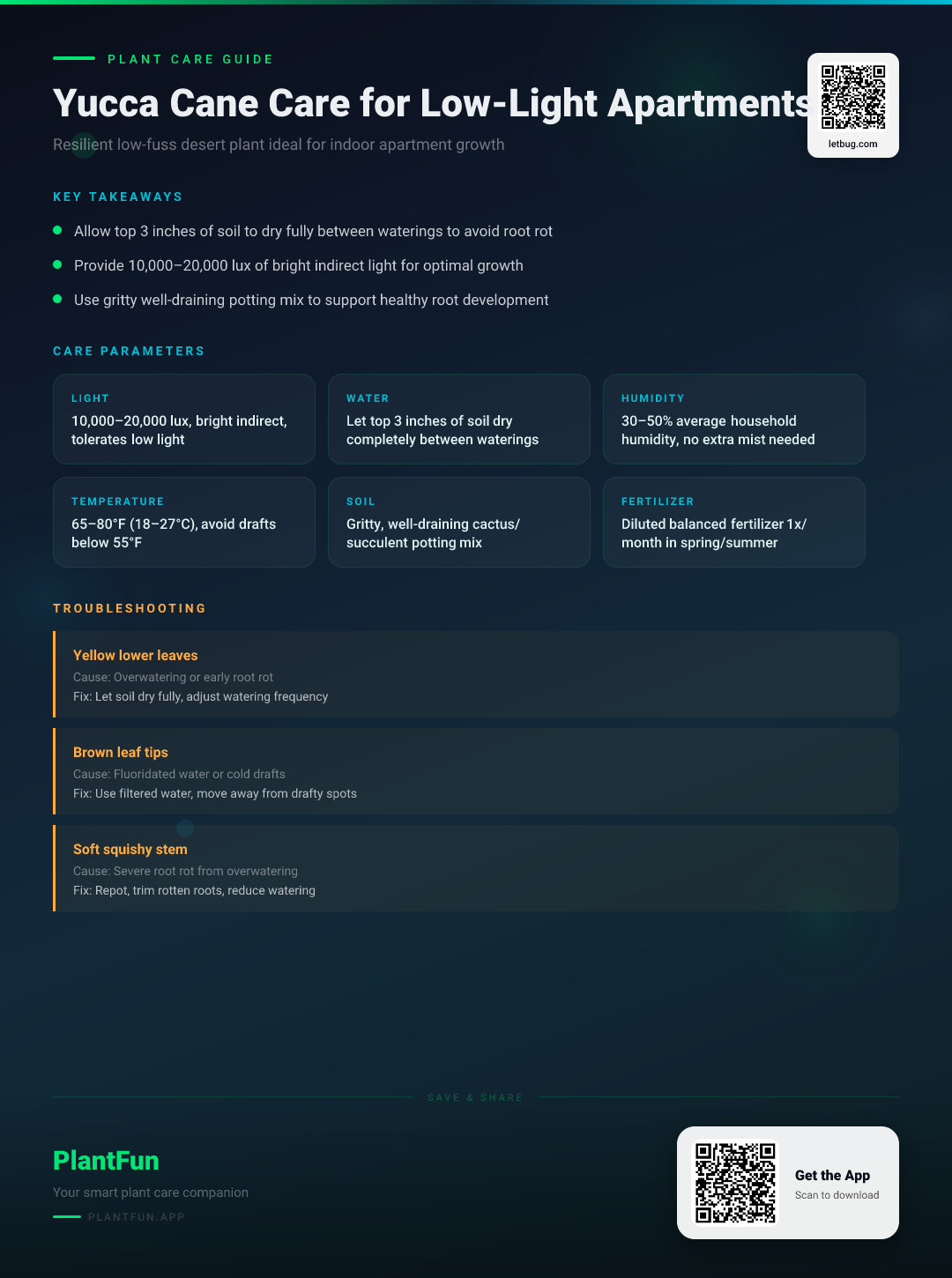
To keep your Yucca elephantipes thriving, treat it as a drought-tolerant succulent, not a tropical rainforest plant. Provide high-intensity, indirect light (10,000–20,000 lux) and wait until the top 3 inches of the soil are completely dry before watering. Avoid over-potting in large containers, which leads to chronic root rot in dim apartment corners.
My Experience: Learning the Hard Way
When I first brought home my oversized Yucca elephantipes, I treated it like my Pothos. I placed it in a dark hallway and watered it whenever the surface looked slightly dry. Within three months, the beautiful cane began to soften at the base, and the leaves dropped in a yellowing heap. I learned quickly that indoor Yucca plant care is about restraint. My mistake was assuming all houseplants crave moisture; my Yucca, conversely, was fighting for its life against stagnant, heavy soil.
Quick Care Card: Essential Thresholds for Indoor Yucca
| Feature | Requirement |
|---|---|
| Light | 10,000–20,000 lux (Bright, indirect) |
| Water | Allow top 3 inches to dry completely |
| Humidity | Low to moderate (30-50%) |
| Temperature | 65–80°F (18–27°C) |
| Soil | High-drainage succulent/cactus mix |
| Fertilizer | Balanced, half-strength, spring/summer only |
| Toxicity | Toxic to cats and dogs (ASPCA, 2026) |
Why Your Apartment Yucca Is Struggling: The ‘Desert Myth’ Explained
Many owners fail because they confuse “low-light tolerance” with “low-light preference.” While a Yucca can survive in a dim corner, it will not thrive. It will become etiolated—stretching its stems thin as it searches for light—leading to weak cellular structures (NC State Extension, 2026).
Format B: The Rescue Plan - Diagnostic Checklist
- Check the stem: Gently press the lower trunk. If it is soft or squishy, you have advanced root rot.
- Check the soil: Is the soil dense or moisture-retentive? If so, repotting is non-negotiable.
- Assess the light: Use a light meter or phone app to ensure the plant receives at least 10,000 lux.
- Inspect for pests: Check leaf axils for spider mites or scale, which thrive on stressed plants.
Light Requirements: Achieving 10,000–20,000 Lux Without a Greenhouse
Your Yucca needs high intensity to maintain its structural integrity. If you cannot place it directly in front of a window, you may need a full-spectrum LED growth light. Position the lamp so the light intensity hitting the leaves hits the 10,000-lux mark for at least 8 hours a day (NC State Extension, 2026).
Watering Mastery: Why the Top 3 Inches of Soil Must Dry Completely
Indoor Yucca root rot symptoms are almost always linked to overwatering. The plant prefers deep, infrequent soaking. Using your finger as a moisture meter, push it 3 inches into the soil. If you feel any dampness, wait another 3-5 days.
Humidity and Temperature: Keeping Your Yucca Between 65-80°F (18-27°C)
Drafts are your enemy. Keep your plant away from AC vents and heaters. Consistency is key for metabolic function, similar to the physiological monitoring described in intensive care protocols (Cane, 1990).
Soil Science: Choosing the Right Gritty Mix for Apartment Containers
Standard potting soil is too heavy for Yucca. I recommend a mix of 50% professional succulent mix, 25% perlite, and 25% pumice. This ensures rapid drainage and prevents the roots from sitting in stagnant moisture.
Voice FAQ: Why is my Yucca cane stem feeling soft and squishy?
This is typically a sign of anaerobic decay caused by waterlogged soil. Once the cane turns squishy, the rot has usually penetrated the vascular system of the plant.
Voice FAQ: How often should I water my Yucca if it’s in a dark corner?
If your plant is in a low-light area, the plant’s metabolic rate slows down. You might only need to water once every 4–6 weeks. Always prioritize the “dry finger test” over a calendar schedule.
Seasonal Adjustments: Managing Dormancy in Winter vs. Growth in Summer
During winter, reduce watering by half. The plant is in a semi-dormant state and the lack of sunlight makes evaporation significantly slower.
Troubleshooting Guide: Identifying Leaf Tip Browning vs. Yellowing
Leaf Tip Browning
Symptom: Dry, crispy tips on the lower leaves.
Likely cause: Low humidity or inconsistent watering.
Fix:
- Increase humidity slightly or ensure your watering is deep rather than frequent.
- Trim the brown tips with sterilized shears.
Yellowing Leaves
Symptom: Entire leaves turning yellow and drooping.
Likely cause: Overwatering or poor drainage.
Fix:
- Stop watering immediately and allow the soil to dry out.
- Check for wet, mushy roots during your next inspection.
Long-Term Prevention: Potting Techniques to Prevent Root Rot
Always use a pot with significant drainage holes. If you prefer decorative cachepots, remove the plant to water it in the sink, letting all excess water drain before returning it to the decorative container (Buchanan & Cane, 1978).
References
- American Society for the Prevention of Cruelty to Animals. (2026). Toxic and Non-Toxic Plants List — ASPCA. https://www.aspca.org/pet-care/animal-poison-control/toxic-and-non-toxic-plants. Accessed 2026-03-14.
- North Carolina State University Extension. (2026). Yucca Cane Care — NC State Extension Gardener Plant Toolbox. https://plants.ces.ncsu.edu/plants/yucca-cane/. Accessed 2026-03-14.
- Cane, R. (1990). Hemoglobin. Critical Care Medicine. https://doi.org/10.1097/00003246-199009000-00028. Accessed 2026-03-14.
- Buchanan, N.; Cane, R. (1978). Drug utilization in a general intensive care unit. Intensive Care Medicine. https://doi.org/10.1007/bf01684388. Accessed 2026-03-14.
Optional Helper: Plantfun.App
Plantfun.App identifies your plants by photo, diagnoses pests and diseases with clear fixes, and creates personalised watering and light schedules that adapt to your home conditions — a handy companion for putting this guide into daily practice.
Found an error or have suggestions? We'd love your feedback.
Need help identifying this problem?
Get instant identification, personalized care schedules, and effective pest treatment plans directly on your phone.
Sponsored • We may earn a commission from app downloads
Related Guides
Yucca Cane Care in Low-Light Apartments: The Complete Guide for Resilient, Architectural Growth
Master Yucca cane care in your apartment with exact lux levels, watering frequency, and pruning secrets to keep your plant sculptural, vibrant, and healthy.
Care GuideThe Complete Spineless Yucca Care Checklist for Thriving Growth in Typical Urban Apartments
Skip expensive plant gadgets with this free spineless yucca care checklist. Get exact light, water, and soil parameters to keep your yucca thriving in even the driest, sunniest urban apartment.
Care GuideYucca Elephantipes Care Checklist: Avoid 7 Common Mistakes for Resilient Growth in Typical Apartments
Stop killing your apartment yucca with overwatering or bad light placement. Grab our actionable checklist with 7 common mistake fixes to keep your Yucca elephantipes resilient and lush year-round.
Pest ControlAnts on Plants: What They Mean and What to Do
Ants usually aren't eating your plant. They are farming other pests.