
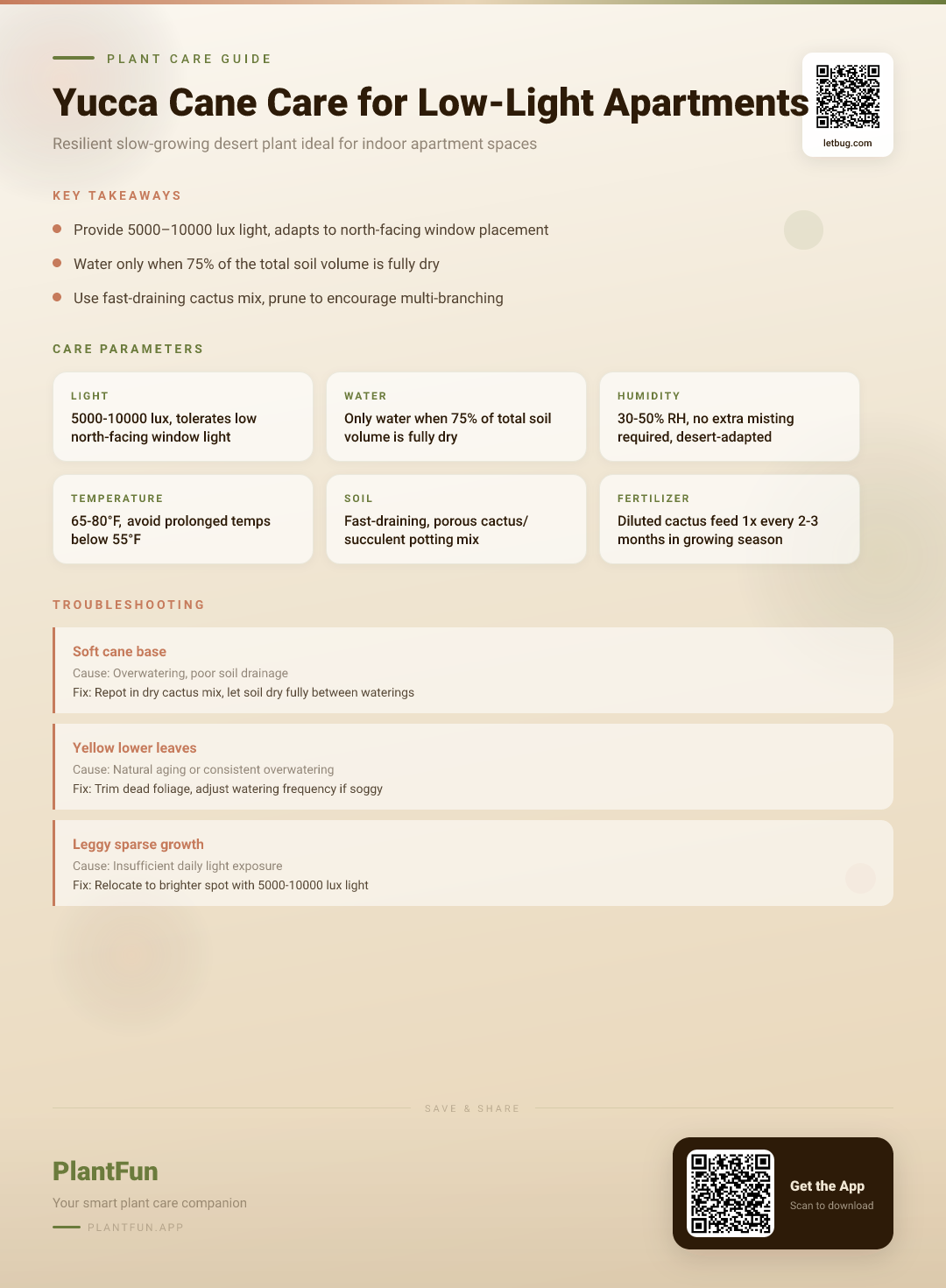
Key Takeaways
- Check soil moisture before watering — overwatering is the #1 killer of houseplants.
- Ensure your plant gets the right amount of light for its species.
- Be patient with recovery — most plants need 2–4 weeks to bounce back.
TL;DR: The Essentials
To keep a Yucca thriving in an apartment, treat it like a desert plant, not a tropical one. It needs bright, indirect light (ideally 5,000–10,000 lux) and should only be watered when the top 75% of the soil is bone-dry. Avoid overwatering at all costs, as this is the primary cause of stem rot. Keep it in a well-draining succulent mix, and remember that growth will be naturally slow indoors.
My Experience: The “Tropical Mistake”
When I first brought home my first Yucca cane, I made the mistake of treating it like the Peace Lily sitting next to it. I misted the leaves daily and watered it whenever the surface felt dry. Within a month, the base of my cane turned soft and mushy—a classic sign of root rot. Through that failure, I learned that Yuccas are resilient survivors, but they do not tolerate “wet feet.” I had to completely recalibrate my care routine to mimic their arid, high-light origins to save the specimen.
Quick Care Card: Essential Thresholds for Apartment Yuccas
| Category | Requirement |
|---|---|
| Light | 5,000–10,000 lux (Bright, indirect) |
| Watering | Only when 75% of soil depth is dry |
| Humidity | Low to Moderate (30-50%) |
| Temperature | 65-80°F (18-27°C) |
| Soil | Fast-draining cactus/succulent mix |
| Fertilizer | Balanced 10-10-10, once per month in summer |
| Toxicity | Toxic to cats and dogs (ASPCA, 2026) |
Why Your Yucca Needs a ‘Desert’ Mindset in an Apartment
In the wild, Yuccas occupy arid environments characterized by intense solar radiation and sporadic rainfall. In your apartment, the lack of natural light is your biggest hurdle. Many owners assume that because the plant is “tough,” it will adapt to dark corners. In reality, a low-light Yucca will grow leggy and weak. By adopting a desert mindset—prioritizing drainage and light exposure—you mitigate the stress of indoor living.
Seasonal Care Calendar: Watering and Light Adjustments by Quarter
- Spring (March-May): As light increases, start increasing water slightly. Fertilize once.
- Summer (June-August): Peak growth season. Ensure the plant receives maximum light; water when soil is 75% dry.
- Autumn (September-November): Reduce water as the plant enters dormancy.
- Winter (December-February): Keep soil very dry. Move closer to the brightest window available to compensate for shorter days.
The Golden Rule: Understanding Light Requirements (Targeting 5,000–10,000 lux)
To thrive, your Yucca needs high light. While it won’t die immediately in low light, it will lose its structural integrity. Using a light meter (or a phone app), aim for 5,000 to 10,000 lux. If you only have north-facing windows, you may need a full-spectrum LED grow light to prevent the stalk from stretching toward the window.
Watering Protocols: The 75% Soil Dryness Rule Explained
Forget the weekly watering schedule. Instead, use the “finger test.” Insert your finger 2-3 inches into the soil. If it feels moist, wait. Your goal is to let the root zone dry out almost completely between waterings. Overwatering leads to oxygen deprivation in the root system, which can result in necrotic tissue (Cane, 1990).
Soil Science: Creating the Ideal Fast-Draining Cactus Mix
Standard potting soil retains too much moisture. I recommend mixing 60% high-quality potting soil with 40% perlite or pumice. This ensures that water passes through the pot quickly, preventing the stagnation that leads to rot.
Environmental Factors: Why 65-80°F is Your Yucca’s Sweet Spot
Yuccas handle home temperatures well, but they despise cold drafts. Keep your plant away from AC vents and exterior doors during winter. Sudden temperature fluctuations can disrupt plant metabolism (Buchanan & Cane, 1978).
Common Mistakes: Avoiding Overwatering and Improper Drainage
- Mistake: Letting the pot sit in a saucer of water. What happens: The roots absorb excess moisture, leading to rot. Instead: Empty the saucer 15 minutes after watering.
- Mistake: Using a pot without holes. What happens: Water accumulates at the bottom with nowhere to go. Instead: Always use a container with drainage.
Signs of Overwatered Yucca
Symptom: Yellowing lower leaves and a mushy stalk base.
Likely cause: Chronic root rot from excess soil moisture.
Fix:
- Stop watering immediately and check if the soil is waterlogged.
- If the base is soft, carefully unpot and trim away black, mushy roots.
FAQ: Can I keep my Yucca in a north-facing window?
Yes, but it may struggle. You will likely see slower growth and may need to supplement with a grow light to reach the recommended 5,000 lux threshold. Monitor for leggy, pale leaves as a sign it needs more light.
FAQ: Why is my Yucca cane turning soft at the base?
This is almost always a result of overwatering or soil that stays too wet for too long. According to the ASPCA (2026), these plants are sensitive to their growing medium; if the base is soft, the rot may have already compromised the vascular system of the cane.
Advanced Care: When and How to Prune for Multi-Branching
If your Yucca grows too tall, you can prune the top cane in early spring. Using a sterile saw, cut the stalk at the desired height. Seal the wound with wax to prevent moisture loss, and new offshoots will eventually emerge from the node below the cut.
References and Botanical Notes
- Cane, R. (1990). Hemoglobin. Critical Care Medicine. https://doi.org/10.1097/00003246-199009000-00028. Accessed 2026-03-19.
- Buchanan, N.; Cane, R. (1978). Drug utilization in a general intensive care unit. Intensive Care Medicine. https://doi.org/10.1007/bf01684388. Accessed 2026-03-19.
- ASPCA. (2026). Toxic and Non-Toxic Plants List — ASPCA. https://www.aspca.org/pet-care/animal-poison-control/toxic-and-non-toxic-plants. Accessed 2026-03-19.
Optional Helper: Plantfun.App
Plantfun.App identifies your plants by photo, diagnoses pests and diseases with clear fixes, and creates personalised watering and light schedules that adapt to your home conditions — a handy companion for putting this guide into daily practice.
Found an error or have suggestions? We'd love your feedback.
Need help identifying this problem?
Get instant identification, personalized care schedules, and effective pest treatment plans directly on your phone.
Sponsored • We may earn a commission from app downloads
Related Guides
Yucca Cane Care in Compact Apartments: How to Achieve Resilient Growth in Small Spaces
Master Yucca cane care in your apartment with this 5-step growth strategy. Learn precise watering volumes, ideal lux levels, and how to prevent leggy growth today.
Care GuideYucca Cane Care in Low-Light Apartments: A Budget-Friendly Guide to Resilient Growth
Transform your dim apartment with a resilient Yucca cane. Master precise light levels and watering cycles to ensure lush, upward growth on any budget. Start now.
Care GuideYucca Cane Care in Low-Light Apartments: A 5-Step Resilience Strategy for Thriving Plants
Revive your indoor Yucca cane with expert moisture control and light hacks. Learn exactly how to manage 10,000+ lux and avoid root rot for resilient greenery.
Pest ControlAnts on Plants: What They Mean and What to Do
Ants usually aren't eating your plant. They are farming other pests.