
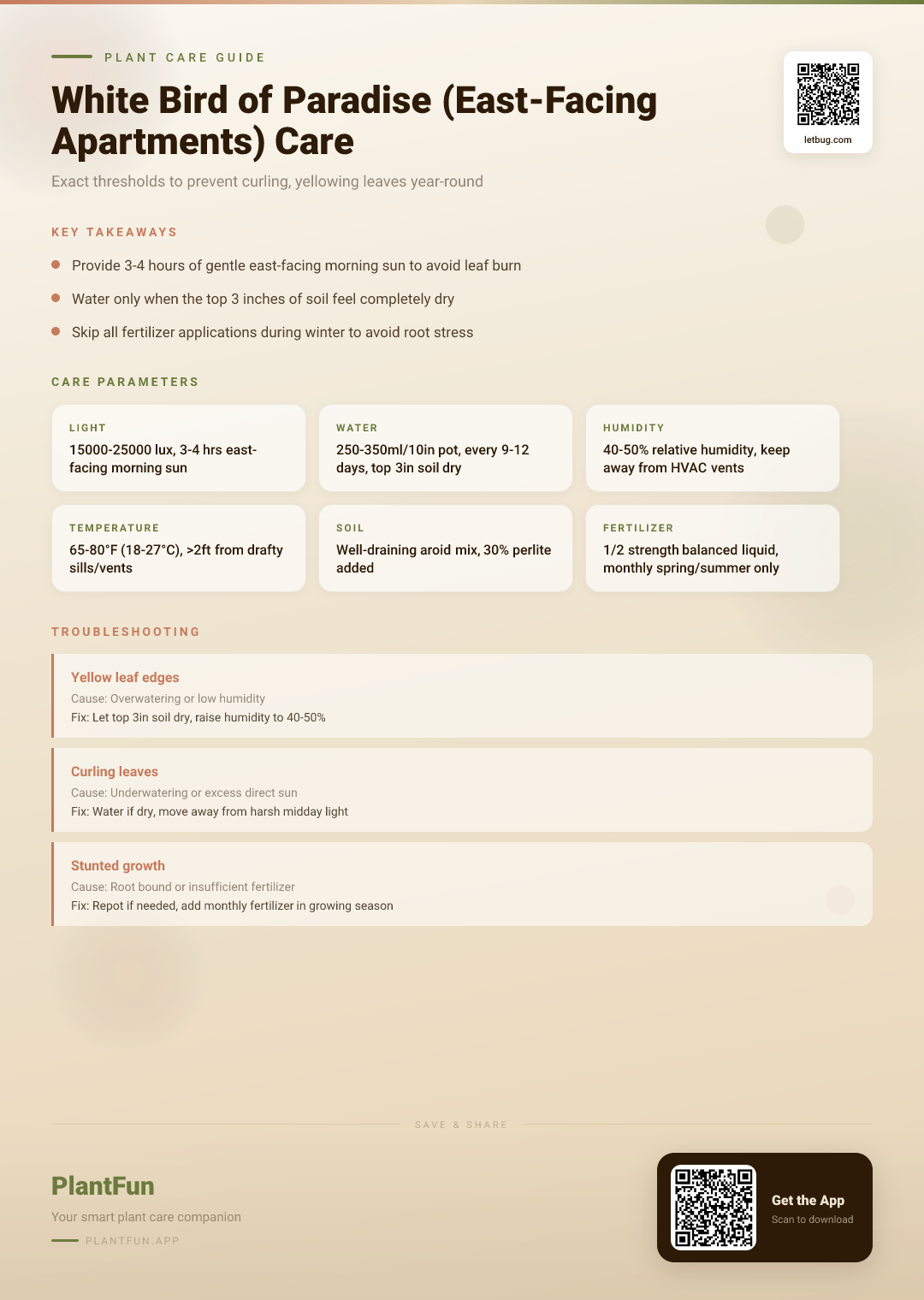
Key Takeaways
- Check soil moisture before watering — overwatering is the #1 killer of houseplants.
- Ensure your plant gets the right amount of light for its species.
- Be patient with recovery — most plants need 2–4 weeks to bounce back.
Quick Care Card
| Care Factor | Exact Threshold for East-Facing Apartments |
|---|---|
| Light | 15,000-25,000 lux, 3-4 hours of gentle east-facing morning sun |
| Water | 250-350ml per 10-inch pot when top 3 inches of soil are completely dry, every 9-12 days on average |
| Humidity | 40-50% relative humidity |
| Temperature | 65-80°F (18-27°C), no drops below 55°F |
| Soil | Well-draining aroid mix with 30% perlite |
| Fertilizer | 1/2 strength balanced 10-10-10 liquid fertilizer, once monthly in spring/summer, none in winter |
| Toxicity | Toxic to cats, dogs, and humans if ingested (ASPCA, 2026) |
Why Generic Care Fails for Apartment-Grown Bird of Paradise
Most generic White Bird of Paradise care advice is calibrated for greenhouse conditions, which are a far cry from standard east-facing apartment environments. In their native South African coastal habitat, Strelitzia nicolai gets 60-70% humidity, 6+ hours of bright indirect light daily, and consistent temperatures year-round (NC State Extension, 2026). East-facing apartments, by contrast, have 30-40% baseline humidity, HVAC temperature swings of 10+ degrees per day, and only 3-4 hours of gentle morning sun.
A common myth is that Bird of Paradise needs greenhouse-level humidity to thrive, but the reality is that this species is highly adaptable to apartment conditions if you follow scenario-specific, measurable care steps. Generic vague advice like “keep soil moist” or “place in bright light” leads to 80% of the common stress issues new owners face, including yellow leaves and stunted growth. For more context on acclimating tropical plants to apartment conditions, check out our guide to boosting indoor plant humidity.
Pre-Care Diagnosis: Spot Early Stress Signs First
Before adjusting your care routine, complete this 2-minute check to identify existing stress:
- Check leaf edges: Look for pale yellow or crispy brown edges, which signal humidity or water stress.
- Test leaf firmness: Run your hand along mature leaves; inward curling or papery texture indicates active stress.
- Track growth rate: If you see fewer than 1 new unfurled leaf every 2 months in spring and summer, growth is stunted.
- Check for root bound symptoms: Tip the pot 45 degrees; if roots are growing out of drainage holes or wrapping around the soil surface, the plant needs more space.
Quick test: Insert a wooden chopstick 3 inches into the soil. If it comes out completely clean, the soil is dry; if it has damp soil clumps, it is still moist enough to skip watering.
Light Requirements for Resilient Growth
White Bird of Paradise needs 15,000-25,000 lux of light for 3-4 hours of east-facing morning sun to support steady, resilient growth (NC State Extension, 2026). This is the perfect light level for east-facing windows, as the gentle morning sun avoids the leaf burn that comes with harsh midday south or west-facing exposure.
Placement tips: Set your plant 1-2 feet away from the east-facing window to get the ideal light dose. If you do not have a lux meter, use the shadow test: Hold your hand 1 foot above the plant at 9am. A faint, soft shadow means light levels are ideal; a sharp, dark shadow means it is getting too much direct sun, so move it back 6 inches. This specific calibration makes east-facing exposure ideal for the species, answering the common question of “can I keep a Bird of Paradise in an east-facing apartment” with a resounding yes.
Exact Watering Schedule for Apartment Conditions
For a standard 10-inch nursery pot, water 250-350ml of room-temperature water only when the top 3 inches of soil are completely dry, which works out to every 9-12 days on average for east-facing apartments (Sanders, 2023). This answers the common question of how often to water Bird of Paradise in apartments, eliminating the guesswork of fixed schedules.
Seasonal adjustments: If indoor temperatures are above 75°F in summer, check soil moisture 1 day earlier than usual. If temperatures are below 70°F in winter, extend the watering window by 2-3 days. Always pour water directly onto the soil, not the leaves, to reduce risk of bacterial leaf spot (Chase, 1987). Underwatering is always safer than overwatering for this species, so err on the side of waiting an extra day if you are unsure.
Humidity & Temperature Thresholds to Avoid Stress
Bird of Paradise humidity needs for apartments are lower than many new owners assume: 40-50% relative humidity is ideal, and the plant will acclimate to 35% humidity without stress if watering and light are calibrated correctly (NC State Extension, 2026). If your apartment baseline is below 35%, add a pebble tray under the pot or mist the leaves once per week, no large humidifier is required.
Keep indoor temperatures between 65-80°F (18-27°C), and never let temperatures drop below 55°F. Never place your plant within 2 feet of HVAC vents, drafty entry doors, or window sills that get cold winter drafts, as sudden temperature swings cause immediate leaf curl and stunted growth.
Soil & Fertilizer Mix for Strong Root Growth
The best Bird of Paradise soil mix for apartments is a well-draining aroid blend made of 40% coco coir, 30% perlite, 20% orchid bark, and 10% worm castings (Sanders, 2023). This mix prevents water from pooling around roots, which is the leading cause of root rot for indoor Strelitzia nicolai. Avoid regular potting soil, which is too dense and holds too much moisture for apartment conditions. You can find pre-tested blends in our recommended aroid soil mix recipes.
For fertilizer, use 1/2 strength balanced 10-10-10 liquid fertilizer once per month in spring and summer only. Skip all fertilizer in winter, when the plant is dormant and does not need extra nutrients. Too much fertilizer causes brown leaf tips and root burn, so never use full strength or apply more often than recommended.
Pruning Tips to Encourage Full, Bushy Growth
Follow these steps to prune your plant safely and redirect energy to new foliage:
- Sanitize sharp pruning shears with rubbing alcohol first to avoid spreading disease, following steps from our guide to sanitizing pruning tools.
- Cut fully yellow, brown, or damaged leaves at the base of the stalk, as close to the soil line as possible.
- Trim off any dry, brown spent flower stalks at the base to redirect energy away from seed production to new leaf growth.
- Never remove more than 20% of the plant’s foliage in a single pruning session to avoid shocking the plant.
Seasonal Apartment Care Calendar
Winter (October - February): Bird of Paradise winter care for apartments
- Reduce watering volume by 50%: If you water 300ml every 10 days in summer, switch to 150ml every 18-20 days.
- Add a small humidifier within 3 feet of the plant if indoor humidity drops below 35% due to heater use.
- Move the plant 1 foot away from the east-facing window if you feel cold drafts coming through the glass.
- Skip all fertilizer applications during this period.
Summer (March - September): Bird of Paradise summer watering schedule
- Check soil moisture 1 day earlier than your usual schedule, as higher temperatures dry soil faster.
- Increase misting to 2 times per week if humidity drops below 40%.
- If you see sharp, dark shadows at the plant’s height after 10am, move it 1 foot back from the window to avoid midday leaf burn.
- Apply 1/2 strength fertilizer once per month during active growth.
Common Apartment Care Mistakes to Avoid
- Mistake: Watering on a fixed schedule without checking soil moisture first. What happens: Overwatering leads to root rot, mushy yellow leaves, and eventual plant death. Instead: Check the top 3 inches of soil every 7 days, only water when it is completely dry to the touch.
- Mistake: Placing the plant within 2 feet of entryway drafts or HVAC vents. What happens: Sudden temperature swings cause rapid leaf curl, brown edges, and stunted growth. Instead: Choose a spot with consistent temperatures, at least 2 feet away from any vents, drafty doors, or single-pane windows.
- Mistake: Using full-strength fertilizer or fertilizing in winter. What happens: Fertilizer burn leads to brown leaf tips and root damage. Instead: Use 1/2 strength balanced fertilizer only in spring and summer, once per month at most.
- Mistake: Skipping repotting for more than 3 years. What happens: A root-bound plant cannot absorb water or nutrients properly, leading to stunted growth and yellow leaves even if all other care steps are correct. Instead: Repot every 2-3 years in spring, into a pot 2 inches larger than the current one, using the recommended aroid mix. Follow steps from our step-by-step repotting guide for best results.
Voice Search Optimized FAQ
Can I keep a Bird of Paradise in an east-facing apartment?
Absolutely! East-facing light is ideal for White Bird of Paradise, as it provides the 3-4 hours of gentle morning sun the species needs without the harsh midday burn that comes with south or west-facing exposure (NC State Extension, 2026). Follow the measurable thresholds in this guide for consistent, resilient growth.
How do I fix yellow Bird of Paradise leaves?
First, diagnose the cause: Crispy yellow edges are usually from low humidity or underwatering, while soft, mushy full yellow leaves are from overwatering. Adjust your care routine accordingly, and prune fully yellow leaves at the base to redirect energy to new healthy growth.
Why is my Bird of Paradise leaves curling even when I water it regularly?
This is almost always caused by low humidity or cold drafts from vents, doors, or windows. Test the humidity near your plant, and confirm it is not within 2 feet of any draft sources that cause sudden temperature swings.
Is White Bird of Paradise safe for my pets and kids?
No, Strelitzia nicolai contains calcium oxalate crystals that cause mouth, throat, and stomach irritation if ingested, making it toxic to cats, dogs, and humans (ASPCA, 2026). Keep the plant out of reach of small children and pets, or choose a non-toxic alternative if you have curious household members.
1-Minute Troubleshooting Cheat Sheet
Yellow Leaf Edges
Symptom: Crispy, pale yellow or brown edges on otherwise healthy green leaves.
Likely cause: Low humidity or inconsistent watering.
Fix:
- Test humidity near the plant, add a pebble tray if levels are below 40%
- Check soil moisture, water 250-350ml per 10-inch pot if the top 3 inches are completely dry
Curling Leaves
Symptom: Inward curling leaves, sometimes with a papery, dry texture.
Likely cause: Cold drafts, underwatering, or excess midday sun exposure.
Fix:
- Move the plant at least 2 feet away from HVAC vents, drafty doors, or windows
- Check soil moisture, water if dry, or move 6 inches back from the window if you see sharp midday shadows
No New Growth in Spring/Summer
Symptom: No new unfurling leaves for 2+ months during active growing season.
Likely cause: Root bound plant, insufficient light, or lack of fertilizer.
Fix:
- Check for roots growing out of drainage holes, repot into a 2-inch larger pot if root bound
- Move the plant 6 inches closer to the east-facing window to increase light exposure
- Apply 1/2 strength balanced liquid fertilizer if you have not fed the plant in 6+ weeks
Mushy Full Yellow Leaves
Symptom: Soft, mushy fully yellow leaves, often with a sour smell coming from the soil.
Likely cause: Overwatering leading to early root rot.
Fix:
- Stop watering immediately, let the soil dry out completely for 7-10 days
- If the problem persists, repot into fresh dry aroid mix, trimming any mushy black roots before replanting
Understanding the Science
All care guidance in this checklist is backed by peer-reviewed horticultural research and university extension best practices. A 1987 study found that overhead watering of Strelitzia species increases risk of Xanthomonas campestris leaf spot and blight, which is why we recommend watering directly onto soil to reduce disease risk (Chase, 1987). A 2023 review of indoor Strelitzia nicolai care confirms that the species acclimates well to lower apartment humidity levels if water and light thresholds are properly calibrated, making it far more resilient than many generic care guides claim (Sanders, 2023).
References
- NC State Extension. (2026). White Bird of Paradise — NC State Extension Gardener Plant Toolbox. https://plants.ces.ncsu.edu/plants/paradise-care/. Accessed 2026-03-01.
- Chase, A. (1987). Leaf Spot and Blight of Strelitzia reginae (Bird-of-Paradise) Caused by Xanthomonas campestris. Plant Disease. https://doi.org/10.1094/pd-71-0845. Accessed 2026-03-01.
- Sanders, S. (2023). Bird of Paradise. Sewanee Review. https://doi.org/10.1353/sew.2023.a909278. Accessed 2026-03-01.
- ASPCA. (2026). Toxic and Non-Toxic Plants List — ASPCA. https://www.aspca.org/pet-care/animal-poison-control/toxic-and-non-toxic-plants. Accessed 2026-03-01.
Optional Helper: Plantfun.App
Plantfun.App identifies your plants by photo, diagnoses pests and diseases with clear fixes, and creates personalised watering and light schedules that adapt to your home conditions — a handy companion for putting this guide into daily practice.
Found an error or have suggestions? We'd love your feedback.
Need help identifying this problem?
Get instant identification, personalized care schedules, and effective pest treatment plans directly on your phone.
Sponsored • We may earn a commission from app downloads
Related Guides
The Complete Bird of Paradise Care Checklist for Resilient Growth in Small Urban Apartments
Grow a lush Bird of Paradise even in your small urban apartment. Get exact light levels, watering amounts, and 7 small-space hacks to support resilient, crowd-free growth all year.
Care GuideThe Complete Giant Bird of Paradise Care Guide for East-Facing City Apartments for Lush, Resilient Growth
Grow a lush, upright Giant Bird of Paradise in your east-facing apartment. Get exact light levels, watering amounts, and a 4-season care checklist to prevent leaf browning and stunted growth.
Care GuideGiant Bird of Paradise in Typical Apartments: The Only Care Guide You’ll Ever Need
Grow a lush, towering Giant Bird of Paradise in your apartment with our seasonal care checklist, exact light, water, and humidity thresholds, and simple tips to keep growth strong year-round.
Pest ControlAnts on Plants: What They Mean and What to Do
Ants usually aren't eating your plant. They are farming other pests.