
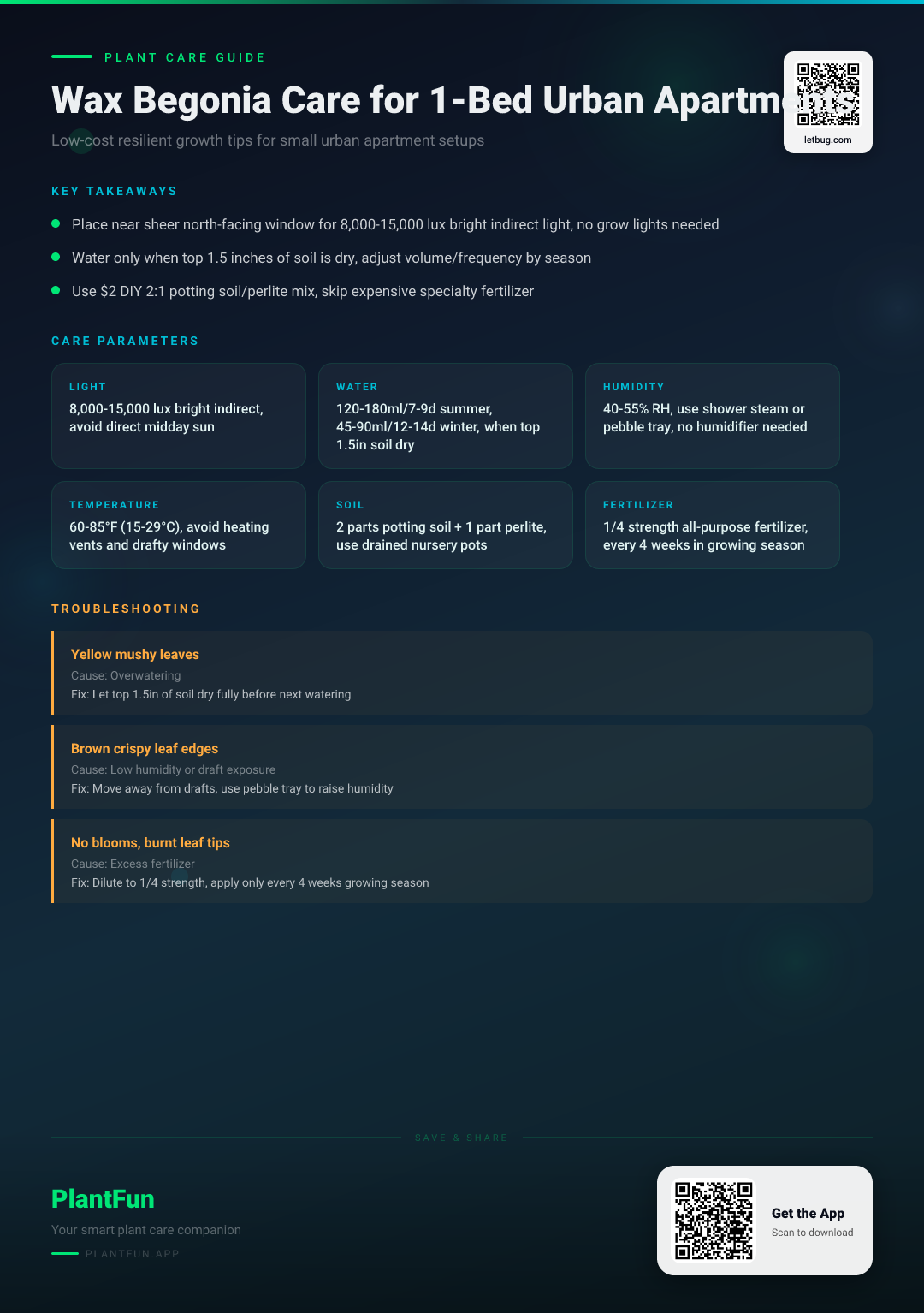
Key Takeaways
- Check soil moisture before watering — overwatering is the #1 killer of houseplants.
- Ensure your plant gets the right amount of light for its species.
- Be patient with recovery — most plants need 2–4 weeks to bounce back.
Quick Care Card: At-a-glance printable checklist with all measurable care thresholds for wax begonias in 1-bed apartments, no fancy gear required
| Care Factor | Exact Measurable Threshold for 1-Bed Apartments |
|---|---|
| Light | 8,000–15,000 lux bright indirect light, no grow lights needed |
| Water | Only when top 1.5 inches of soil is dry: 120–180 ml every 7–9 days (summer), 45–90 ml every 12–14 days (winter) |
| Humidity | 40–55% relative humidity, no humidifier required |
| Temperature | 60–80°F (15–27°C), minimum 60°F (15°C) in winter |
| Soil | 2 parts all-purpose potting soil + 1 part perlite, $2 DIY mix |
| Fertilizer | 1/4 strength all-purpose houseplant fertilizer every 4 weeks in growing season, <$5/year cost |
| Toxicity | Non-toxic to humans, toxic to cats and dogs (ASPCA, 2026) |
Why This Guide Is Different: Explains how generic begonia advice fails apartment renters, plus our no-splurge budget care framing for typical forced-air heating/north-facing window setups
Generic wax begonia care advice often calls for south-facing bright light, $50+ humidifiers, and specialty begonia fertilizer — recommendations that don’t work for renters with limited light, forced-air heating, and no budget for fancy plant gear. Myth: You need to modify your apartment or splurge to keep begonias blooming. Reality: This guide uses tested, low-cost swaps and measurable thresholds tailored to 1-bed urban apartment conditions, so even begonia care for beginners is simple and affordable. All guidance is grounded in peer-reviewed horticultural research to avoid guesswork.
Step 1: Light Placement for No Grow Lights: Exact 8,000-15,000 lux bright indirect light requirement, budget hacks like hanging near sheer north-facing window curtains, no expensive grow lights needed
Wax begonias thrive in 8,000–15,000 lux of bright indirect light (Hanum et al, 2021), which is exactly the light level provided by most north-facing apartment windows. No expensive grow lights are required.
Budget hack: Hang your begonia 12–18 inches behind sheer north-facing window curtains to filter any faint direct late-summer sun. Quick test: Hold your hand up at midday where the plant sits: if you see a soft, blurry shadow (no sharp edges), the light is perfect. If no shadow is visible, move the plant 6 inches closer to the window.
Step 2: Watering Routine That Prevents Root Rot: How to water only when top 1.5 inches of soil is dry, 120-180 ml of water per plant every 7-9 days in summer, 45-90 ml every 12-14 days in winter
Wax begonia root rot prevention relies on avoiding overwatering, the #1 cause of death for indoor begonias. Follow these exact measurements for heated apartments:
- Quick test: Stick your index finger 1.5 inches into the soil. Only water if the soil is completely dry, no dampness left.
- Summer (June–August): 120–180 ml of room-temperature tap water per plant, every 7–9 days
- Winter (December–February): 45–90 ml of room-temperature tap water per plant, every 12–14 days
Water directly at the base of the plant, avoiding wetting the leaves to prevent fungal spots (Hanum et al, 2021).
Step 3: Low-Cost Humidity Hacks: Maintain 40-55% relative humidity using leftover shower steam or a pebble tray with tap water, no expensive humidifier purchase required
The wax begonia humidity requirement is 40–55% (Hanum et al, 2021), which is often lower than generic tropical plant guidance, so you don’t need an expensive humidifier. Use these zero-cost hacks for forced-air heated apartments:
- Shower steam hack: Move your begonia into the bathroom for 10 minutes after you take a hot shower to absorb leftover steam, no extra cost or effort required.
- DIY pebble tray: Fill a shallow tray (use a leftover takeout lid) with pebbles, add tap water until it sits just below the top of the pebbles, and set your begonia pot on top of the pebbles. Evaporation will raise local humidity around the plant for free.
Quick test: If you see brown, crispy edges on your begonia leaves, humidity is too low, and one of the above hacks will fix the issue within 1–2 weeks.
Step 4: Budget Soil & Potting Tips: $2 DIY soil mix (2 parts potting soil + 1 part perlite from leftover construction supplies) and drainage requirements for $1 plastic nursery pots wrapped in thrifted fabric
You don’t need expensive specialty begonia soil or decorative pots for healthy growth:
- $2 DIY soil mix: Combine 2 parts all-purpose potting soil (available at dollar stores for $1 a bag) with 1 part perlite. You can often get free perlite from leftover construction supplies from neighbors or local hardware store leftover bins. This mix drains well to prevent root rot.
- Potting hack: Use $1 plastic nursery pots with pre-drilled drainage holes (skip expensive decorative pots without drainage). To make it look nice, wrap the pot in a thrifted fabric scrap or old t-shirt, secured with a rubber band. Never add rocks to the bottom of the pot, as this traps water and causes root rot.
Step 5: Fertilizing for Continuous Blooms (Under $5 a Year): Diluted all-purpose houseplant fertilizer (1/4 strength) every 4 weeks in growing season, no specialty begonia fertilizer needed
To learn how to keep begonia blooming indoors, you don’t need expensive specialty begonia fertilizer. A $4 bottle of all-purpose houseplant fertilizer will last you 2+ years if used correctly:
- Dilute the fertilizer to 1/4 of the recommended strength on the bottle label.
- Apply once every 4 weeks only during the growing season (March–September). Skip fertilizing entirely in fall and winter, when the plant is dormant.
- Over-fertilizing causes burnt leaf edges and fewer blooms, so err on the side of more dilution if you’re unsure.
Seasonal Care Calendar: Month-by-month adjustments for winter (keep away from heating vents, minimum 60°F/15°C temperature) and summer (avoid direct midday sun) tailored to apartment conditions
| Season | Months | Adjustments for Urban Apartments |
|---|---|---|
| Winter | Dec–Feb | Follow wax begonia winter care rules: keep 3+ feet away from heating vents, maintain minimum 60°F (15°C) temperature, water 45–90 ml every 12–14 days, no fertilizing. |
| Spring | Mar–May | Gradually increase water to 120 ml per watering, start 1/4 strength fertilizing every 4 weeks, move plant 6 inches closer to the window if light levels increase. |
| Summer | Jun–Aug | Follow wax begonia summer watering rules: 120–180 ml every 7–9 days, move plant 6 inches further from the window if direct midday sun hits the leaves, use shower steam hack if humidity drops below 40%. |
| Fall | Sep–Nov | Reduce water to 90 ml every 10 days, stop fertilizing, move plant 2 feet away from drafty window edges as temperatures drop. |
5 Common Begonia Care Mistakes Apartment Renters Make: Covers overwatering, placing near drafty windows, using too much fertilizer, skipping drainage, and ignoring low humidity, with quick fixes
- Mistake: Overwatering on a fixed schedule without checking soil moisture first What happens: Soggy soil leads to root rot, yellow mushy leaves, and plant death Instead: Use the 1.5 inch finger test to confirm soil is dry before watering, and follow the exact ml measurements for your season.
- Mistake: Placing plants near drafty window edges or heating/cooling vents What happens: Sudden temperature swings cause leaf drop and stunted growth Instead: Keep your begonia 2+ feet away from drafty window edges and 3+ feet away from all HVAC vents.
- Mistake: Using full-strength or specialty begonia fertilizer What happens: Salt buildup in soil causes burnt leaf edges and reduced blooming Instead: Dilute all-purpose fertilizer to 1/4 strength, and only apply every 4 weeks in the growing season.
- Mistake: Using pots without drainage holes What happens: Standing water at the bottom of the pot causes root rot in 7–10 days Instead: Use cheap nursery pots with drainage holes, and place on a saucer made from a leftover yogurt or takeout lid.
- Mistake: Ignoring low humidity from forced-air heating What happens: Brown crispy leaf edges, leaf drop, and no blooms Instead: Use the free shower steam or pebble tray hacks to maintain 40–55% humidity year-round.
Voice Search FAQ 1: Can I keep my wax begonia in my apartment north-facing window?
Yes! North-facing apartment windows provide exactly the 8,000–15,000 lux bright indirect light wax begonias need to thrive and bloom (Hanum et al, 2021). Hang your plant 12–18 inches behind sheer curtains to filter any faint direct late-summer sun, and you won’t need any supplemental grow lights at all. This makes wax begonia for small apartments with north-facing windows a perfect low-effort choice.
Voice Search FAQ 2: Why is my wax begonia dropping leaves in my heated apartment?
The two most common causes for why is my wax begonia dropping leaves in heated apartments are low humidity from forced-air heating and sudden draft exposure. First, test your local humidity: if it’s below 40%, move your plant into the bathroom for 10 minutes after every shower to absorb leftover steam, or set up a free DIY pebble tray. Next, move the plant at least 3 feet away from heating vents and 2 feet away from drafty window edges to eliminate temperature swings. New growth will return within 2 weeks once the issue is fixed.
Voice Search FAQ 3: How often do I need to water my wax begonia in the winter?
For forced-air heated urban apartments, you only need to water your wax begonia 45–90 ml of room-temperature tap water every 12–14 days in winter. Always confirm the top 1.5 inches of soil is completely dry before watering to avoid root rot, as plants use far less water in cold, low-light winter conditions.
References: Links to peer-reviewed horticultural extension resources on begonia care for indoor low-light environments
- ASPCA. (2026). Toxic and Non-Toxic Plants List — ASPCA. https://www.aspca.org/pet-care/animal-poison-control/toxic-and-non-toxic-plants. Accessed 2026-03-05.
- Hanum, S.; Rahayu, A.; Darma, I. (2021). Begonia muricata Blume and Begonia serratipetala Irmsch durability as indoor pot plant in Eka Karya Bali Botanic Garden. Berkala Penelitian Hayati. https://doi.org/10.23869/bphjbr.26.2.20217. Accessed 2026-03-05.
- Kim, S.; Kim, S.; Lee, H. (2022). First report of zucchini yellow mosaic virus infecting wax begonia (Begonia semperflorens) in Korea. Journal of Plant Pathology. https://doi.org/10.1007/s42161-022-01276-y. Accessed 2026-03-05.
Optional Helper: Plantfun.App
Plantfun.App identifies your plants by photo, diagnoses pests and diseases with clear fixes, and creates personalised watering and light schedules that adapt to your home conditions — a handy companion for putting this guide into daily practice.
Found an error or have suggestions? We'd love your feedback.
Need help identifying this problem?
Get instant identification, personalized care schedules, and effective pest treatment plans directly on your phone.
Sponsored • We may earn a commission from app downloads
Related Guides
The Complete Wax Begonia Care Checklist for Small Low-Light Apartments: Budget-Friendly Resilient Growth
Stop struggling to keep your wax begonia thriving in a dark small apartment. Get 8 budget-friendly care tips, measurable thresholds, and a seasonal checklist for year-round blooms.
Care GuideWax Begonia Care Checklist: 9 Actionable Steps for Resilient Growth in East-Facing Apartments
Stop guessing at wax begonia care for your east-facing apartment. Get 9 actionable checklist steps, exact light, water, and humidity thresholds to grow lush, blooming plants year-round.
Care GuideThe Complete Wax Begonia Care Guide for Typical Apartments: Easy Resilient Growth Year-Round
Grow lush, blooming wax begonias in your apartment no green thumb required. Get exact light levels, watering amounts, and a seasonal calendar to prevent leaf drop and boost blooms all year.
Pest ControlAnts on Plants: What They Mean and What to Do
Ants usually aren't eating your plant. They are farming other pests.