
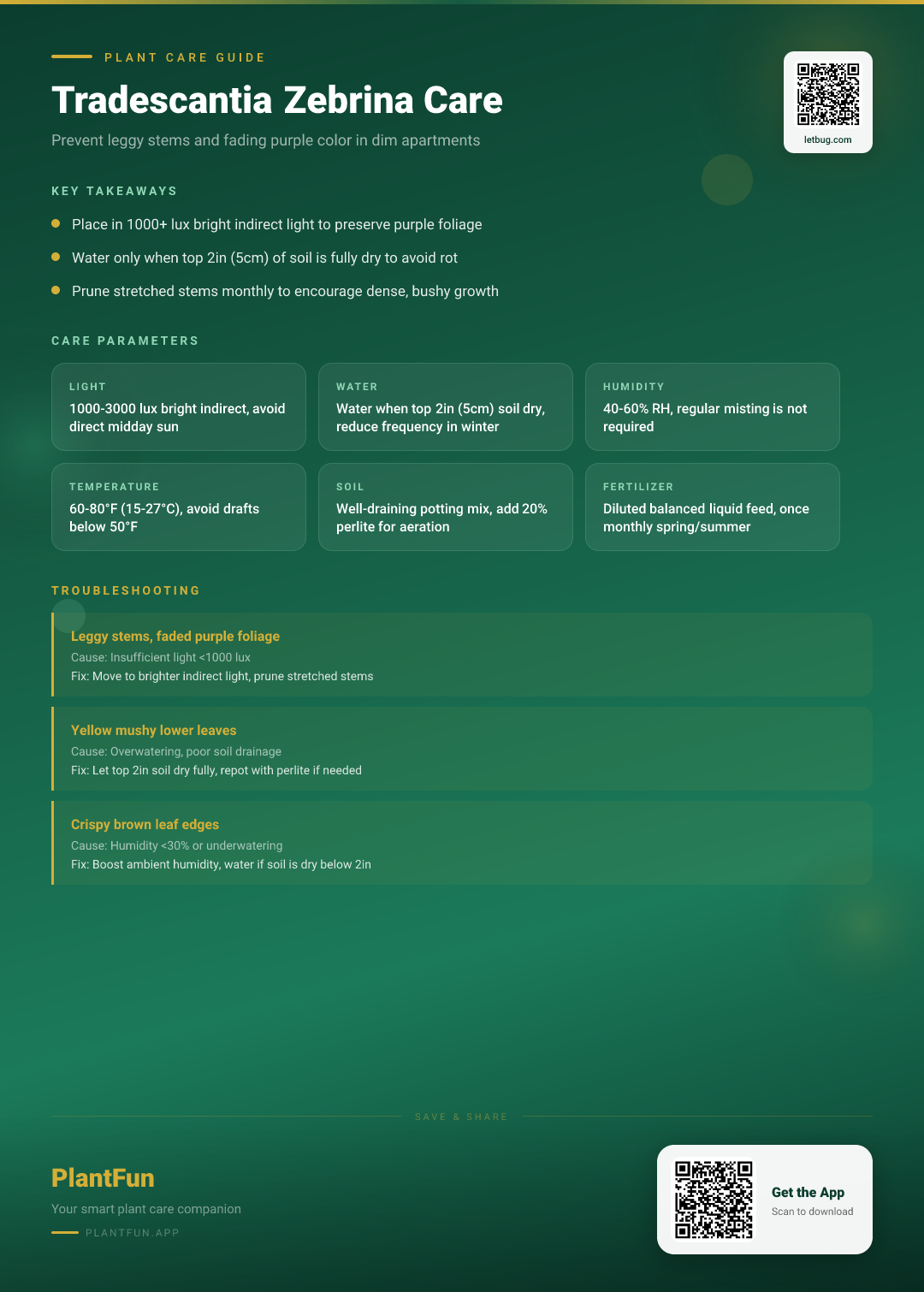
Key Takeaways
- Check soil moisture before watering — overwatering is the #1 killer of houseplants.
- Ensure your plant gets the right amount of light for its species.
- Be patient with recovery — most plants need 2–4 weeks to bounce back.
Quick Care Card: The Essential Specs for Tradescantia Resiliency
| Feature | Requirement |
|---|---|
| Light | Bright indirect (10,000–15,000 lux) |
| Water | Every 7–10 days; top 2 inches dry |
| Humidity | 40–50% |
| Temperature | 65–75°F (18–24°C) |
| Soil | Well-draining peat-based mix |
| Fertilizer | Balanced liquid, monthly in summer |
| Toxicity | Toxic to cats and dogs (ASPCA, 2026) |
TL;DR: Why Your Tradescantia is Getting ‘Leggy’ and Faded
If your Tradescantia zebrina is reaching for the sun with long, bare stems and losing its signature purple hue, it is starving for light. In apartment settings, these plants often fail because light intensity falls below 1,000 lux, triggering etiolation—a survival response where the plant stretches its stems to reach a light source. To fix this, move the plant to a brighter location, prune the leggy growth, and establish a strict watering cadence once the top 2 inches of soil are dry.
My Experience: The “Leggy” Lesson
When I first brought home my Tradescantia zebrina, I placed it in a dim corner of my living room, assuming its reputation as an easy-care plant meant it would tolerate low light. Within weeks, the beautiful, compact foliage had stretched out, and the stunning purple stripes faded to a dull, washed-out green. I realized then that my “low light” was actually a starvation zone. By moving it to a spot with consistent, bright indirect light and learning to prune, I transformed that lanky mess into a lush, overflowing display.
Understanding Your Apartment’s Light: Why 500-1,000 Lux Isn’t Enough
Plants rely on light energy for photosynthesis. In many apartments, ambient light levels hover around 500–1,000 lux, which is insufficient for the high-energy requirements of Tradescantia. To thrive, these plants need 10,000–15,000 lux (NC State Extension, 2026). If you cannot provide a south-facing window, consider a dedicated grow light to sustain the plant’s structural integrity.
The Watering Math: Why Top-Soil Dryness at 2 Inches (5cm) Matters
Overwatering is the fastest way to kill a Tradescantia. Because these plants store water in their succulent-like stems, they are susceptible to root rot if left in saturated media. I always use the “two-finger test”: stick your finger 2 inches (5cm) into the soil. If it is still damp, walk away. When you do water, ensure the excess drains completely to prevent the root system from suffocating.
Step-by-Step: Pruning and Propagating for a Bushier Aesthetic
- Identify the stem: Look for nodes (the bumps where leaves emerge) on your leggy stems.
- Make the cut: Using sterilized scissors, snip the stem about 1/4 inch above a healthy node.
- Prepare the cutting: Remove the lower leaves to expose the node.
- Propagate: Place the stem in a glass of water or directly into moist potting mix. Roots typically form within 7–10 days.
- Replant: Once roots are 1-2 inches long, plant the cuttings back into the mother pot to create a fuller, bushier look.
Myth-Busting: Should You Mist Your Tradescantia for Humidity?
Common advice suggests misting your plant to increase humidity. In my experience, this does nothing to change the ambient microclimate and can actually invite fungal issues on the foliage. Instead, if your home is very dry (below 40% humidity), use a pebble tray or a humidifier to maintain a steady 40–50% range.
Seasonal Care Calendar: Adjusting for Winter vs. Summer Growth
- Spring/Summer: This is the primary growing season. Increase water frequency and apply a balanced houseplant fertilizer once a month.
- Fall/Winter: Growth slows significantly. Reduce watering frequency to prevent root rot and hold off on all fertilizer until the days lengthen in spring.
Can I save a leggy Tradescantia just by moving it to a window?
Symptom: The plant is tall, stretched, and sparse.
Likely cause: Insufficient light levels (etiolation).
Fix:
- Move the plant to a spot with brighter, indirect light.
- Prune the long, leggy stems back to encourage new, compact growth from the base.
Why is my Tradescantia losing its purple color in my bedroom?
Symptom: Foliage is fading to green.
Likely cause: Light deprivation (pigmentation requires high light intensity).
Fix:
- Shift the plant closer to a window that receives bright indirect sunlight.
- If color does not return, consider a supplemental full-spectrum LED grow light.
How do I know if I am underwatering my Tradescantia?
Symptom: Leaves are curling or wilting despite dry soil.
Likely cause: Dehydration of the vascular system.
Fix:
- Perform the finger-depth test to confirm soil dryness.
- Provide a thorough soak, ensuring water reaches the entire root ball, then drain the saucer.
Common Mistakes: Avoiding the ‘Drowning’ Trap in Poor Light
- Mistake: Watering on a fixed schedule (e.g., every Monday).
- What happens: You may overwater when the plant is not actively growing or has not dried out.
- Instead: Water only when the top 2 inches (5cm) of soil are dry.
- Mistake: Using dense, heavy garden soil.
- What happens: The roots stay wet for too long, leading to rot.
- Instead: Use a high-quality, well-draining peat-based potting mix (NC State Extension, 2026).
References: Botanical Standards for Commelinaceae Indoor Cultivation
- Pizzolato, T. (2006). Procambial Initiation for the Vascular System in the Shoot of Tradescantia zebrina (Commelinaceae). International Journal of Plant Sciences. https://doi.org/10.1086/497842. Accessed 2026-03-11.
- Korn, R. (2008). Quantitative Analysis of the Cross Veins of Tradescantia zebrina hort. ex Bosse (Commelinaceae). International Journal of Plant Sciences. https://doi.org/10.1086/589696. Accessed 2026-03-11.
- ASPCA. (2026). Toxic and Non-Toxic Plants List — ASPCA. https://www.aspca.org/pet-care/animal-poison-control/toxic-and-non-toxic-plants. Accessed 2026-03-11.
- NC State Extension. (2026). Tradescantia Zebrina — NC State Extension Gardener Plant Toolbox. https://plants.ces.ncsu.edu/plants/tradescantia-zebrina/. Accessed 2026-03-11.
Optional Helper: Plantfun.App
Plantfun.App identifies your plants by photo, diagnoses pests and diseases with clear fixes, and creates personalised watering and light schedules that adapt to your home conditions — a handy companion for putting this guide into daily practice.
Found an error or have suggestions? We'd love your feedback.
Need help identifying this problem?
Get instant identification, personalized care schedules, and effective pest treatment plans directly on your phone.
Sponsored • We may earn a commission from app downloads
Related Guides
Tradescantia Zebrina in Apartment Low-Light: The Complete Guide to Preventing Leggy Stems
Tired of your Tradescantia Zebrina getting leggy? Master 4 specific care thresholds, lighting hacks, and a pruning schedule that keeps your plant lush and vibrant.
Care GuideTradescantia Zebrina in Low-Light Apartments: The Budget-Friendly Guide to Lush, Resilient Growth
Transform your leggy Tradescantia zebrina into a dense, vibrant masterpiece. Master 4 specific light and water thresholds to ensure year-round growth on a budget.
Care GuideTradescantia Zebrina in a Low-Light Apartment: The Complete 4-Season Maintenance Routine
Transform your leggy Tradescantia into a lush, purple-striped masterpiece. Get exact watering volumes, seasonal pruning schedules, and 4 essential care habits today.
Pest ControlAnts on Plants: What They Mean and What to Do
Ants usually aren't eating your plant. They are farming other pests.