
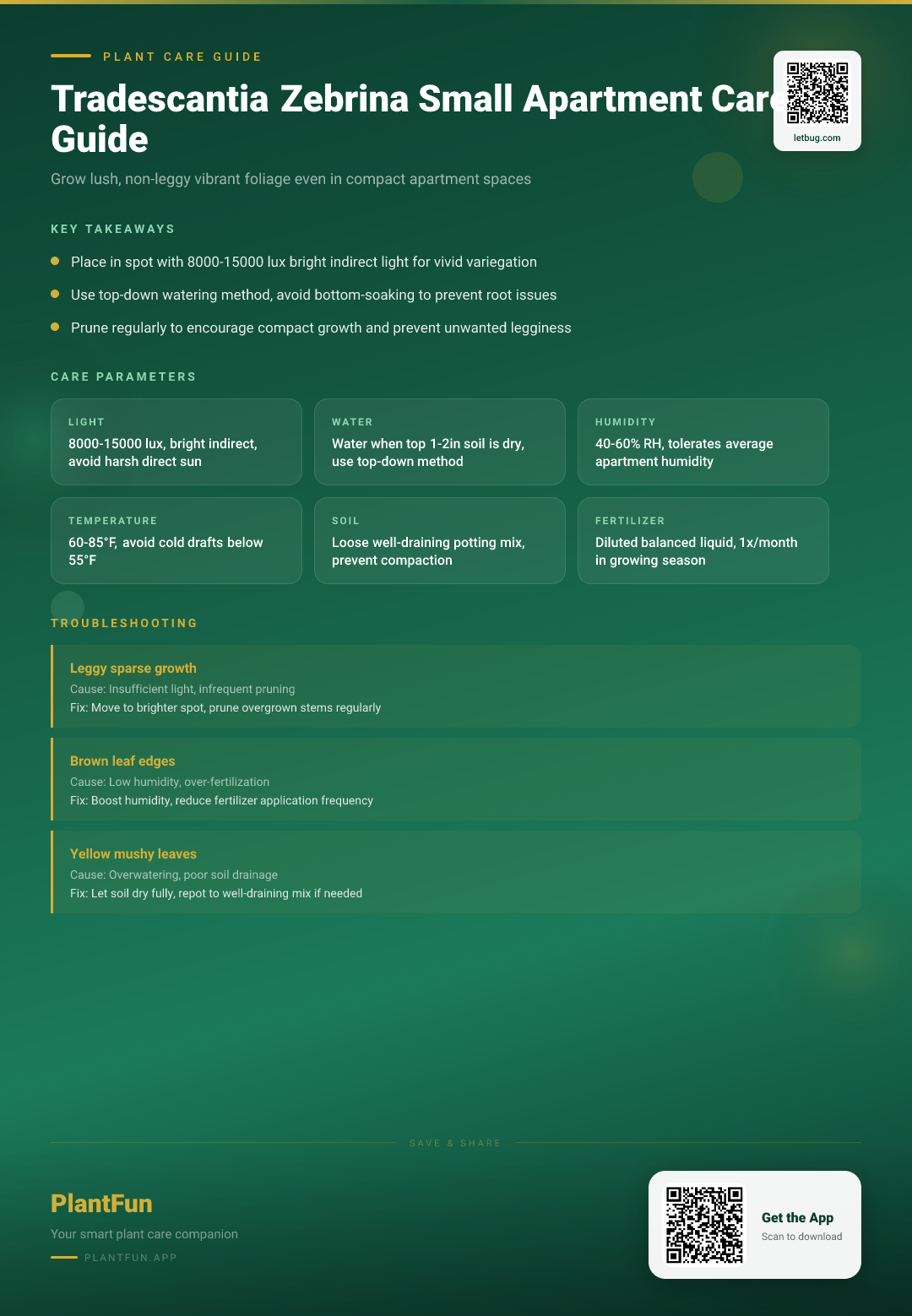
Key Takeaways
- Check soil moisture before watering — overwatering is the #1 killer of houseplants.
- Ensure your plant gets the right amount of light for its species.
- Be patient with recovery — most plants need 2–4 weeks to bounce back.
TL;DR: To stop your Tradescantia zebrina from becoming leggy in a small apartment, provide 8,000–15,000 lux of bright, indirect light and prune stems back by 30% every few months to encourage lateral branching. Always water from the top, allowing the top two inches of soil to dry out, and prioritize airflow to prevent fungal issues.
Quick Care Card: Essential Thresholds for Tradescantia Zebrina
| Feature | Requirement |
|---|---|
| Light | 8,000–15,000 lux (Bright, indirect) |
| Water | Top-down; dry top 2 inches |
| Humidity | 40%–60% (Moderate) |
| Temperature | 65°F–80°F (18°C–27°C) |
| Soil | Well-draining peat-based mix |
| Fertilizer | Balanced liquid, monthly in spring/summer |
| Toxicity | Toxic to cats and dogs (ASPCA, 2026) |
My Experience: The “Leggy” Struggle
When I first brought home my Tradescantia zebrina, I tucked it into a dark corner of my studio apartment, thinking it would be a low-light hero. Within a month, the beautiful purple stripes faded, and the stems stretched out to look like spindly, unhappy wires. I learned the hard way that this plant doesn’t want to hide; it wants to participate in your space. By shifting it to my brightest windowsill and adopting a ruthless pruning schedule, I transformed that sad specimen into the overflowing, bushy centerpiece I have today.
Why Tradescantia Zebrina Struggles in Small Apartment Microclimates
In small apartments, airflow is often stagnant, and light is frequently obstructed by neighboring buildings. Because Tradescantia zebrina has specific vascular patterns (Pizzolato, 2006) and cross-vein structures (Korn, 2008), it reacts aggressively to these limitations by stretching toward the nearest light source. This leads to the “leggy” look where leaves are spaced inches apart, and the plant eventually loses its structural integrity.
Understanding the Light Requirement: Achieving 8,000-15,000 Lux Indoors
Light is the most significant factor for growth. If you aren’t sure how much light your plant is getting, you can use a basic light meter app to aim for 8,000–15,000 lux. In a small apartment, place the pot directly on a south or east-facing windowsill. If your window is obstructed, you may need a small LED grow light placed within 12 inches of the foliage to maintain that vibrant purple hue.
The Watering Science: Why Top-Down Hydration Beats Bottom-Soaking for This Species
Many owners suggest bottom-soaking, but for Tradescantia, top-down watering is superior. It flushes out accumulated salts and ensures the upper layer of soil doesn’t stay perpetually damp, which is a major cause of stem rot.
- The Finger Test: Insert your index finger two inches into the soil. If it feels moist, wait. If it feels dry, irrigate until water flows from the drainage holes (NC State Extension, 2026).
Step-by-Step Pruning Strategy for Compact, Non-Leggy Growth
Pruning is the secret to a bushy plant.
- Identify the leggy stems: Look for long sections with large gaps between leaves.
- Make the cut: Snip the stem just above a node (where the leaf meets the stem). This forces the plant to send out two new shoots from that point.
- Sanitize: Always clean your shears with rubbing alcohol before moving to the next stem to prevent pathogen spread.
- Repeat: Do this every 6–8 weeks to keep the plant compact and full.
Can I keep my Tradescantia in a windowless bathroom? (Voice Search FAQ)
No. Even with high humidity, Tradescantia will die without adequate light. It requires bright, indirect light to survive. If you have no windows, you must use a dedicated grow light on a 12-hour timer.
Why is my Tradescantia turning brown at the edges?
Symptom: Leaf tips are turning crispy or brown.
Likely cause: Low humidity or inconsistent watering.
Fix:
- Check your watering frequency; ensure you aren’t letting it go completely bone-dry for too long.
- Increase ambient humidity by grouping plants or using a pebble tray nearby.
Seasonal Care Calendar: Adjusting Humidity and Water from Winter to Summer
- Spring/Summer: Growth is active. Increase water frequency and apply a balanced fertilizer once per month.
- Fall/Winter: Growth slows. Let the soil dry out significantly more between waterings to account for reduced light levels (NC State Extension, 2026).
Common Apartment Mistakes: Soil Compaction and Improper Airflow
- Mistake: Using dense, heavy potting soil.
- What happens: The roots suffocate and rot.
- Instead: Mix your potting soil with perlite at a 3:1 ratio for better aeration.
When and How to Propagate Your Cuttings to Fill Out Your Pot
Don’t discard your trimmings! Place 3-inch stem cuttings in a jar of water. Once roots are one inch long (usually 10–14 days), tuck them back into the main pot to fill in sparse patches. This is the fastest way to make your Tradescantia display look fuller.
References
- Korn, R. (2008). Quantitative Analysis of the Cross Veins of Tradescantia zebrina hort. ex Bosse (Commelinaceae). International Journal of Plant Sciences. https://doi.org/10.1086/589696. Accessed 2026-03-12.
- Pizzolato, T. (2006). Procambial Initiation for the Vascular System in the Shoot of Tradescantia zebrina (Commelinaceae). International Journal of Plant Sciences. https://doi.org/10.1086/497842. Accessed 2026-03-12.
- ASPCA. (2026). Toxic and Non-Toxic Plants List — ASPCA. https://www.aspca.org/pet-care/animal-poison-control/toxic-and-non-toxic-plants. Accessed 2026-03-12.
- NC State Extension. (2026). Tradescantia Zebrina — NC State Extension Gardener Plant Toolbox. https://plants.ces.ncsu.edu/plants/tradescantia-zebrina/. Accessed 2026-03-12.
Optional Helper: Plantfun.App
Plantfun.App identifies your plants by photo, diagnoses pests and diseases with clear fixes, and creates personalised watering and light schedules that adapt to your home conditions — a handy companion for putting this guide into daily practice.
Found an error or have suggestions? We'd love your feedback.
Need help identifying this problem?
Get instant identification, personalized care schedules, and effective pest treatment plans directly on your phone.
Sponsored • We may earn a commission from app downloads
Related Guides
Tradescantia Zebrina in Apartment Low-Light: The Complete Guide to Preventing Leggy Stems
Tired of your Tradescantia Zebrina getting leggy? Master 4 specific care thresholds, lighting hacks, and a pruning schedule that keeps your plant lush and vibrant.
Care GuideTradescantia Zebrina in a Low-Light Apartment: The Complete Resilience Care Guide
Transform your leggy Tradescantia Zebrina into a lush, vibrant display. Get exact lux requirements, pruning schedules, and 4 secret tips for apartment success.
Care GuideThe Complete Tradescantia Zebrina Care Checklist for Thriving Growth in Typical Urban Apartments
Get a free printable Tradescantia zebrina care checklist with exact light, water, and humidity thresholds to keep your wandering dude lush and trailing even in small urban apartments.
Pest ControlAnts on Plants: What They Mean and What to Do
Ants usually aren't eating your plant. They are farming other pests.