
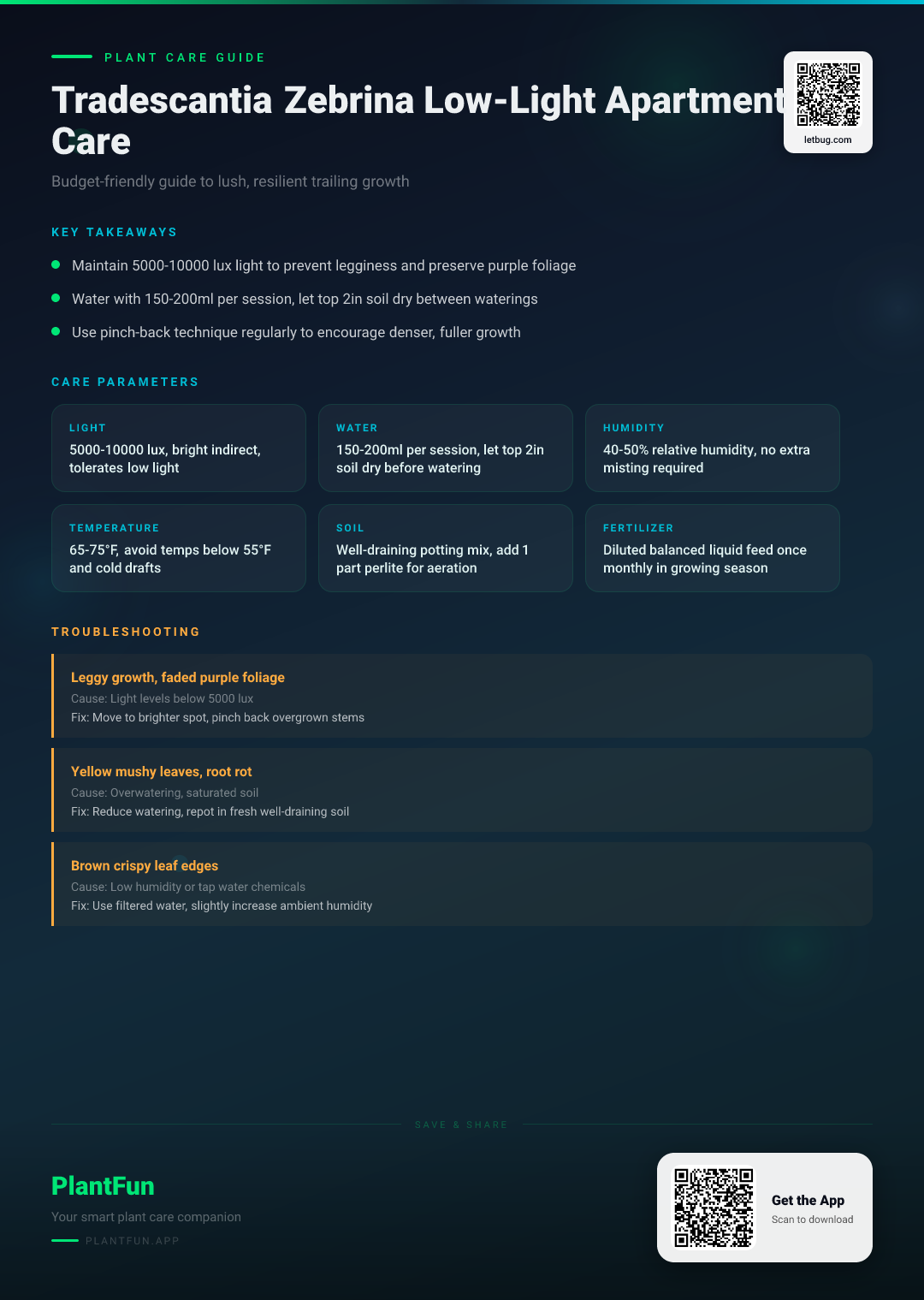
Key Takeaways
- Check soil moisture before watering — overwatering is the #1 killer of houseplants.
- Ensure your plant gets the right amount of light for its species.
- Be patient with recovery — most plants need 2–4 weeks to bounce back.
Quick Care Card: Essential Thresholds for Apartment Success
| Feature | Requirement |
|---|---|
| Light | 5,000–10,000 Lux (Bright, indirect) |
| Water | 150ml–200ml per week (Soil-dependent) |
| Humidity | 40%–50% |
| Temperature | 65°F–75°F (18°C–24°C) |
| Soil | Well-draining peat-based mix |
| Fertilizer | Minimal; balanced liquid feed monthly |
| Toxicity | Toxic to cats and dogs (ASPCA, 2026) |
TL;DR: Why Your Tradescantia Needs Less Than You Think
Tradescantia zebrina is a master of adaptation, not a diva. You don’t need expensive grow lights or specialized fertilizers to keep it thriving in a small apartment. By controlling light intensity and watering volumes, you can force this plant to stay compact and colorful. It grows fast, handles pruning like a champ, and survives on basic care—provided you avoid the common trap of over-watering.
My Experience: Learning the Hard Way
When I first brought home my Tradescantia zebrina, I assumed it needed a “drench and drain” approach. I flooded the pot every weekend, kept it in a corner that never saw the sun, and wondered why it looked like a stringy, green mess. It took me a full season of experimentation to realize this plant is modular; it relies on its stem nodes to sprout new growth. Once I started pinching the tips and rationing water, the foliage density skyrocketed. It taught me that in apartment gardening, restraint is often your best tool.
Understanding the Habitat: How Tradescantia Adapts to Low-Light Homes
In its natural environment, Tradescantia zebrina is a trailing plant that creeps along the forest floor. The internal architecture of its shoots, including its vascular system, is designed for efficient nutrient transport (Pizzolato, 2006). Its cross-vein patterns help it maintain stability even when light availability fluctuates (Korn, 2008). In your home, this means the plant will naturally “stretch” (become leggy) if it thinks it needs to find more sun. Understanding this growth cycle helps you manipulate the plant’s shape through manual pruning rather than relying on chemical growth regulators.
Measuring Light: How to Hit the 5,000–10,000 Lux Sweet Spot
Low light doesn’t mean no light. To keep your Tradescantia vibrant, aim for a position where it receives at least 5,000 lux. You can measure this easily with free smartphone light meter apps. If your apartment is consistently dim, place the plant within 1–2 feet of a window. Avoid direct, harsh afternoon sun, which can scorch the delicate leaves (NC State Extension, 2026).
The Budget Watering Protocol: Using 150ml-200ml for Consistent Hydration
In small apartments, airflow is often lower than in greenhouses, making soil stay wet longer. Instead of watering until it runs out the bottom, start with 150ml to 200ml of water.
- Use a measuring cup to ensure consistency.
- Apply water directly to the soil, avoiding the crown of the plant to prevent rot.
- Wait until the top 1-2 inches of soil are dry before repeating (check by sticking your finger into the pot).
Managing Humidity & Temperature: Staying in the 40-50% and 65-75°F Range
Your Tradescantia prefers average room conditions. If your apartment drops below 40% humidity (common in winter with heaters), the leaf tips may turn brown. Keep the plant away from drafty windows or direct air conditioning vents to maintain a steady 65°F–75°F range.
Step-by-Step: The ‘Pinch-Back’ Technique for Fuller Growth
To make your plant look full rather than sparse:
- Identify the node: Locate a point on the stem where a leaf meets the stem.
- Pinch: Use your fingers or clean scissors to cut just 1/4 inch above the node.
- Repeat: Do this to every long stem every 4–6 weeks.
- Propagate: Take the cuttings, strip the bottom leaves, and place the stems in water. They will root within a week, allowing you to fill in bald spots in your original pot.
Troubleshooting Guide
Leggy Stems and Fading Color
Symptom: Stems are long with large gaps between leaves, and the purple hue is turning green.
Likely cause: Insufficient light intensity (NC State Extension, 2026).
Fix:
- Move the plant to a brighter window.
- Prune back the leggy stems to force new, compact growth at the base.
Mushy, Brown Stems
Symptom: Base of the stems feels soft and looks dark/discolored.
Likely cause: Over-watering leading to root rot.
Fix:
- Stop watering immediately and check if the pot has drainage holes.
- Remove the plant from the soil, trim away black/mushy roots, and repot in fresh, well-draining soil.
Frequently Asked Questions
1. How often should I water my Tradescantia in a small apartment? Generally, once every 7–10 days is sufficient. Always verify by checking that the top inch of soil is dry, as apartment temperatures and humidity vary.
2. Can I use tap water for my Tradescantia or does it need distilled? Tap water is usually fine. However, if your tap water is heavily chlorinated, let it sit out in an open container for 24 hours before using it.
3. Is Tradescantia zebrina safe for my pets? According to the ASPCA (2026), this plant is considered toxic to cats and dogs. Keep it in a hanging planter or out of reach.
Seasonal Care Calendar: Adjusting for Winter Dimness vs. Summer Growth
- Spring/Summer: Growth is active. Increase water frequency slightly and prune monthly.
- Autumn/Winter: Growth slows significantly. Reduce water by 25% and ensure the plant is in the brightest spot possible to compensate for shorter days.
Common Mistakes: Avoiding Root Rot and Over-Fertilization
- Mistake: Using a pot without drainage holes. What happens: Water pools at the bottom, suffocating roots. Instead: Use a plastic nursery pot inside a decorative cover pot.
- Mistake: Feeding every time you water. What happens: Salt buildup, which causes yellowing leaves. Instead: Fertilize once a month during the growing season at half-strength.
References
- Pizzolato, T. (2006). Procambial Initiation for the Vascular System in the Shoot of Tradescantia zebrina (Commelinaceae). International Journal of Plant Sciences. https://doi.org/10.1086/497842. Accessed 2026-03-10.
- Korn, R. (2008). Quantitative Analysis of the Cross Veins of Tradescantia zebrina hort. ex Bosse (Commelinaceae). International Journal of Plant Sciences. https://doi.org/10.1086/589696. Accessed 2026-03-10.
- ASPCA. (2026). Toxic and Non-Toxic Plants List — ASPCA. https://www.aspca.org/pet-care/animal-poison-control/toxic-and-non-toxic-plants. Accessed 2026-03-10.
- NC State Extension. (2026). Tradescantia Zebrina — NC State Extension Gardener Plant Toolbox. https://plants.ces.ncsu.edu/plants/tradescantia-zebrina/. Accessed 2026-03-10.
Optional Helper: Plantfun.App
Plantfun.App identifies your plants by photo, diagnoses pests and diseases with clear fixes, and creates personalised watering and light schedules that adapt to your home conditions — a handy companion for putting this guide into daily practice.
Found an error or have suggestions? We'd love your feedback.
Need help identifying this problem?
Get instant identification, personalized care schedules, and effective pest treatment plans directly on your phone.
Sponsored • We may earn a commission from app downloads
Related Guides
Tradescantia Zebrina in Apartment Low-Light: The Complete Guide to Preventing Leggy Stems
Tired of your Tradescantia Zebrina getting leggy? Master 4 specific care thresholds, lighting hacks, and a pruning schedule that keeps your plant lush and vibrant.
Care GuideTradescantia Zebrina in a Low-Light Apartment: The Complete 4-Season Maintenance Routine
Transform your leggy Tradescantia into a lush, purple-striped masterpiece. Get exact watering volumes, seasonal pruning schedules, and 4 essential care habits today.
Care GuideThe Complete Tradescantia Fluminensis Care Checklist for Lush, Resilient Growth in Standard Apartments
Get your Tradescantia thriving even in low-humidity apartments. Follow our 11-point care checklist with exact light, water, and soil thresholds for full, trailing growth all year.
Pest ControlAnts on Plants: What They Mean and What to Do
Ants usually aren't eating your plant. They are farming other pests.