
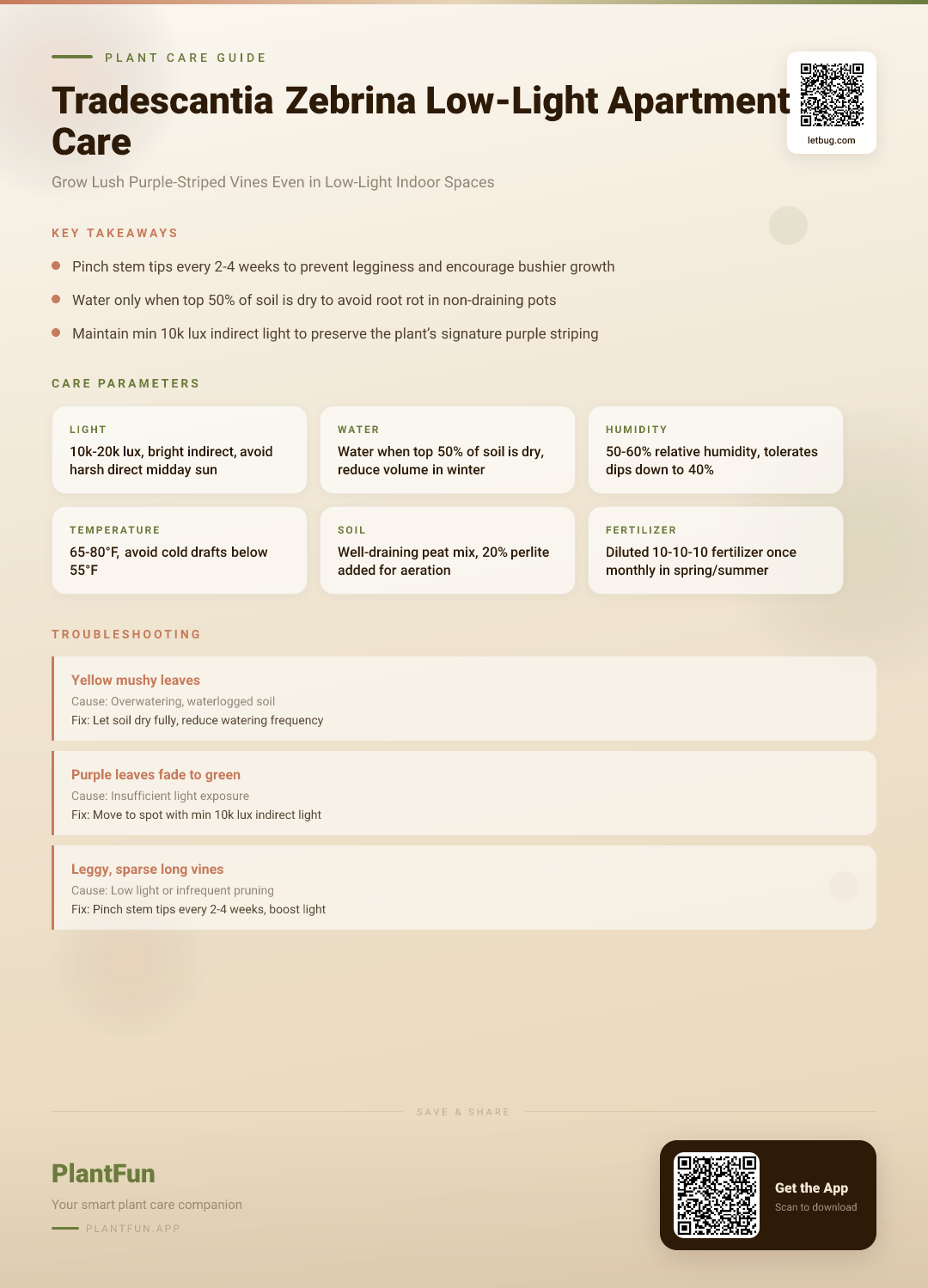
Key Takeaways
- Check soil moisture before watering — overwatering is the #1 killer of houseplants.
- Ensure your plant gets the right amount of light for its species.
- Be patient with recovery — most plants need 2–4 weeks to bounce back.
TL;DR: The Quick Fix
To keep your Tradescantia zebrina compact and vibrant in an apartment, prioritize high-intensity light (10,000+ lux). Stop the “leggy” look by pinching back stems every 4–6 weeks and only water when the top 50% of the soil is dry to the touch. If the purple fades, the plant is signaling an immediate need for more direct light exposure.
My Experience
When I first brought home my first Tradescantia zebrina, I placed it on a bookshelf six feet away from a north-facing window. Within three weeks, the stems stretched out, losing their signature silver-and-purple zebra stripes, leaving only pale green, spindly vines. I learned the hard way that this plant doesn’t just tolerate light—it demands it. Through constant experimentation with my living room layout, I found that the “pinch-and-rotate” method is the only way to maintain a full, lush appearance in an urban apartment setting.
Quick Care Card: Snapshot of Thresholds
| Category | Requirement |
|---|---|
| Light | 10k–20k lux (Bright, indirect) |
| Water | 50% soil dry-down |
| Humidity | 50–60% |
| Temperature | 65–80°F |
| Soil | Well-draining peat-based mix |
| Fertilizer | Balanced liquid 10-10-10 (monthly) |
| Toxicity | Toxic to cats and dogs (ASPCA, 2026) |
Why Tradescantia Zebrina Struggles in Apartment Light
In an apartment, low light forces the plant to prioritize upward growth over leaf density. Scientifically, the plant uses internode elongation—stretching the stem between leaf nodes—to “search” for higher light levels (Pizzolato, 2006). This process, driven by auxin hormones, results in those sparse, stringy vines. Furthermore, the vibrant purple anthocyanins (pigments) that give the plant its characteristic color are light-dependent; in low light, the plant prioritizes chlorophyll production to maximize light absorption, causing the purple to fade to a dull, solid green (Korn, 2008).
The 10,000 Lux Threshold
Most standard apartments provide 2,000–5,000 lux in a living room, which is insufficient for Tradescantia. You need at least 10,000 lux for healthy internode development (NC State Extension, 2026).
How to measure: Download a free light-meter app on your smartphone and hold it at leaf-level during mid-day. If you are consistently below 10,000 lux, move the plant to a windowsill or supplement with a dedicated LED grow light.
Step-by-Step Seasonal Care Calendar
- Spring (March-May): Growth acceleration. Increase watering frequency as temperatures rise. Pinch back any “winter-leggy” tips to force side-shoot branching.
- Summer (June-August): Peak demand. Water thoroughly when 50% of the soil is dry. Feed every 4 weeks with a diluted balanced fertilizer.
- Autumn (September-November): Slow down. Reduce water as the light intensity drops. Stop fertilizing by late October.
- Winter (December-February): Dormancy management. Reduce water significantly—only when 75% of the soil is dry. Ensure it stays at least 65°F to prevent leaf drop (NC State Extension, 2026).
The Art of the Pinch
Never be afraid to cut your plant. To prevent stringiness, use clean, sharp shears or your fingernails to remove the top 1–2 inches of every stem. This “pinching” removes the terminal bud (the source of apical dominance), forcing the plant to redirect energy into lateral buds, which creates a fuller, bushier profile.
Watering Mastery
If you use a decorative pot without drainage, you are playing a dangerous game. To avoid root rot:
- Use a plastic nursery pot inside the decorative container.
- Remove the nursery pot during watering to allow excess water to drain completely in the sink.
- Wait until the top 2 inches of soil feel bone-dry before re-potting back into the decorative sleeve.
Common Mistakes: Troubleshooting
Overwatering
Symptom: Yellow, mushy leaves at the base of the stems.
Likely cause: Trapped moisture in the root zone.
Fix:
- Withhold water for 10 days.
- Check for root rot (dark, slimy roots); if present, trim back and repot in fresh, dry soil.
Underwatering
Symptom: Crispy, brown leaf edges and wilting stems.
Likely cause: Soil has stayed dry for too long.
Fix:
- Submerge the entire pot in a bowl of water for 20 minutes (bottom watering).
- Increase water frequency by one day per cycle.
FAQ
1. Why is my Tradescantia losing its purple color and turning green? It is almost certainly a light deficit. The purple pigments require higher intensity light to maintain their expression. Move the plant to a brighter location (closer to a window) to restore the coloration (Korn, 2008).
2. How often should I water my Tradescantia in an apartment setting? Do not follow a calendar. Use the “finger test”: stick your finger 2 inches into the soil. If it feels moist, wait. If it feels dry, water until it leaks from the bottom. In winter, this might be once every 14 days; in summer, every 5-7 days.
3. Can I keep my Tradescantia in a bathroom with no windows? No. While they enjoy the humidity, they cannot survive without adequate light. Even if your bathroom is humid, the lack of 10,000+ lux light will eventually cause the plant to perish (NC State Extension, 2026).
Long-term Propagation
If your plant becomes unsalvageable, propagate! Take 4-inch cuttings, strip the bottom leaves, and place the stems in water. In two weeks, you will have roots. Group 5-10 cuttings in a single pot to instantly create a fuller, bushier display than the original “leggy” plant.
References
- Pizzolato, T. (2006). Procambial Initiation for the Vascular System in the Shoot of Tradescantia zebrina (Commelinaceae). International Journal of Plant Sciences. https://doi.org/10.1086/497842. Accessed 2026-03-13.
- Korn, R. (2008). Quantitative Analysis of the Cross Veins of Tradescantia zebrina hort. ex Bosse (Commelinaceae). International Journal of Plant Sciences. https://doi.org/10.1086/589696. Accessed 2026-03-13.
- ASPCA. (2026). Toxic and Non-Toxic Plants List — ASPCA. https://www.aspca.org/pet-care/animal-poison-control/toxic-and-non-toxic-plants. Accessed 2026-03-13.
- NC State Extension. (2026). Tradescantia Zebrina — NC State Extension Gardener Plant Toolbox. https://plants.ces.ncsu.edu/plants/tradescantia-zebrina/. Accessed 2026-03-13.
Optional Helper: Plantfun.App
Plantfun.App identifies your plants by photo, diagnoses pests and diseases with clear fixes, and creates personalised watering and light schedules that adapt to your home conditions — a handy companion for putting this guide into daily practice.
Found an error or have suggestions? We'd love your feedback.
Need help identifying this problem?
Get instant identification, personalized care schedules, and effective pest treatment plans directly on your phone.
Sponsored • We may earn a commission from app downloads
Related Guides
Tradescantia Zebrina in Low-Light Apartments: The Budget-Friendly Guide to Lush, Resilient Growth
Transform your leggy Tradescantia zebrina into a dense, vibrant masterpiece. Master 4 specific light and water thresholds to ensure year-round growth on a budget.
Care GuideTradescantia Zebrina in a Low-Light Apartment: The Complete Resilience Care Guide
Transform your leggy Tradescantia Zebrina into a lush, vibrant display. Get exact lux requirements, pruning schedules, and 4 secret tips for apartment success.
Care GuideThe Complete Tradescantia Fluminensis Care Checklist for Lush, Resilient Growth in Standard Apartments
Get your Tradescantia thriving even in low-humidity apartments. Follow our 11-point care checklist with exact light, water, and soil thresholds for full, trailing growth all year.
Pest ControlAnts on Plants: What They Mean and What to Do
Ants usually aren't eating your plant. They are farming other pests.