
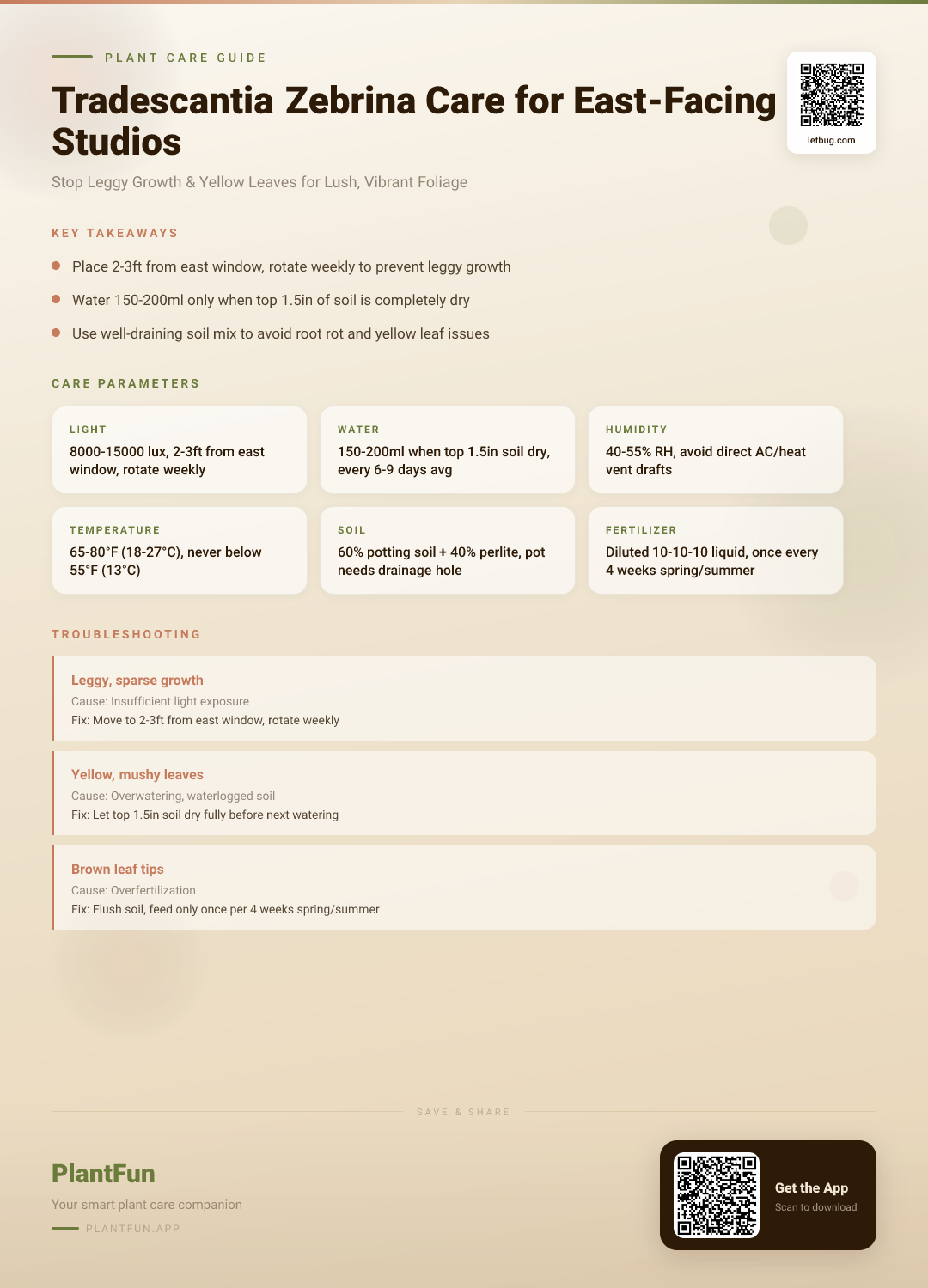
Key Takeaways
- Check soil moisture before watering — overwatering is the #1 killer of houseplants.
- Ensure your plant gets the right amount of light for its species.
- Be patient with recovery — most plants need 2–4 weeks to bounce back.
Quick Care Card
| Parameter | Exact Threshold for East-Facing Studios |
|---|---|
| Light | 8,000-15,000 lux, 2-3ft from east window, 180-degree rotation weekly |
| Water | 150-200ml room-temperature filtered water when top 1.5in of soil is dry (every 6-9 days average) |
| Humidity | 40-55% relative humidity |
| Temperature | 65-80°F (18-27°C), no lower than 55°F (13°C) |
| Soil | 60% general potting soil + 40% perlite, pot with 1+ drainage hole |
| Fertilizer | Half-strength 10-10-10 liquid, every 4 weeks spring/summer only |
| Toxicity | Mildly toxic to cats, dogs, and humans if ingested (ASPCA, 2026) |
Why This Checklist Is Exclusively Tailored For East-Facing Studios
Generic Tradescantia care advice is often calibrated for bright indirect all-day light and 50%+ humidity, which rarely matches the conditions of small urban east-facing studio apartments. These spaces typically get 2-3 hours of soft morning sun, followed by partial shade for the rest of the day, baseline 30-40% humidity from running AC/heat, and fluctuating temperatures from rental HVAC systems.
Myth vs Reality: Myth: Tradescantia needs 6+ hours of direct sun daily to thrive. Reality: A 2008 study of Tradescantia zebrina leaf structure confirms its characteristic silver stripes reflect excess light, making it perfectly adapted to the partial morning sun of east-facing windows (Korn, 2008). Quick test: Hold your hand at the plant’s placement at 10am — a soft, fuzzy shadow means light levels are ideal. This checklist eliminates guesswork for Tradescantia care for apartments, so you don’t waste time troubleshooting preventable issues.
Step 1: Light Placement for Full, Non-Leggy Growth
Tradescantia zebrina requires 8,000-15,000 lux of light to maintain full, bushy growth and vibrant striped foliage (PlantwisePlus Knowledge Bank, 2022). For east-facing studios, place your plant 2-3 feet directly in front of the east window to hit this range. Rotate the pot 180 degrees once weekly to ensure even growth on all sides and prevent lopsided trailing.
Common mistake & fix: If your plant is placed 4+ feet from the window, light levels drop below 5,000 lux, leading to leggy growth with large gaps between leaves. To fix, move the plant to 2ft from the window and pinch 1 inch off the top of each leggy stem to encourage branching. If leaves develop brown crispy edges on the sun-facing side, move the plant to 3ft from the window to avoid mild scorch on hot summer mornings. This is the fastest Tradescantia zebrina leggy growth fix for apartment setups.
Step 2: Exact Watering Schedule for Apartment Conditions
To avoid the top Tradescantia zebrina yellow leaves cause (overwatering), water with 150-200ml of room-temperature filtered water only when the top 1.5 inches of soil are completely dry (NC State Extension, 2026). Quick test: Stick your index finger 1.5 inches into the soil — if it feels completely dry, it’s time to water. In typical east-facing studios, this works out to every 6-9 days on average.
Common mistakes & fixes:
- Overwatering on a fixed schedule: If leaves are yellow, mushy, and falling from the base of the plant, stop watering immediately and let the soil dry completely for 2 weeks. If roots are black and mushy when you remove the pot, repot in fresh dry soil.
- Underwatering: If leaves are curling, drooping, and crispy at the edges, give the plant 200ml of water, wait 10 minutes, then pour out any excess water collected in the saucer. Adjust for Tradescantia zebrina summer watering (every 6 days) and winter watering (every 9-12 days) as temperatures shift.
Step 3: Humidity & Temperature Thresholds
Tradescantia humidity requirements are lower than most tropical houseplants, making them ideal for apartment living, but they still perform best at 40-55% relative humidity, with temperatures between 65-80°F (18-27°C), never dropping below 55°F (13°C) (PlantwisePlus Knowledge Bank, 2022).
Common mistake & fix: Placing your plant within 1 foot of AC or heat vents exposes it to dry, fluctuating drafts that cause leaf drop and brown tips. Move the plant to a spot 3+ feet away from vents, and set it on a pebble tray filled with water to boost local humidity by 5-10% without a humidifier.
Step 4: Soil & Potting Best Practices
Use a Tradescantia soil mix for apartments made of 60% general potting soil + 40% perlite to ensure fast drainage, since low air flow in small studios causes soil to dry slower than in larger homes. Always use a pot with at least 1 drainage hole to prevent water from pooling at the bottom of the pot (NC State Extension, 2026).
Common mistake & fix: Using heavy garden soil or potting mix with added water-retention crystals keeps soil wet for 10+ days, leading to root rot before you notice yellow leaves. If you used this type of mix, repot immediately in the 60/40 soil-perlite blend, trimming any black, mushy roots with clean scissors before placing in the new soil.
Step 5: Fertilizing Routine for Consistent Growth
Follow a low-frequency Tradescantia fertilizer schedule: feed with half-strength 10-10-10 liquid fertilizer once every 4 weeks in spring and summer only. Skip fertilizing completely in fall and winter when growth slows down.
Common mistake & fix: Overfertilizing (either too strong a dose or too frequent application) causes brown leaf tips and salt buildup in the soil. To fix, leach the soil by running 3x the pot’s volume of water through the soil to flush out excess salts, then skip fertilizing for 8 weeks.
Seasonal Care Calendar for East-Facing Studios
Adjust your care routine throughout the year to match shifting apartment conditions:
- Winter (Dec-Feb): Reduce watering to every 9-12 days for Tradescantia zebrina winter care, move the plant 6 inches further from the window if glass panes get cold (to avoid temperatures below 55°F), and stop fertilizing completely.
- Spring (Mar-May): Resume fertilizing every 4 weeks, check soil moisture every 5 days as temperatures rise, and rotate weekly to capture increasing morning sun.
- Summer (Jun-Aug): Check humidity twice weekly, add a pebble tray if humidity drops below 40%, and move the plant 6 inches back from the window if morning sun is hot enough to cause leaf scorch.
- Fall (Sep-Nov): Gradually reduce watering frequency, stop fertilizing at the end of October, and move the plant away from drafty window sills as nighttime temperatures drop.
7 Common Tradescantia Zebrina Mistakes (And Fast Fixes)
- Mistake: Placing your plant 5+ feet from the east window. What happens: Light levels drop below 5,000 lux, leading to leggy growth with faded stripes. Instead: Move to 2-3ft from the window, pinch back leggy stems to encourage bushy growth (this is how to fix leggy Tradescantia in 24 hours).
- Mistake: Watering every week on a fixed schedule without checking soil moisture. What happens: Overwatering leads to yellow mushy leaves and root rot, the number one answer to “why is my Tradescantia zebrina turning yellow”. Instead: Stick your finger 1.5 inches into soil, only water when that layer is completely dry.
- Mistake: Using unamended potting soil with no perlite. What happens: Soil stays wet for 10+ days, rotting roots before you notice visible symptoms. Instead: Use the 60/40 potting soil + perlite mix for fast drainage.
- Mistake: Fertilizing year-round. What happens: Salt buildup burns leaf tips and stunts new growth. Instead: Only fertilize in spring and summer, at half the recommended package strength.
- Mistake: Leaving your plant next to a running AC or heat vent. What happens: Dry drafts cause leaf curl, brown tips, and rapid leaf drop. Instead: Move to a spot 3ft away from vents, add a pebble tray to boost local humidity.
- Mistake: Never rotating your plant. What happens: One side grows full and vibrant, the other is sparse and lopsided. Instead: Rotate 180 degrees once a week when you check soil moisture.
- Mistake: Ignoring tiny webbing on leaf undersides. What happens: Spider mite infestations spread fast, causing widespread leaf yellowing and drop. Instead: Wipe leaves with a damp cloth weekly, spray with diluted neem oil if you see webbing.
If you’re wondering “can Tradescantia grow in low light apartments”, the answer is no — if your studio has no east window or only artificial light below 8,000 lux, this plant will not thrive long-term.
Easy 2-Minute Propagation Tip for Overgrown Plants
Overgrown or leggy Tradescantia zebrina is easy to propagate to fill in bare spots in your existing pot, perfect for small apartment hanging displays:
- Use clean sharp scissors to snip 4-inch stem cuttings from the end of overgrown stems, making sure each cutting has at least 3 leaf nodes (small bumps where leaves attach to the stem).
- Remove the bottom 2 leaves from each cutting, leaving the top 2-3 leaves intact.
- Place cuttings in a small jar of room-temperature filtered water, making sure the bare nodes are submerged and leaves stay above water.
- Place the jar 2ft from your east window, change water every 3 days. Roots will grow in 7-10 days, then you can plant the cuttings back in the original pot to create a fuller, bushier plant.
Voice Search FAQ
Why is my Tradescantia zebrina getting leggy?
The most common cause is light levels below 8,000 lux, usually from placing the plant too far from your east-facing window (NC State Extension, 2026). Move it to 2-3ft from the window, then pinch 1 inch off the top of each leggy stem to encourage new bushy growth.
Can I keep my Tradescantia in my east-facing studio window?
Absolutely! East-facing windows provide exactly the soft 2-3 hours of morning sun and partial afternoon shade that Tradescantia zebrina prefers, making it perfect for Tradescantia east-facing window care. Just keep it 2-3ft from the glass to avoid leaf scorch on extra hot summer mornings.
How often should I water my Tradescantia in an apartment?
In a typical east-facing studio, water every 6-9 days, using 150-200ml of room-temperature water, only when the top 1.5 inches of soil are completely dry (PlantwisePlus Knowledge Bank, 2022). Adjust for season: every 6 days in summer, every 9-12 days in winter when growth slows.
Troubleshooting Quick Reference Chart
| Symptom | Root Cause | Fast Fix |
|---|---|---|
| Leggy stems with large gaps between leaves | Light levels below 8,000 lux (too far from window) | Move to 2-3ft from east window, pinch 1 inch off top of leggy stems |
| Yellow mushy lower leaves | Overwatering, waterlogged soil | Let soil dry completely for 2 weeks, repot in 60/40 soil/perlite mix if roots are mushy |
| Brown crispy leaf tips | Low humidity, drafty vents, or overfertilization | Move 3ft from vents, add pebble tray, leach soil if you’ve fertilized more than every 4 weeks |
| Faded purple/silver leaf stripes | Too little light or too much direct sun | Adjust placement to 2-3ft from east window, rotate weekly |
| Curling, drooping leaves | Underwatering | Give 200ml of water, drain excess from saucer after 10 minutes |
| Tiny webbing on leaf undersides, yellow spotted leaves | Spider mite infestation | Wipe leaves with damp cloth, spray with diluted neem oil once a week for 3 weeks |
References
- NC State Extension. (2026). Tradescantia Zebrina Care Checklist — NC State Extension Gardener Plant Toolbox. https://plants.ces.ncsu.edu/plants/tradescantia-zebrina/. Accessed 2026-03-02.
- PlantwisePlus Knowledge Bank. (2022). Tradescantia zebrina (wandering jew). https://doi.org/10.1079/pwkb.species.110354. Accessed 2026-03-02.
- Korn, R. (2008). Quantitative Analysis of the Cross Veins of Tradescantia zebrina hort. ex Bosse (Commelinaceae). International Journal of Plant Sciences. https://doi.org/10.1086/589696. Accessed 2026-03-02.
- ASPCA. (2026). Toxic and Non-Toxic Plants List — ASPCA. https://www.aspca.org/pet-care/animal-poison-control/toxic-and-non-toxic-plants. Accessed 2026-03-02.
Optional Helper: Plantfun.App
Plantfun.App identifies your plants by photo, diagnoses pests and diseases with clear fixes, and creates personalised watering and light schedules that adapt to your home conditions — a handy companion for putting this guide into daily practice.
Found an error or have suggestions? We'd love your feedback.
Need help identifying this problem?
Get instant identification, personalized care schedules, and effective pest treatment plans directly on your phone.
Sponsored • We may earn a commission from app downloads
Related Guides
The Complete Tradescantia Care Checklist for Lush, Resilient Growth in Small Urban Apartments
Grow full, vibrant Tradescantia in your small urban apartment with our seasonal care checklist, including exact light, water, and humidity thresholds to prevent leggy growth and yellow leaves.
Care GuideThe Complete Tradescantia Zebrina Care Guide for Small East-Facing Apartments: 6 Tips for Lush Resilient Growth
Grow lush, resilient Tradescantia zebrina even in a tiny east-facing apartment. Get exact light, water, and humidity thresholds plus 4 space-saving hacks to keep vines neat and vibrant.
Care GuideThe Budget Tradescantia Zebrina Care Checklist for Resilient Growth in Small Urban Apartments
Grab this zero-cost care checklist to grow full, trailing Tradescantia zebrina in your small apartment, with exact light, water, and humidity thresholds that require no fancy specialty supplies.
Pest ControlAnts on Plants: What They Mean and What to Do
Ants usually aren't eating your plant. They are farming other pests.