
Key Takeaways
- Check soil moisture before watering — overwatering is the #1 killer of houseplants.
- Ensure your plant gets the right amount of light for its species.
- Be patient with recovery — most plants need 2–4 weeks to bounce back.
TL;DR: The Ionantha Survival Protocol
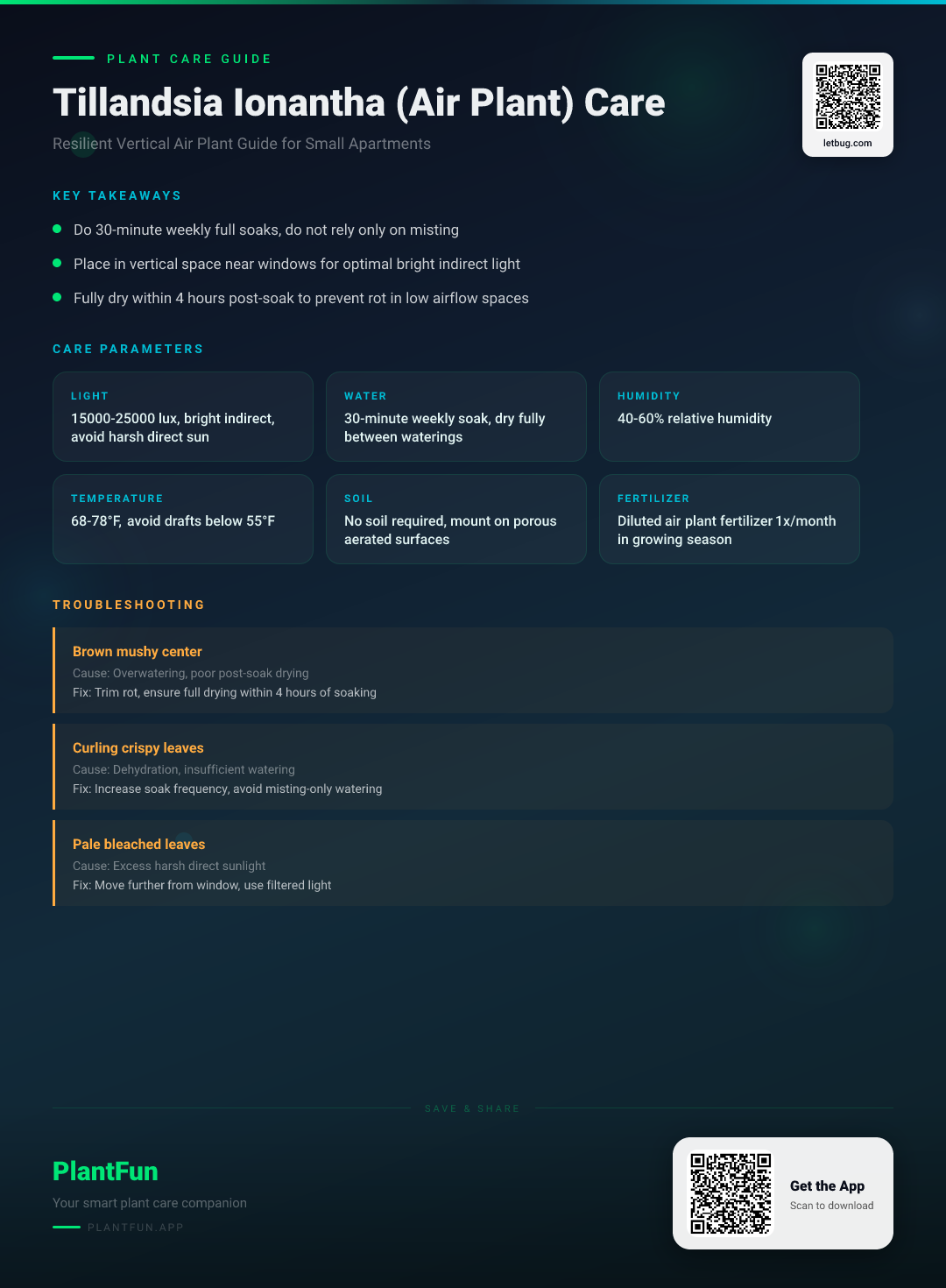
To keep your Tillandsia Ionantha thriving in a small apartment, move beyond the ‘mist-and-forget’ myth. Provide 15,000–25,000 lux of bright, indirect light, soak for 30 minutes weekly, and ensure the plant is completely dry within four hours. Airflow is your best defense against rot; avoid stagnant corners and always mount your plants vertically.
Quick Care Card: Essential Thresholds
| Feature | Requirement |
|---|---|
| Light | 15,000–25,000 lux (bright, indirect) |
| Water | 30-minute soak weekly |
| Humidity | 40–60% |
| Temperature | 68°F–78°F |
| Substrate | None (Epiphytic) |
| Fertilizer | Bromeliad-specific (low nitrogen) monthly |
| Toxicity | Non-toxic to cats and dogs (ASPCA, 2026) |
Why Your Apartment is a Different Habitat
When I first started collecting Tillandsia, I made the common mistake of treating them like bathroom decorations. In a typical modern apartment, air is often stagnant due to central heating or high-efficiency windows that prevent cross-ventilation. Because these plants are epiphytes—meaning they anchor to other surfaces rather than soil (NC State Extension, 2026)—they rely entirely on their trichomes to absorb moisture. In a low-airflow apartment, water becomes trapped between the leaves, leading to bacterial decay long before the plant can metabolize the moisture.
Format A: The Complete Scenario Guide - Introduction to Tillandsia Ionantha
Tillandsia Ionantha is a powerhouse of the air plant world, famous for its blush-red blooming cycle. However, its dense leaf structure makes it uniquely vulnerable to crown rot. Unlike larger Tillandsia species, the Ionantha packs its leaves tightly, creating a natural basin that acts like a moisture trap.
Step 1: Mastering the Soaking Technique (The ‘Dry-to-Core’ Protocol)
Many beginners rely on misting, which is insufficient for long-term health (Nowak & Martin, 1997). Follow this protocol:
- Submerge: Place your Tillandsia in a bowl of room-temperature, dechlorinated water for exactly 30 minutes.
- The Shake: After removing, gently shake the plant upside down over the sink to dislodge excess water trapped in the base.
- The Drying Rack: Place the plant on a towel in a high-airflow area for at least 3–4 hours. Never return a damp plant to its display vessel.
Step 2: Maximizing Light in Compact Spaces
Since floor space is premium in apartments, go vertical. Mount your Ionantha on magnetic strips, wire grids, or cork boards at eye level. Aim for 15,000–25,000 lux. If you are unsure, use a light meter app; if the plant is more than 3 feet from a south-facing window, it is likely light-starved.
Seasonal Care Calendar: Adjusting for Winter Heating vs. Summer AC
- Winter: Heating systems lower indoor humidity drastically. Increase soak time by 10 minutes, but ensure the plant is away from direct radiator heat.
- Summer: AC creates artificial drought. Monitor for browning tips—a sign of water deficit (Nowak & Martin, 1997).
Common Mistakes: Why Spraying is Never Enough and Why Gravity Matters
- Mistake: Misting as a sole water source.
- What happens: The plant receives insufficient hydration for metabolic processes.
- Instead: Commit to a weekly soak.
- Mistake: Placing plants upright in a bowl.
- What happens: Water pools in the core, causing rot.
- Instead: Always display them upside down or at an angle so water drains via gravity.
Voice FAQ
Why is the center of my Air Plant turning brown and mushy? This is a classic sign of rot caused by stagnant water. It often occurs when the plant is returned to its display before the core is completely dry.
Can I grow my Tillandsia in a windowless bathroom with high humidity? No. Even with high humidity, Tillandsia requires significant light (15,000–25,000 lux) to survive (NC State Extension, 2026). Humidity without light leads to weak, spindly growth.
Advanced Care: Fertilizer Ratios
To encourage blooms, use a water-soluble Bromeliad fertilizer diluted to 1/4 strength once a month during the growing season. High-nitrogen fertilizers can burn these delicate plants.
Troubleshooting Guide
Dehydration
Symptom: Leaves curling inward tightly and tips turning crispy/brown.
Likely cause: Insufficient hydration or extremely low ambient humidity.
Fix:
- Increase soak duration to 45 minutes.
- Move the plant away from AC vents or heaters.
Crown Rot
Symptom: Leaves at the base turning dark brown, mushy, or pulling away from the stem easily.
Likely cause: Water trapped in the rosette due to poor airflow.
Fix:
- Remove mushy leaves using sterilized scissors.
- Increase airflow around the plant significantly.
References
- ASPCA. (2026). Toxic and Non-Toxic Plants List — ASPCA. https://www.aspca.org/pet-care/animal-poison-control/toxic-and-non-toxic-plants. Accessed 2026-03-12.
- NC State Extension. (2026). Tillandsia Ionantha — NC State Extension Gardener Plant Toolbox. https://plants.ces.ncsu.edu/plants/ionantha-care/. Accessed 2026-03-12.
- Nowak, E.; Martin, C. (1997). Physiological and Anatomical Responses to Water Deficits in the Cam Epiphyte Tillandsia ionantha (Bromeliaceae). International Journal of Plant Sciences. https://doi.org/10.1086/297495. Accessed 2026-03-12.
- Vázquez-Flores, X.; Valdez-Hernández, E.; Mata-Alejandro, H. (2025). Topographic tetrazolium test in seeds of Tillandsia ionantha Planch. Agro Productividad. https://doi.org/10.32854/bf7wd502. Accessed 2026-03-12.
Optional Helper: Plantfun.App
Plantfun.App identifies your plants by photo, diagnoses pests and diseases with clear fixes, and creates personalised watering and light schedules that adapt to your home conditions — a handy companion for putting this guide into daily practice.
Found an error or have suggestions? We'd love your feedback.
Need help identifying this problem?
Get instant identification, personalized care schedules, and effective pest treatment plans directly on your phone.
Sponsored • We may earn a commission from app downloads
Related Guides
Tillandsia Ionantha Care for Dim Apartment Living: The Ultimate Low-Budget Survival Plan
Revive your wilting air plant with this budget-friendly care plan. Master the 20-minute soak method and 3 essential light adjustments to keep your Tillandsia lush.
Care GuideTillandsia Ionantha Care: A Budget-Friendly Guide for Resilient Growth in Modern Apartments
Master air plant care with this budget-friendly guide. Learn the exact soak-to-mist ratio for resilient, vibrant Tillandsia ionantha in your own apartment.
Care GuideTillandsia Ionantha Care for Dim Apartments: The Complete Rescue and Growth Guide
Revive your struggling air plant with our expert soak-and-dry method. Learn the exact humidity levels and light requirements to keep Tillandsia ionantha thriving.
Pest ControlAnts on Plants: What They Mean and What to Do
Ants usually aren't eating your plant. They are farming other pests.