
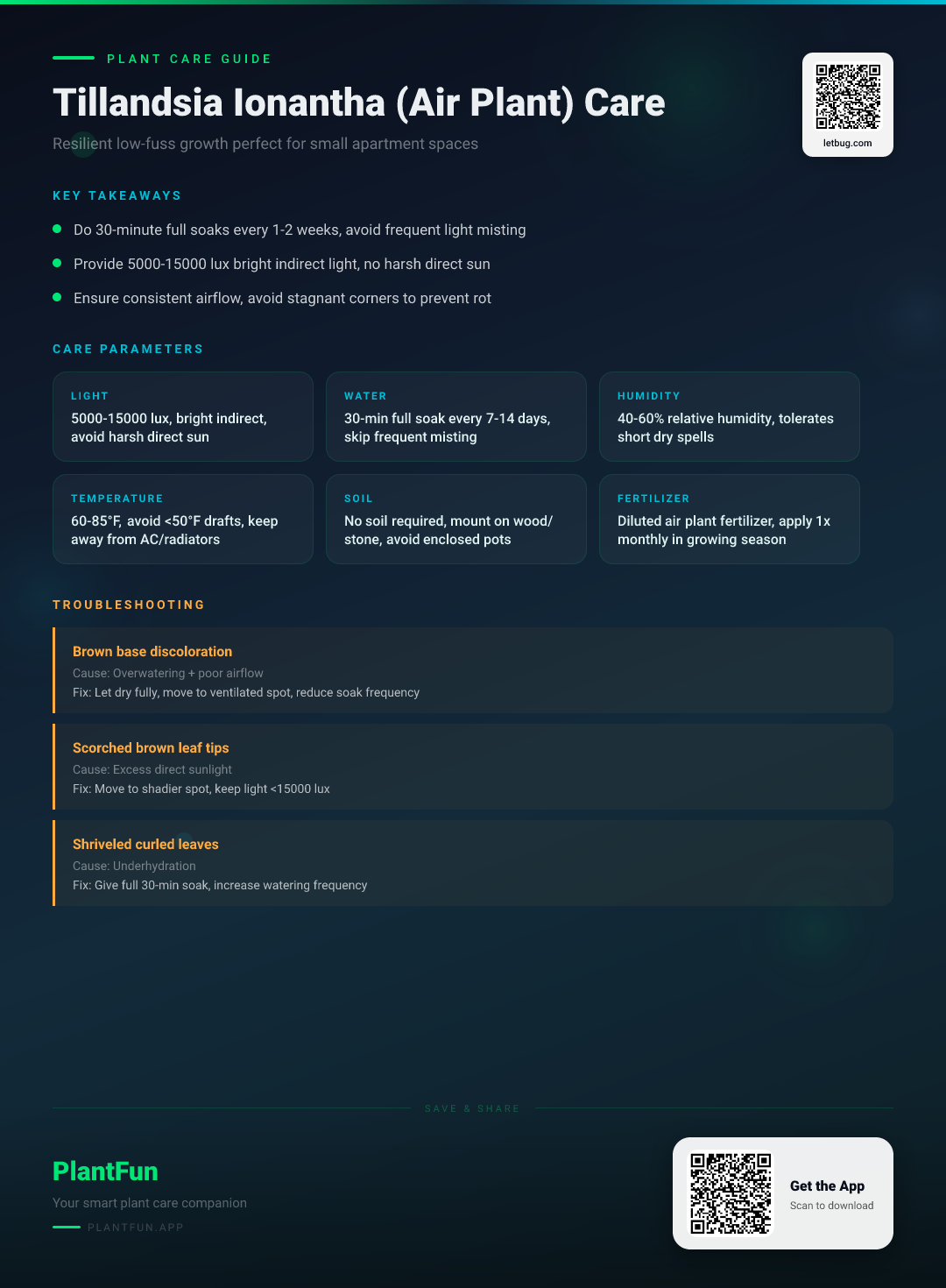
Key Takeaways
- Check soil moisture before watering — overwatering is the #1 killer of houseplants.
- Ensure your plant gets the right amount of light for its species.
- Be patient with recovery — most plants need 2–4 weeks to bounce back.
TL;DR: Stop treating your Tillandsia ionantha like a neglected decoration. To thrive in a small apartment, these epiphytes need bright, filtered light (5,000–15,000 lux), a 30-minute soak once a week, and vigorous airflow to prevent base rot. They are non-toxic to pets, making them the ultimate sculptural accent for tight, climate-controlled living spaces.
Quick Care Card: Essential Data for Ionantha Success
| Feature | Requirement |
|---|---|
| Light | 5,000–15,000 Lux (Bright, indirect) |
| Watering | 30-minute soak weekly |
| Humidity | 40–60% Relative Humidity |
| Temperature | 60°F–80°F (15°C–27°C) |
| Fertilizer | Bromeliad-specific (low nitrogen), monthly |
| Toxicity | Non-toxic to cats and dogs (ASPCA, 2026) |
Why Small Apartments Are Secretly Perfect for Tillandsia Ionantha
When I first started collecting Tillandsia, I assumed they were ‘set and forget’ plants. My mistake was placing them in a dark bathroom with zero ventilation, leading to rapid rot. I learned the hard way that while these plants are hardy, they demand a specific micro-climate. Small apartments are actually ideal because you can easily control the ambient humidity and proximity to windows, provided you prioritize the relationship between water and airflow.
Understanding Your Plant: The Biology of Epiphytic Absorption
Unlike traditional potted plants, Tillandsia ionantha are epiphytes, meaning they grow on surfaces rather than in soil. They possess specialized scale-like structures called trichomes on their leaves, which act like a sponge to absorb moisture and nutrients directly from the air (Nowak & Martin, 1997). Understanding this is critical: they don’t “drink” through their base, but rather through their entire leaf surface.
Light Requirements: Achieving 5,000-15,000 Lux Without Scorching
In a city apartment, finding the right light level can be a puzzle. These plants require consistent, bright, indirect light (NC State Extension, 2026). If you don’t have a light meter, a simple test is to hold your hand 12 inches from the plant; if it casts a soft, blurry shadow, the light is likely perfect. Anything stronger, like direct midday sun, can burn the leaves.
Hydration Strategy: Mastering the 30-Minute Soak vs. The Mist Myth
Forget the myth that misting is enough. In the dry, heated air of a high-rise, misting evaporates too quickly to provide meaningful hydration.
- Fill a basin with filtered or room-temperature water.
- Submerge your ionantha completely for 30 minutes.
- Remove and shake off excess water.
- Place upside down on a towel for 1–2 hours to ensure the base is completely dry.
Airflow Optimization: Preventing Rot in Stagnant Corner Spaces
Because they lack a root system in soil, water trapped in the central rosette is the primary killer of air plants (NC State Extension, 2026). In stagnant apartment corners, you must manually introduce airflow. I use a small USB desk fan on low for one hour after watering to ensure the leaf crevices are dry.
Temperature & Humidity: Keeping 40-60% Relative Humidity in Dry Air
While they can tolerate fluctuations, keeping your space between 40-60% relative humidity prevents the tips from browning (Nowak & Martin, 1997). If your apartment is particularly dry, a humidifier near your display is more effective than daily misting.
Seasonal Care Calendar: Adapting Routines for Winter Radiators vs Summer AC
- Winter: Radiator heat dries the air. Increase soaking frequency to every 5-7 days and monitor for signs of dehydration.
- Summer: Air conditioning mimics a desert environment. Ensure your plants are not directly in the path of cold air, which can stress the plant.
Common Mistakes to Avoid
- Mistake: Using copper wire for mounting. What happens: Copper is toxic to bromeliads. Instead: Use aluminum wire or nylon fishing line.
- Mistake: Storing upright after watering. What happens: Water pools at the base, causing rot. Instead: Dry them upside down for at least two hours.
FAQ
Can I keep my air plant in a bedroom with no natural sunlight?
No. Like all plants, they require light for photosynthesis. If your bedroom is dark, consider an LED grow light set to an 8-10 hour cycle to keep the plant alive.
Why is my Tillandsia ionantha turning brown at the base?
This is a classic sign of rot due to trapped water (NC State Extension, 2026). It often happens if the plant stays wet for too long after a soak. Ensure you are drying your plants thoroughly before returning them to their display.
How do I know if my air plant is getting enough water?
Look for “cupping” or curling leaves. If the leaves are curling inward more than usual, the plant is dehydrated and requires a longer soak.
Advanced Care: Forcing Blooms and Supporting ‘Pups’ in Limited Space
When a Tillandsia ionantha reaches maturity, it will blush vibrant red/pink and produce a violet flower. Once the bloom fades, the parent plant will produce “pups” (offsets) at the base. Leave these attached! They thrive on the parent’s energy. Eventually, you can divide them to double your collection without needing more space.
References
- ASPCA. (2026). Toxic and Non-Toxic Plants List — ASPCA. https://www.aspca.org/pet-care/animal-poison-control/toxic-and-non-toxic-plants. Accessed 2026-03-18.
- NC State Extension. (2026). Tillandsia Ionantha — NC State Extension Gardener Plant Toolbox. https://plants.ces.ncsu.edu/plants/tillandsia-ionantha/. Accessed 2026-03-18.
- Nowak, E.; Martin, C. (1997). Physiological and Anatomical Responses to Water Deficits in the Cam Epiphyte Tillandsia ionantha (Bromeliaceae). International Journal of Plant Sciences. https://doi.org/10.1086/297495. Accessed 2026-03-18.
- Vázquez-Flores, X.; Valdez-Hernández, E.; Mata-Alejandro, H. (2025). Topographic tetrazolium test in seeds of Tillandsia ionantha Planch. Agro Productividad. https://doi.org/10.32854/bf7wd502. Accessed 2026-03-18.
Optional Helper: Plantfun.App
Plantfun.App identifies your plants by photo, diagnoses pests and diseases with clear fixes, and creates personalised watering and light schedules that adapt to your home conditions — a handy companion for putting this guide into daily practice.
Found an error or have suggestions? We'd love your feedback.
Need help identifying this problem?
Get instant identification, personalized care schedules, and effective pest treatment plans directly on your phone.
Sponsored • We may earn a commission from app downloads
Related Guides
Tillandsia Ionantha in Small Apartments: The Ultimate Vertical Care Guide for Resilient Air Plants
Transform your small apartment into a vertical oasis with Tillandsia ionantha. Follow our 4-step hydration routine to prevent rot and maximize healthy growth.
Care GuideTillandsia Ionantha Care: A Budget-Friendly Guide for Resilient Growth in Modern Apartments
Master air plant care with this budget-friendly guide. Learn the exact soak-to-mist ratio for resilient, vibrant Tillandsia ionantha in your own apartment.
Care GuideTillandsia Ionantha Care for Dim Apartments: The Complete Rescue and Growth Guide
Revive your struggling air plant with our expert soak-and-dry method. Learn the exact humidity levels and light requirements to keep Tillandsia ionantha thriving.
Pest ControlAnts on Plants: What They Mean and What to Do
Ants usually aren't eating your plant. They are farming other pests.