
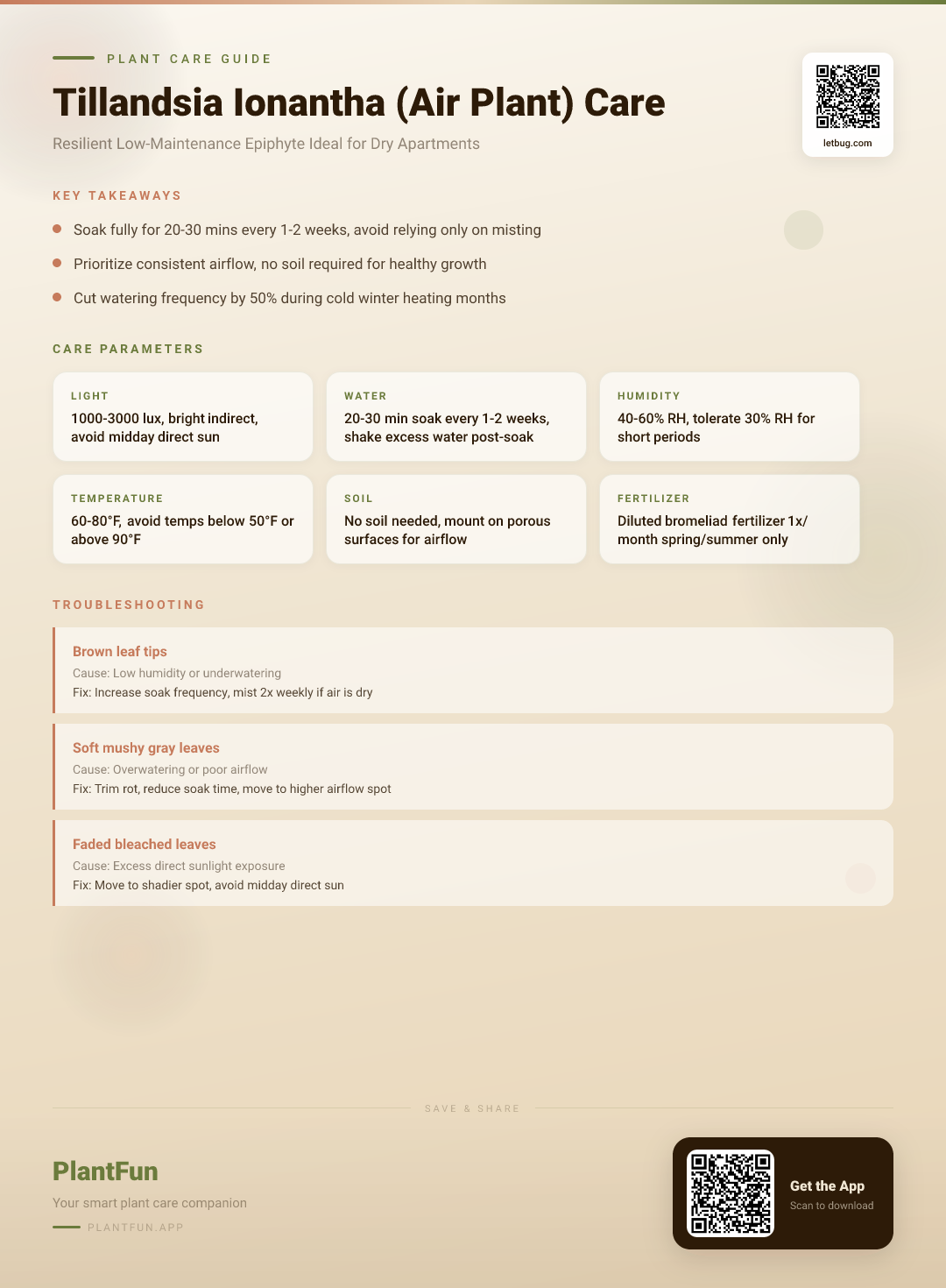
Key Takeaways
- Check soil moisture before watering — overwatering is the #1 killer of houseplants.
- Ensure your plant gets the right amount of light for its species.
- Be patient with recovery — most plants need 2–4 weeks to bounce back.
Quick Care Card: Essential Thresholds for Tillandsia Ionantha
| Feature | Requirement |
|---|---|
| Light | Bright, indirect light (e.g., east-facing window) |
| Watering | Soak for 30–60 minutes weekly |
| Humidity | 40–60% (supplemental misting in dry air) |
| Temperature | 60°F–80°F (15°C–27°C) |
| Soil | None (Epiphytic growth) |
| Fertilizer | Bromeliad-specific formula, diluted, monthly |
| Toxicity | Non-toxic to cats and dogs (ASPCA, 2026) |
TL;DR: The Truth About Air Plant Resilience in Apartments
Tillandsia Ionantha are not “unkillable” decor; they are living epiphytes that require consistent hydration and airflow. In dry apartments, misting is insufficient. To thrive, submerge your air plants in room-temperature water for 30–60 minutes once a week, then allow them to dry completely upside down to prevent rot. They need bright, indirect light and should never be left in standing water or damp, stagnant corners.
Understanding the Epiphytic Biology: Why Airflow Matters More Than Soil
When I first started collecting Tillandsia, I assumed they lived solely on “thin air.” In reality, they are specialized plants that absorb moisture and nutrients through microscopic scales on their leaves called trichomes. Because they lack a traditional root system for soil-based nutrient uptake, they rely on environmental moisture (Nowak & Martin, 1997). If you place them in a low-airflow glass terrarium, you are essentially starving the plant of the gas exchange it needs to survive. My experience has taught me that the “epiphytic” nature of these plants means they prefer to be mounted or placed in open containers where air can circulate freely around the entire foliage.
Step-by-Step Soaking Ritual: Moving Beyond Misting
Forget the spray bottle—it rarely provides enough water to penetrate the trichomes in a dry apartment. Instead, follow my systemic soaking method:
- Prepare the Bath: Use room-temperature filtered or rainwater. Avoid softened water, as the sodium content can damage the plant.
- The Soak: Place the plant in a bowl of water for 30–60 minutes. If the plant is severely dehydrated, you can extend this to two hours.
- The Shake: Remove the plant and gently shake it upside down. This dislodges water trapped in the leaf axils (the center of the plant), which is a common site for rot.
- The Dry: Place the plant on a towel in a spot with good airflow. It must dry completely within 4 hours. If it stays damp longer, move it to a brighter spot or increase air circulation.
Measurable Care Parameters: Light, Humidity, and Temperature Ranges
Tillandsia Ionantha thrives when you mirror its native habitat’s intensity without the scorching midday sun. Aim for roughly 1,000–2,000 foot-candles of light (NC State Extension, 2026). If you notice the leaves losing their vibrant green/silver color and turning pale, move them closer to your light source. Temperature-wise, keep your plants away from direct heater vents or air conditioning blasts, as these rapidly deplete leaf moisture.
The Seasonal Care Calendar: Adjusting for Winter Heating vs. Summer Air Conditioning
- Winter (Heating Season): Indoor humidity often drops below 30%. I add an extra 15 minutes to my weekly soak and place my plants further away from radiators to prevent desiccation.
- Summer (AC/Dry Season): Air conditioning strips moisture from the air. During these months, I keep a small fan nearby to ensure the plants aren’t sitting in stagnant, dry pockets.
Troubleshooting Guide: Why are my Tillandsia leaf tips turning brown?
Dehydration
Symptom: Leaf tips are curling inward and turning brown/crispy.
Likely cause: Inadequate soaking duration or low ambient humidity.
Fix:
- Increase soak time by 15–30 minutes.
- Check that your drying spot is not directly under a heat vent.
Rot
Symptom: The base of the plant turns brown or mushy and leaves fall off easily.
Likely cause: Water remained in the center of the plant for too long.
Fix:
- Carefully remove mushy leaves.
- Ensure future soaks include a thorough “shake-dry” process.
Fertilizer Burn
Symptom: Leaf tips turn brown suddenly despite regular water.
Likely cause: Fertilizer concentration was too high.
Fix:
- Flush the plant with plain water for 30 minutes.
- Dilute your fertilizer to 1/4 strength for future applications.
Light Stress
Symptom: Brown spots appearing on the leaves, usually in the center of the plant.
Likely cause: Direct, harsh sun causing sunburn.
Fix:
- Move the plant to a spot with filtered light (e.g., behind a sheer curtain).
Myth-Busting: Can I really just leave them on a shelf without water?
I once heard a vendor suggest that air plants only need to be misted once a month. This is a common myth that leads to plant death. While Tillandsia are drought-tolerant, they are not “water-free.” Without consistent hydration, the plant enters a state of permanent physiological stress, leading to the exhaustion of internal reserves (Nowak & Martin, 1997). You must learn how to water air plants properly to ensure long-term vitality.
FAQ: How do I know if my Tillandsia is actually thirsty?
A healthy Tillandsia feels firm and plump. If you notice the leaves curling tight like a straw or the plant feeling unusually lightweight when you pick it up, it is thirsty. A quick check of the leaf color—which often fades when dry—is also a great indicator.
FAQ: Can I keep my air plant in a bathroom with no windows?
No. While bathrooms provide high humidity, plants require light for photosynthesis to utilize that water. Without a window, the plant will eventually starve. You can use a dedicated grow light, but keep the plant away from shower spray to prevent rot.
Common Mistakes to Avoid: Rot, Drying, and Fertilizer Burn
- Mistake: Storing in a dark, humid bathroom. What happens: The plant receives humidity but no light to process it, leading to fungal rot. Instead: Keep them in a bright room and bring them into the bathroom only during showers for a temporary humidity boost.
- Mistake: Skipping the soak in favor of daily misting. What happens: Only the surface of the trichomes gets damp, not the deeper plant tissue. Instead: Perform a weekly deep-soak session.
References
- ASPCA. (2026). Toxic and Non-Toxic Plants List — ASPCA. https://www.aspca.org/pet-care/animal-poison-control/toxic-and-non-toxic-plants. Accessed 2026-03-19.
- NC State Extension. (2026). Tillandsia Ionantha — NC State Extension Gardener Plant Toolbox. https://plants.ces.ncsu.edu/plants/ionantha-care/. Accessed 2026-03-19.
- Nowak, E.; Martin, C. (1997). Physiological and Anatomical Responses to Water Deficits in the Cam Epiphyte Tillandsia ionantha (Bromeliaceae). International Journal of Plant Sciences. https://doi.org/10.1086/297495. Accessed 2026-03-19.
- Vázquez-Flores, X.; Valdez-Hernández, E.; Mata-Alejandro, H. (2025). Topographic tetrazolium test in seeds of Tillandsia ionantha Planch. Agro Productividad. https://doi.org/10.32854/bf7wd502. Accessed 2026-03-19.
Optional Helper: Plantfun.App
Plantfun.App identifies your plants by photo, diagnoses pests and diseases with clear fixes, and creates personalised watering and light schedules that adapt to your home conditions — a handy companion for putting this guide into daily practice.
Found an error or have suggestions? We'd love your feedback.
Need help identifying this problem?
Get instant identification, personalized care schedules, and effective pest treatment plans directly on your phone.
Sponsored • We may earn a commission from app downloads
Related Guides
Tillandsia Ionantha Care: A Budget-Friendly Guide for Resilient Growth in Modern Apartments
Master air plant care with this budget-friendly guide. Learn the exact soak-to-mist ratio for resilient, vibrant Tillandsia ionantha in your own apartment.
Care GuideTillandsia Ionantha in Small Apartments: The Ultimate Vertical Care Guide for Resilient Air Plants
Transform your small apartment into a vertical oasis with Tillandsia ionantha. Follow our 4-step hydration routine to prevent rot and maximize healthy growth.
Care GuideTillandsia Ionantha Care for Dim Apartment Living: The Ultimate Low-Budget Survival Plan
Revive your wilting air plant with this budget-friendly care plan. Master the 20-minute soak method and 3 essential light adjustments to keep your Tillandsia lush.
Pest ControlAnts on Plants: What They Mean and What to Do
Ants usually aren't eating your plant. They are farming other pests.