
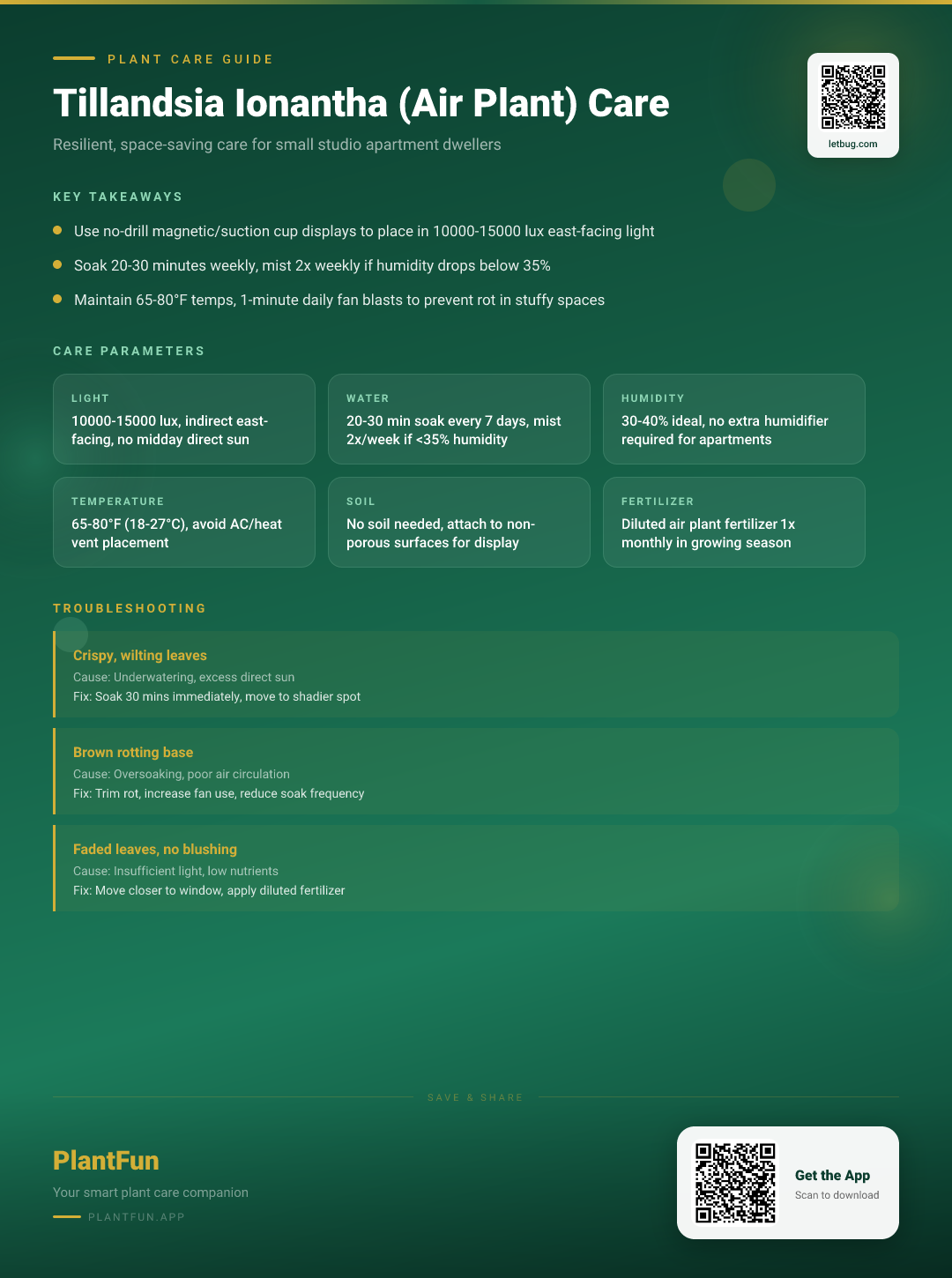
Key Takeaways
- Check soil moisture before watering — overwatering is the #1 killer of houseplants.
- Ensure your plant gets the right amount of light for its species.
- Be patient with recovery — most plants need 2–4 weeks to bounce back.
Quick Care Card
| Parameter | Exact Threshold for Studio Apartments |
|---|---|
| Light | 10,000-15,000 lux (bright indirect east-facing window light, soft shadow at 10am) (NC State Extension, 2026) |
| Water | 20-30 minute room temperature soak every 7 days; 10-second mist 2x/week if humidity <35% RH (Nowak & Martin, 1997) |
| Humidity | 30-40% (standard apartment humidity range, no humidifier required) |
| Temperature | 65-80°F (18-27°C), avoid sudden temperature swings (NC State Extension, 2026) |
| Soil | None (epiphytic, absorbs all nutrients and water through leaf trichomes) |
| Fertilizer | 1/4 strength bromeliad fertilizer added to soak water 1x/month during spring and summer growing season |
| Toxicity | Non-toxic to cats, dogs, and humans (ASPCA, 2026) |
Why This Guide Is Built For Small Studio Apartment Dwellers
Generic Tillandsia ionantha care advice is often designed for large homes with dedicated plant space, high tropical humidity, and permission to modify walls. If you’re a renter in a compact studio, you’re dealing with three unique challenges that standard guides ignore: limited counter and shelf space, no permission to drill holes for displays, and average indoor humidity of 30-40% from constant heating and cooling use. This guide cuts out all bulky, space-wasting display hacks, focuses only on renter-friendly, no-damage solutions, and is tailored to the exact environmental conditions of most small apartments. A common myth we’re debunking upfront: air plants don’t need 60%+ humidity to thrive. Tillandsia ionantha evolved to tolerate extended droughts in its native Mexican and Central American habitats (Nowak & Martin, 1997), so it adapts perfectly to standard apartment humidity with the right watering routine. It’s also non-toxic for pets and small children (ASPCA, 2026), making it an ideal low-fuss plant for cramped living spaces. If you’re looking for more small-space friendly plant options, check out our guide to the best low-maintenance studio apartment plants on LetBug.com.
Step 1: Space-Saving Display Placement That Hits Exact Light Requirements
The first rule of Tillandsia ionantha light requirements is 10,000-15,000 lux of bright indirect light, which is typically found within 2 feet of an east-facing window (NC State Extension, 2026). Quick test to confirm your spot works: Hold your hand 6 inches above the display location at 10am. If you see a soft, fuzzy shadow (not a sharp, dark shadow or no shadow at all), the light level is perfect. All of the following renter friendly air plant ideas use zero counter or shelf space, require no drilling, and won’t leave damage when you move:
- Magnetic holders: Stick to metal fridge doors, window frames, or filing cabinets within 2 feet of your east-facing window.
- Suction cup holders: Attach directly to east-facing window glass, so your plant gets unobstructed bright light without taking up surface space.
- Thin cotton string loops: Tie to existing fixtures like curtain rods, shelf edges, or cabinet handles to hang your plant at the perfect height for light exposure. This small space air plant display approach ensures you don’t waste valuable storage space on your plants, while hitting their exact light needs. For more creative no drill air plant display ideas, see our full guide to renter-friendly plant displays at LetBug.com.
Step 2: Exact Watering Routine For 30-40% Apartment Humidity
If you’ve wondered how often to water Tillandsia ionantha in a standard apartment, the answer is tailored to your 30-40% average humidity level:
- Soak your plant in room temperature distilled or rain water for 20-30 minutes once every 7 days (Nowak & Martin, 1997). Only submerge the leaves, not the very base of the plant, to avoid trapping water in the center.
- After soaking, shake the plant gently for 5 seconds to remove excess water from between the leaves, then place it upside down on a paper towel for 10 minutes to dry completely before returning it to its display. No messy trays or drainage required.
- If your apartment humidity drops below 35% (test with a $10 hygrometer), add 10-second misting sessions 2x per week to supplement the weekly soak. Myth vs reality: Misting alone is not enough to water your air plant. The tiny trichomes on Tillandsia ionantha leaves need full immersion to absorb enough water to stay healthy (Nowak & Martin, 1997), so misting is only a supplement for low humidity, not a replacement for soaking. This air plant soak time is tested specifically for apartment humidity levels, so you don’t have to worry about over or underwatering. If you struggle with low humidity in your apartment, check out our guide to easy, space-free humidity hacks at LetBug.com.
Step 3: Temperature & Air Flow Optimization For Small, Often Stuffy Apartments
The ideal temperature range for Tillandsia ionantha is 65-80°F (18-27°C) (NC State Extension, 2026), which matches the standard thermostat setting for most apartments. Follow these two simple rules to avoid temperature-related stress:
- Never place your air plant within 1 foot of AC vents, heat vents, or drafty window edges. Sudden temperature swings of more than 10°F can shock the plant and cause leaf drop.
- Run a small desk fan on low for 1 minute per day near your air plant to circulate stale, stuffy air. This prevents trapped water from causing rot, which is a common issue in cramped studios with poor natural air flow.
Weekly 5-Minute Care Checklist
This printable, bite-sized checklist is designed for busy renters who don’t have time for complex plant care routines:
- [30 sec] Light check: Confirm your plant gets a soft shadow at 10am, reposition to a brighter spot if needed.
- [1 min] Humidity check: If your hygrometer reads below 35%, give your plant a 10-second mist.
- [3 min] Weekly water day: Soak for 20-30 minutes, shake excess water, dry upside down for 10 minutes.
- [30 sec] Health check: Scan for brown tips, mushy leaves, or faded color to catch stress early. Total time: 5 minutes or less per week, perfect for anyone learning air plant care for beginners.
Seasonal Care Calendar For Apartment Dwellers
Adjust your care routine slightly for seasonal changes in apartment light and temperature to keep your plant thriving year-round:
Winter (Tillandsia ionantha winter care)
- Reduce soak frequency to every 10 days, as lower light levels slow the plant’s water use.
- Move your plant 6 inches closer to the east-facing window to compensate for shorter, dimmer winter days.
- Keep the plant at least 3 feet away from drafty window edges and space heaters.
Summer (Tillandsia summer care)
- Add 1 extra 10-second mist per week if humidity drops below 30% from running AC constantly.
- Move your plant 3 inches further away from the window if you see signs of sun scorch (brown spots on leaves) from stronger midday sun.
- Avoid leaving the plant near closed windows where temperatures can rise above 90°F on hot days. For more seasonal houseplant care tips tailored to apartment living, see our winter houseplant survival guide at LetBug.com.
Common Small-Space Care Mistakes To Avoid
These are the most frequent mistakes renters make when learning how to keep air plants alive in small apartments, with simple fixes:
- Mistake: Placing your Tillandsia ionantha too close to kitchen grease vents or bathroom shower heads. What happens: Grease or hard water deposits clog the leaf trichomes, preventing water and nutrient absorption, leading to brown tips and stunted growth. Instead: Place your plant at least 3 feet away from kitchen vents and shower heads, and use distilled water for soaking if you have hard tap water.
- Mistake: Oversoaking in small cups that cover the entire base of the plant for multiple hours. What happens: Trapped water in the center of the plant leads to bacterial rot, which can kill the plant in as little as 2 days. Instead: Soak only the leaves for 20-30 minutes max, always shake excess water after soaking, and dry upside down before returning to display.
- Mistake: Hiding air plants in dark cubbies or shelf corners to save counter space. What happens: Light levels below 8,000 lux prevent photosynthesis, leading to faded leaf color, stunted growth, and eventual plant death. Instead: Use one of the no-drill display options near your east-facing window, which uses zero counter space and meets the plant’s light requirements.
FAQ (Voice Search Optimized)
Can I keep my Tillandsia ionantha on my fridge if I don’t have window space?
Only if your fridge is within 3 feet of an east-facing window that provides 10,000-15,000 lux of light. If your fridge is in a dark kitchen corner, the plant will not get enough light and will die over 2-3 months. If you have no window space available, you can use a small magnetic clip-on grow light attached to your fridge, set to 12 hours per day, to meet its light requirements.
Why is my air plant getting brown tips even when I water it regularly?
The most common causes are hard water deposits clogging leaf trichomes, humidity below 30%, or exposure to direct midday sun (NC State Extension, 2026). First, test your apartment humidity level, then switch to distilled water for soaking and misting, and confirm your plant is not getting direct sun after 11am.
How do I display air plants without drilling holes in my apartment walls?
Use magnetic holders for metal surfaces (fridges, window frames, filing cabinets), suction cup holders for window glass, or thin cotton string loops tied to existing fixtures like curtain rods, shelf edges, or cabinet handles. All of these options require no drilling, leave no sticky residue or damage when you move, and use zero counter or shelf space.
Troubleshooting Quick Reference
Fast fixes for the most common issues renters face with Tillandsia ionantha in small apartments:
Brown Leaf Tips
Symptom: Dry, crispy brown tips on the ends of leaves, with the rest of the plant green and firm.
Likely cause: Low humidity below 30%, hard water deposits, or mild sun scorch.
Fix:
- Switch to distilled or rain water for all soaking and misting sessions.
- Add an extra 10-second mist per week if your apartment humidity is below 35%.
- Move the plant 3 inches further away from the window if it gets direct sun after 11am.
Soft, Mushy Leaves
Symptom: Dark, mushy leaves at the base of the plant, foul rotten smell, leaves fall off easily when touched.
Likely cause: Oversoaking, excess water trapped in the plant center, or poor air flow leading to bacterial rot.
Fix:
- Cut off all mushy leaves with clean, sharp scissors to stop the rot from spreading.
- Let the plant dry upside down in a well-ventilated spot for 24 hours before returning to its display.
- Reduce soak time to 20 minutes, always shake excess water after soaking, and run a small fan for 1 minute daily to improve air flow.
Faded Leaf Color & Stunted Growth
Symptom: Leaves lose their bright green or reddish tint, turn pale gray, and produce no new growth over 3 months.
Likely cause: Light levels below 8,000 lux, insufficient light for photosynthesis.
Fix:
- Move the plant closer to your east-facing window, to a spot where you see a soft shadow when you hold your hand up at 10am.
- If no window space is available, add a small clip-on grow light set to 12 hours per day, positioned 6 inches above the plant.
Wilted, Curled Leaves
Symptom: Leaves curl inward tightly, feel dry and crispy all over, and the plant looks shriveled.
Likely cause: Underwatering, or trichomes clogged with grease or hard water deposits preventing water absorption.
Fix:
- Soak the plant in room temperature distilled water for 45 minutes to rehydrate fully.
- Gently rinse the leaves under cool running water to remove any surface deposits.
- Return to your regular 20-30 minute weekly soak routine after rehydration.
References
- NC State Extension. (2026). Tillandsia Ionantha Care Guide — NC State Extension Gardener Plant Toolbox. https://plants.ces.ncsu.edu/plants/tillandsia-ionantha/. Accessed 2026-02-28.
- Nowak, E.; Martin, C. (1997). Physiological and Anatomical Responses to Water Deficits in the Cam Epiphyte Tillandsia ionantha (Bromeliaceae). International Journal of Plant Sciences. https://doi.org/10.1086/297495. Accessed 2026-02-28.
- Vázquez-Flores, X.; Valdez-Hernández, E.; Mata-Alejandro, H. (2025). Topographic tetrazolium test in seeds of Tillandsia ionantha Planch. Agro Productividad. https://doi.org/10.32854/bf7wd502. Accessed 2026-02-28.
- ASPCA. (2026). Toxic and Non-Toxic Plants List — ASPCA. https://www.aspca.org/pet-care/animal-poison-control/toxic-and-non-toxic-plants. Accessed 2026-02-28.
Optional Helper: Plantfun.App
Plantfun.App identifies your plants by photo, diagnoses pests and diseases with clear fixes, and creates personalised watering and light schedules that adapt to your home conditions — a handy companion for putting this guide into daily practice.
Found an error or have suggestions? We'd love your feedback.
Need help identifying this problem?
Get instant identification, personalized care schedules, and effective pest treatment plans directly on your phone.
Sponsored • We may earn a commission from app downloads
Related Guides
The Complete Tillandsia Ionantha Care Guide for Small Studio Apartments: Grow Thriving Low-Maintenance Air Plants
Grow thriving Tillandsia ionantha air plants even in tiny urban studio apartments. Get exact light levels, watering amounts, and space-saving hacks for resilient, long-lasting growth.
Care GuideThe Complete Tillandsia Ionantha Care Checklist for Small Studio Apartment Resilient Growth
Grow lush, resilient Tillandsia ionantha air plants even in cramped, dry studio apartments. Get exact light levels, soaking times, and space-saving mounting tips to skip brown tips and stunted growth.
Care GuideThe Complete Tillandsia Ionantha Care Checklist for Resilient Growth in Small Studio Apartments
Stop watching your air plant turn brown and crispy. Get a 12-point Tillandsia ionantha care checklist tailored for low-humidity studio apartments to keep them vibrant year-round.
Pest ControlAnts on Plants: What They Mean and What to Do
Ants usually aren't eating your plant. They are farming other pests.