
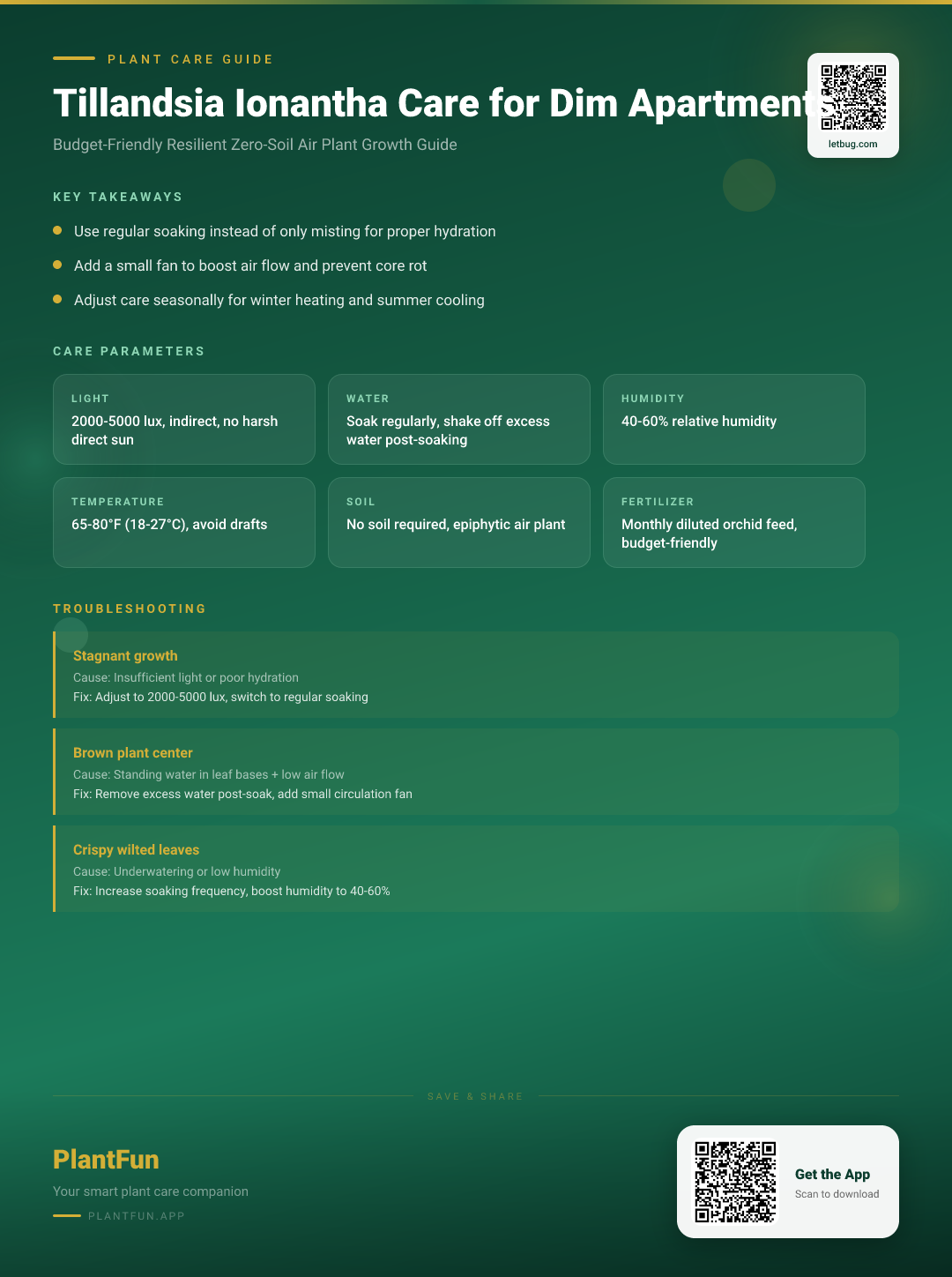
Key Takeaways
- Check soil moisture before watering — overwatering is the #1 killer of houseplants.
- Ensure your plant gets the right amount of light for its species.
- Be patient with recovery — most plants need 2–4 weeks to bounce back.
Quick Care Card: The Essentials for Apartment Longevity
| Feature | Requirement |
|---|---|
| Light | Bright, indirect (2,000–5,000 lux) |
| Water | Soak 20-30 mins weekly; shake dry |
| Humidity | 40-60% (ideal for leaf turgidity) |
| Temperature | 65–80°F (18–27°C) |
| Soil | None (Epiphytic) |
| Fertilizer | Diluted Bromeliad/Orchid food monthly |
| Toxicity | Non-toxic to cats and dogs (ASPCA, 2026) |
TL;DR: The 30-Second Air Plant Survival Summary
Tillandsia ionantha are not ‘set-it-and-forget-it’ decor; they are living epiphytes that absorb moisture through specialized scales called trichomes. To thrive in an apartment, provide bright indirect light, weekly 30-minute soaks, and—crucially—immediate drying to prevent core rot. Avoid the ‘misting-only’ trap; it rarely provides enough hydration for healthy growth (Nowak & Martin, 1997).
Why Air Plants Struggle in Typical Apartments (And How to Cheat the Environment)
When I first got my Tillandsia ionantha, I treated it like a plastic ornament. I left it on a dark bookshelf and misted it once a month. Naturally, it shriveled. Apartment dwellers often face two killers: stagnant air and low light. Unlike terrestrial houseplants for beginners, these plants lack roots to access water, relying entirely on atmospheric moisture. To survive, we must mimic their natural canopy home by optimizing airflow and humidity (NC State Extension, 2026).
Light Requirements: Achieving 2,000–5,000 Lux Without South-Facing Windows
Tillandsia are not low-light plants. They crave bright, indirect exposure. If you lack a South-facing window, place your air plant within 2-3 feet of an East or West-facing window. If your apartment remains gloomy, supplement with a full-spectrum LED bulb. You need roughly 2,000 to 5,000 lux to maintain active metabolism (Nowak & Martin, 1997).
The Hydration Protocol: How to Soak vs. Misting for Optimal Turgidity
Avoid the ‘misting’ myth. Misting increases humidity momentarily but fails to hydrate the plant tissue deeply.
- Soak: Submerge the plant in filtered or rainwater for 20-30 minutes once weekly.
- The Shake: Immediately shake the plant upside down to remove water trapped in the leaf bases.
- Dry: Place the plant on a towel in a well-ventilated area until it is completely dry (1-2 hours) before returning it to its display.
Air Circulation Hacks: Using Simple Fans to Prevent Core Rot in Low-Flow Units
In an apartment, stagnant air is the enemy. Without natural breezes, moisture sits in the core of the plant, leading to rot. I keep a small USB fan running near my Tillandsia collection for two hours after a soak. This mimics the mountain breezes their ancestors evolved in.
Temperature & Humidity: Maintaining 65-80°F (18-27°C) and 40-60% Humidity
Most apartment homes hover within the comfortable range for these plants. However, keep them away from heating vents or AC drafts, which desiccate the foliage rapidly. If your home drops below 40% humidity, consider a small indoor humidity monitor to track conditions.
Budget-Friendly Fertilization: The Monthly Diluted Orchid Feed Strategy
Use a balanced, water-soluble fertilizer specifically for Bromeliads or Orchids. Dilute it to 1/4 of the recommended strength. Fertilize only once per month during the growing season (spring and summer) to support healthy indoor growth.
Voice Search FAQ
How do I tell if my air plant is thirsty?
The leaves will curl inward and lose their vibrant color, appearing dull or grey. If you gently squeeze the leaves, they will feel soft rather than firm and turgid (Nowak & Martin, 1997).
Why is the center of my air plant turning brown?
This is a classic sign of ‘core rot’ caused by water trapped at the base of the leaves. Ensure you always shake your plant dry after watering air plants.
Can I leave my air plant in a closed glass terrarium?
No. Closed environments prevent the air circulation necessary for the plant to dry and respire, which will inevitably lead to fungal decay and death.
Seasonal Care Calendar: Adjusting for Winter Heating and Summer Cooling
- Winter: Increase soak frequency if your heater is running constantly. Monitor for dry, crispy leaf tips.
- Summer: Higher temps increase metabolic rates. Ensure adequate airflow to prevent the plant from ‘cooking’ in stagnant, humid air.
Common Mistakes to Avoid
- Mistake: Leaving the plant wet in the base. What happens: The core turns black and mushy. Instead: Shake the plant vigorously upside down after every soak.
- Mistake: Using tap water with high mineral content. What happens: Mineral buildup clogs the trichomes. Instead: Use distilled water or rainwater whenever possible.
References
- ASPCA. (2026). Toxic and Non-Toxic Plants List — ASPCA. https://www.aspca.org/pet-care/animal-poison-control/toxic-and-non-toxic-plants. Accessed 2026-03-16.
- NC State Extension. (2026). Tillandsia Ionantha Care — NC State Extension Gardener Plant Toolbox. https://plants.ces.ncsu.edu/plants/ionantha-care/. Accessed 2026-03-16.
- Nowak, E., & Martin, C. (1997). Physiological and Anatomical Responses to Water Deficits in the Cam Epiphyte Tillandsia ionantha (Bromeliaceae). International Journal of Plant Sciences. https://doi.org/10.1086/297495. Accessed 2026-03-16.
- Vázquez-Flores, X., Valdez-Hernández, E., & Mata-Alejandro, H. (2025). Topographic tetrazolium test in seeds of Tillandsia ionantha Planch. Agro Productividad. https://doi.org/10.32854/bf7wd502. Accessed 2026-03-16.
Optional Helper: Plantfun.App
Plantfun.App identifies your plants by photo, diagnoses pests and diseases with clear fixes, and creates personalised watering and light schedules that adapt to your home conditions — a handy companion for putting this guide into daily practice.
Found an error or have suggestions? We'd love your feedback.
Need help identifying this problem?
Get instant identification, personalized care schedules, and effective pest treatment plans directly on your phone.
Sponsored • We may earn a commission from app downloads
Related Guides
Tillandsia Ionantha Care for Dim Apartment Living: A Resilience Checklist for Tiny Air Plants
Revive your struggling air plant with our expert soak-and-dry protocol. Discover precise light lux levels, optimal humidity, and the 30-minute recovery method.
Care GuideTillandsia Ionantha Care for Dim Apartment Living: The Ultimate Low-Budget Survival Plan
Revive your wilting air plant with this budget-friendly care plan. Master the 20-minute soak method and 3 essential light adjustments to keep your Tillandsia lush.
Care GuideTillandsia Ionantha Care for Dim Apartments: The Complete Rescue and Growth Guide
Revive your struggling air plant with our expert soak-and-dry method. Learn the exact humidity levels and light requirements to keep Tillandsia ionantha thriving.
Pest ControlAnts on Plants: What They Mean and What to Do
Ants usually aren't eating your plant. They are farming other pests.