
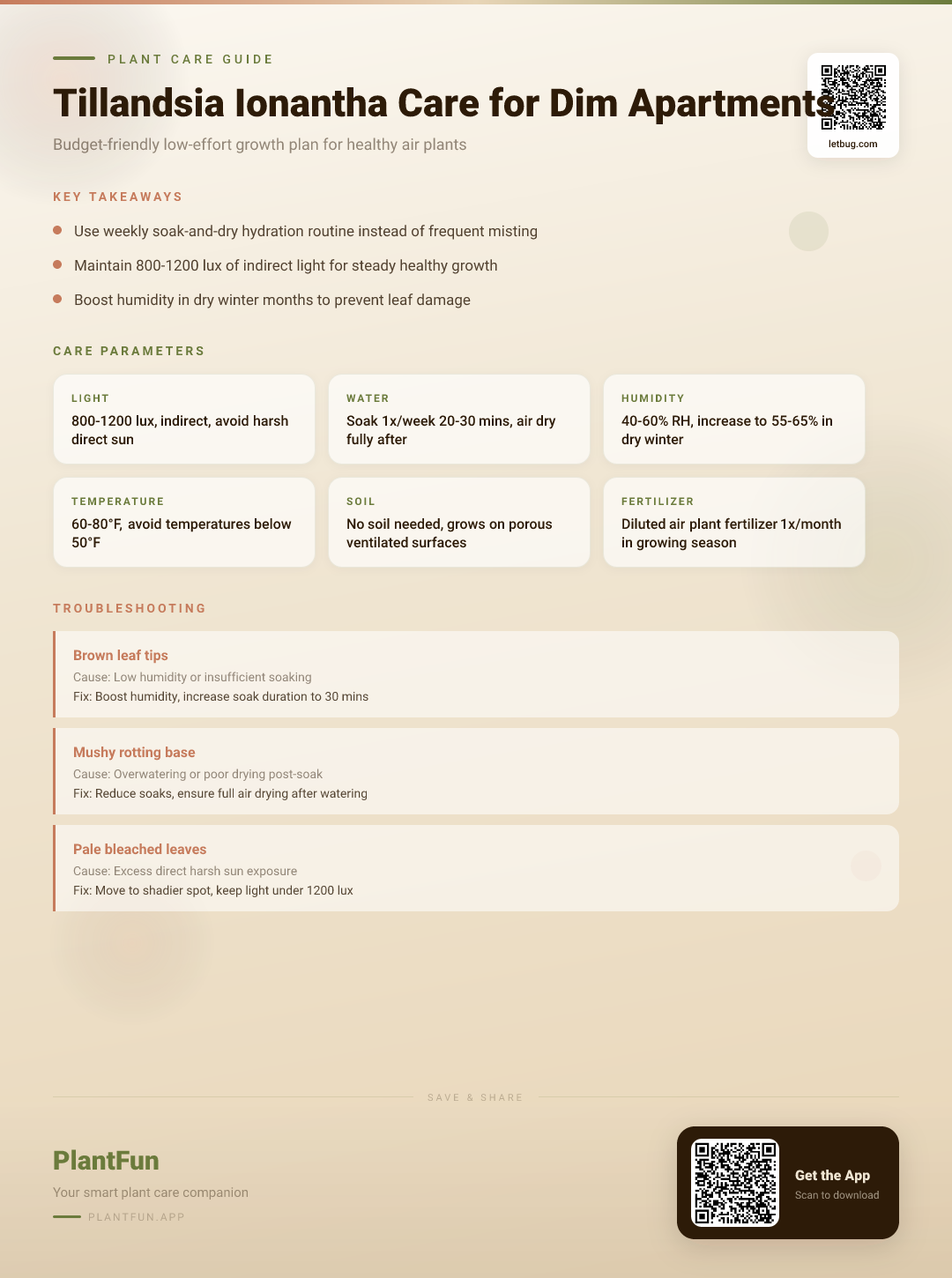
Key Takeaways
- Check soil moisture before watering — overwatering is the #1 killer of houseplants.
- Ensure your plant gets the right amount of light for its species.
- Be patient with recovery — most plants need 2–4 weeks to bounce back.
Quick Care Card: Essential Thresholds for Tillandsia Ionantha
| Feature | Requirement |
|---|---|
| Light | 800–1,200 Lux (Bright, indirect) |
| Watering | Soak for 30–60 minutes weekly |
| Humidity | 40%–60% (Moderate) |
| Temperature | 60°F–80°F (15°C–27°C) |
| Soil | None (Epiphytic) |
| Fertilizer | Optional: Weak bromeliad blend monthly |
| Toxicity | Non-toxic to cats and dogs (ASPCA, 2026) |
TL;DR: The Minimalist Air Plant Philosophy
To keep Tillandsia Ionantha thriving in an apartment, avoid the common trap of misting. Instead, prioritize a weekly 45-minute soak in room-temperature water followed by thorough, upside-down drying to prevent rot. Place them in bright, indirect light—aiming for 800-1,200 lux—and ensure adequate airflow. No specialized equipment or expensive fertilizers are required for success.
Why Air Plants Struggle in Typical Apartment Conditions
When I first brought home my collection of Tillandsia Ionantha, I made the mistake of treating them like standard houseplants, thinking they could survive on occasional light sprays. I quickly learned that these epiphytes—plants that grow on other surfaces rather than in soil—possess specialized trichomes (small, scale-like structures on their leaves) designed to harvest moisture from the air (NC State Extension, 2026).
In many apartments, the primary culprits for failure are poor air circulation and low humidity. Without sufficient light and airflow, the plant’s metabolic pathways, which utilize Crassulacean Acid Metabolism (CAM) for gas exchange, become disrupted, leading to stunted growth or decay (Nowak & Martin, 1997).
The 5-Step Budget Hydration Protocol: From Soaking to Drying
My zero-cost hydration routine ensures these plants receive sufficient moisture without needing expensive misters or humidifiers.
- Harvest: Collect room-temperature tap water. If your local water is heavily chlorinated, let it sit uncovered for 24 hours.
- The Soak: Submerge the plant entirely for 30–60 minutes once a week. This ensures the trichomes are fully saturated.
- The Shake: Remove the plant and gently shake it upside down over the sink to remove excess water trapped deep in the foliage.
- The Drying: Place the plant on a clean, dry towel. It must be completely dry within 4 hours to avoid crown rot.
- The Reset: Return your plant to its display spot only once no visible moisture remains between the leaves.
Light Optimization: How to Find 800-1,200 Lux Without a Greenhouse
Many apartment dwellers struggle to gauge light levels. You don’t need a professional meter; if you can comfortably read a book in your chosen spot, you are likely hitting the 800-1,200 lux threshold.
- East-Facing Windows: Generally the best spot for air plants in an apartment, offering soft morning light.
- Distance: Keep your plants within 2-3 feet of a window, but shield them from direct afternoon sun, which can scorch the foliage (NC State Extension, 2026).
- Monitoring: If the leaves begin to flatten or turn pale green, move them closer to the light source.
Seasonal Adjustments: Managing Humidity in Dry Winter Apartments
Winter is the most challenging time for Tillandsia maintenance. When central heating kicks in, indoor humidity often drops below 30%. During these months, I adjust my air plant care schedule by adding an extra 10 minutes to the soak time. I also avoid placing them near heating vents, as the desiccating air will cause the leaf tips to crisp regardless of how often you soak them.
Troubleshooting: Why are my air plant leaf tips turning brown?
[Dehydration Stress]
Symptom: The leaves are curling excessively and the tips are turning crunchy brown.
Likely cause: Inadequate hydration or too much dry heat.
Fix:
- Increase the duration of your weekly soak by 15 minutes.
- Move the plant further away from artificial heat sources.
[Crown Rot]
Symptom: The base of the plant is turning mushy and dark brown or black.
Likely cause: Standing water remained in the center of the plant for too long.
Fix:
- Remove the affected leaves immediately.
- Ensure the plant is placed in a high-airflow area to speed up drying.
FAQ: Can I keep my Tillandsia in a windowless bathroom?
While the high humidity of a bathroom is beneficial, these plants still require light for photosynthesis. If your bathroom has no windows, the plant will not survive long-term. You can rotate it into a brighter room for a few days each week, but consistent light is better for healthy Tillandsia Ionantha propagation (Vázquez-Flores et al., 2025).
FAQ: How do I know if my air plant is getting enough water?
Watch the leaves. A well-hydrated Tillandsia feels firm and plump. If the plant feels very light when you pick it up or if the leaves appear concave rather than rounded, it is time for a hydration boost.
Common Mistakes: Stop ‘misting’ your plants to death
- Mistake: Misting the plant daily.
- What happens: The water evaporates too quickly to be absorbed by the trichomes, leading to chronic dehydration.
- Instead: Commit to the weekly soak-and-dry protocol.
- Mistake: Forcing the plant into a glass terrarium with poor ventilation.
- What happens: Stagnant air causes the plant to suffocate and develop fungal rot.
- Instead: Use open containers or decorative mounts that allow air to circulate freely around the entire plant.
References and Botanical Background
- ASPCA. (2026). Toxic and Non-Toxic Plants List — ASPCA. https://www.aspca.org/pet-care/animal-poison-control/toxic-and-non-toxic-plants. Accessed 2026-03-16.
- NC State Extension. (2026). Tillandsia Ionantha Care — NC State Extension Gardener Plant Toolbox. https://plants.ces.ncsu.edu/plants/ionantha-care/. Accessed 2026-03-16.
- Nowak, E., & Martin, C. (1997). Physiological and Anatomical Responses to Water Deficits in the Cam Epiphyte Tillandsia ionantha (Bromeliaceae). International Journal of Plant Sciences. https://doi.org/10.1086/297495. Accessed 2026-03-16.
- Vázquez-Flores, X., Valdez-Hernández, E., & Mata-Alejandro, H. (2025). Topographic tetrazolium test in seeds of Tillandsia ionantha Planch. Agro Productividad. https://doi.org/10.32854/bf7wd502. Accessed 2026-03-16.
Optional Helper: Plantfun.App
Plantfun.App identifies your plants by photo, diagnoses pests and diseases with clear fixes, and creates personalised watering and light schedules that adapt to your home conditions — a handy companion for putting this guide into daily practice.
Found an error or have suggestions? We'd love your feedback.
Need help identifying this problem?
Get instant identification, personalized care schedules, and effective pest treatment plans directly on your phone.
Sponsored • We may earn a commission from app downloads
Related Guides
Tillandsia Ionantha Care for Dim Apartments: The Complete Rescue and Growth Guide
Revive your struggling air plant with our expert soak-and-dry method. Learn the exact humidity levels and light requirements to keep Tillandsia ionantha thriving.
Care GuideTillandsia Ionantha Care for Dim Apartment Living: A Resilience Checklist for Tiny Air Plants
Revive your struggling air plant with our expert soak-and-dry protocol. Discover precise light lux levels, optimal humidity, and the 30-minute recovery method.
Care GuideTillandsia Ionantha Care for Dim Apartments: The Ultimate Budget-Friendly Resilient Growth Guide
Revive your stagnant Tillandsia Ionantha with this zero-soil care plan. Master precise soaking schedules and humidity levels to ensure vibrant, resilient growth.
Pest ControlAnts on Plants: What They Mean and What to Do
Ants usually aren't eating your plant. They are farming other pests.