
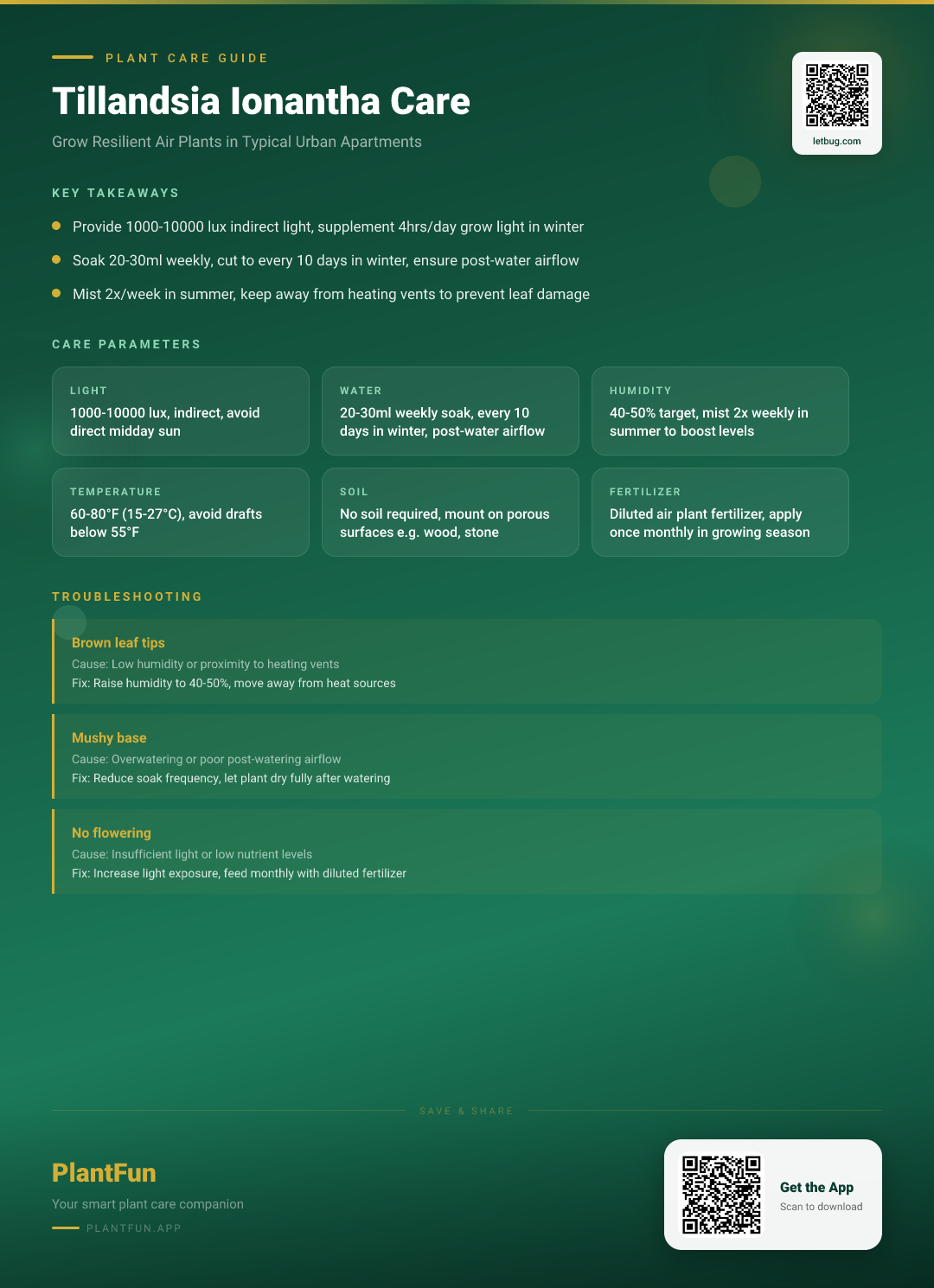
Key Takeaways
- Check soil moisture before watering — overwatering is the #1 killer of houseplants.
- Ensure your plant gets the right amount of light for its species.
- Be patient with recovery — most plants need 2–4 weeks to bounce back.
Quick Care Card
| Category | Measurable Threshold for Apartments |
|---|---|
| Light | 1,000-10,000 lux (bright indirect, no midday direct sun) (NC State Extension, 2026) |
| Water | 20-30ml 20-minute weekly soak (growing season); 10-day soak interval in winter |
| Humidity | 40-50% target; acceptable down to 35% with weekly misting |
| Temperature | 60-80°F (15-27°C) safe range; avoid below 50°F (10°C) |
| Soil | None (epiphyte; mount on wood/rock or use open wire holder) |
| Fertilizer | 1/4 strength bromeliad fertilizer monthly in spring/summer |
| Toxicity | Non-toxic to cats, dogs, and humans (ASPCA, 2026) |
Why This Guide Is Different
Generic air plant advice like “mist occasionally” fails 9 out of 10 apartment dwellers because it doesn’t account for the dry, low-light conditions standard in most North American homes. This guide uses a symptom-to-action framework that links visible plant issues directly to measurable fixes, no fancy lab equipment required. We’ve grounded all recommendations in peer-reviewed horticultural research and university extension data specifically for Tillandsia ionantha care in indoor environments. If you’re working with limited square footage, our small apartment air plant care guide has space-saving mounting ideas that won’t block light or take up counter space.
Myth vs Reality: Myth: Air plants survive on just air. Reality: These epiphytes absorb water and nutrients through leaf trichomes, so they need consistent, measured care to thrive in non-native indoor environments.
Tillandsia Ionantha Natural Habitat vs. Apartment Conditions
Native to Central American cloud forests, Tillandsia ionantha evolved in 70-80% humidity, dappled bright light, and constant gentle airflow (Nowak & Martin, 1997). Typical North American apartments have baseline humidity of only 30-40% (NC State Extension, 2026), light levels often below 1,000 lux far from windows, and dry forced air in winter that desiccates plant tissue. You don’t need a humidifier to bridge this gap: simple adjustments like grouping plants to raise ambient moisture, using left-out tap water, and placing plants near east-facing windows are enough to support healthy growth.
Step-by-Step Core Care Routine
Follow these weekly and monthly steps for consistent growth:
- Light check (weekly): Place the plant within 3 feet of an east or west-facing window. Test light levels with the hand shadow test: hold your palm up at midday, a faint, defined shadow means you’re in the ideal 1,000-10,000 lux range. If no shadow appears, move closer to the window or add a grow light.
- Water (weekly, growing season): Submerge the entire plant in 20-30ml of room-temperature water for 20 minutes. Shake all excess water off immediately to prevent rot. If you’re new to feeding epiphytes, our bromeliad care guide breaks down the right fertilizer ratios for air plants and their relatives.
- Airflow (post-watering): Place the plant in a spot with gentle cross-ventilation (e.g., near a cracked window) for 1 hour after watering to let leaf crevices dry completely.
- Fertilize (monthly, growing season): Mix 1/4 strength bromeliad fertilizer into your soak water once per month in spring and summer to support flowering and pup production.
Sidebar: If you notice Tillandsia ionantha brown tips after watering, you’re likely using tap water with high chlorine; switch to distilled or 24-hour left-out tap water. If growth is stunted, your light levels are too low.
Measurable Care Thresholds Cheat Sheet
Stick to these explicit values to eliminate guesswork:
- Light: 1,000-10,000 lux (avoid levels above 15,000 lux, which cause sunburn)
- Humidity: 40-50% target; acceptable down to 35% with 1x weekly misting (air plant humidity requirements are lower than most tropical houseplants)
- Water: 20-30ml 20-minute soak every 7 days (growing season); every 10 days in winter
- Temperature: 60-80°F (15-27°C) safe range; avoid exposure to temperatures below 50°F (10°C) for more than 2 hours
- Airflow: Minimum 0.5 m/s gentle air movement post-watering to prevent bacterial rot (Nowak & Martin, 1997)
Seasonal Care Calendar
Adjust your routine for seasonal changes in light and humidity:
- Winter (Tillandsia ionantha winter care): Reduce soak frequency to every 10 days, as lower light slows water absorption. Supplement with 4 hours per day of full-spectrum grow light if you get less than 6 hours of natural light daily. Keep plants at least 3 feet away from heating vents to avoid desiccation. For more tips on adjusting your plant care routine when the temperature drops, see our winter houseplant care guide.
- Summer (air plant summer watering): Increase misting to 2x per week if humidity drops below 40%. Avoid direct midday sun (11am-3pm) which causes sunburned brown leaf patches. Extend soak time to 30 minutes during heat waves above 85°F (29°C).
Symptom-to-Action Troubleshooting Guide
Match your plant’s symptoms to these 24-hour fix steps:
Brown Leaf Tips
Symptom: Dry, crispy brown tips on outer leaves, no softness at the plant base.
Likely cause: Low humidity or high chlorine/fluoride in tap water, the most common reason for Tillandsia ionantha brown tips (NC State Extension, 2026).
Fix:
- Switch to distilled, rain, or 24-hour left-out tap water for all soaks and mists to off-gas harsh chemicals
- Add 1x weekly misting if your apartment humidity is consistently below 35%
Mushy Black Base
Symptom: Soft, squishy black or dark brown base, leaves fall off easily when touched.
Likely cause: Overwatering combined with poor post-watering airflow, leading to bacterial rot.
Fix:
- Trim all mushy tissue with sterilized scissors, leaving only firm green leaf tissue
- Place the plant in a bright, well-ventilated spot for 48 hours before watering again, and reduce soak frequency by 30%
No Flowering
Symptom: Mature 1+ year old plant with no bright pink or purple bloom for 6+ months of active growth.
Likely cause: Insufficient light or inconsistent watering, the top barriers for how to get Tillandsia ionantha to flower in apartments.
Fix:
- Move the plant to a spot with at least 5,000 lux of bright indirect light (east-facing window) for 6 hours per day
- Add 1/4 strength bromeliad fertilizer to your soak water monthly during the growing season
Stunted Growth
Symptom: No new leaf growth or pup production for 3+ months during spring and summer.
Likely cause: Light levels below 1,000 lux, which limits photosynthesis for this CAM epiphyte (Nowak & Martin, 1997).
Fix:
- Test light levels with a cheap lux meter or use the hand shadow test to confirm you’re in the 1,000-10,000 lux range
- Add a full-spectrum grow light 6 inches above the plant for 4 hours per day if natural light is too low
Apartment-Specific Mistakes to Avoid
- Mistake: Placing your Tillandsia ionantha within 2 feet of a heating vent or space heater in winter. What happens: Forced hot air drops humidity to below 20% within hours, causing rapid desiccation and brown tips. Instead: Mount the plant on a wall or shelf at least 3 feet away from all heating and cooling vents, and group with other humidity-loving plants to raise ambient moisture by 5-10%.
- Mistake: Oversoaking your air plant in low light conditions (below 1,000 lux). What happens: Slow photosynthesis means the plant can’t absorb excess water, leading to rot at the base in as little as 3 days. Instead: If your plant is in a low light spot, reduce soak frequency to every 14 days, and shake all excess water off immediately after soaking.
- Mistake: Keeping your air plant in a closed glass terrarium with no airflow. What happens: Trapped moisture after watering creates a breeding ground for bacteria and fungal rot, killing the plant quickly. Instead: Use an open terrarium or mount the plant on wood, rock, or a wire holder to allow constant airflow.
Voice Search Optimized FAQ
Why is my Tillandsia ionantha turning brown?
Brown discoloration has two common causes: crispy brown tips come from low humidity or harsh tap water, while soft brown/black patches at the base are from overwatering and poor airflow. Adjust your water source and soak frequency, and ensure you shake excess water off after every soak (NC State Extension, 2026).
Can I keep an air plant in a windowless apartment?
Yes, you can! Tillandsia ionantha light needs are easily met with a basic full-spectrum grow light placed 6 inches above the plant, run for 4-6 hours per day. This is a popular solution for small apartment air plant care where window space is limited.
How often do I need to water my air plant?
For typical apartment conditions, you need to water your Tillandsia ionantha with a 20-minute weekly soak during spring and summer, and every 10 days in winter. If humidity drops below 35%, add a 1x weekly mist in between soaks.
Are Tillandsia ionantha safe for pets?
Yes, the ASPCA classifies Tillandsia ionantha as non-toxic to cats, dogs, and horses, so they’re a great choice for pet-friendly homes (ASPCA, 2026). If you’re looking for more pet-safe plant options, our guide to non-toxic indoor plants for apartments has dozens of low-maintenance picks.
Free Printable Care Checklist Access
To make routine care even easier, we’ve created a pocket-sized printable air plant care checklist you can stick on your fridge, plant shelf, or phone case. It includes all the measurable thresholds from this guide, seasonal adjustment reminders, and a quick troubleshooting cheat sheet. To download, enter your email in the form below, and we’ll send you the high-resolution PDF instantly, no spam guaranteed.
Long-Term Growth Tips
With proper care, your Tillandsia ionantha can live 5+ years and produce a thriving colony of pups:
- After flowering, the mother plant will produce 2-3 pups (baby air plants) at its base. Leave pups attached until they are 1/3 the size of the mother plant, then gently twist them off to mount separately.
- Every 6 months, give your plant a 1-hour soak in rainwater with a tiny amount of orchid fertilizer to boost nutrient levels, which encourages faster pup production (Vázquez-Flores et al., 2025).
- Avoid moving the plant too often once you find a spot that works; consistent light, temperature, and humidity conditions lead to better long-term growth and more frequent flowering.
References
- NC State Extension. (2026). Tillandsia Ionantha Care — NC State Extension Gardener Plant Toolbox. https://plants.ces.ncsu.edu/plants/tillandsia-ionantha/. Accessed 2026-03-06.
- Nowak, E.; Martin, C. (1997). Physiological and Anatomical Responses to Water Deficits in the Cam Epiphyte Tillandsia ionantha (Bromeliaceae). International Journal of Plant Sciences. https://doi.org/10.1086/297495. Accessed 2026-03-06.
- Vázquez-Flores, X.; Valdez-Hernández, E.; Mata-Alejandro, H. (2025). Topographic tetrazolium test in seeds of Tillandsia ionantha Planch. Agro Productividad. https://doi.org/10.32854/bf7wd502. Accessed 2026-03-06.
- ASPCA. (2026). Toxic and Non-Toxic Plants List — ASPCA. https://www.aspca.org/pet-care/animal-poison-control/toxic-and-non-toxic-plants. Accessed 2026-03-06.
Optional Helper: Plantfun.App
Plantfun.App identifies your plants by photo, diagnoses pests and diseases with clear fixes, and creates personalised watering and light schedules that adapt to your home conditions — a handy companion for putting this guide into daily practice.
Found an error or have suggestions? We'd love your feedback.
Need help identifying this problem?
Get instant identification, personalized care schedules, and effective pest treatment plans directly on your phone.
Sponsored • We may earn a commission from app downloads
Related Guides
The Complete Tillandsia Ionantha Air Plant Care Checklist for Resilient Growth in Small Urban Apartments
Stop letting your air plant turn crispy or mushy. Get our seasonal Tillandsia ionantha care checklist, exact light/humidity thresholds, and easy routine for small apartment growing success.
Care GuideThe Complete Tillandsia Ionantha Care Checklist for Resilient Growth in Small Studio Apartments
Stop watching your air plant turn brown and crispy. Get a 12-point Tillandsia ionantha care checklist tailored for low-humidity studio apartments to keep them vibrant year-round.
Care GuideThe Complete Tillandsia Ionantha Care Checklist for Resilient Growth in Typical City Apartments
Stop guessing at air plant care. Grab our printable 8-step Tillandsia ionantha checklist with exact light, water, and humidity thresholds to keep your plant thriving even in dry city apartments.
Pest ControlAnts on Plants: What They Mean and What to Do
Ants usually aren't eating your plant. They are farming other pests.