
Key Takeaways
- Check soil moisture before watering — overwatering is the #1 killer of houseplants.
- Ensure your plant gets the right amount of light for its species.
- Be patient with recovery — most plants need 2–4 weeks to bounce back.
Quick Care Card
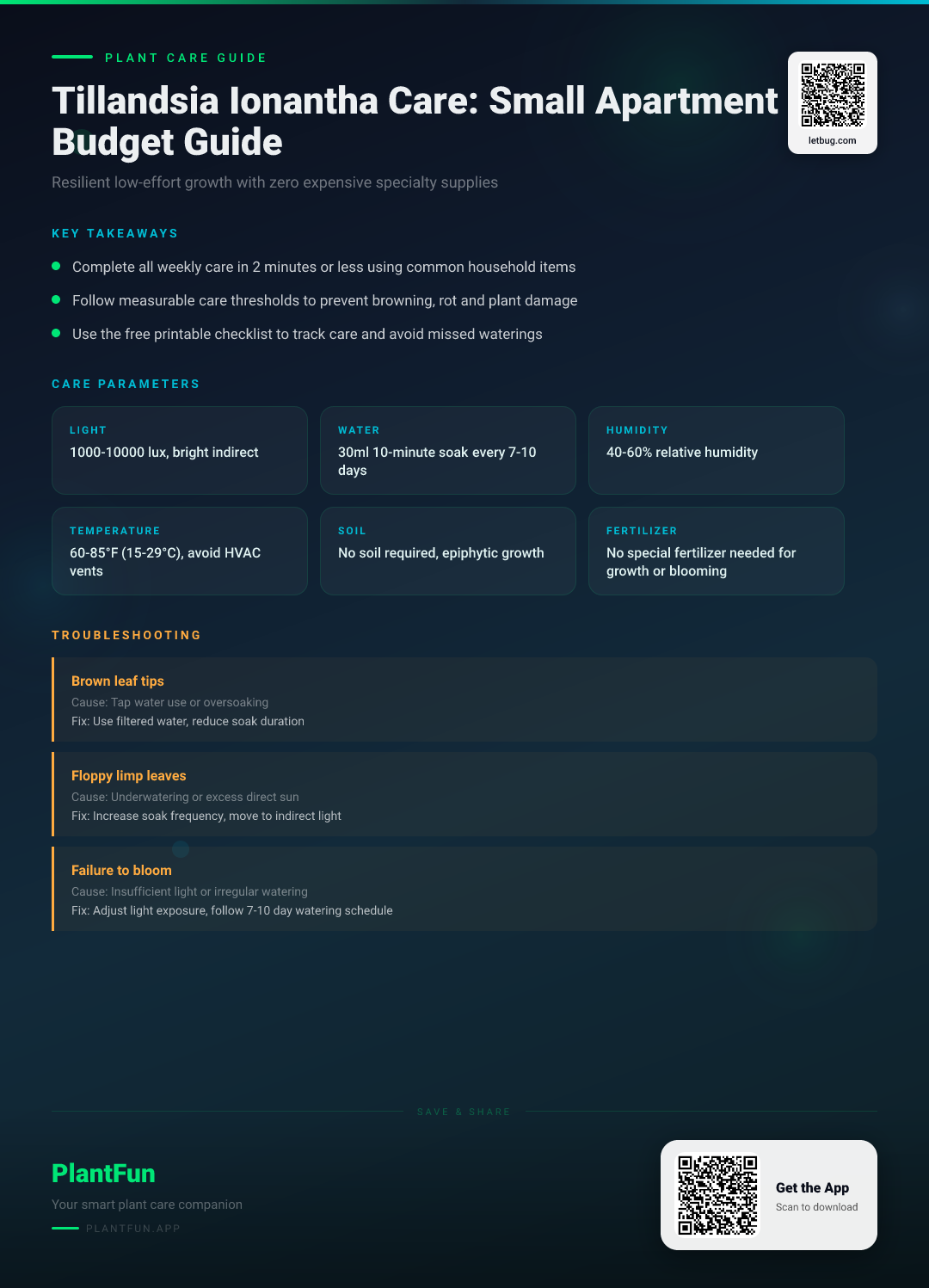
| Parameter | Exact Threshold |
|---|---|
| Light | 1000-10,000 lux bright indirect light |
| Water | 30ml 10-minute soak every 7-10 days |
| Humidity | 40-60% relative humidity |
| Temperature | 60-85°F (15-29°C) |
| Soil | None required (epiphyte) |
| Fertilizer | Optional, no specialty product needed |
| Toxicity | Non-toxic to pets and humans (ASPCA, 2026) |
Why Tillandsia Ionantha Thrives (or Fails) in Typical Urban Apartments
Tillandsia ionantha is native to Central American cloud forests, where it grows on tree branches with dappled light, regular mild moisture, and consistent temperatures. The 40-50% humidity common in most urban apartments is actually well-aligned with its natural tolerance for periodic water deficits (Nowak & Martin, 1997), making it ideal for small apartment air plant care. If you’re wondering do air plants need special soil? No, they absorb water and nutrients through tiny leaf scales called trichomes, so no bulky planters or soil are required (NC State Extension, 2026). Most failures stem from easily fixed mistakes: wrong light placement, over-reliance on misters, or exposure to HVAC drafts, rather than unsuitable apartment conditions. This plant is non-toxic to cats, dogs, and humans (ASPCA, 2026), making it a great addition to our list of pet safe indoor plants for small apartments.
Your $0 Budget Care Supplies Checklist
Skip the expensive specialty air plant gear — these household items work better for Tillandsia ionantha care, with zero cost:
- Clean leftover glass jar (for soaking, far more effective than fancy misters)
- Plain paper towel (for drying post-soak to prevent rot)
- Recycled wine cork, suction cup, or old picture frame hook (for mounting, no fancy holders needed)
- Tap water left out 24 hours (to evaporate chlorine, no filtered water required)
- Free phone light meter app (or use the hand test: hold your hand where the plant sits at noon, a faint shadow means perfect light) These cheap air plant care supplies eliminate the need for $20 misters, $15 specialized holders, or $10 air plant fertilizer, making this a truly budget air plant care routine.
Step-by-Step Weekly Care Routine
This entire routine takes 2 minutes or less per week, no extra time required:
- Fill your clean glass jar with 30ml of room-temperature, dechlorinated water (leave tap water out 24 hours first)
- Submerge your Tillandsia ionantha fully for exactly 10 minutes, set a timer to avoid oversoaking
- Remove the plant and shake gently to dislodge trapped water from leaf crevices
- Place upside down on a paper towel for 5 minutes to dry completely
- Return to its mounting spot, and mark the date on your fridge checklist This is the exact schedule for how often to water Tillandsia ionantha in 40-50% humidity apartments, with no guesswork involved.
Core Measurable Care Thresholds to Follow
Stick to these non-negotiable, science-backed metrics for consistent growth:
- Light: 1000-10,000 lux bright indirect light. If you’re asking can air plants live in low light? Levels below 1000 lux will stall growth, so move your plant to a brighter spot if it fails the hand shadow test (NC State Extension, 2026). If your apartment only has low light, check out our curated list of low light indoor plants that don’t need bright sun to thrive.
- Humidity: 40-60% relative humidity. Tillandsia ionantha humidity requirements are lower than most other air plants, so no humidifier is needed for standard apartments (Nowak & Martin, 1997).
- Water: 30ml 10-minute soak every 7-10 days. Adjust to every 10 days in dry winter months, every 7 days in humid summer months.
- Temperature: 60-85°F (15-29°C). Avoid temperatures below 50°F, which cause permanent leaf damage.
Seasonal Care Adjustment Calendar
Tweak your routine to match apartment seasonal changes:
- Jan-Feb (winter heating): Reduce soak time to 7 minutes, water every 10 days, move 1 foot away from radiators (key Tillandsia ionantha winter care tip)
- Mar-Apr (spring): Increase soak to 10 minutes, water every 8 days as daylight hours increase
- May-Aug (summer AC): Keep 2 feet away from AC vents, water every 7 days, mist once weekly only if humidity drops below 40%
- Sep-Dec (fall): Gradually reduce water frequency as daylight shortens, stop any supplemental feeding 2 weeks before the first frost
Printable Fridge Checklist Template
Print this simple 1-page checklist at home and tape it to your fridge to never miss a care session:
Tillandsia Ionantha Weekly Checklist
□ Soaked for 7-10 minutes in dechlorinated water
□ Shook excess water and dried upside down for 5 minutes
□ Light spot passes the hand shadow test
□ Removed any brown dead outer leaves
□ No HVAC vents blowing directly on the plant
Notes: _________________________
This air plant care checklist takes 10 seconds to fill out each week, eliminating guesswork for busy apartment dwellers.
5 Common Budget Care Mistakes to Avoid
- Mistake: Soaking in unconditioned tap water with high chlorine What happens: Brown leaf tips and stunted growth Instead: Leave tap water out on the counter for 24 hours to let chlorine evaporate, or use collected rainwater
- Mistake: Misting daily instead of soaking What happens: Leaves don’t absorb enough water, leading to crispy brown leaves — the top answer to why is my air plant turning brown Instead: Stick to the 10-minute soak schedule, mist only as a supplemental humidity boost in very dry conditions
- Mistake: Placing directly near HVAC vents or radiators What happens: Rapid moisture loss, leaf scorch, or rot from trapped water that can’t dry Instead: Keep your plant at least 1 foot away from all heating and cooling vents
- Mistake: Oversoaking for longer than 15 minutes, or not drying fully post-soak What happens: Rot at the base of the plant, which is often fatal Instead: Set a timer for 10 minutes, always shake excess water and dry upside down before remounting
- Mistake: Buying expensive specialty air plant fertilizer to encourage blooming What happens: Wasted money, salt buildup on leaves that causes damage Instead: Use the free blooming tip we cover in the FAQ, no fertilizer required
FAQ: Can I keep my Tillandsia ionantha on my east-facing kitchen counter near the coffee maker?
Yes! That’s an ideal spot for Tillandsia ionantha kitchen care: east-facing windows deliver 2000-5000 lux of bright morning indirect light, and the steam from your coffee maker adds a small humidity boost that it loves (NC State Extension, 2026). Just make sure it’s not directly under a cabinet that blocks light, and keep it 6 inches away from the hot coffee maker surface to avoid heat damage.
FAQ: Why is my air plant turning brown even though I mist it every day?
Misting only delivers a fraction of the water Tillandsia ionantha needs to thrive, as its trichomes require full saturation to take up enough moisture (Nowak & Martin, 1997). Daily misting also often leads to trapped water in leaf crevices that causes rot, while the rest of the plant stays dehydrated. Switch to our 10-minute soak schedule, and you’ll see green new growth within 2 weeks.
FAQ: How do I get my Tillandsia ionantha to bloom without buying fertilizer?
These Tillandsia ionantha blooming tips are 100% free: First, make sure it’s getting at least 2000 lux of bright indirect light daily for 4-6 hours. Second, expose it to a 10°F temperature drop at night for 2 consecutive weeks (for example, move it 1 foot further from your heater at night in winter). Mature plants (3+ years old) will produce a bright pink or purple bloom stalk within 4-6 weeks, no fertilizer required. If you’re looking to propagate your plant after blooming, check out our guide to air plant pup care for step-by-step tips.
Troubleshooting Quick Fix Guide
Brown Crispy Leaf Tips
Symptom: Dry, brown edges on the outer leaves, no mushy spots at the base.
Likely cause: Underwatering, or exposure to unconditioned tap water.
Fix:
- Soak for 12 minutes for your next 2 waterings, then return to the regular schedule
- Switch to dechlorinated water for all soaks
Floppy, Limp Leaves
Symptom: Leaves are soft, droopy, and pale green instead of stiff and silvery-green.
Likely cause: Overwatering, or not drying fully after soaking leading to early rot.
Fix:
- Shake all excess water from the plant, and leave it upside down on a paper towel in a bright spot for 24 hours
- Skip your next scheduled watering, and reduce soak time by 2 minutes for future sessions. If you’re worried it’s too far gone, read our guide on how to save a dying air plant for more rescue tips.
No Bloom After 2+ Years of Growth
Symptom: Mature plant is growing new leaves, but never produces a pink bloom stalk.
Likely cause: Insufficient light, or no temperature fluctuation to trigger blooming.
Fix:
- Move the plant to a spot that gets 4-6 hours of morning sun per day (2000+ lux)
- Expose it to a 10°F nighttime temperature drop for 2 weeks to trigger bloom production
Brown, Mushy Base
Symptom: The base of the plant is soft and brown, leaves fall off easily when touched.
Likely cause: Severe rot from oversoaking or trapped water.
Fix:
- Pull off all dead, mushy leaves, and trim the rotted base with clean scissors
- Leave the remaining healthy part of the plant to dry in a bright, well-ventilated spot for 3 days
- If new growth appears at the base, resume the regular care schedule; if not, harvest any healthy pups to propagate
References
- NC State Extension. (2026). Tillandsia Ionantha Care — NC State Extension Gardener Plant Toolbox. https://plants.ces.ncsu.edu/plants/tillandsia-ionantha/. Accessed 2026-03-01.
- Nowak, E.; Martin, C. (1997). Physiological and Anatomical Responses to Water Deficits in the Cam Epiphyte Tillandsia ionantha (Bromeliaceae). International Journal of Plant Sciences. https://doi.org/10.1086/297495. Accessed 2026-03-01.
- Vázquez-Flores, X.; Valdez-Hernández, E.; Mata-Alejandro, H. (2025). Topographic tetrazolium test in seeds of Tillandsia ionantha Planch. Agro Productividad. https://doi.org/10.32854/bf7wd502. Accessed 2026-03-01.
- ASPCA. (2026). Toxic and Non-Toxic Plants List — ASPCA. https://www.aspca.org/pet-care/animal-poison-control/toxic-and-non-toxic-plants. Accessed 2026-03-01.
Optional Helper: Plantfun.App
Plantfun.App identifies your plants by photo, diagnoses pests and diseases with clear fixes, and creates personalised watering and light schedules that adapt to your home conditions — a handy companion for putting this guide into daily practice.
Found an error or have suggestions? We'd love your feedback.
Need help identifying this problem?
Get instant identification, personalized care schedules, and effective pest treatment plans directly on your phone.
Sponsored • We may earn a commission from app downloads
Related Guides
The Complete Tillandsia Ionantha Care Checklist for Resilient Growth in Small Studio Apartments
Stop watching your air plant turn brown and crispy. Get a 12-point Tillandsia ionantha care checklist tailored for low-humidity studio apartments to keep them vibrant year-round.
Care GuideTillandsia Ionantha Care Checklist for Small Apartments: 7 Tips for Resilient Blooming Growth
Stop letting your air plants turn brown and crispy. Grab our free Tillandsia ionantha care checklist with exact light, water, and humidity parameters for thriving growth in small apartments.
Care GuideThe Complete Tillandsia Ionantha Air Plant Care Checklist for Resilient Growth in Small Urban Apartments
Stop letting your air plant turn crispy or mushy. Get our seasonal Tillandsia ionantha care checklist, exact light/humidity thresholds, and easy routine for small apartment growing success.
Pest ControlAnts on Plants: What They Mean and What to Do
Ants usually aren't eating your plant. They are farming other pests.