
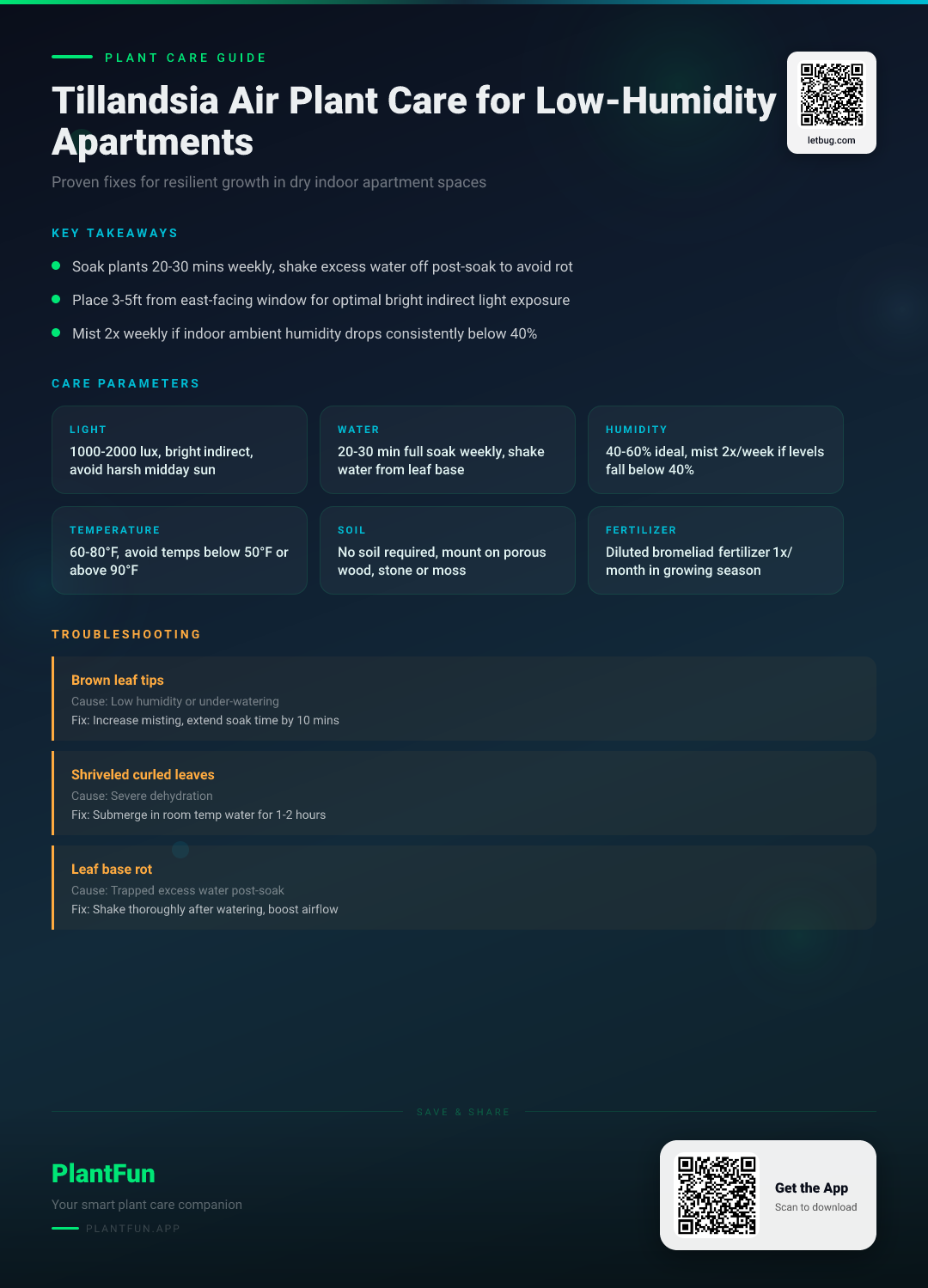
Key Takeaways
- Check soil moisture before watering — overwatering is the #1 killer of houseplants.
- Ensure your plant gets the right amount of light for its species.
- Be patient with recovery — most plants need 2–4 weeks to bounce back.
Quick Care Card: Essential Data Points for Success
| Feature | Requirement |
|---|---|
| Light | Bright, filtered indirect light (1,000–2,000 lux) |
| Water | Soak 30-60 mins weekly; misting is supplemental |
| Humidity | 40%–60% ideal; supplement in apartments |
| Temperature | 60°F–80°F (15°C–27°C) |
| Soil | None (Epiphytic) |
| Fertilizer | Specialized air plant food, monthly in growing season |
| Toxicity | Non-toxic to pets and humans (ASPCA, 2026) |
TL;DR: The Truth About Apartment Humidity and Tillandsia
Air plants aren’t “set-it-and-forget-it” décor. In dry apartments, they suffer from chronic dehydration due to artificial HVAC systems. Success requires a consistent weekly soak of 30-60 minutes, high-quality filtered or rainwater, and ensuring they dry completely within 4 hours to prevent rot. Treat them as living organisms that need active hydration, not just aesthetic shelf fillers.
Why Your Air Plant is Drying Out: The Indoor Climate Problem
When I first started collecting Tillandsia, I made the mistake of treating them like plastic ornaments, misting them once every two weeks. Predictably, my plants shriveled and developed crispy, brown tips within a month. The issue lies in the vapor pressure deficit of our homes. Central heating and air conditioning strip moisture from the air, creating an arid environment that exceeds what these tropical epiphytes can handle through foliar absorption alone.
Measurement Thresholds for Success: Lux, Humidity, and Soak Time
To thrive, your Tillandsia needs specific environmental inputs. According to the (NC State Extension, 2026), air plants obtain water and nutrients through specialized scales called trichomes on their leaves.
- Light: Aim for 1,000 to 2,000 lux. A north-facing window is usually insufficient; east or west windows with a sheer curtain are best.
- Humidity: While they prefer 50%+, they can survive at 30% if you strictly adhere to the soak schedule.
- Soak Time: Immerse the plant entirely in water for 30–60 minutes. Longer than 2 hours can increase the risk of tissue degradation.
Step-by-Step Recovery: Rehydrating Dehydrated Tillandsia Leaves
If your plant is shriveling, use this rescue protocol:
- Hydration Bath: Submerge the plant in room-temperature, dechlorinated water for 60 minutes.
- The Shake-Out: Gently shake the plant upside down to remove excess water from the leaf bases. Pooling water is the #1 cause of rot.
- Drying Phase: Place the plant on a towel in a well-ventilated spot. It must be completely dry within 4 hours.
- Observation: If leaves remain curled, repeat the soak in 3 days. Do not over-fertilize during recovery.
The 5 Golden Rules of Apartment Air Plant Care
- Ditch the Misting Myth: Misting rarely provides enough hydration. Always prioritize full-submersion soaks.
- Water Quality Matters: Use rain, spring, or distilled water. High mineral content in hard tap water can clog trichomes over time.
- Gravity is Your Friend: After soaking, dry the plant upside down. This prevents water from settling in the rosette.
- Airflow is Non-Negotiable: Place plants where they receive gentle cross-ventilation to prevent stagnant water.
- Monitor the Trichomes: A healthy plant will have a “fuzzy” or silver appearance. If it turns smooth or deeply green, it may be stressed.
Seasonal Adjustments: Managing Winter Radiator Heat vs Summer AC
During winter, radiator heat creates extremely low-humidity pockets. I increase my soaking frequency to every 5 days during these months. Conversely, in summer, if my AC is running constantly, I monitor for “leaf tip burn.” If the tips turn brown, it is a sign that the ambient air is stripping moisture faster than the plant can absorb it through leaf-based humidity capture.
FAQ: Why are the tips of my air plant leaves turning brown?
This is usually a sign of low humidity or mineral buildup. If you are using tap water, the salts can accumulate on the leaves. Try switching to filtered water and increasing your soak duration by 10 minutes.
FAQ: Can I use tap water for my Tillandsia or does it need rain water?
“Can I use tap water for my air plant?” is a question I hear often. While tap water is rarely fatal, the chlorine and heavy minerals can build up. If you must use tap, let it sit out for 24 hours to dissipate chlorine before soaking.
FAQ: How do I know if my air plant is getting enough indirect light?
If your plant is stretching (growing long, thin, and sparse), it is “etiolating” to search for more light. Move it closer to your light source. Remember, indoor light is far less intense than direct greenhouse sunlight.
Common Mistakes to Avoid: Avoid Rot and Leaf-Base Pooling
- Mistake: Leaving the plant in a water-tight decorative container.
- What happens: Lack of airflow leads to rot at the base.
- Instead: Only display your plants in open vessels that allow for rapid drying.
- Mistake: Soaking the plant with tap water high in additives.
- What happens: Trichomes become blocked, reducing nutrient uptake.
- Instead: Use rainwater or filtered water.
References: Botanical Sourcing and Botanical Care Standards
- EL Sayed, N. (2020). Spray Golden Pothos and Croton Plants with Glutathione and Bilirubin to Purify the Indoor Air from Pollutants. Journal of Plant Production. https://doi.org/10.21608/jpp.2020.102766. Accessed 2026-03-17.
- Mukherjee, P.; Bouri, T. (2026). Phytoremediation Potential of Indoor Plants in Reducing Air Pollution in Libraries: A Review. International Journal of Science and Research (IJSR). https://doi.org/10.21275/sr26102092801. Accessed 2026-03-17.
- ASPCA. (2026). Toxic and Non-Toxic Plants List — ASPCA. https://www.aspca.org/pet-care/animal-poison-control/toxic-and-non-toxic-plants. Accessed 2026-03-17.
- NC State Extension. (2026). Tillandsia Air Plants — NC State Extension Gardener Plant Toolbox. https://plants.ces.ncsu.edu/plants/tillandsia-air/. Accessed 2026-03-17.
Optional Helper: Plantfun.App
Plantfun.App identifies your plants by photo, diagnoses pests and diseases with clear fixes, and creates personalised watering and light schedules that adapt to your home conditions — a handy companion for putting this guide into daily practice.
Found an error or have suggestions? We'd love your feedback.
Need help identifying this problem?
Get instant identification, personalized care schedules, and effective pest treatment plans directly on your phone.
Sponsored • We may earn a commission from app downloads
Related Guides
Tillandsia Ionantha Care for Dim Apartment Living: A Resilience Checklist for Tiny Air Plants
Revive your struggling air plant with our expert soak-and-dry protocol. Discover precise light lux levels, optimal humidity, and the 30-minute recovery method.
Care GuideTillandsia Air Plants in Low-Humidity Apartments: The Resilient Growth Guide You Need
Transform your air plant care with our 3-step soaking system. Get precise humidity levels, light ranges, and recovery tips to keep your Tillandsia vibrant today.
Care GuideTillandsia Ionantha Care for Dim Apartments: The Ultimate Budget-Friendly Resilient Growth Guide
Revive your stagnant Tillandsia Ionantha with this zero-soil care plan. Master precise soaking schedules and humidity levels to ensure vibrant, resilient growth.
Pest ControlAnts on Plants: What They Mean and What to Do
Ants usually aren't eating your plant. They are farming other pests.