
Key Takeaways
- Check soil moisture before watering — overwatering is the #1 killer of houseplants.
- Ensure your plant gets the right amount of light for its species.
- Be patient with recovery — most plants need 2–4 weeks to bounce back.
TL;DR: The Essentials
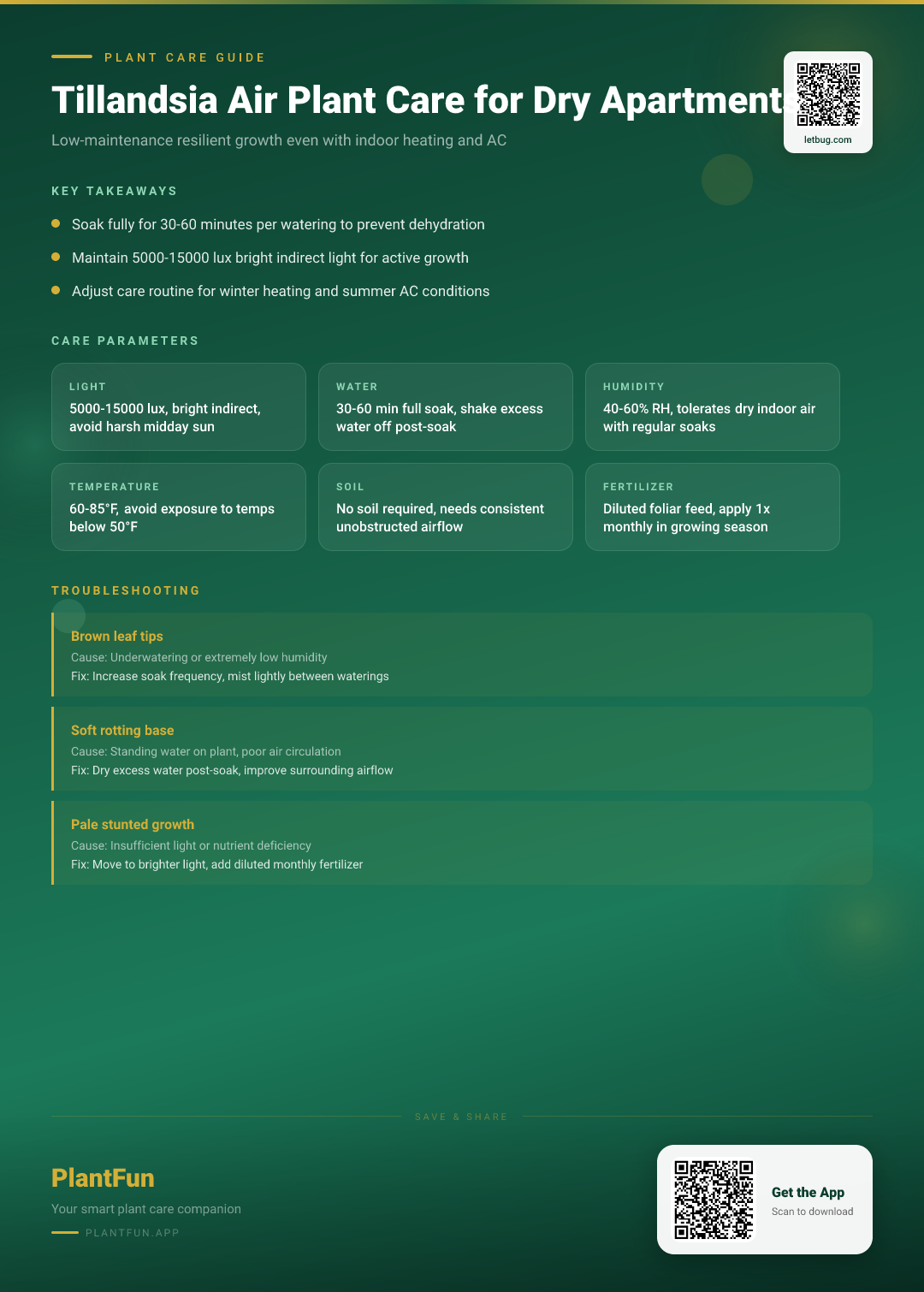
To keep your Tillandsia healthy in a dry apartment, move away from misting. Instead, soak your plants in room-temperature water for 30–60 minutes once a week, followed by a thorough shake to remove trapped water. Provide bright, indirect light (5,000–15,000 lux) and increase soaking frequency during winter months when heaters sap indoor humidity. If leaf tips turn brown, your plant is signaling moisture stress; increase your soaking duration immediately.
Quick Care Card: Essential Thresholds for Tillandsia
| Feature | Requirement |
|---|---|
| Light | 5,000–15,000 lux (bright, indirect) |
| Watering | Soak 30–60 mins/week |
| Humidity | 50–70% (supplemental for dry homes) |
| Temperature | 60°F–80°F (15°C–27°C) |
| Soil | None (Epiphytic) |
| Fertilizer | Bromeliad-specific (diluted 1/4 strength) |
| Toxicity | Non-toxic (ASPCA, 2026) |
Why Your Air Plant is Drying Out: The Apartment Humidity Reality
When I first started collecting Tillandsia, I made the classic mistake of treating them like “no-maintenance” decor. I left them on a bookshelf in my living room, misting them occasionally. Within three weeks, the tips curled, turned crispy, and the base began to shrivel.
The reality is that modern apartments, especially those with HVAC systems, are moisture-starved deserts. As noted by the North Carolina State University Extension, Tillandsia are epiphytes—plants that grow on other surfaces rather than soil—meaning they must absorb all their hydration through their trichomes, the specialized silver scales on their leaves (NC State Extension, 2026). When ambient humidity drops below 40% due to central heating, those trichomes cannot absorb enough moisture from the air alone to sustain the plant’s metabolic functions.
Format A: The Complete Scenario Guide
- The Low-Humidity Apartment: If your hygrometer reads under 45%, transition to a 60-minute soak every 5–7 days.
- The Bathroom Setup: Your bathroom is an ideal microclimate due to periodic humidity spikes from showers. However, ensure the plant receives bright light; a windowless bathroom will lead to slow, etiolated (weak, stretched) growth.
- The Office/Desk: If you work in a climate-controlled office, your plant is likely suffering from recirculated dry air. Consider a dedicated, small-scale humidity tray or increased soaking frequency.
Measuring Light: Maintaining 5,000–15,000 lux for Active Growth
Tillandsia need light to photosynthesize, but direct noon sun can scorch the delicate leaves. In my experience, a light meter app on your smartphone is the best tool for this. Aim for 5,000–15,000 lux. If your plant is dark green, it likely craves more light. If it has a silvery, frosted appearance, it is well-adapted to higher light levels.
The Hydration Ritual: Why Soaking for 30–60 Minutes Matters
Forget misting; it is merely a superficial dampening. A true hydration ritual involves total immersion. Submerge your Tillandsia in a bowl of room-temperature, filtered water for 30–60 minutes (NC State Extension, 2026). After the soak, gently shake the plant upside down to dislodge any water caught in the leaf axils. This is non-negotiable, as standing water will cause crown rot, which is often fatal.
Seasonal Care Calendar: Adjusting for Winter Heating vs. Summer Air Conditioning
- Winter: Heating systems lower humidity. Increase your soak time by 15 minutes and ensure the plant is at least 3 feet away from direct heat vents.
- Summer: If you use AC, the air becomes just as dry as in winter. Monitor the leaf tips. If they curl inward tighter than usual, the plant is conserving water—it needs an extra soak.
How do I know if my air plant is thirsty or dying?
- Thirsty: Leaves feel soft, lack rigidity, and the tips start to curl significantly. The base may look slightly concave.
- Dying: The base of the plant turns dark brown or black, and leaves pull away with a light tug (a sign of advanced rot). If the plant is mushy at the base, it has likely been sitting in water too long.
Can I keep my air plant in a glass terrarium without airflow?
While glass terrariums are aesthetically pleasing, they often become “death traps” for Tillandsia. Without constant air circulation, moisture trapped inside will inevitably lead to fungal decay. If you must use a terrarium, leave the top off and use it only for short-term display, not long-term cultivation.
Why is my air plant turning brown at the tips?
Symptom: Dry, crunchy brown tips on otherwise healthy leaves.
Likely cause: Chronic low humidity or infrequent watering causing the plant to prioritize its center over its extremities.
Fix:
- Increase soaking duration to 60 minutes.
- Ensure the plant is not near an HVAC supply vent.
Common Mistakes: The Dangers of Standing Water and Low Air Circulation
- Mistake: Letting the plant dry in a stagnant pile of water.
- What happens: Bacterial and fungal pathogens thrive in stagnant water trapped in the base.
- Instead: Always shake the plant dry and let it dry upside down for 2–4 hours on a paper towel.
Advanced Care: Fertilizer Dilution and Foliar Feeding Techniques
While Tillandsia aren’t heavy feeders, they benefit from a boost during the active growing season. Use a bromeliad-specific fertilizer at 1/4 of the recommended concentration. You can incorporate this into your monthly soak. Research into air quality improvements shows that healthy, actively growing plants are more effective at maintaining their local environment (Mukherjee & Bouri, 2026).
References and Botanical Sources
- NC State Extension. (2026). Tillandsia Air Plants — NC State Extension Gardener Plant Toolbox. https://plants.ces.ncsu.edu/plants/tillandsia-care/. Accessed 2026-03-19.
- EL Sayed, N. (2020). Spray Golden Pothos and Croton Plants with Glutathione and Bilirubin to Purify the Indoor Air from Pollutants. Journal of Plant Production. https://doi.org/10.21608/jpp.2020.102766. Accessed 2026-03-19.
- Mukherjee, P.; Bouri, T. (2026). Phytoremediation Potential of Indoor Plants in Reducing Air Pollution in Libraries: A Review. International Journal of Science and Research (IJSR). https://doi.org/10.21275/sr26102092801. Accessed 2026-03-19.
- ASPCA. (2026). Toxic and Non-Toxic Plants List — ASPCA. https://www.aspca.org/pet-care/animal-poison-control/toxic-and-non-toxic-plants. Accessed 2026-03-19.
Optional Helper: Plantfun.App
Plantfun.App identifies your plants by photo, diagnoses pests and diseases with clear fixes, and creates personalised watering and light schedules that adapt to your home conditions — a handy companion for putting this guide into daily practice.
Found an error or have suggestions? We'd love your feedback.
Need help identifying this problem?
Get instant identification, personalized care schedules, and effective pest treatment plans directly on your phone.
Sponsored • We may earn a commission from app downloads
Related Guides
Tillandsia Air Plants in Low-Humidity Apartments: The Resilient Growth Guide You Need
Transform your air plant care with our 3-step soaking system. Get precise humidity levels, light ranges, and recovery tips to keep your Tillandsia vibrant today.
Care GuideTillandsia Air Plants in Low-Humidity Apartments: 5 Proven Fixes for Resilient Growth
Stop watching your air plants shrivel. Learn the exact soak duration, humidity levels, and airflow tricks to keep your Tillandsia thriving in any dry apartment.
Care GuideTillandsia Ionantha in Small Apartments: The Ultimate Vertical Care Guide for Resilient Air Plants
Transform your small apartment into a vertical oasis with Tillandsia ionantha. Follow our 4-step hydration routine to prevent rot and maximize healthy growth.
Pest ControlAnts on Plants: What They Mean and What to Do
Ants usually aren't eating your plant. They are farming other pests.