
Key Takeaways
- Check soil moisture before watering — overwatering is the #1 killer of houseplants.
- Ensure your plant gets the right amount of light for its species.
- Be patient with recovery — most plants need 2–4 weeks to bounce back.
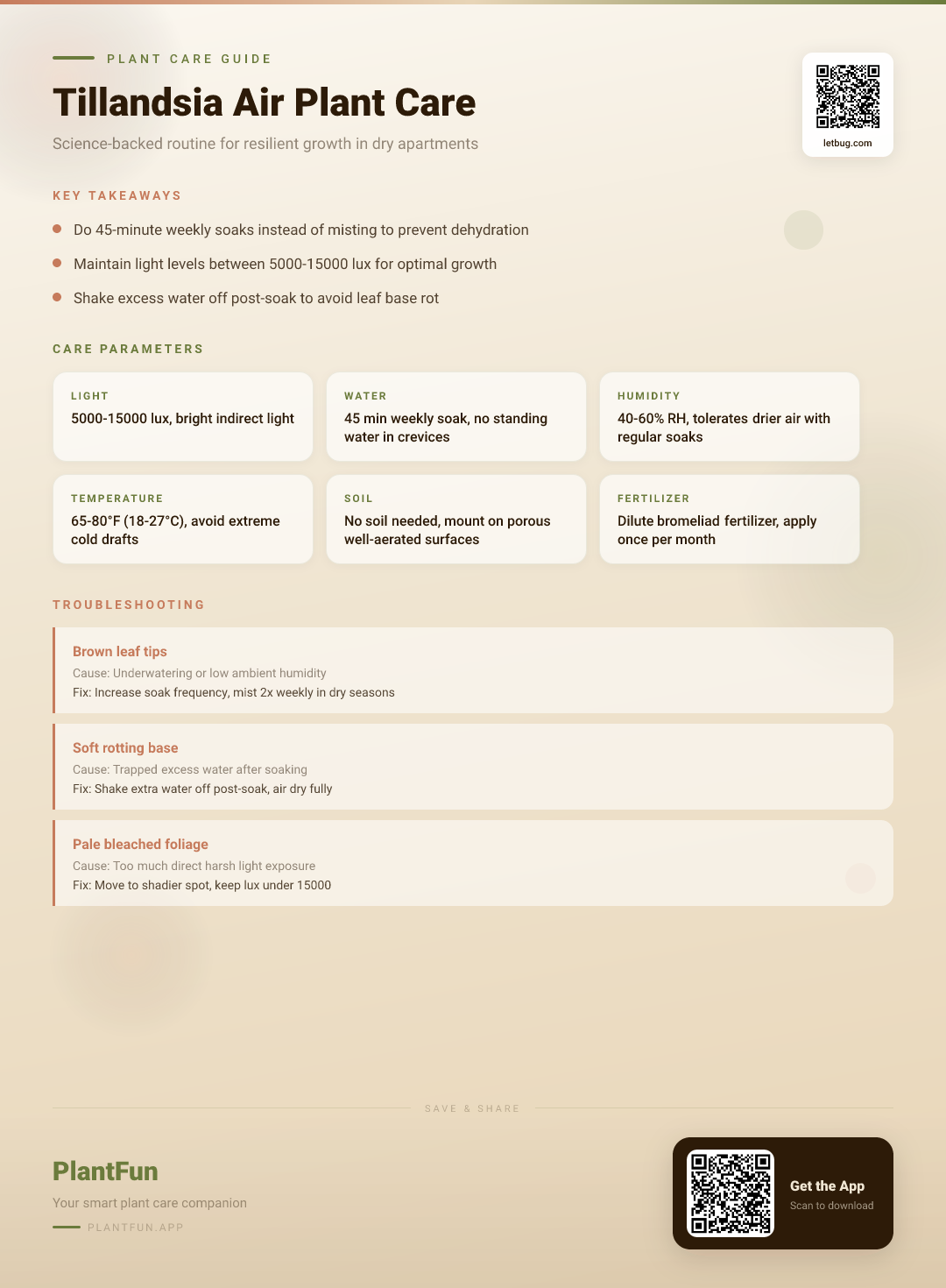
TL;DR: Misting is insufficient for apartment-dwelling Tillandsia. To keep them thriving, submerge them in room-temperature water for 45 minutes once a week, followed by a thorough drying period. Ensure they receive 5,000–15,000 lux of bright, indirect light and keep them away from direct HVAC vents.
Quick Care Card: Essential Thresholds for Apartment Tillandsia
| Feature | Requirement |
|---|---|
| Light | 5,000–15,000 lux (Bright, indirect) |
| Water | 45-minute soak weekly |
| Humidity | 40–60% (supplemental if lower) |
| Temperature | 65–80°F (18–27°C) |
| Soil | N/A (Epiphytic) |
| Fertilizer | Bromeliad-specific (low nitrogen), monthly |
| Toxicity | Non-toxic to pets (ASPCA, 2026) |
Why Apartments Dehydrate Air Plants: The Humidity Disconnect
When I first started collecting Tillandsia, I fell into the trap of assuming they drew all their moisture from the air. In my first drafty apartment, I watched my Tillandsia ionantha slowly turn into a brittle, gray husk. The reality is that modern indoor environments, especially those with central heating or cooling, strip moisture from the air, often pushing ambient humidity below 30%. Because these plants are epiphytes—meaning they grow on other plants rather than in soil—they rely on their trichomes (specialized silver-colored scales) to absorb water (NC State Extension, 2026). In dry air, these trichomes remain shut to prevent internal water loss, effectively starving the plant of hydration.
The 3-Step Hydration Ritual: Why Misting Fails
Most beginners rely on misting, which barely hydrates the outer leaf surface and evaporates before the plant can uptake meaningful moisture. To ensure your Tillandsia air plant care routine is effective, abandon the spray bottle for your primary watering method.
- Submerge: Place your plant entirely in a bowl of room-temperature water for 45 minutes.
- Drain: Shake the plant vigorously upside down to remove trapped water from the base.
- Dry: Place the plant on a towel in a well-ventilated area for 4 hours to ensure the base is completely dry before returning it to its display.
Light Requirements: Maintaining 5,000-15,000 Lux Indoors
While they are often marketed as “low-light” plants, this is a misnomer. To trigger proper metabolism, Tillandsia need significant light intensity. I aim for a spot within two feet of a south or east-facing window. If your plant looks “stretched” or loses its vibrant color, it is likely light-starved. Use a simple light meter app to ensure you are hitting the 5,000–15,000 lux range (NC State Extension, 2026).
Temperature and Airflow: Keeping Your Plant Between 65-80°F (18-27°C)
Airflow is the secret ingredient in epiphyte indoor care. These plants evolved to live in breezy forest canopies. In your home, keep them away from stagnant corners. A gentle draft helps them dry properly after their soak, preventing fungal rot. If your home stays between 65–80°F, your air plants will be in their comfort zone (NC State Extension, 2026).
The 45-Minute Weekly Soak: Precise Volume and Technique
For a healthy plant, a 45-minute soak once a week is the golden standard. If you notice the leaves curling tighter than usual, increase the duration to one hour. Avoid using distilled water exclusively, as plants benefit from the trace minerals in filtered tap water. Always ensure you are not using softened water, which contains salts that can damage the delicate trichomes.
Seasonal Adjustments: Managing Winter Radiator Heat and Summer Evaporation
In the winter, if your radiator makes your apartment feel like a desert, you may need to soak your plants every 5 days instead of every 7. Conversely, in the summer, if you run the AC, ensure the plants are not placed directly in the path of the cold air, which can cause cold stress.
FAQ: Why are my air plant tips turning brown?
Symptom: The leaf tips are crispy and brown, indicating dehydration.
Likely cause: Humidity is too low or soaking intervals are too infrequent.
Fix: Increase your soak time by 15 minutes and move the plant to a location with higher ambient moisture, such as a bathroom with a window.
FAQ: Can I use tap water for my Tillandsia or does it need distilled?
Yes, you can use tap water. In fact, plants often prefer the trace minerals found in municipal water over the “empty” profile of distilled water. However, if your tap water is heavily chlorinated, let it sit in an open container for 24 hours before use.
FAQ: How do I know if my air plant is getting enough light?
If your plant remains compact and retains a healthy, silver or green hue, it is likely happy. If it begins to grow tall, thin, and pale, move it closer to your light source immediately.
Common Mistakes to Avoid: Avoiding ‘Water Traps’ and Rot
- Mistake: Letting water sit in the crown of the plant.
- What happens: Fungal rot causes the base to turn black and mushy.
- Instead: Always turn the plant upside down and shake it out after every soak.
- Mistake: Putting plants in sealed glass terrariums.
- What happens: The lack of airflow creates a petri dish for rot.
- Instead: Display them in open vessels or mounted on wood.
References
- EL Sayed, N. (2020). Spray Golden Pothos and Croton Plants with Glutathione and Bilirubin to Purify the Indoor Air from Pollutants. Journal of Plant Production. https://doi.org/10.21608/jpp.2020.102766. Accessed 2026-03-14.
- Mukherjee, P.; Bouri, T. (2026). Phytoremediation Potential of Indoor Plants in Reducing Air Pollution in Libraries: A Review. International Journal of Science and Research (IJSR). https://doi.org/10.21275/sr26102092801. Accessed 2026-03-14.
- ASPCA. (2026). Toxic and Non-Toxic Plants List — ASPCA. https://www.aspca.org/pet-care/animal-poison-control/toxic-and-non-toxic-plants. Accessed 2026-03-14.
- NC State Extension. (2026). Tillandsia Air Plants — NC State Extension Gardener Plant Toolbox. https://plants.ces.ncsu.edu/plants/tillandsia-air/. Accessed 2026-03-14.
Optional Helper: Plantfun.App
Plantfun.App identifies your plants by photo, diagnoses pests and diseases with clear fixes, and creates personalised watering and light schedules that adapt to your home conditions — a handy companion for putting this guide into daily practice.
Found an error or have suggestions? We'd love your feedback.
Need help identifying this problem?
Get instant identification, personalized care schedules, and effective pest treatment plans directly on your phone.
Sponsored • We may earn a commission from app downloads
Related Guides
Tillandsia Ionantha Care: A Budget-Friendly Guide for Resilient Growth in Modern Apartments
Master air plant care with this budget-friendly guide. Learn the exact soak-to-mist ratio for resilient, vibrant Tillandsia ionantha in your own apartment.
Care GuideTillandsia Air Plants in Low-Humidity Apartments: The Resilient Growth Guide You Need
Transform your air plant care with our 3-step soaking system. Get precise humidity levels, light ranges, and recovery tips to keep your Tillandsia vibrant today.
Care GuideTillandsia Ionantha Care for Dim Apartments: A Budget-Friendly Growth Plan That Really Works
Revive your air plants with a simple, cost-effective soak-and-dry routine. Learn the exact light thresholds and hydration intervals for healthy Tillandsia growth.
Pest ControlAnts on Plants: What They Mean and What to Do
Ants usually aren't eating your plant. They are farming other pests.