
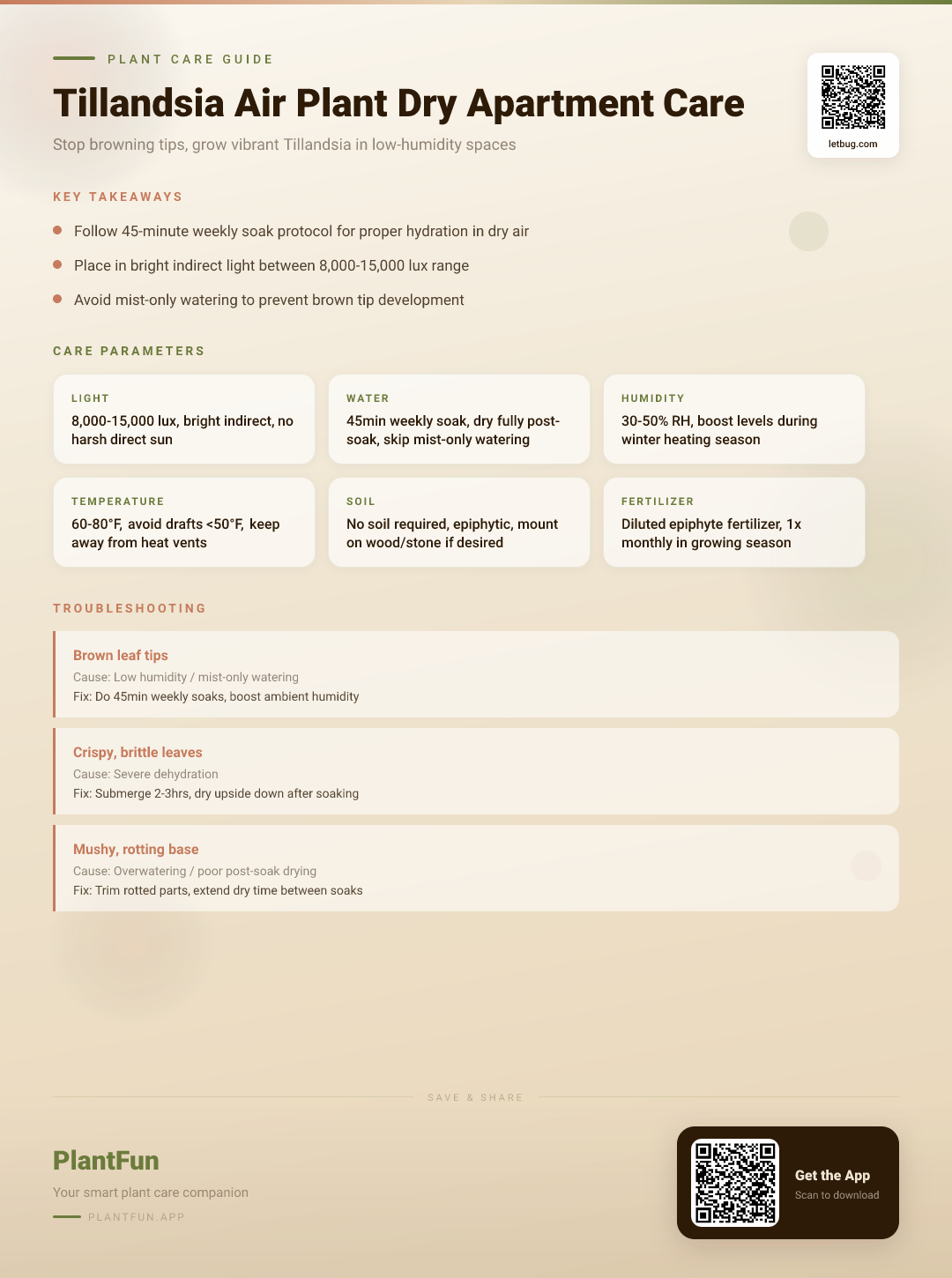
Key Takeaways
- Check soil moisture before watering — overwatering is the #1 killer of houseplants.
- Ensure your plant gets the right amount of light for its species.
- Be patient with recovery — most plants need 2–4 weeks to bounce back.
TL;DR: The Quick Fix
If your air plant has browning, crispy tips, it is likely suffering from chronic dehydration caused by low indoor humidity. To revive it, move the plant to a spot with 8,000–15,000 lux of bright indirect light, and initiate a 45-minute submersion soak in room-temperature water every 7–10 days. Always ensure the plant is shaken dry and air-dried upside down for at least 4 hours to prevent rot.
My Experience with Tillandsia
When I first started collecting Tillandsia, I fell for the ‘set-it-and-forget-it’ marketing myth. I treated them like plastic decor, hanging them in a sunny but arid apartment window. Within a month, my prized Tillandsia xerographica had developed brittle, brown tips that traveled halfway down the leaves. I learned the hard way that these epiphytes—plants that grow on other objects rather than in soil—are highly responsive to their atmospheric environment. I had to pivot my entire care strategy to mimic their native cloud-forest humidity levels.
Quick Care Card: Essential Thresholds for Apartment Tillandsia
| Feature | Requirement |
|---|---|
| Light | 8,000–15,000 lux (bright, indirect) |
| Watering | 45-minute soak weekly or bi-weekly |
| Humidity | 40–60% ideal (use pebble trays) |
| Temperature | 60°F–80°F (15°C–27°C) |
| Soil | None (Epiphytic) |
| Fertilizer | Bromeliad-specific (quarter strength) |
| Toxicity | Non-toxic to cats and dogs (ASPCA, 2026) |
Why Your Air Plant Is Browning: The Apartment Humidity Reality
Most urban apartments hover between 20% and 30% humidity, especially during winter heating seasons. Tillandsia are evolved to absorb moisture from the air via specialized scales called trichomes (NC State Extension, 2026). In dry air, these trichomes remain open and lose moisture faster than they can intake it, leading to the classic browning tips.
Format B: The Rescue Plan - Identifying Dehydration vs. Rot
Dehydration
Symptom: Leaf tips are curling, turning crispy brown, or becoming concave (folding inward).
Likely cause: Inadequate soaking or ambient humidity below 30%.
Fix:
- Perform a deep soak for 60 minutes.
- Increase watering frequency by 2 days.
Rot
Symptom: The base of the plant turns dark brown or black and leaves fall off with a slight tug.
Likely cause: Water trapped in the rosette due to improper drying.
Fix:
- Remove affected leaves immediately.
- Ensure vertical or inverted drying position for 6 hours.
Measuring Light: Optimal Bright Indirect Exposure (8,000-15,000 Lux)
While often labeled as ‘low light,’ most Tillandsia thrive best in bright, indirect light (NC State Extension, 2026). If you notice your plant leaning, it needs more intensity. If the leaves bleach, pull it back from the light source. Using a simple light-meter app on your phone can help you hit that 8,000–15,000 lux sweet spot.
The 45-Minute Soak Protocol: Mastering Hydration in 30-50% Humidity
Forget misting. To truly hydrate a plant in a dry apartment, submersion is non-negotiable.
- Fill a container with room-temperature, dechlorinated water.
- Submerge the plant entirely for 45 minutes.
- Remove and shake gently to dislodge trapped water in the base.
- Place on a towel in a well-ventilated area for 4 hours.
Root Cause Analysis: Why Mist-Only Watering Often Fails
Misting provides superficial moisture that evaporates within minutes, which is insufficient for the plant to perform photosynthesis effectively (NC State Extension, 2026). Misting often leaves the leaf surface damp without allowing the plant to reach full turgidity—the state of rigidity caused by water pressure in the cell walls.
Seasonal Adjustments: Managing Airflow During Winter Heating Spikes
Winter heating creates rapid airflow and dry pockets. I always move my Tillandsia away from radiators or forced-air vents. These currents accelerate transpiration, forcing the plant to go dormant or die back. If your home is exceptionally dry, group your plants on a pebble tray to elevate local humidity (Mukherjee & Bouri, 2026).
Step-by-Step Recovery: Rehydrating a Crispy Air Plant Without Drowning It
- Inspect: Confirm the base is firm (not black).
- Soak: Submerge in filtered water for 1 hour.
- Assess: Observe if leaves become firm or if they remain shriveled.
- Repeat: If shriveled, soak for 60 minutes every 3 days for one week.
FAQ: Why is my air plant turning brown at the tips?
It is usually a sign that the ambient humidity is too low for the species, causing the plant to lose moisture through its trichomes faster than it can replenish it (NC State Extension, 2026).
FAQ: How do I know if my air plant is getting enough water?
The leaves should feel firm and look plump, not concave or paper-thin. When in doubt, check if your air plant is getting enough water by observing the leaf curl—the more curled the leaves, the more thirsty the plant is.
FAQ: Can I keep my air plant in a low-light corner?
While some species survive, they will not thrive. If you are struggling with low-light, read our guide on indoor plant placement to find a better spot.
Common Mistakes: Using Hard Water and Improper Drying Techniques
- Mistake: Using tap water with high mineral content.
- What happens: Mineral buildup clogs the trichomes, preventing gas exchange.
- Instead: Use rainwater, distilled water, or filtered water.
- Mistake: Leaving the plant on a flat surface while drying.
- What happens: Water pools at the base, leading to rapid stem rot.
- Instead: Always dry the plant upside down or at a 45-degree angle.
Long-Term Prevention: Developing a Sustainable Maintenance Calendar
Consistency is the secret to healthy epiphytes. I use a ‘Soak Sunday’ schedule to ensure I never miss a session. If your environment is particularly dry, consider rotating your plants to a bathroom or kitchen where humidity is naturally higher (EL Sayed, 2020).
References
- EL Sayed, N. (2020). Spray Golden Pothos and Croton Plants with Glutathione and Bilirubin to Purify the Indoor Air from Pollutants. Journal of Plant Production. https://doi.org/10.21608/jpp.2020.102766. Accessed 2026-03-17.
- Mukherjee, P.; Bouri, T. (2026). Phytoremediation Potential of Indoor Plants in Reducing Air Pollution in Libraries: A Review. International Journal of Science and Research (IJSR). https://doi.org/10.21275/sr26102092801. Accessed 2026-03-17.
- ASPCA. (2026). Toxic and Non-Toxic Plants List — ASPCA. https://www.aspca.org/pet-care/animal-poison-control/toxic-and-non-toxic-plants. Accessed 2026-03-17.
- NC State Extension. (2026). Tillandsia Air Plants — NC State Extension Gardener Plant Toolbox. https://plants.ces.ncsu.edu/plants/tillandsia-care/. Accessed 2026-03-17.
Optional Helper: Plantfun.App
Plantfun.App identifies your plants by photo, diagnoses pests and diseases with clear fixes, and creates personalised watering and light schedules that adapt to your home conditions — a handy companion for putting this guide into daily practice.
Found an error or have suggestions? We'd love your feedback.
Need help identifying this problem?
Get instant identification, personalized care schedules, and effective pest treatment plans directly on your phone.
Sponsored • We may earn a commission from app downloads
Related Guides
Tillandsia Ionantha in a Low-Humidity Apartment: The Ultimate Care Guide for Resilient Air Plants
Revive your dry air plants with our expert hydration strategy. Get the exact soak durations, airflow tips, and humidity hacks to keep Tillandsia healthy today.
Care GuideTillandsia Ionantha Care for Dim Apartments: The Ultimate Budget-Friendly Resilient Growth Guide
Revive your stagnant Tillandsia Ionantha with this zero-soil care plan. Master precise soaking schedules and humidity levels to ensure vibrant, resilient growth.
Care GuideThe Complete Tillandsia Ionantha Air Plant Care Checklist for Resilient Growth in Small Urban Apartments
Stop letting your air plant turn crispy or mushy. Get our seasonal Tillandsia ionantha care checklist, exact light/humidity thresholds, and easy routine for small apartment growing success.
Pest ControlAnts on Plants: What They Mean and What to Do
Ants usually aren't eating your plant. They are farming other pests.