
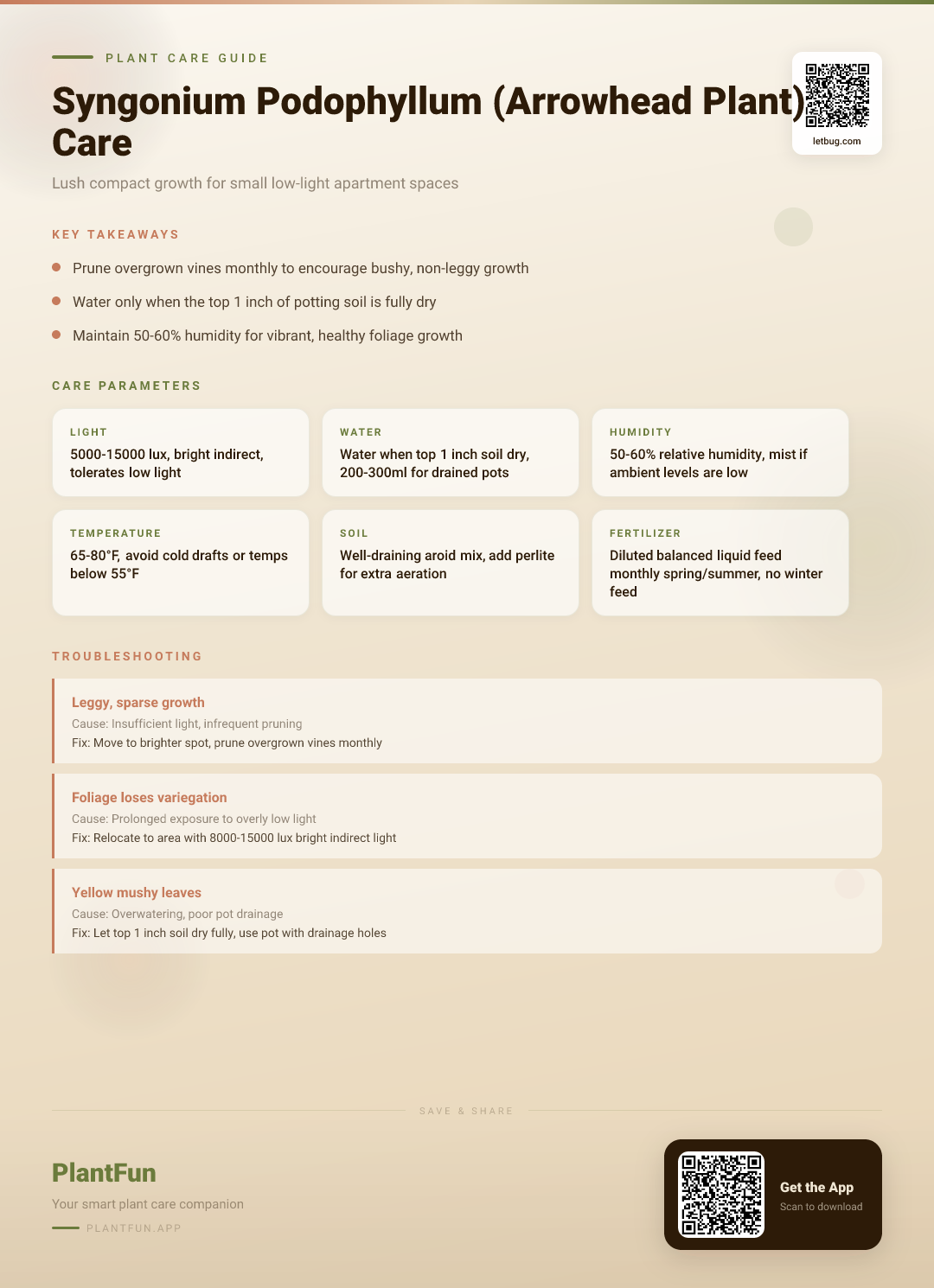
Key Takeaways
- Check soil moisture before watering — overwatering is the #1 killer of houseplants.
- Ensure your plant gets the right amount of light for its species.
- Be patient with recovery — most plants need 2–4 weeks to bounce back.
TL;DR: The Essentials
To keep your Syngonium podophyllum compact and lush in an apartment, prioritize high-intensity indirect light (5,000–15,000 lux) and allow the top 1 inch of soil to dry between waterings. Use sharp, sterile shears to prune long, vining stems to force lateral, bushy growth. Avoid over-fertilizing, which triggers rapid, weak stem elongation in low-light environments.
Quick Care Card: Essential Data
| Feature | Requirement |
|---|---|
| Light | 5,000–15,000 lux (Bright, indirect) |
| Humidity | 50–60% |
| Temperature | 65–80°F (18–27°C) |
| Water | Top 1 inch of soil dry between cycles |
| Soil | Well-draining, peat-based mix |
| Fertilizer | Balanced liquid feed, monthly (Spring/Summer) |
| Toxicity | Toxic to cats and dogs (ASPCA, 2026) |
Why Arrowhead Plants Struggle in Typical Apartments: Decoding the ‘Leggy’ Syndrome
When I first brought home my Syngonium podophyllum, I placed it in a dim corner, thinking it was a “low-light” plant. Within weeks, the stems stretched several inches, the leaves grew sparse, and it became a shadow of its former self. This is a common phenomenon in small apartments where light intensity drops sharply as you move away from a window. This plant is a rapid grower; when it senses insufficient light, it enters a state of ‘etiolation’—a survival mechanism where it elongates stems to “search” for a brighter light source (NC State Extension, 2026).
Understanding Your Light: How to Measure 5,000-15,000 Lux Without a Light Meter
While specialized lux meters are affordable, you can estimate light intensity using a simple smartphone app or observation. If you can read a book easily without straining your eyes in the spot where the plant sits, you are likely in the 5,000–10,000 lux range. If the plant is casting a sharp, crisp shadow on the wall behind it, you have reached the 15,000 lux threshold. Avoid direct sun, which can scorch the variegated foliage.
Watering Mastery: Why 200-300ml of Water Depends on Your Specific Pot Drainage
Watering isn’t a volume game; it’s about saturation. If you pour 300ml into a pot without drainage, you invite root rot. Always ensure your pot has drainage holes. Using a moisture meter or the “finger test,” check if the top 1 inch is dry. When watering, apply water until it runs through the drainage hole, then discard the excess from the saucer to prevent stagnant water.
Step-by-Step Pruning: How to Encourage Bushy Growth in Small Quarters
- Identify the longest, “leggy” vine that ruins the plant’s shape.
- Locate a node—the small bump on the stem where leaves emerge.
- Using sterilized shears, cut approximately 1/4 inch above the node.
- Within 2–4 weeks, two new stems will typically emerge from the leaf axils below the cut, creating a fuller, more compact silhouette.
The Humidity Factor: Simple DIY Solutions for 50-60% Relative Humidity
Apartment air, especially during heating season, often drops below 30% humidity. Syngonium performs best at 50-60% (NC State Extension, 2026). I keep a pebble tray filled with water beneath my plant’s pot (ensuring the pot sits on the stones, not in the water) to create a micro-climate of humidity.
Seasonal Shifts: Adjusting Your Care Routine for Apartment HVAC Cycles
In summer, your plant will transpire more rapidly, requiring more frequent checks. In winter, as the sun angle lowers and your heater dries the air, reduce watering frequency by 30–40% to account for slower metabolic rates. Never place your Syngonium near a direct HVAC vent.
Frequently Asked Questions
Can I keep my Syngonium in a windowless bathroom?
While these plants handle lower light, they still require photosynthetically active light to survive long-term. Without a window, the plant will eventually decline. I recommend a low-wattage full-spectrum LED bulb if you lack natural light.
Why is my Arrowhead plant losing its variegated patterns?
This is a signal that your plant is receiving too little light. To support the energy-intensive chlorophyll production required for variegated leaves, the plant is reverting to solid green to maximize its light-harvesting capacity. Move it 1–2 feet closer to your light source.
How do I prevent my Syngonium from vining out of control?
Consistent pruning is the only way to maintain a compact, bush-like form. If you prefer not to prune, you can use small plant clips to stake the vines into the pot, which encourages the stems to root where the nodes touch the soil.
Common Mistakes: The Perils of Over-Fertilizing in Low-Light
- Mistake: Heavy fertilization in winter.
- What happens: The plant produces weak, spindly growth that the low-light environment cannot sustain.
- Instead: Only fertilize at half-strength during the active growing season (Spring/Summer).
The LetBug Troubleshooting Checklist for Resilient Growth
Yellow Leaves
Symptom: Lower leaves turning yellow and dropping.
Likely cause: Overwatering or poor drainage causing root stress (Chase, 1988).
Fix:
- Check soil moisture; if soggy, repot into a well-draining mix.
- Ensure the pot has proper drainage holes.
Brown, Crispy Leaf Edges
Symptom: Tips of leaves turning brown and brittle.
Likely cause: Low humidity or inconsistent watering.
Fix:
- Increase ambient humidity using a tray of pebbles.
- Establish a consistent weekly watering schedule.
Pests on Underside of Leaves
Symptom: Small webbing or sticky residue.
Likely cause: Spider mites or scale.
Fix:
- Wipe leaves with a damp cloth.
- Use a mild insecticidal soap if the infestation persists.
References
- ASPCA. (2026). Toxic and Non-Toxic Plants List — ASPCA. https://www.aspca.org/pet-care/animal-poison-control/toxic-and-non-toxic-plants. Accessed 2026-03-15.
- Chase, A. (1988). New Disease of Syngonium podophyllum ‘White Butterfly’ Caused by a Pathovar of Xanthomonas campestris. Plant Disease. https://doi.org/10.1094/pd-72-0074. Accessed 2026-03-15.
- International Journal of Petrochemistry & Natural Gas. (2022). Study on potential aspect of an ornamental plant - Syngonium podophyllum (Schott) as a phytoremidiator on environmental pollution: A Short Review. International Journal of Petrochemistry & Natural Gas. https://doi.org/10.33140/ijpng.02.02.02. Accessed 2026-03-15.
- NC State Extension. (2026). Syngonium Podophyllum — NC State Extension Gardener Plant Toolbox. https://plants.ces.ncsu.edu/plants/syngonium-podophyllum/. Accessed 2026-03-15.
Optional Helper: Plantfun.App
Plantfun.App identifies your plants by photo, diagnoses pests and diseases with clear fixes, and creates personalised watering and light schedules that adapt to your home conditions — a handy companion for putting this guide into daily practice.
Found an error or have suggestions? We'd love your feedback.
Need help identifying this problem?
Get instant identification, personalized care schedules, and effective pest treatment plans directly on your phone.
Sponsored • We may earn a commission from app downloads
Related Guides
Arrowhead Plant in a Studio Apartment: The Ultimate Care Guide for Lush Growth
Maximize your small-space jungle with the Syngonium podophyllum. Get exact lux, humidity, and watering metrics to keep your Arrowhead plant compact and vibrant.
Care GuideSyngonium Podophyllum in a Low-Light Apartment: The Complete Resilient Growth Guide
Transform your leggy Arrowhead plant into a lush, compact specimen. Learn precise light levels, watering schedules, and seasonal tips for apartment success.
Care GuideArrowhead Plant Care in Typical Apartments: A Resilient Seasonal Growth Checklist for Success
Stop your Arrowhead plant from becoming leggy. Master exact light levels, hydration, and a seasonal routine to keep your Syngonium thriving in any apartment.
Pest ControlAnts on Plants: What They Mean and What to Do
Ants usually aren't eating your plant. They are farming other pests.