
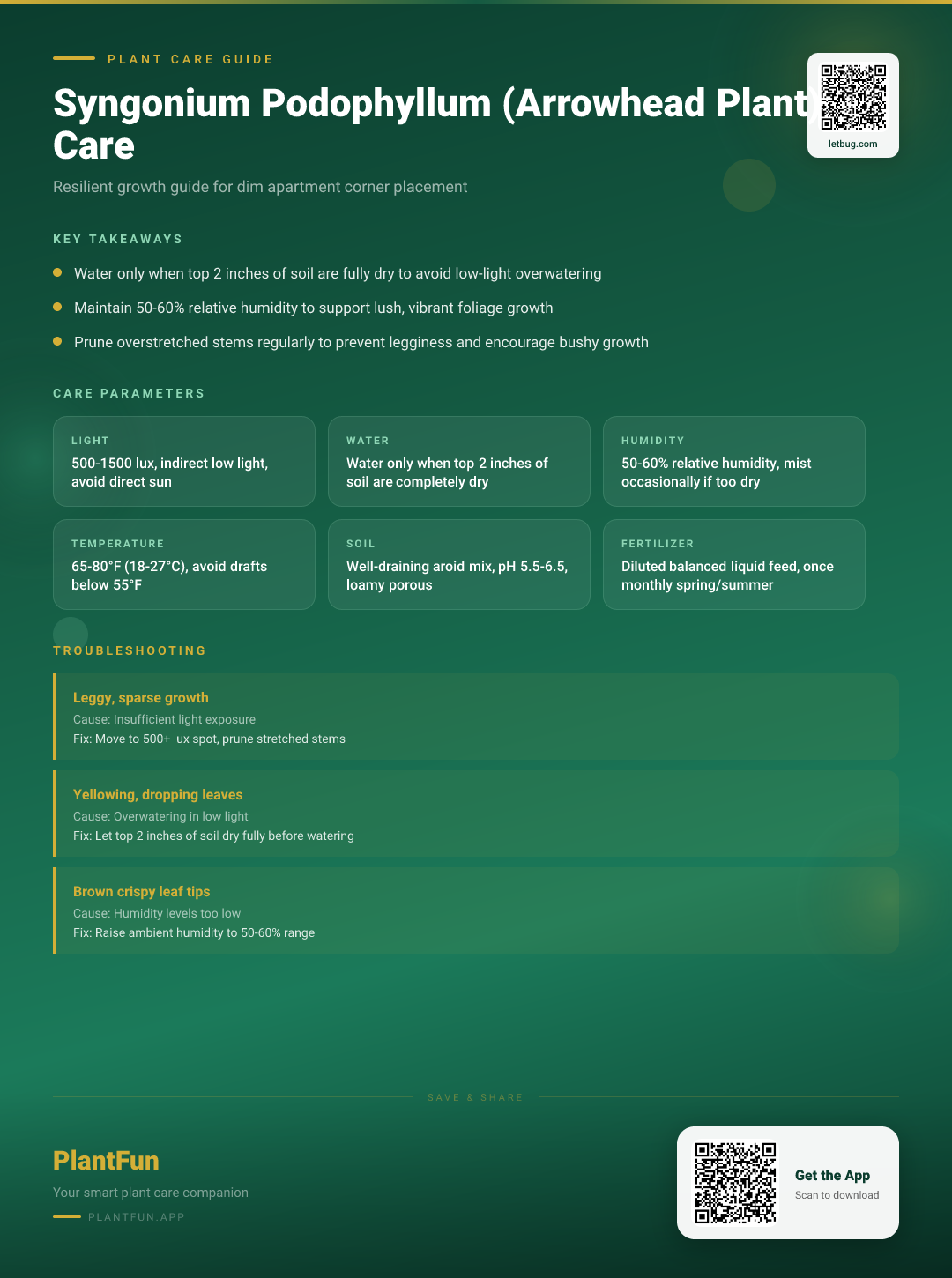
Key Takeaways
- Check soil moisture before watering — overwatering is the #1 killer of houseplants.
- Ensure your plant gets the right amount of light for its species.
- Be patient with recovery — most plants need 2–4 weeks to bounce back.
TL;DR: The Essentials
To keep your Syngonium podophyllum thriving in a dim apartment, focus on three pillars: provide at least 500-1,500 lux of light, allow the top 2 inches of soil to dry between waterings, and maintain humidity levels near 50-60%. Avoid placing your plant in absolute darkness, as this leads to weak, spindly growth. Always remember that this species is toxic if ingested (ASPCA, 2026).
Quick Care Card: The Essential Syngonium Vital Statistics
| Feature | Requirement |
|---|---|
| Light | 500-1,500 lux (Indirect bright to medium) |
| Water | Allow top 2” of soil to dry |
| Humidity | 50-60% (Ideal for lush foliage) |
| Temperature | 65-80°F (18-27°C) |
| Soil | Well-draining, peat-based mix |
| Fertilizer | Balanced liquid feed during growing season |
| Toxicity | Toxic to cats and dogs (ASPCA, 2026) |
Why Your Apartment Scenario Changes the Rules for Syngonium
When I first got my Syngonium podophyllum, I made the mistake of tucking it into a windowless bathroom corner, expecting it to be as indestructible as a snake plant. It didn’t take long to realize that while these plants are resilient, they are not magic. In an apartment setting, airflow is often lower and light is more restricted than in a greenhouse. Understanding that Syngonium can act as a phytoremediator—meaning it helps process air pollutants—gives us a clue: it needs a healthy environment to function optimally (International Journal of Petrochemistry & Natural Gas, 2022).
Measuring Light: 500-1,500 lux for Long-Term Maintenance
Light is the primary driver of growth. While Syngonium is often labeled a “low light” plant, this is a misnomer. They survive in low light, but they don’t thrive in it. I use a simple light meter app to ensure my plants receive at least 500 lux. If you are in a dim apartment, place your plant within 3-5 feet of a window. Avoid direct, harsh sun, which can scorch the leaves (NC State Extension, 2026).
Hydration Strategy: Watering When the Top 2 Inches of Soil Dry Out
Overwatering is the fastest way to kill an Arrowhead plant in a low-light apartment. Because low light reduces photosynthesis, the plant processes water more slowly. My rule of thumb: stick your finger 2 inches into the soil. If it feels moist, wait two more days. If it’s dry, it’s time to water. This prevents the anaerobic conditions that lead to root rot.
The 50-60% Relative Humidity Target for Lush Foliage
In small apartments, indoor heating often drops humidity levels below 30% in winter. This causes crispy leaf edges. I keep mine in a group with other tropicals or place a pebble tray underneath the pot to raise local humidity to the 50-60% range (NC State Extension, 2026).
Temperature Control: Keeping Your Plant Happy Between 65-80°F (18-27°C)
Syngonium are tropical understory plants. They hate cold drafts. Avoid placing them near AC units or leaky window frames during the winter. A steady room temperature within the 65-80°F range keeps their metabolism consistent.
Step-by-Step: Pruning for Resilient, Bushy Growth
If you want to avoid a trailing, vine-like look, you must prune.
- Identify the longest stems that have become sparse.
- Locate a node (the bump where a leaf meets the stem).
- Use sterilized shears to cut just 1/4 inch above the node.
- This encourages the plant to branch out, creating a bushier silhouette rather than a long, leggy vine.
Troubleshooting: How do I stop my Arrowhead plant from becoming leggy?
[Leggy Growth]
Symptom: The stems are long with significant gaps between leaves.
Likely cause: The plant is stretching to find a more viable light source.
Fix:
- Move the plant closer to a light source.
- Prune back the leggy growth to force dormant buds to activate.
[Yellowing Leaves]
Symptom: Lower leaves turn yellow and fall off prematurely.
Likely cause: Often a sign of overwatering in low-light conditions.
Fix:
- Check soil moisture levels immediately.
- Ensure the pot has proper drainage holes to avoid water logging (NC State Extension, 2026).
[Brown, Crispy Edges]
Symptom: The tips of the leaves turn brown and brittle.
Likely cause: Low ambient humidity or chemical buildup from tap water.
Fix:
- Increase humidity with a humidifier or pebble tray.
- Use filtered or distilled water if the edges persist.
[Bacterial Spotting]
Symptom: Small, water-soaked spots on leaves.
Likely cause: Pathogenic issues like Xanthomonas (Chase, 1988).
Fix:
- Isolate the plant from others.
- Improve air circulation to keep foliage dry.
FAQ: Can I move my Syngonium to a darker room during the winter?
It is generally not recommended. Even in winter, the plant needs light to maintain its structural health. If you must move it, ensure the room still has access to bright indirect light.
FAQ: Is it normal for my Syngonium to drop its lower leaves as it grows?
Yes, it is a natural part of the aging process. However, if multiple leaves drop simultaneously, it is likely a sign of a watering or lighting issue.
Seasonal Care Calendar: Adjusting for Apartment Fluctuations
- Spring/Summer: Increase watering and start a monthly fertilizer regimen.
- Fall/Winter: Allow the soil to dry out more between waterings as growth slows. Reduce light exposure if the sun is too harsh through bare trees.
Common Mistakes to Avoid: Overwatering in Low-Light Corners
- Mistake: Watering on a set schedule regardless of light.
- What happens: The soil stays soggy, leading to root rot.
- Instead: Only water based on the 2-inch soil test.
- Mistake: Neglecting to dust leaves.
- What happens: Dust blocks light absorption, further straining the plant.
- Instead: Wipe leaves with a damp cloth every two weeks.
References and Botanical Further Reading
- International Journal of Petrochemistry & Natural Gas. (2022). Study on potential aspect of an ornamental plant - Syngonium podophyllum (Schott) as a phytoremidiator on environmental pollution: A Short Review. https://doi.org/10.33140/ijpng.02.02.02. Accessed 2026-03-12.
- Chase, A. (1988). New Disease of Syngonium podophyllum ‘White Butterfly’ Caused by a Pathovar of Xanthomonas campestris. Plant Disease. https://doi.org/10.1094/pd-72-0074. Accessed 2026-03-12.
- ASPCA. (2026). Toxic and Non-Toxic Plants List — ASPCA. https://www.aspca.org/pet-care/animal-poison-control/toxic-and-non-toxic-plants. Accessed 2026-03-12.
- NC State Extension. (2026). Syngonium Podophyllum Care — NC State Extension Gardener Plant Toolbox. https://plants.ces.ncsu.edu/plants/syngonium-podophyllum/. Accessed 2026-03-12.
Optional Helper: Plantfun.App
Plantfun.App identifies your plants by photo, diagnoses pests and diseases with clear fixes, and creates personalised watering and light schedules that adapt to your home conditions — a handy companion for putting this guide into daily practice.
Found an error or have suggestions? We'd love your feedback.
Need help identifying this problem?
Get instant identification, personalized care schedules, and effective pest treatment plans directly on your phone.
Sponsored • We may earn a commission from app downloads
Related Guides
The Complete Arrowhead Plant Care Guide for Typical Apartments: Grow Resilient Lush Foliage
Stop struggling to keep your arrowhead plant thriving in your apartment. Get exact lux levels, watering amounts, and 7 actionable tips for thick, lush, resilient growth all year.
Care GuideThe Complete Arrowhead Plant Care Checklist for Thriving Growth in Small Urban Apartments
Grow a lush arrowhead plant even in a cramped apartment. Get exact light, water, and humidity thresholds, plus space-saving hacks and a free printable care checklist you can reference fast.
Care GuideThe Complete Arrowhead Plant Care Checklist for Resilient Growth in Typical Apartments
Stop guessing at Arrowhead Plant care. Get a tailored checklist, exact light, water, and humidity parameters to grow lush, resilient vines even in typical low-light city apartments.
Pest ControlAnts on Plants: What They Mean and What to Do
Ants usually aren't eating your plant. They are farming other pests.