
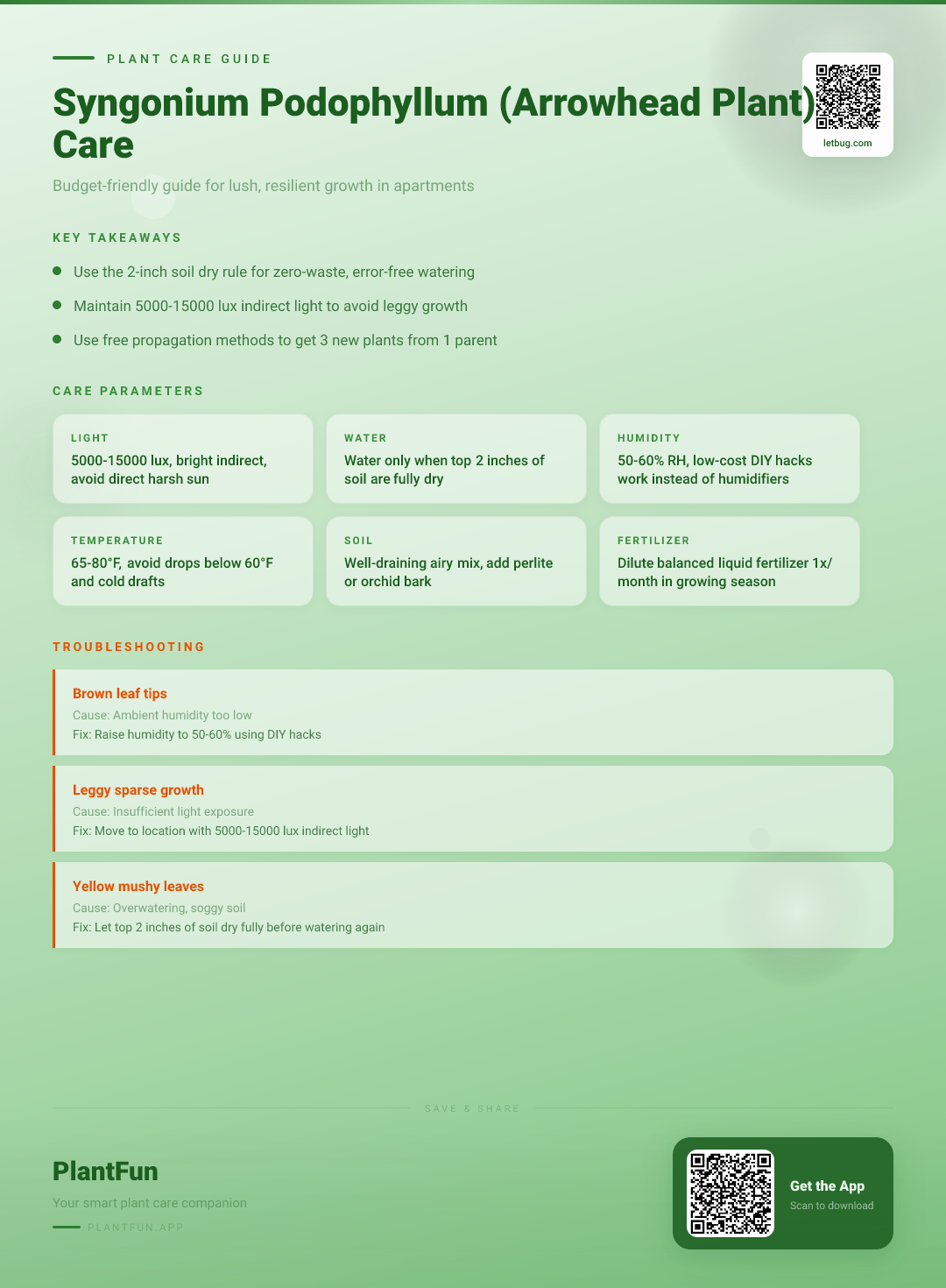
Key Takeaways
- Check soil moisture before watering — overwatering is the #1 killer of houseplants.
- Ensure your plant gets the right amount of light for its species.
- Be patient with recovery — most plants need 2–4 weeks to bounce back.
TL;DR: Syngonium podophyllum, or the Arrowhead plant, thrives in standard apartment conditions with bright, indirect light (5,000–15,000 lux) and consistent watering once the top 2 inches of soil feel dry. They are budget-friendly, highly adaptable, and perfect for beginners. Keep them away from pets as they are toxic (ASPCA, 2026). Maximize growth by mimicking tropical humidity through grouping plants rather than buying expensive humidifiers.
Quick Care Card: Essential thresholds for the resilient Syngonium
| Feature | Optimal Threshold |
|---|---|
| Light | Bright indirect (5,000–15,000 lux) |
| Water | When top 2 inches of soil dry out |
| Humidity | 50–60% |
| Temperature | 65–80°F (18–27°C) |
| Soil | Well-draining, peat-based mix |
| Fertilizer | Balanced liquid feed, monthly (Spring/Summer) |
| Toxicity | Toxic to cats and dogs (ASPCA, 2026) |
Why the Syngonium Podophyllum thrives in budget-constrained apartment living
When I first started collecting plants in my studio, I made the mistake of thinking I needed high-end grow lights and fancy misters. My first Arrowhead plant taught me otherwise. These plants are incredibly resilient and perfectly suited for the micro-climates found in small apartments (NC State Extension, 2026). Because they are not overly demanding of expensive equipment, they remain the gold standard for budget-friendly houseplant care.
Decoding light: Maximizing the 5,000–15,000 lux window in your space
Your windows are free energy. Most apartments have north or east-facing windows, which are ideal for Syngonium. These plants prefer 5,000 to 15,000 lux. If you aren’t sure how much light your space gets, download a simple, free light meter app on your phone—it’s far more accurate than guessing. Avoid direct midday sun, which can scorch the foliage.
Watering economics: The 2-inch rule for zero-waste hydration
I never use a watering schedule. Instead, I use the ‘finger test.’ Stick your index finger two inches into the potting mix. If it feels dry, it is time to hydrate. Overwatering is the most common cause of root stress. Using a simple terra-cotta pot or a plastic nursery pot with drainage holes is the best way to ensure excess water escapes (NC State Extension, 2026).
Humidity hacks: Achieving 50-60% levels without expensive humidifiers
Arrowhead plants appreciate the 50–60% humidity range. Rather than investing in a power-hungry humidifier, I group my Syngonium with other foliage plants. This creates a small, localized micro-climate where moisture released through transpiration stays near the leaves.
Temperature management: Keeping the 65-80°F range stable in small rooms
Drafty windows and heating vents are the enemies of a stable environment. I keep my plants within the 65–80°F range by placing them away from direct airflow. Even a few feet of distance makes a significant difference in preventing leaf stress.
The 0-dollar propagation strategy: Turning one plant into three
Syngonium are excellent candidates for water propagation. Simply identify a node (the small bump on the stem where leaves emerge), cut just below it with clean scissors, and place the cutting in a repurposed glass jar of water. Within 3–4 weeks, you will see roots develop. It is the cheapest way to expand your collection.
Seasonal care calendar: Adjusting for low-light winter months
Winter requires a slower pace. I reduce watering frequency during colder months as light intensity drops and the plant enters a period of dormancy. Since the plant is growing slower, do not fertilize between November and February.
Common mistakes to avoid: Preventing leggy growth without growth lights
-
Mistake: Keeping the plant in a dark corner.
What happens: The stems stretch out looking for light, resulting in ‘leggy’ growth.
Instead: Move the plant closer to a window, even by just two feet, to increase lux levels. -
Mistake: Using heavy, non-draining soil.
What happens: Roots suffocate, leading to yellowing leaves.
Instead: Mix standard potting soil with perlite or orchid bark to ensure proper aeration.
Can I keep my Arrowhead plant in a room without windows?
Technically, no plant can thrive long-term without some light source. If you have a room without windows, you must use an artificial light source, or you will eventually lose the plant. For more on maximizing your space, check out my guide on apartment-friendly plant layouts.
Why are the tips of my Syngonium leaves turning brown?
Symptom: Dry, crispy brown edges on leaves.
Likely cause: Low humidity or inconsistent watering.
Fix:
- Increase humidity by grouping plants.
- Ensure you are watering thoroughly until it drains out the bottom.
How do I know when my Arrowhead plant needs more light?
Symptom: Small, sparse leaves or extreme leaning toward the window.
Likely cause: Inadequate light (below 5,000 lux).
Fix:
- Gradually move the plant to a brighter location.
- Rotate the pot weekly to ensure all sides receive equal light.
References and botanical research notes
- NC State Extension. (2026). Syngonium Podophyllum — NC State Extension Gardener Plant Toolbox. https://plants.ces.ncsu.edu/plants/podophyllum-care/. Accessed 2026-03-19.
- ASPCA. (2026). Toxic and Non-Toxic Plants List — ASPCA. https://www.aspca.org/pet-care/animal-poison-control/toxic-and-non-toxic-plants. Accessed 2026-03-19.
- Chase, A. (1988). New Disease of Syngonium podophyllum ‘White Butterfly’ Caused by a Pathovar of Xanthomonas campestris. Plant Disease. https://doi.org/10.1094/pd-72-0074. Accessed 2026-03-19.
- International Journal of Petrochemistry & Natural Gas. (2022). Study on potential aspect of an ornamental plant - Syngonium podophyllum (Schott) as a phytoremidiator on environmental pollution: A Short Review. International Journal of Petrochemistry & Natural Gas. https://doi.org/10.33140/ijpng.02.02.02. Accessed 2026-03-19.
Optional Helper: Plantfun.App
Plantfun.App identifies your plants by photo, diagnoses pests and diseases with clear fixes, and creates personalised watering and light schedules that adapt to your home conditions — a handy companion for putting this guide into daily practice.
Found an error or have suggestions? We'd love your feedback.
Need help identifying this problem?
Get instant identification, personalized care schedules, and effective pest treatment plans directly on your phone.
Sponsored • We may earn a commission from app downloads
Related Guides
Syngonium Podophyllum in Your Apartment: The Complete Seasonal Care Guide for Resilient Growth
Transform your leggy Syngonium into a lush showpiece. Master precise light, 50%+ humidity levels, and seasonal watering schedules for a healthier Arrowhead plant.
Care GuideSyngonium Podophyllum Care for Dim Apartment Corners: A Budget-Friendly Resilient Growth Plan
Transform your dim apartment corner with a resilient Arrowhead Plant. Get precise water, light, and humidity thresholds to ensure lush growth on a tiny budget.
Care GuideSyngonium Podophyllum Care: Growing Healthy Arrowhead Plants in Compact, Low-Light Apartment Spaces
Transform your leggy Arrowhead Plant into a lush, compact masterpiece. Learn specific light levels, water ratios, and pruning hacks for thriving in small homes.
Pest ControlAnts on Plants: What They Mean and What to Do
Ants usually aren't eating your plant. They are farming other pests.