
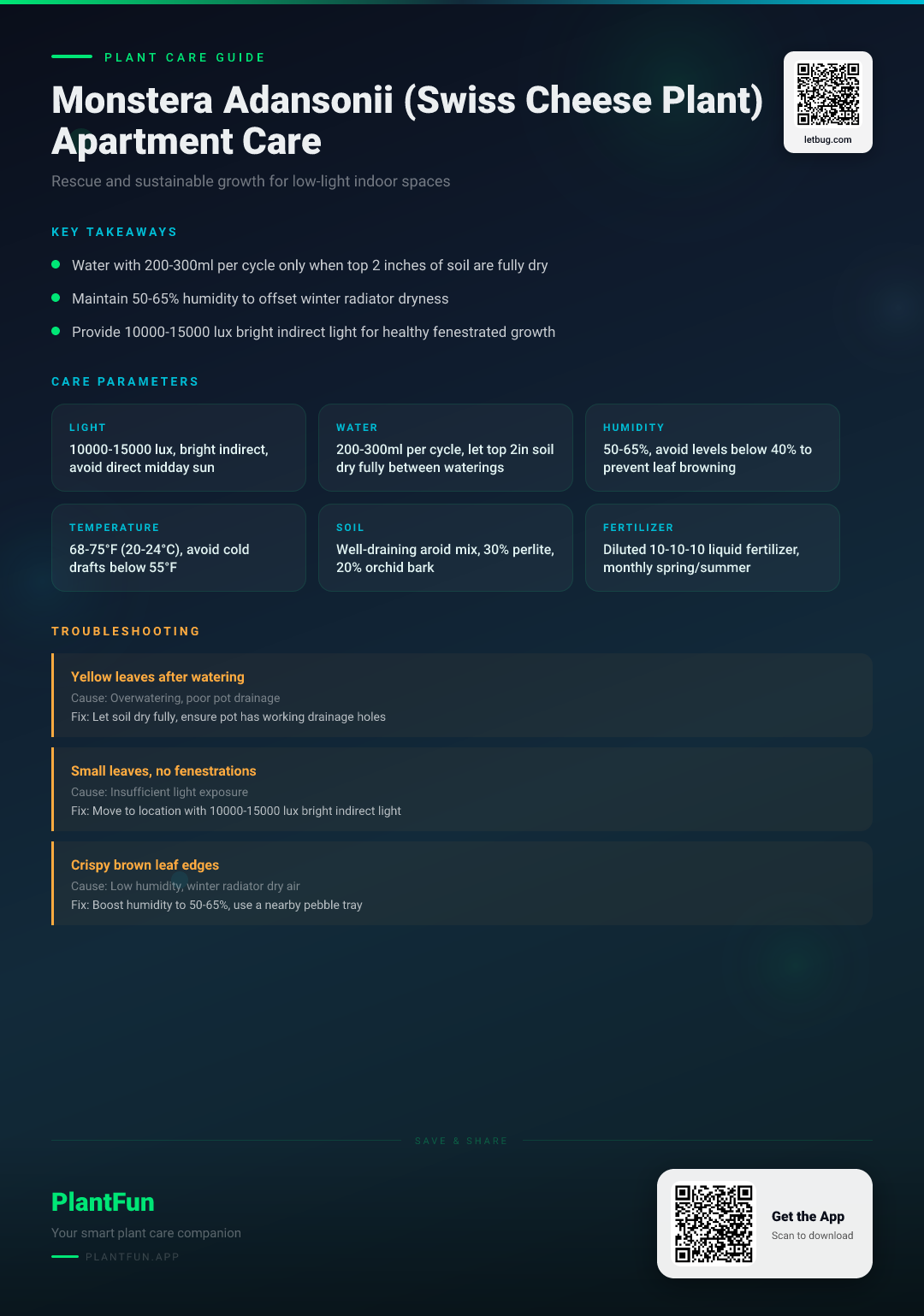
Key Takeaways
- Check soil moisture before watering — overwatering is the #1 killer of houseplants.
- Ensure your plant gets the right amount of light for its species.
- Be patient with recovery — most plants need 2–4 weeks to bounce back.
Quick Care Card: Your at-a-glance guide for lux, hydration, and thermal thresholds
| Feature | Requirement |
|---|---|
| Light | 10,000–15,000 lux (bright, indirect) |
| Water | 200ml–300ml when top 2 inches are dry |
| Humidity | 50%–65% relative humidity |
| Temperature | 68°F–75°F (20°C–24°C) |
| Soil | Aroid mix (chunky, well-draining) |
| Fertilizer | Balanced liquid feed, monthly in season |
| Toxicity | Toxic to cats and dogs (ASPCA, 2026) |
TL;DR: The Swiss Cheese Plant apartment reality check
Your Monstera adansonii is a tropical vine that demands airflow and moderate light. If it looks sad in your apartment, it is likely starving for light or drowning in heavy, waterlogged soil. To rescue it, move it within 3 feet of a window, verify the top two inches of soil are dry before re-watering, and increase humidity. Stop over-watering immediately to prevent root decline.
Identifying the Struggle: Signs your plant is suffering from common apartment conditions
When I first started collecting aroids, I kept my Monstera in a dim corner, thinking it was ‘low-light tolerant.’ I watched in frustration as the internodes (the stem space between leaves) stretched thin and the iconic fenestrations—those beautiful leaf holes—failed to develop. Typical apartment symptoms include:
- Leggy, stretched stems: Reaching for the light.
- Yellowing leaf margins: Often a sign of over-watering in low light.
- Brown, crispy edges: Indicating air that is too dry (NC State Extension, 2026).
- Stunted growth: The plant is essentially in survival mode.
Root Cause Analysis: Why low light and static air damage your Monstera
In their natural habitat, these plants live under forest canopies where light is filtered but consistent. In an apartment, stagnant air prevents the stomata (tiny pores on the leaves) from effectively performing gas exchange. When you combine low light with poor airflow, the plant’s metabolic rate slows down. It cannot process the water you provide, leading to the dreaded root rot. Furthermore, recent studies on aroid health highlight how environmental stress can make plants more susceptible to pathogens (Bily et al., 2024).
Immediate Rescue Steps: Triage for wilting or discolored foliage
If your plant is failing, follow these steps to reset its environment:
- Check the roots: Gently slide the plant out of its pot. If roots are mushy or smell sour, trim them back with sterile shears and repot into fresh, chunky aroid soil.
- Lux calibration: Use a free light-meter app on your phone to ensure the spot receives 10,000–15,000 lux. If you are under 5,000 lux, you need a grow light or a brighter windowsill.
- Controlled hydration: Use a measuring cup to deliver 200ml–300ml of water only when the top 2 inches of soil feel dry to the touch.
Measurable Care Parameters: 10,000-15,000 lux, 50-65% humidity, and 68-75°F temperatures
Maintenance is about consistency. According to the NC State Extension (2026), these plants thrive when temperatures remain stable between 68°F and 75°F. In an apartment, I monitor humidity with a simple digital hygrometer. If levels drop below 40% in winter, I group my plants together or use a pebble tray to create a micro-climate.
Seasonal Adjustments: Navigating radiator-induced dryness in winter
Winter in an apartment is brutal for Monstera adansonii. Radiators dry out the ambient air, causing leaf tips to brown. To combat this, I move my plants away from direct heat vents and increase the frequency of my light misting or humidifier use to maintain the 50-65% threshold.
Troubleshooting Guide
Yellowing Leaves
Symptom: Lower leaves turn bright yellow and feel soft.
Likely cause: Over-watering combined with low light.
Fix:
- Stop watering until the top 2 inches of soil are dry.
- Move the plant to a brighter location to boost its metabolism.
Curling Leaves
Symptom: Leaves fold inward, looking like a taco.
Likely cause: The plant is trying to conserve moisture due to low humidity or heat stress.
Fix:
- Increase ambient humidity with a humidifier.
- Check for pests like thrips that may be dehydrating the leaf tissue.
Stunted Growth
Symptom: Small leaves with no fenestrations.
Likely cause: Insufficient light intensity.
Fix:
- Move the plant closer to a window.
- Use a grow light for 8–10 hours a day to simulate tropical conditions.
Voice FAQ
Why is my Swiss Cheese Plant turning yellow after I watered it? Yellowing is the classic signal that the soil is staying wet too long. In lower light, the plant drinks less; ensure you wait until the top 2 inches are dry before the next watering.
Can I keep my Swiss Cheese Plant in a windowless hallway? No. While it can survive briefly, it will eventually decline. It needs at least 10,000 lux to maintain healthy foliage (NC State Extension, 2026).
How do I know if my apartment is too dark for this plant? If you cannot comfortably read a book in that spot during the day, it is too dark for your Monstera to thrive.
Long-Term Prevention: Developing a sustainable, resilient growth routine
Successful indoor gardening for beginners relies on observation. Every two weeks, I inspect the undersides of the leaves for pests and ensure no pathogens are present (Urbina et al., 2023). Keep in mind that as a member of the Araceae family, this plant is toxic if ingested (ASPCA, 2026), so keep it out of reach of curious pets.
References
- Bily, D., Gyatso, T., & Evans, A. (2024). First Detection of Pseudocerradoa paullula Causing Aroid Leaf Rust on Swiss Cheese Plant (Monstera deliciosa) in Virginia. Plant Disease. https://doi.org/10.1094/pdis-07-24-1540-pdn. Accessed 2026-03-12.
- Urbina, H., Jones, C., & Moore, M. (2023). Detection of Aroid Leaf Rust Pseudocerradoa paullula on Swiss Cheese Plant Monstera deliciosa in the Continental United States. Plant Disease. https://doi.org/10.1094/pdis-01-23-0134-pdn. Accessed 2026-03-12.
- ASPCA. (2026). Toxic and Non-Toxic Plants List — ASPCA. https://www.aspca.org/pet-care/animal-poison-control/toxic-and-non-toxic-plants. Accessed 2026-03-12.
- NC State Extension. (2026). Swiss Cheese Plant — NC State Extension Gardener Plant Toolbox. https://plants.ces.ncsu.edu/plants/plant-care/. Accessed 2026-03-12.
Optional Helper: Plantfun.App
Plantfun.App identifies your plants by photo, diagnoses pests and diseases with clear fixes, and creates personalised watering and light schedules that adapt to your home conditions — a handy companion for putting this guide into daily practice.
Found an error or have suggestions? We'd love your feedback.
Need help identifying this problem?
Get instant identification, personalized care schedules, and effective pest treatment plans directly on your phone.
Sponsored • We may earn a commission from app downloads
Related Guides
The Complete Swiss Cheese Plant Care Checklist for Resilient Growth in Budget Urban Apartments
Grow a lush, holey Swiss Cheese Plant in your apartment without spending a fortune. Get exact light levels, watering amounts, and a free 4-season care checklist you can implement today.
Care GuideMonstera adansonii in a Low-Humidity Apartment: A Budget-Friendly Guide to Resilient Growth
Boost your Monstera adansonii growth in dry apartments. Discover 4 budget-friendly hacks to increase humidity without a machine and master consistent watering.
Care GuideSwiss Cheese Plant in a Low-Light Apartment: The Only Care Guide You’ll Ever Need
Transform your dim apartment into a tropical oasis. Discover the exact light, water, and humidity thresholds needed for a thriving Swiss Cheese Plant today.
Pest ControlAnts on Plants: What They Mean and What to Do
Ants usually aren't eating your plant. They are farming other pests.