
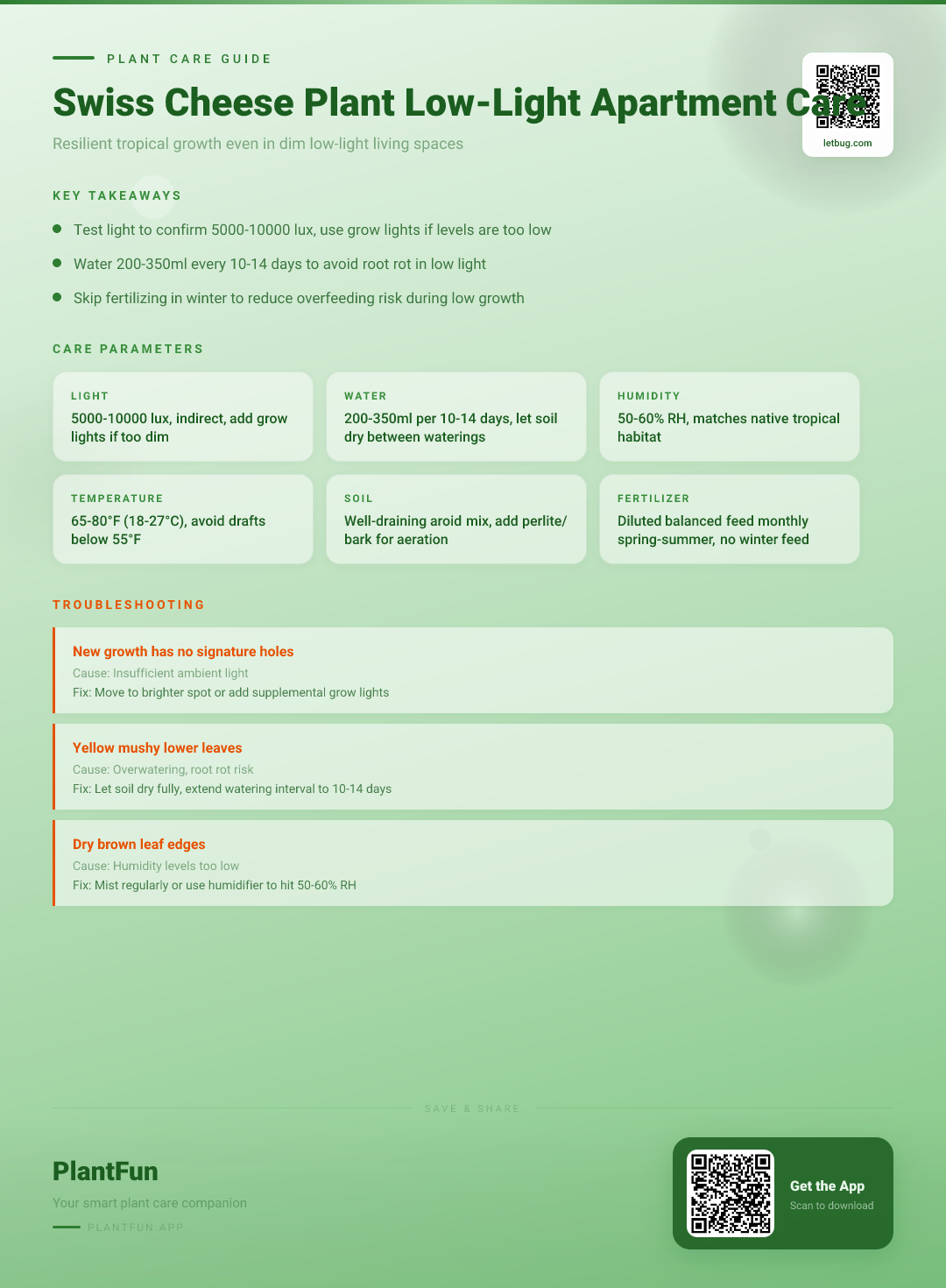
Key Takeaways
- Check soil moisture before watering — overwatering is the #1 killer of houseplants.
- Ensure your plant gets the right amount of light for its species.
- Be patient with recovery — most plants need 2–4 weeks to bounce back.
TL;DR: You can keep a Monstera deliciosa in a low-light apartment by managing your expectations. While it won’t grow rapidly or develop deep fenestrations (the signature holes) without bright, indirect light, you can maintain its health by strictly limiting water to prevent rot, supplementing with grow lights if possible, and maintaining 50-60% relative humidity. Avoid over-fertilizing during winter, and always check that the top 2 inches of soil are dry before reaching for your watering can.
Quick Care Card: Essential Parameters for Apartment Success
| Parameter | Requirement |
|---|---|
| Light | 5,000–10,000 lux (Bright, indirect) |
| Watering | 200-350ml every 10-14 days (Soil-dependent) |
| Humidity | 50-60% RH |
| Temperature | 65-80°F (18-27°C) |
| Soil | Well-draining aroid mix (bark, perlite, peat) |
| Fertilizer | Balanced liquid feed, monthly in growing season |
| Toxicity | Toxic to cats and dogs (ASPCA, 2026) |
My Experience
When I first brought my Monstera deliciosa into my ground-floor apartment, I made the mistake of placing it in a “decorative corner” far from the windows. Within a month, the beautiful foliage began yellowing and the stems grew thin and “leggy”—reaching desperately for a light source that wasn’t there. I learned the hard way that while these plants are resilient, they aren’t magic; they require specific environmental cues to survive, not just exist.
Why Your Swiss Cheese Plant Struggles in Low Light
In its natural habitat, the Monstera deliciosa is an understory climber, but “understory” does not mean “dark cupboard.” (NC State Extension, 2026). In an apartment, low light triggers a survival mechanism where the plant prioritizes upward growth over leaf development. This is why you might see new stems reaching toward a window while existing leaves turn yellow or drop entirely.
Evaluating Your Apartment Light: How to measure 5,000–10,000 lux
Light intensity is the single most critical factor. I recommend using a simple light meter app on your smartphone to measure the “lux” at leaf level. If your reading is consistently below 2,000 lux, your plant is in a state of starvation. You need to aim for 5,000–10,000 lux for steady, healthy growth.
Watering Mastery: Avoiding root rot in limited light (200-350ml per 10-14 days)
In dim rooms, your plant’s metabolic rate slows down, meaning it consumes water far slower than it would in a greenhouse.
- The Finger Test: Before watering, stick your finger 2 inches into the soil. If it feels damp, wait.
- Controlled Dosing: Use a measuring cup. Start with 200ml. If the soil remains saturated for more than 14 days, you are risking root rot.
Humidity & Airflow: Maintaining 50-60% RH to mimic tropical origins
Central heating in apartments creates “desert conditions” that brown the edges of leaves. Use a dedicated hygrometer to monitor for 50-60% Relative Humidity. I personally use a pebble tray or a small humidifier placed three feet from my Monstera to bridge the gap without saturating the surrounding air too much.
Temperature Control: Keeping your Monstera between 65-80°F (18-27°C)
Avoid placing your plant near heating vents or drafty doorways. Fluctuations in temperature can shock the plant, leading to stunted leaf growth or leaf drop (NC State Extension, 2026).
Format A: Step-by-Step Care Calendar for Apartment Dwellers
- Week 1: Check soil moisture. If dry, apply 250ml of room-temperature water.
- Week 2: Clean leaves with a damp cloth to maximize light absorption.
- Week 3: Inspect for signs of pests or Aroid Leaf Rust (Bily et al., 2024).
- Week 4: Rotate the pot 90 degrees to ensure even exposure to available light.
Can I keep my Swiss Cheese plant in a corner without a window?
Technically, it will survive for a short time, but it will not thrive. If you must have it in a dark corner, you must invest in a full-spectrum LED grow light. Without supplemental light, the plant will eventually deplete its stored energy.
Why is my Monstera losing its leaf holes in a dim room?
Fenestrations (the holes) are an adaptation to allow light to reach lower leaves in a forest canopy. In a dim apartment, the plant “decides” that growing these complex shapes is too energy-expensive. It will produce solid, heart-shaped leaves instead to maximize the surface area for photosynthesis.
Common Mistakes: The danger of over-fertilizing in winter months
- Mistake: Using high-nitrogen fertilizer in late autumn.
- What happens: The plant is forced to grow when light levels are insufficient, causing weak, spindly stems.
- Instead: Halt all fertilization from November to February.
Troubleshooting: When to supplement with grow lights
Leaf Yellowing
Symptom: Lower leaves turning yellow and eventually falling off.
Likely cause: Overwatering or light deficiency.
Fix:
- Check soil moisture levels with the finger test.
- If soil is soggy, repot into a mix with more perlite or bark.
- Move the plant to a brighter location or add a dedicated grow light.
Brown, Crispy Edges
Symptom: The tips of leaves are turning brown and crispy.
Likely cause: Low humidity or salt buildup.
Fix:
- Increase ambient humidity using a humidifier.
- Flush the soil with distilled water to remove mineral buildup.
Stunted Growth
Symptom: The plant has not produced a new leaf in months.
Likely cause: Insufficient light intensity.
Fix:
- Move the plant closer to a window.
- Increase the duration of supplemental light to 10-12 hours per day.
References
- Bily, D., Gyatso, T., & Evans, A. (2024). First Detection of Pseudocerradoa paullula Causing Aroid Leaf Rust on Swiss Cheese Plant (Monstera deliciosa) in Virginia. Plant Disease. https://doi.org/10.1094/pdis-07-24-1540-pdn. Accessed 2026-03-12.
- Urbina, H., Jones, C., & Moore, M. (2023). Detection of Aroid Leaf Rust Pseudocerradoa paullula on Swiss Cheese Plant Monstera deliciosa in the Continental United States. Plant Disease. https://doi.org/10.1094/pdis-01-23-0134-pdn. Accessed 2026-03-12.
- ASPCA. (2026). Toxic and Non-Toxic Plants List — ASPCA. https://www.aspca.org/pet-care/animal-poison-control/toxic-and-non-toxic-plants. Accessed 2026-03-12.
- NC State Extension. (2026). Swiss Cheese Plant — NC State Extension Gardener Plant Toolbox. https://plants.ces.ncsu.edu/plants/cheese-plant/. Accessed 2026-03-12.
Optional Helper: Plantfun.App
Plantfun.App identifies your plants by photo, diagnoses pests and diseases with clear fixes, and creates personalised watering and light schedules that adapt to your home conditions — a handy companion for putting this guide into daily practice.
Found an error or have suggestions? We'd love your feedback.
Need help identifying this problem?
Get instant identification, personalized care schedules, and effective pest treatment plans directly on your phone.
Sponsored • We may earn a commission from app downloads
Related Guides
The Complete Swiss Cheese Plant Care Checklist for Resilient Growth in Budget Urban Apartments
Grow a lush, holey Swiss Cheese Plant in your apartment without spending a fortune. Get exact light levels, watering amounts, and a free 4-season care checklist you can implement today.
Care GuideSwiss Cheese Plant in a Low-Light Apartment: The Only Care Guide You’ll Ever Need
Transform your dim apartment into a tropical oasis. Discover the exact light, water, and humidity thresholds needed for a thriving Swiss Cheese Plant today.
Care GuideMonstera Deliciosa in a Dry Apartment: The Complete Care Guide for Resilient Growth
Transform your struggling Monstera into a thriving centerpiece. Follow our exact 50% humidity protocol and light-based watering cycles for lush, fenestrated leaves.
ToolMonstera Deliciosa in East-Facing Apartments: Budget & Pro Tools for Perfect Light & Water
Stop guessing light and water for your east-facing Monstera deliciosa. Get budget and pro tool picks, exact care thresholds, and a seasonal guide to keep leaves lush and full of fenestrations.