
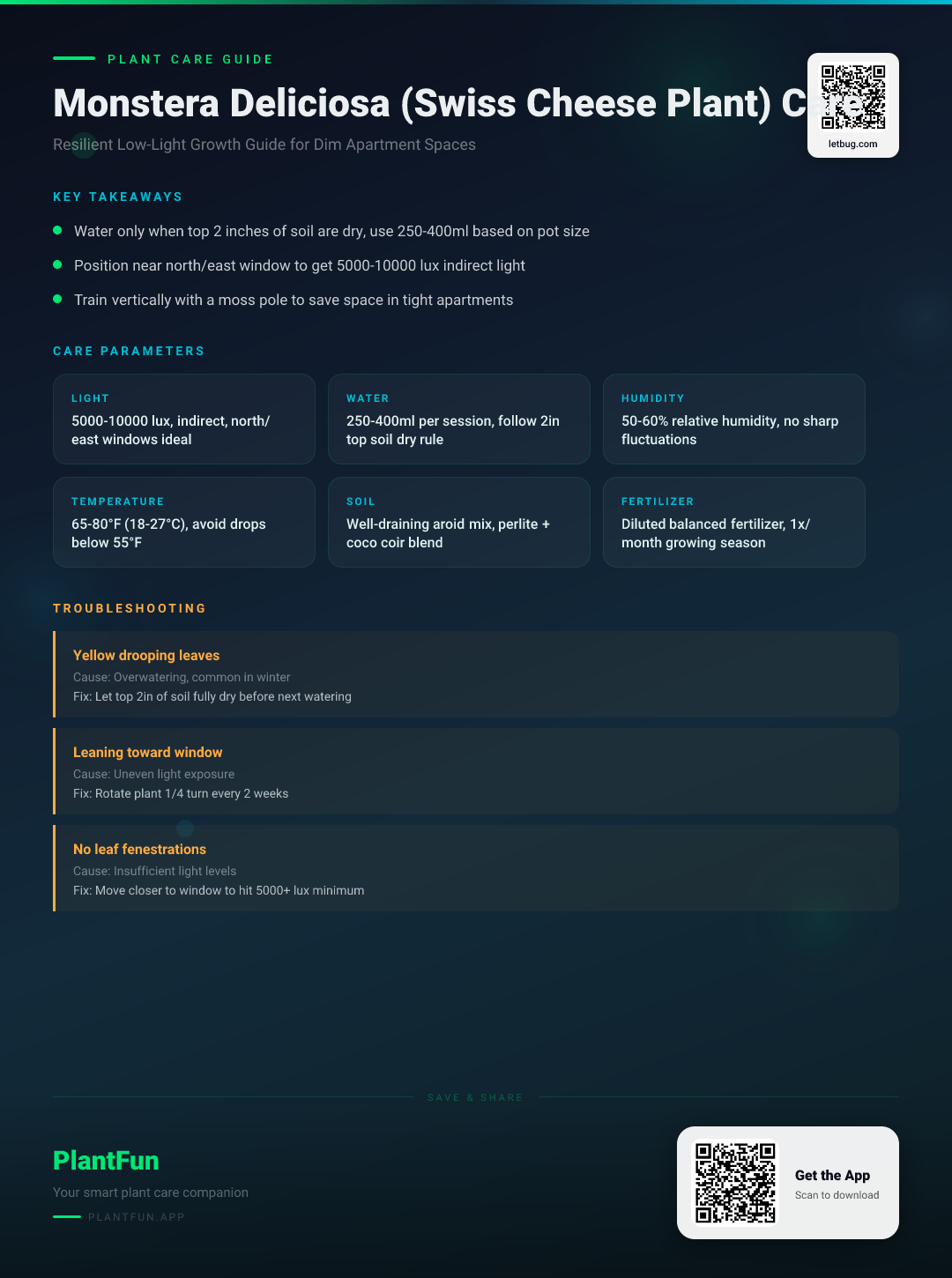
Key Takeaways
- Check soil moisture before watering — overwatering is the #1 killer of houseplants.
- Ensure your plant gets the right amount of light for its species.
- Be patient with recovery — most plants need 2–4 weeks to bounce back.
TL;DR: You can absolutely grow a healthy, fenestrated Monstera deliciosa in an apartment. The secret is maximizing available light (aim for 5,000–10,000 lux), avoiding the overwatering trap, and training your plant vertically to manage space. Use the 2-inch soil moisture test to determine when to water, and prioritize bright, indirect light over direct sun to prevent leaf scorch.
Quick Care Card: Essential thresholds for Monstera health
| Feature | Requirement |
|---|---|
| Light | 5,000–10,000 lux (bright, indirect) |
| Water | Allow top 2 inches to dry out |
| Humidity | 50–60% |
| Temperature | 65–80°F (18–27°C) |
| Soil | Well-draining aroid mix (bark, perlite, peat) |
| Fertilizer | Balanced liquid feed, monthly in summer |
| Toxicity | Toxic to cats and dogs (ASPCA, 2026) |
Why Monstera deliciosa struggles in average apartments
When I first brought home my Monstera deliciosa, I made the mistake of placing it in a dark corner of my bedroom. Within weeks, the plant became “leggy”—the stems stretched, searching for light, and the iconic fenestrations (the natural holes in the leaves) stopped developing. Apartments often lack the high-intensity light these tropical epiphytes crave. However, by understanding their natural habit of climbing trees to reach higher light zones, we can simulate these conditions in small urban spaces.
Format A: The Complete Scenario Guide - Introduction to resilience
To succeed with Monstera deliciosa care, you must stop treating your apartment like a static environment. Successful growers view the plant as an active participant in the space. In a low-light setup, your goal is to manage the plant’s energy intake versus its water consumption. If the light is lower, the plant’s metabolic rate slows down (NC State Extension, 2026), meaning you must adjust your watering schedule accordingly.
Light Requirements: Achieving 5,000-10,000 lux in north or east-facing rooms
Light is the engine for leaf production. In an apartment, I recommend placing your Monstera within 2–3 feet of a north or east-facing window.
- The Lux Test: If you don’t have a light meter, use a free phone sensor app to verify your spot receives 5,000–10,000 lux.
- North-facing: Your plant will need to be right against the glass.
- East-facing: This is ideal, as it provides gentle morning sun without the intensity that burns foliage.
Watering Mastery: Using the 2-inch rule (approx. 250-400ml depending on pot size)
Avoid a rigid schedule. Instead, use the “finger test”: push your index finger 2 inches into the soil. If it feels damp, wait. If it is dry, provide approximately 250–400ml of water, ensuring excess drains away. Watering too frequently is the most common cause of root rot in low-light settings.
Humidity & Temperature: Maintaining 50-60% humidity and 65-80°F (18-27°C)
Monstera deliciosa thrives in the warmth of typical human living spaces. Keep your thermostat between 65–80°F (18–27°C). If your home is dry—common in winter with radiator heat—use a small humidifier to maintain 50–60% relative humidity. This helps the foliage stay supple and prevents crispy edges.
Seasonal Calendar: Adjusting your care cycle for apartment climate shifts
- Spring/Summer: Growth phase. Increase water slightly, fertilize monthly.
- Fall/Winter: Dormancy phase. Reduce water significantly as light levels drop, and cease fertilization until new growth appears in spring.
Common Mistakes: Avoiding the ‘overwatering trap’ in winter months
- Mistake: Watering on a calendar schedule.
- What happens: Water sits in the pot, leading to anaerobic conditions and root rot.
- Instead: Only water when the top 2 inches of soil are dry, regardless of the calendar.
Yellowing Leaves
Symptom: Lower leaves turning yellow and mushy.
Likely cause: Overwatering.
Fix:
- Check soil moisture levels immediately.
- Ensure the pot has adequate drainage holes.
Brown Leaf Tips
Symptom: Edges of leaves becoming dry and crispy.
Likely cause: Low humidity.
Fix:
- Use a humidifier nearby.
- Group plants together to create a micro-climate.
Voice Search FAQ: Why is my Monstera leaning toward the window?
Your plant is exhibiting phototropism. It is stretching toward the light source because it lacks the intensity required to sustain its current growth. Rotate the pot 90 degrees every two weeks to promote even growth.
Voice Search FAQ: How often should I actually water my Monstera?
There is no one-size-fits-all answer. As discussed in our guide on indoor watering habits, checking the soil moisture manually is the only reliable method to prevent root rot.
Expert Tips: Training your plant to grow vertically in tight spaces
In the wild, these plants are climbers. Using a moss pole helps the plant reach toward the light source vertically, which saves floor space and triggers the development of larger, more mature leaves with more fenestrations. Tie the main stem to the pole as it grows to encourage this behavior.
Conclusion: Building a long-term relationship with your indoor Monstera
Caring for a Monstera in an apartment is about observation. While pathogens like leaf rust can occasionally affect foliage (Bily et al., 2024), most issues are preventable through consistent environmental management. Treat your plant as a living partner, and it will reward you with lush, architectural growth for years to come.
References
- ASPCA. (2026). Toxic and Non-Toxic Plants List — ASPCA. https://www.aspca.org/pet-care/animal-poison-control/toxic-and-non-toxic-plants. Accessed 2026-03-11.
- Bily, D., Gyatso, T., & Evans, A. (2024). First Detection of Pseudocerradoa paullula Causing Aroid Leaf Rust on Swiss Cheese Plant (Monstera deliciosa) in Virginia. Plant Disease. https://doi.org/10.1094/pdis-07-24-1540-pdn. Accessed 2026-03-11.
- NC State Extension. (2026). Swiss Cheese Plant Care — NC State Extension Gardener Plant Toolbox. https://plants.ces.ncsu.edu/plants/plant-care/. Accessed 2026-03-11.
- Peltomaa, K. (2012). James Reason. Quality Management in Health Care. https://doi.org/10.1097/qmh.0b013e3182418294. Accessed 2026-03-11.
Optional Helper: Plantfun.App
Plantfun.App identifies your plants by photo, diagnoses pests and diseases with clear fixes, and creates personalised watering and light schedules that adapt to your home conditions — a handy companion for putting this guide into daily practice.
Found an error or have suggestions? We'd love your feedback.
Need help identifying this problem?
Get instant identification, personalized care schedules, and effective pest treatment plans directly on your phone.
Sponsored • We may earn a commission from app downloads
Related Guides
Monstera Deliciosa in a Low-Light Apartment: The Complete Care Guide for Resilient Growth
Transform your dim apartment into a tropical oasis. Master Monstera deliciosa care with 4 exact light-to-water ratios and a growth schedule that ensures fenestrations.
Care GuideMonstera Deliciosa Care Checklist: Grow Lush Leaves in Typical Small Urban Apartments
Grow lush, holey Monstera deliciosa leaves even in a small urban apartment. Get exact light, water, humidity thresholds plus a symptom-to-action checklist for stress-free resilient growth.
Care GuideMonstera Deliciosa in a Typical Apartment: The Only Resilience Care Guide You Need
Revive your Monstera with precise, apartment-friendly care. Learn exact lux needs, 7-day watering intervals, and how to prevent brown edges for lush growth.
Pest ControlHow to Spot Early Pest Signs on Your Monstera Deliciosa: A Weekly Inspection & Rescue Plan
Catch Monstera deliciosa pest infestations before they permanently damage your prized fenestrated leaves. Get a 5-minute weekly inspection routine, easy-to-spot early warning signs, and non-toxic rescue steps you can implement today to stop spread to other houseplants.