
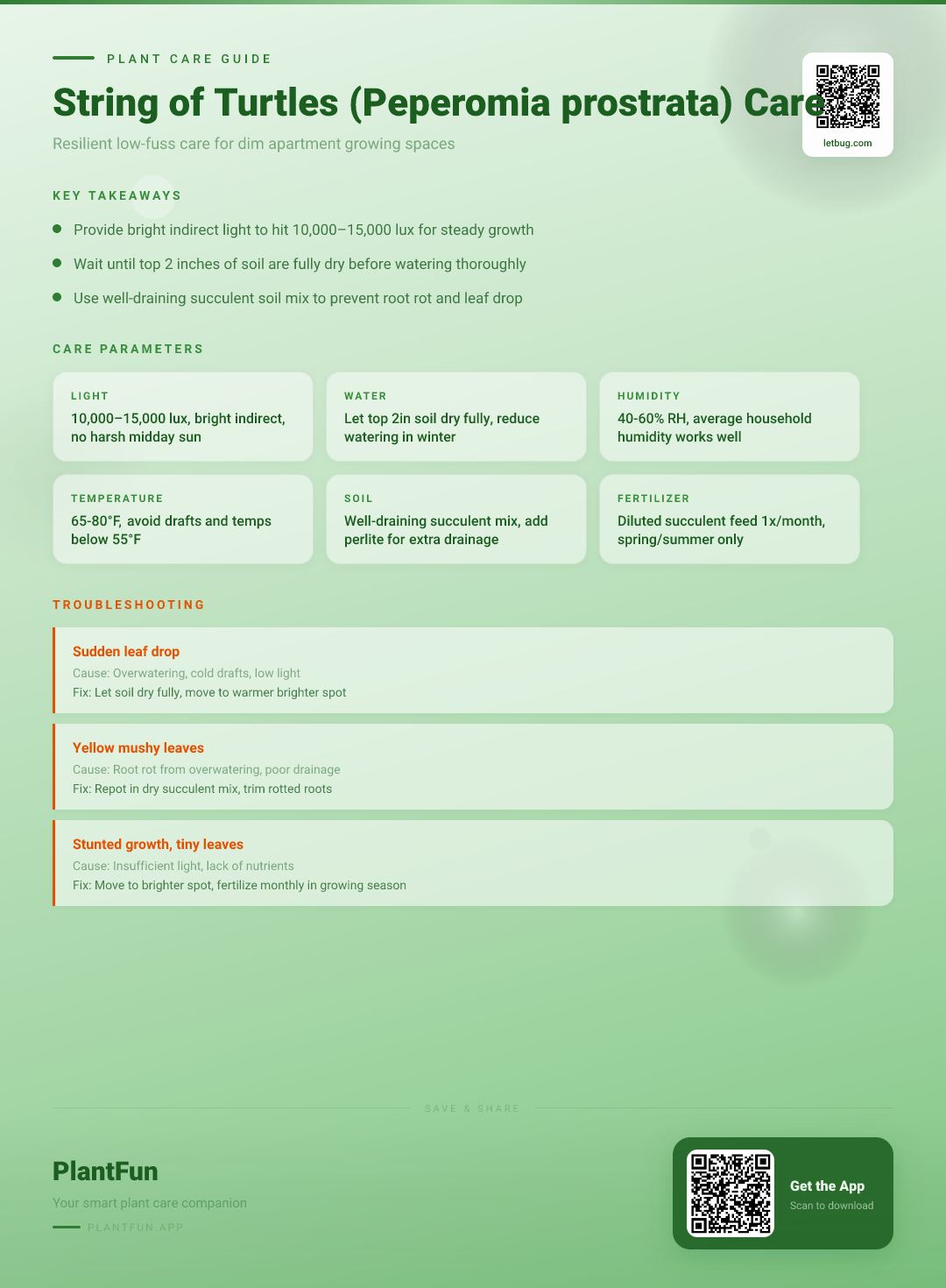
Key Takeaways
- Check soil moisture before watering — overwatering is the #1 killer of houseplants.
- Ensure your plant gets the right amount of light for its species.
- Be patient with recovery — most plants need 2–4 weeks to bounce back.
Quick Care Card: Essential Thresholds for Peperomia prostrata
| Category | Requirement |
|---|---|
| Light | 10,000–15,000 lux (bright, indirect) |
| Water | Allow top 50% of soil to dry |
| Humidity | 40–60% (moderate) |
| Temperature | 65–80°F (18–27°C) |
| Soil | Fast-draining, peat-free succulent mix |
| Fertilizer | Balanced liquid feed at half-strength (monthly) |
| Toxicity | Non-toxic (ASPCA, 2026) |
TL;DR: The 30-Second Apartment Strategy
To keep your Peperomia prostrata happy in an apartment, stop treating it like a typical trailing houseplant. It is a semi-succulent that demands high aeration and bright, indirect light. If you are struggling, move it within 2 feet of a window, switch to a chunky, orchid-bark-heavy soil mix, and only water when the leaves feel slightly soft to the touch. Avoid the “soak-and-dry” calendar approach; instead, rely on the “leaf-squeeze” test.
Why Your String of Turtles Isn’t Growing (Diagnosis-First)
When I first brought home my Peperomia prostrata, I tucked it into a decorative ceramic pot without a drainage hole, thinking it looked aesthetic. Within three weeks, the stems went mushy and the leaves began to drop. I learned the hard way: Peperomia prostrata is a slow-growing epiphyte (NC State Extension, 2026). If it isn’t growing, it’s usually because the roots are suffocating or the light is too dim to fuel photosynthesis. Before you buy more fertilizer, check the root health; if the roots are brown and mushy, your plant is struggling with anaerobic conditions.
Light Requirements: Achieving 10,000–15,000 Lux in Typical Living Spaces
Many apartment dwellers assume “low light” means dark corners. In reality, Peperomia prostrata needs bright, indirect light to maintain its signature pattern and compact growth rate. If you don’t have a light meter, use this simple rule: the plant should be able to “see” the sky from its position. If it’s on a bookshelf more than 3 feet from a window, it is in “survival mode” rather than “growth mode.”
Watering Mastery: Why the ‘Soak-and-Dry’ Method Fails in Apartments
In most homes, the “soak-and-dry” method leads to root rot because apartment air circulation is often poorer than in a greenhouse. Instead, I use the weight-and-feel method. Pick up your pot before and after watering. If it feels light, it is time. If the leaves are firm and plump, the plant has sufficient moisture stored in its succulent foliage. Only irrigate when the leaves show slight pliability (NC State Extension, 2026).
Soil Science: Creating the Perfect Succulent-Friendly Mix
Standard potting soil is the enemy of the String of Turtles. To recreate its natural epiphytic environment, I mix:
- 50% High-quality coco coir or peat moss
- 30% Perlite or pumice for drainage
- 20% Orchid bark to allow oxygen to reach the roots
Humidity & Temperature: Keeping Your Plant Happy Between 65-80°F
While they tolerate average home humidity, these plants thrive when temperatures remain stable between 65–80°F (NC State Extension, 2026). Avoid placing them near drafty windows or active AC vents, which can cause rapid leaf drop.
Troubleshooting Guide: Why is my String of Turtles losing leaves?
[Overwatering]
Symptom: Yellow, translucent leaves that fall off at the slightest touch.
Likely cause: Excess moisture trapped in the soil.
Fix:
- Remove the plant from the pot and inspect for black, mushy roots.
- Trim away rotting roots with sterile scissors.
- Repot into a terracotta pot with a chunkier, better-draining medium.
[Light Deprivation]
Symptom: Stems are becoming “leggy” with large gaps between leaves.
Likely cause: The plant is stretching to find a light source.
Fix:
- Move the plant closer to an east-facing window.
- Consider a supplementary LED grow light if natural light is insufficient.
[Low Humidity/Heat Stress]
Symptom: Crisp, brown edges on the leaves.
Likely cause: Dry apartment air or proximity to a heater.
Fix:
- Move the plant away from radiators or air vents.
- Use a small humidity tray filled with pebbles and water beneath the pot.
Can I keep my String of Turtles in a dark corner of my bedroom?
While you can place the plant there for a short time for aesthetic purposes, it will not thrive. It will likely stop growing and eventually lose its variegation. I recommend keeping it near a window and rotating it weekly for even light distribution.
How often should I really water my String of Turtles in winter?
Winter growth slows down significantly due to lower light levels (NC State Extension, 2026). During this period, you may only need to water once every 3–4 weeks. Always check the leaves; if they are still plump, wait another week.
Seasonal Care Calendar: Adjusting for the Shift in Apartment Light
- Spring/Summer: Increase watering frequency slightly as growth picks up. Fertilize at 50% strength once a month.
- Autumn/Winter: Reduce water significantly. Stop all fertilization to allow the plant to enter its natural dormancy period.
Common Mistakes to Avoid for Beginners
- Mistake: Using a pot without drainage. What happens: Water accumulates at the bottom, leading to root death. Instead: Always use a pot with a drainage hole or a plastic liner that can be removed for watering.
- Mistake: Heavy-handed watering. What happens: The plant rots quickly. Instead: Wait until the leaves feel slightly soft.
References
- Hoskins, J. (1998). From ‘yocto’ to ‘Yotta’ and How Long Is a Piece of String. Indoor and Built Environment. https://doi.org/10.1177/1420326x9800700401. Accessed 2026-03-18.
- Hoskins, J. (1998). From ‘yocto’ to ‘Yotta’ andHow Long Is a Piece of String. Indoor and Built Environment. https://doi.org/10.1159/000024580. Accessed 2026-03-18.
- ASPCA. (2026). Toxic and Non-Toxic Plants List — ASPCA. https://www.aspca.org/pet-care/animal-poison-control/toxic-and-non-toxic-plants. Accessed 2026-03-18.
- NC State Extension. (2026). String of Turtles — NC State Extension Gardener Plant Toolbox. https://plants.ces.ncsu.edu/plants/turtles-care/. Accessed 2026-03-18.
Optional Helper: Plantfun.App
Plantfun.App identifies your plants by photo, diagnoses pests and diseases with clear fixes, and creates personalised watering and light schedules that adapt to your home conditions — a handy companion for putting this guide into daily practice.
Found an error or have suggestions? We'd love your feedback.
Need help identifying this problem?
Get instant identification, personalized care schedules, and effective pest treatment plans directly on your phone.
Sponsored • We may earn a commission from app downloads
Related Guides
String of Turtles in a Typical Apartment: The Only Care Guide You’ll Ever Need
Transform your String of Turtles into a lush, cascading centerpiece. Learn exact water volumes, light intensity, and soil recipes for thriving in any apartment.
Care GuideThe Complete String of Turtles Care Checklist for Resilient Growth in Small Urban Apartments
Grow lush, trailing String of Turtles even in a small urban apartment. Get our free 8-step budget-friendly checklist with exact light, water, and soil specs to prevent leaf drop and boost resilient growth.
Care GuideString of Turtles in Typical Apartments: The Only Care Checklist You Need for Lush, Resilient Growth
Stop watching your String of Turtles shrivel or grow leggy in your apartment. Get 12 actionable science-backed care steps, exact light/water thresholds, and a troubleshooting guide for lush, resilient growth.
Pest ControlAnts on Plants: What They Mean and What to Do
Ants usually aren't eating your plant. They are farming other pests.