
Key Takeaways
- Check soil moisture before watering — overwatering is the #1 killer of houseplants.
- Ensure your plant gets the right amount of light for its species.
- Be patient with recovery — most plants need 2–4 weeks to bounce back.
TL;DR: The Essentials
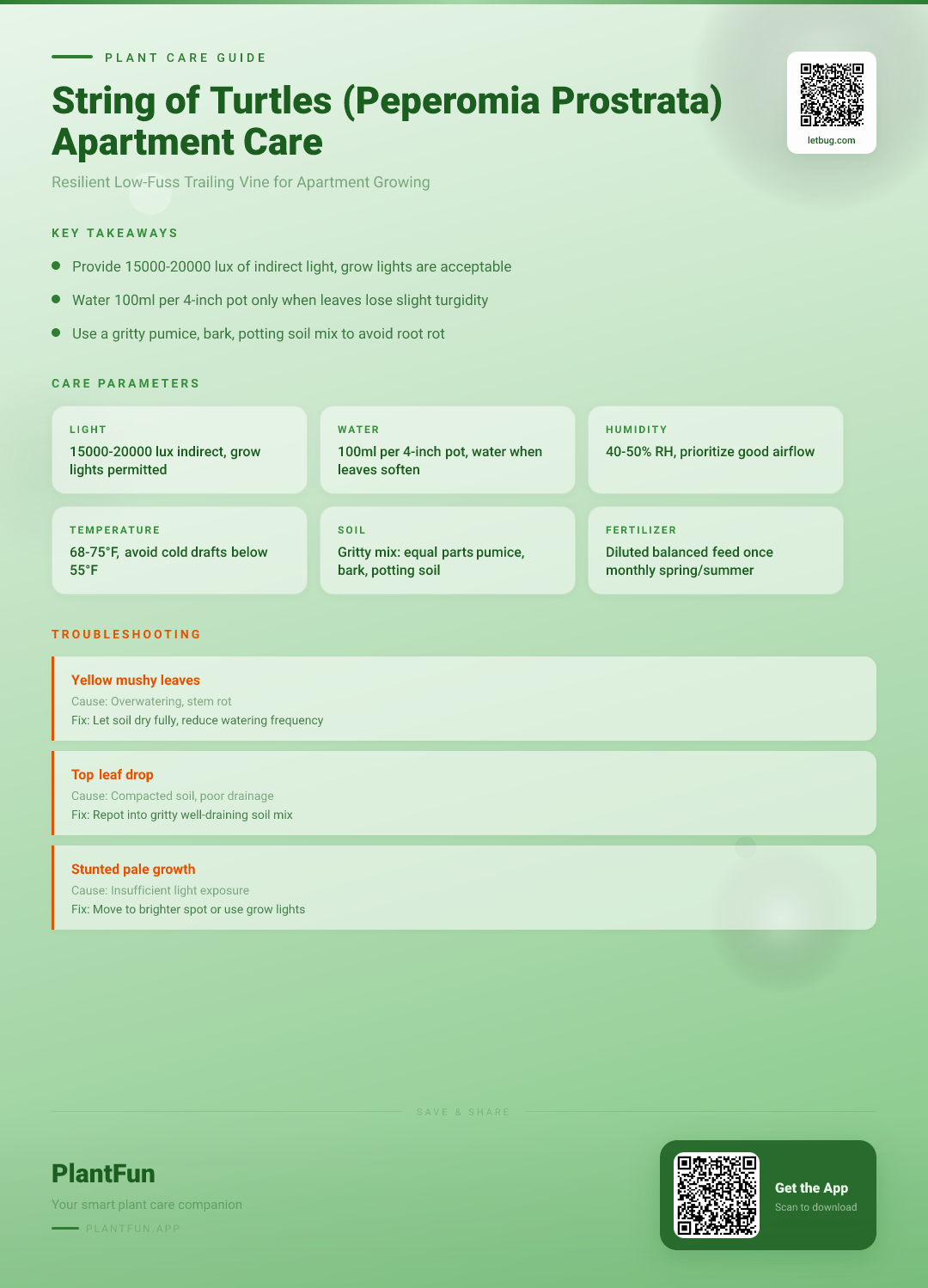
String of Turtles (Peperomia prostrata) thrives in bright, indirect light (15,000–20,000 lux) and well-draining, gritty soil. Water only when the top inch of soil feels dry—typically 100ml per 4-inch pot—and ensure high drainage to avoid root rot. Maintain 40–50% humidity and keep temperatures between 68–75°F.
Quick Care Card
| Feature | Requirement |
|---|---|
| Light | 15,000–20,000 lux (Bright, indirect) |
| Water | 100ml per 4-inch pot when dry |
| Humidity | 40–50% |
| Temperature | 68–75°F (20–24°C) |
| Soil | Gritty mix (pumice, bark, soil) |
| Fertilizer | Balanced liquid feed (diluted) in spring |
| Toxicity | Non-toxic to cats and dogs (ASPCA, 2026) |
My Experience: The “First Turtle” Lesson
When I first brought home a Peperomia prostrata, I assumed it would behave like a succulent. I tucked it into a glass terrarium near a radiator and watered it whenever I remembered. Within three weeks, the stems went mushy and the leaves dropped. It was a classic case of stagnant airflow meeting improper drainage. I learned the hard way that while these plants have thick, succulent-like leaves, they are epiphytic in nature and despise being smothered in damp, airless environments.
The Apartment Reality
In many apartments, the primary challenge is not the light, but the airflow. Unlike a greenhouse, our homes often feature stagnant pockets. When you place a delicate trailer like a String of Turtles in a corner without a breeze, the soil stays damp for too long. If you struggle with this, I recommend reading our guide on how to improve indoor air circulation to prevent fungal issues.
Understanding the Peperomia Prostrata Habitat
Native to the Brazilian rainforest, this plant naturally grows in the dappled shade of trees (NC State Extension, 2026). It is an epiphyte, meaning it anchors itself to bark or moss rather than sitting in dense mud. Understanding this is key to success: it requires oxygen around its roots just as much as it requires moisture.
Step-by-Step Care Guide
- Light: Aim for 15,000–20,000 lux. If you don’t have a south-facing window, a simple LED grow light 6–10 inches above the foliage works wonders.
- Watering: Use a turkey baster or measuring cup to apply exactly 100ml of water to a 4-inch pot only when the top 1–2 inches of soil are dry to the touch.
- Drainage: Ensure your pot has multiple drainage holes. If you use a decorative cachepot, empty it 20 minutes after watering.
- Environmental Check: Keep the plant away from AC vents and heaters to maintain the steady 68–75°F range.
The Soil Science
Standard potting soil is often too peat-heavy, which holds too much water for a Peperomia. I mix my own medium: 40% succulent soil, 40% pumice or perlite, and 20% orchid bark. This ensures the roots get plenty of aeration.
Identifying Watering Stress
Look at the leaves. If they look slightly flat or wrinkled, the plant is dehydrated. If they are yellowing or falling off at the slightest touch, you are overwatering. Always use the finger test: push your finger two inches deep into the soil; if it feels cool and damp, step away from the watering can.
FAQ
Why is my String of Turtles losing leaves near the top of the pot? This is usually a sign of low light or poor air circulation near the base of the plant. The top of the pot receives less light than the trailing ends. Try to move it closer to a light source.
Can I keep my String of Turtles under grow lights if I don’t have a window? Yes. I keep mine under a 20W LED grow light for 12 hours a day. It is often more consistent than unpredictable apartment sunlight.
Is this plant safe for my pets? According to the ASPCA (2026), Peperomia prostrata is non-toxic to cats and dogs, making it a safe choice for pet owners.
Troubleshooting
Stem Rot
Symptom: Mushy, brown stems near the soil line.
Likely cause: Overwatering or soil that is too dense.
Fix:
- Remove the plant from the pot immediately.
- Trim away rotting roots and repot into fresh, gritty mix.
Yellowing Leaves
Symptom: Lower leaves turning yellow and dropping.
Likely cause: Root suffocation.
Fix:
- Reduce watering frequency.
- Increase airflow near the plant.
Seasonal Growth Calendar
- Spring: Growth kicks in. Increase water slightly and add diluted fertilizer.
- Summer: Focus on preventing heat stress. Ensure it doesn’t bake in direct sun.
- Fall: Growth slows. Let the soil dry out more between waterings.
- Winter: Dormancy. Water sparingly. If you notice leaf drop, check if the plant is too close to a drafty window.
Common Mistakes to Avoid
- Mistake: Using glass containers. What happens: No drainage leads to root rot. Instead: Always use breathable ceramic or plastic pots with holes.
- Mistake: Repotting too often. What happens: The plant hates root disturbance. Instead: Only repot when the roots are circling the base, usually every 2 years.
References and Botanical Notes
- ASPCA. (2026). Toxic and Non-Toxic Plants List — ASPCA. https://www.aspca.org/pet-care/animal-poison-control/toxic-and-non-toxic-plants. Accessed 2026-03-17.
- Garner, L. (2010). A thing for string. Child Care. https://doi.org/10.12968/chca.2010.7.10.78397. Accessed 2026-03-17.
- Garner, L. (2013). I never knew that about turtles. Child Care. https://doi.org/10.12968/chca.2013.10.5.6. Accessed 2026-03-17.
- NC State Extension. (2026). String of Turtles Care — NC State Extension Gardener Plant Toolbox. https://plants.ces.ncsu.edu/plants/turtles-care/. Accessed 2026-03-17.
Optional Helper: Plantfun.App
Plantfun.App identifies your plants by photo, diagnoses pests and diseases with clear fixes, and creates personalised watering and light schedules that adapt to your home conditions — a handy companion for putting this guide into daily practice.
Found an error or have suggestions? We'd love your feedback.
Need help identifying this problem?
Get instant identification, personalized care schedules, and effective pest treatment plans directly on your phone.
Sponsored • We may earn a commission from app downloads
Related Guides
String of Turtles in a Dim Apartment: The Complete Care Guide for Resilient Growth
Master String of Turtles care in low-light apartments. Learn exact watering volumes, light requirements, and a 4-step revival plan to keep your vines trailing.
Care GuideString of Turtles in a Typical Apartment: The Only Care Guide You’ll Ever Need
Transform your String of Turtles into a lush, cascading centerpiece. Learn exact water volumes, light intensity, and soil recipes for thriving in any apartment.
Care GuideString of Turtles in a Typical Apartment: The Complete Seasonal Care Guide
Master your String of Turtles care with this expert guide. Get seasonal watering schedules, precise light lux levels, and 3 proven methods for lush growth.
Pest ControlAnts on Plants: What They Mean and What to Do
Ants usually aren't eating your plant. They are farming other pests.