
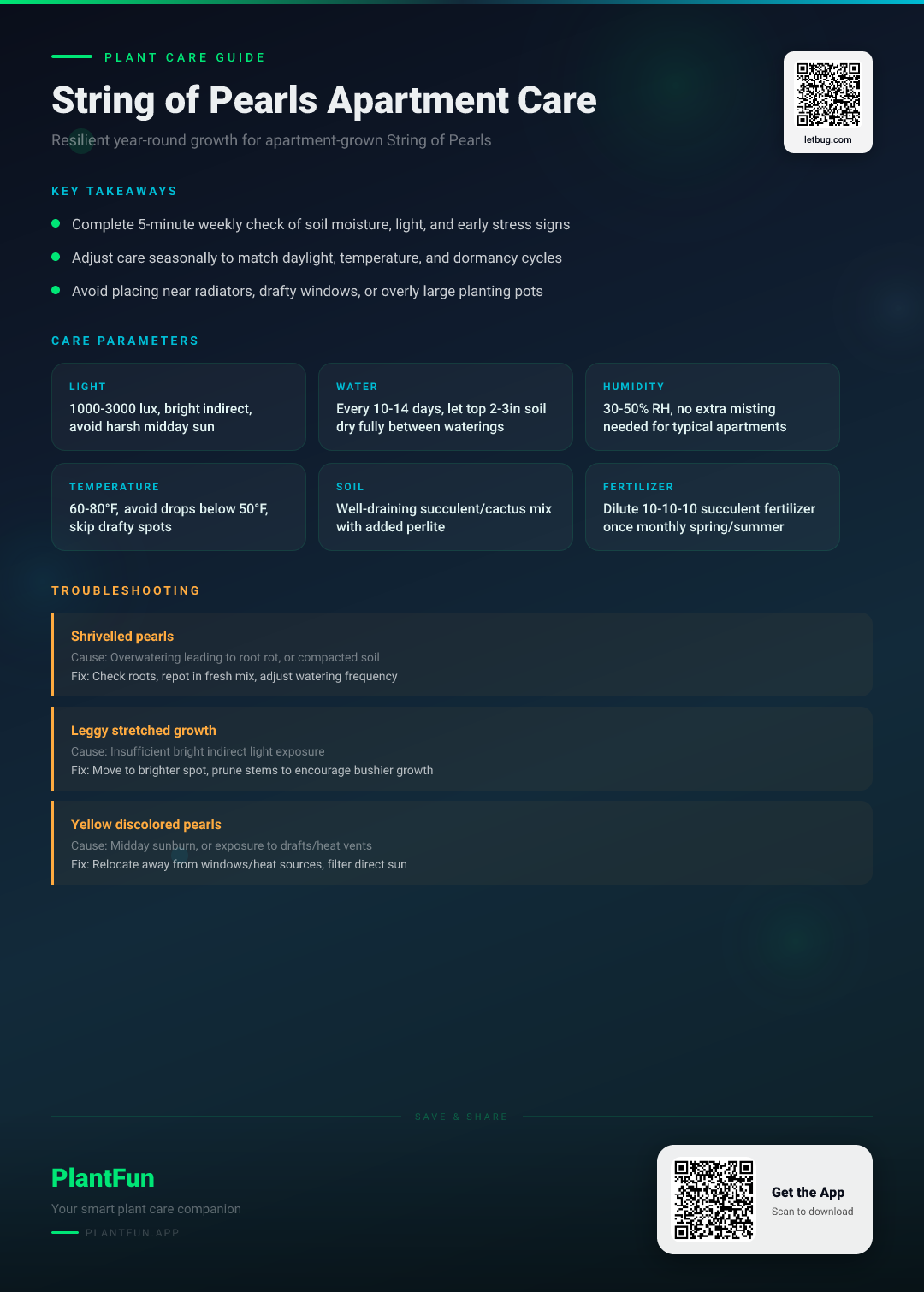
Key Takeaways
- Check soil moisture before watering — overwatering is the #1 killer of houseplants.
- Ensure your plant gets the right amount of light for its species.
- Be patient with recovery — most plants need 2–4 weeks to bounce back.
If you’ve struggled with shrivelled, yellow, or leggy String of Pearls (Senecio rowleyanus) in your rental apartment, you’re not alone. Generic greenhouse care advice rarely accounts for the unique stressors of apartment living: drafty windows, forced air heating, variable light, and no space for fancy equipment like grow lights or humidifiers. This String of Pearls care checklist is tailored specifically for standard apartment conditions, with exact measurable thresholds, seasonal adjustments, and quick fixes for the most common issues to support String of Pearls resilient growth year-round, even for String of Pearls care for beginners.
Understanding the Science
String of Pearls are native to the arid coastal regions of Namibia, where they grow in shallow rocky soil with infrequent rainfall. A 2017 study confirms that their round pearl-shaped leaves have evolved to store large amounts of water, making them extremely drought-tolerant and well-suited to the low-humidity environment of most apartments (The Journal of Primary Health Care, 2017). ASPCA classifies String of Pearls as toxic to cats, dogs, and horses, so keep it out of reach of pets and small children (ASPCA, 2026).
Quick Care Card: At-a-glance printable checklist with all key care thresholds for apartment-grown String of Pearls, updated per season for easy reference
| Care Factor | Spring (Mar-May) | Summer (Jun-Aug) | Fall (Sep-Nov) | Winter (Dec-Feb) |
|---|---|---|---|---|
| Light | 10,000-20,000 lux (bright indirect, 6-8 hrs/day) | 15,000-25,000 lux (avoid >30k lux direct midday sun) | 8,000-15,000 lux (bright indirect, 4-6 hrs/day) | 8,000-12,000 lux (brightest available spot) |
| Water | Every 10-14 days, when top 2” soil is dry | Every 8-18 days, adjust for AC/humidity | Every 14-21 days, when top 3” soil is dry | Every 21-35 days, when entire soil ball is dry |
| Humidity | 30-40% | 25-50% | 30-40% | 25-30% (boost with pebble tray if <20%) |
| Temperature | 60-75°F | 65-80°F | 55-75°F | 60-70°F (avoid <50°F or >85°F) |
| Soil | 70% succulent mix + 30% perlite, well-draining | Same as spring | Same as spring | Same as spring |
| Fertilizer | 1/4 strength 10-10-10 succulent fertilizer, once monthly | Once monthly, same strength | None | None |
| Toxicity | Toxic to cats/dogs (ASPCA, 2026) | Same as spring | Same as spring | Same as spring |
Why Apartment-Grown String of Pearls Struggle More: Breakdown of common apartment stressors (drafty windows, forced air, variable light) that don’t exist in greenhouse settings
Greenhouses provide consistent light, temperature, and humidity year-round, which is very different from the variable conditions of most rental apartments. The top stressors for apartment-grown String of Pearls include:
- Forced air heating that drops winter humidity to 15% or lower, drying out pearls faster than roots can absorb moisture
- Drafty windows that cause 20°F overnight temperature swings, damaging delicate stems and causing pearl drop
- Variable light levels that range from 30,000 lux direct sun on south-facing sills in summer to <5,000 lux in north-facing corners in winter
- Limited space that leads to using oversize pots, which trap excess moisture and cause root rot (NC State Extension, 2026)
Myth vs Reality: Myth: String of Pearls need high humidity to thrive. Reality: Native to arid regions, they actually prefer low humidity between 25-40%, which is perfect for most apartment environments (NC State Extension, 2026).
Step-by-Step Weekly Care Routine: Exact 5-minute weekly tasks for checking soil moisture, light exposure, and early signs of stress, no guesswork required
This 5-minute routine catches issues early before they cause permanent damage:
- Check soil moisture (1 min): Stick your finger 2 inches deep into the soil, or insert a wooden chopstick all the way to the bottom of the pot. If it comes out completely dry, note to water in the next 1-2 days. If it has any damp soil clinging to it, hold off on watering.
- Test light levels (30 sec): Hold your hand 6 inches above the plant at midday. If you see a faint, soft shadow, light levels are adequate for String of Pearls resilient growth. No shadow means the plant needs more light.
- Inspect pearls (1 min): Gently squeeze 2-3 random pearls. They should be firm and plump; soft, wrinkled, or yellow pearls are an early sign of stress.
- Check stems (1 min): Look at the base of the stems where they meet the soil. Mushy, brown, or discolored stems are an early sign of root rot.
- Remove dust (30 sec): Wipe pearls with a dry microfiber cloth to remove dust, which blocks light and slows photosynthesis.
Spring Care Checklist (March-May): Adjustments for longer daylight, increased growth spurts, repotting cues, and low-dose fertilizing schedules tailored to apartment temperatures
Follow these steps as daylight hours increase and your plant exits winter dormancy:
- Gradually move the plant to a brighter east or south-facing sill if it was stored in lower light over winter, increasing exposure by 1 hour per day to avoid sunburn.
- Water when the top 2 inches of soil are completely dry, typically every 10-14 days (NC State Extension, 2026).
- Fertilize once per month with 1/4 strength balanced 10-10-10 succulent fertilizer, only applying to damp soil to avoid root burn.
- Repot only if roots are growing out the drainage holes, using a pot 1 inch larger than the current one. Use a 70% succulent mix + 30% perlite blend, or follow our DIY well-draining succulent soil guide for a custom blend.
- Trim any leggy stems to encourage bushier growth, and save cuttings to propagate if desired using our succulent propagation guide.
Summer Care Checklist (June-August): Tips for avoiding sunburn on south-facing sills, adjusting watering for AC use, and preventing pest infestations from open windows
This season is the peak growth period for String of Pearls, but comes with unique apartment-specific risks:
- If placed on a south-facing sill, add a sheer curtain between 10am and 3pm to block direct midday sun, which can cause brown crispy sunburn spots on pearls exposed to >30,000 lux.
- Adjust String of Pearls summer watering for AC use: if your AC runs daily, humidity may drop to 25%, so water every 8-12 days. If AC is off and humidity is above 50%, extend watering to every 14-18 days.
- Inspect weekly for aphids and spider mites, which often enter apartments through open windows. Wipe stems with diluted neem oil if you see tiny white or green bugs, or see our houseplant pest identification guide for severe infestations.
- Avoid placing the plant near AC vents, as cold blasts can cause sudden pearl drop.
- If you’re wondering how to make String of Pearls fuller, pinch 1/4 inch off the end of each long stem once per month to trigger new side growth.
Fall Care Checklist (September-November): Guidance for reducing watering as light fades, moving plants away from drafty window sills, and prepping for winter heating
As daylight hours shorten and growth slows, adjust your routine to prepare for winter:
- Start reducing watering frequency, watering only when the top 3 inches of soil are completely dry, typically every 14-21 days.
- Move plants 12 inches away from drafty window sills, as overnight temperatures below 50°F can damage delicate stems (NC State Extension, 2026).
- Stop fertilizing completely, as the plant enters dormancy and will not absorb extra nutrients.
- Trim any dead or yellowing stems to prevent rot from spreading.
- If you regularly open windows for fresh air, place the plant on an interior shelf at least 3 feet away from the opening to avoid cold drafts.
Winter Care Checklist (December-February): Exact adjustments for forced air heating, low light levels, and avoiding overwatering during dormancy
String of Pearls winter care is the most commonly mismanaged part of the seasonal routine, especially for apartments with forced air heat:
- Water only when the entire soil ball is completely dry, typically every 21-30 days. Overwatering during dormancy is the #1 cause of String of Pearls death in apartments.
- For String of Pearls forced air heat care, place the plant on a tray of pebbles filled with water (make sure the pot is not sitting directly in water) to boost local humidity to 30% without a humidifier.
- Place the plant within 2 feet of the brightest window in your apartment, and avoid placing it within 3 feet of radiators or heat vents, which can dry out pearls in 48 hours.
- If your apartment gets less than 6 hours of bright indirect light per day, rotate the plant 90 degrees once per week to ensure even growth.
- Skip repotting or propagating in winter, as the dormant plant will not recover well from root disturbance. For more cold-season succulent tips, see our winter succulent care guide.
Common Apartment-Specific Mistakes to Avoid: Breakdown of the top 5 mistakes (placing near radiators, overwatering in low light, using too big a pot) that kill String of Pearls in standard homes
- Mistake: Placing your String of Pearls within 3 feet of radiators, heat vents, or drafty window edges. What happens: Sudden temperature swings of 15°F or more cause pearl drop and shrivelling, even if you’re watering correctly. Instead: Keep the plant in a spot with consistent temperatures between 60-75°F year-round, 12+ inches away from vents and drafty windows.
- Mistake: Overwatering in low light, especially during winter. What happens: Roots sit in saturated soil for weeks, leading to root rot, yellow pearls, and sudden plant death. Instead: Double the time between waterings if your plant is in less than 6 hours of bright indirect light per day, and always check soil moisture before watering.
- Mistake: Using a pot that is 2+ inches larger than the root ball. What happens: Excess soil holds onto moisture for weeks, leading to root rot even if you water on a correct schedule. Instead: Use a pot with drainage holes that is only 1 inch larger than the current root ball when repotting.
- Mistake: Planting String of Pearls in regular potting soil instead of well-draining succulent mix. What happens: Regular soil retains too much moisture, leading to root rot and shrivelled pearls even when you water infrequently. Instead: Use a mix of 70% commercial succulent soil and 30% perlite or pumice for optimal drainage (NC State Extension, 2026).
- Mistake: Leaving your String of Pearls in a dark north-facing corner with no supplemental light. What happens: Stems become leggy, pearls get smaller and fewer, and the plant will eventually die from lack of photosynthesis. Instead: If you only have a north-facing window, place the plant directly on the sill to get maximum available light, and rotate weekly for even growth.
FAQ: Why is my String of Pearls shrivelling even when I water it regularly?
The most common cause is root rot from overwatering, which prevents roots from absorbing moisture even if the soil is wet (NC State Extension, 2026). To check, gently pull the plant out of its pot and look for brown, mushy roots; if you see any, trim them off, repot in fresh dry succulent mix, and wait 7 days before watering. Another common cause is placement near forced air heat vents, which dry out the pearls faster than roots can absorb water.
FAQ: Can I grow String of Pearls in a north-facing apartment window?
Yes, String of Pearls north facing window growth is possible as long as the sill gets at least 4 hours of bright indirect light per day (which most north-facing sills do in spring and summer). If you’re wondering can String of Pearls grow in low light apartments, the answer is yes for short periods, but for resilient growth, you can supplement with 2 hours of morning sun from an east-facing window if available. Avoid placing the plant more than 1 foot away from a north-facing sill, as light levels drop off sharply beyond that point.
FAQ: How often should I water my String of Pearls in an apartment with forced air heat?
For String of Pearls forced air heat care in winter, water only when the entire soil ball is completely dry, typically every 21-30 days. If you’re using a pebble tray to boost humidity, you may be able to extend watering to every 30-35 days. Always check the soil by sticking a chopstick all the way to the bottom of the pot; if it comes out completely dry, it’s time to water. If you’re still unsure how often to water String of Pearls, err on the side of underwatering, as they can survive up to 6 weeks without water but will die in 2 weeks from overwatering.
Troubleshooting Quick Fix Chart: 1-minute solutions for leggy growth, yellow pearls, root rot, and minor pest signs
Leggy Growth
Symptom: Long bare stems with sparse, small pearls spaced far apart.
Likely cause: Insufficient light levels below 8,000 lux for more than 2 weeks.
Fix:
- Move the plant to a spot that gets at least 6 hours of bright indirect light per day, within 2 feet of an east or south-facing window.
- Trim the leggy stems back by 1/3 to trigger new bushy growth along the remaining stem.
Yellow Pearls
Symptom: Soft, yellow, translucent pearls that fall off easily when touched.
Likely cause: Overwatering leading to early root rot, or exposure to cold drafts below 50°F.
Fix:
- Stop watering immediately and check the soil moisture; if it’s still damp 2 inches deep, leave the plant to dry out for 7-10 days.
- If yellowing continues, repot in fresh dry succulent mix, trimming any brown mushy roots before replanting.
Root Rot
Symptom: Mushy brown stems at the soil line, widespread yellowing and shrivelling of pearls even with regular watering.
Likely cause: Saturated soil for more than 7 days, usually from overwatering, poorly draining soil, or a pot that is too large.
Fix:
- Remove the plant from its pot, trim all brown mushy roots with sterile scissors, and discard all wet soil.
- Repot in a small pot with drainage holes filled with 70% succulent mix and 30% perlite, and wait 10 days before watering lightly.
Minor Pest Infestation (Aphids/Spider Mites)
Symptom: Tiny white or green bugs on the undersides of stems, fine webbing between pearls, or sticky residue on pearls.
Likely cause: Pests brought in through open windows in summer, or from new plants brought into the apartment.
Fix:
- Wipe all stems and pearls with a cotton swab dipped in 70% isopropyl alcohol to kill visible pests.
- Spray the entire plant with diluted neem oil once per week for 3 weeks to kill any remaining eggs, and keep it separated from other plants until the infestation is gone.
References: Peer-reviewed horticultural sources on Senecio rowleyanus native habitat and evidence-based indoor care requirements
- NC State Extension. (2026). String of Pearls — NC State Extension Gardener Plant Toolbox. https://plants.ces.ncsu.edu/plants/pearls-care/. Accessed 2026-03-02.
- American Society for the Prevention of Cruelty to Animals. (2026). Toxic and Non-Toxic Plants List — ASPCA. https://www.aspca.org/pet-care/animal-poison-control/toxic-and-non-toxic-plants. Accessed 2026-03-02.
- The Journal of Primary Health Care. (2017). String of PEARLS. The Journal of Primary Health Care. https://doi.org/10.1071/hc15920. Accessed 2026-03-02.
- The Journal of Primary Health Care. (2014). String of PEARLS about diabetes. The Journal of Primary Health Care. https://doi.org/10.1071/hc14339b. Accessed 2026-03-02.
Optional Helper: Plantfun.App
Plantfun.App identifies your plants by photo, diagnoses pests and diseases with clear fixes, and creates personalised watering and light schedules that adapt to your home conditions — a handy companion for putting this guide into daily practice.
Found an error or have suggestions? We'd love your feedback.
Need help identifying this problem?
Get instant identification, personalized care schedules, and effective pest treatment plans directly on your phone.
Sponsored • We may earn a commission from app downloads
Related Guides
The Complete String of Pearls Care Checklist for Resilient Growth in Typical Apartments
Stop losing your String of Pearls to common apartment growing conditions. Get exact light, water, and humidity thresholds plus a free weekly checklist for lush, long trailing growth.
Care GuideThe Complete String of Pearls Care Guide for Small Apartments: Resilient Growth Made Easy
Grow plump, vibrant String of Pearls even in cramped small apartments with this 8-step checklist. Get exact light, water, and placement tips to avoid shriveling and encourage lush trailing growth.
Care GuideThe Complete String of Pearls Care Checklist for Resilient Growth in Small Urban Apartments
Grow plump, trailing String of Pearls in your apartment without shrivelling or rot. Get seasonal watering amounts, light thresholds, and a free printable care checklist you can post on your fridge.
Pest ControlAnts on Plants: What They Mean and What to Do
Ants usually aren't eating your plant. They are farming other pests.