
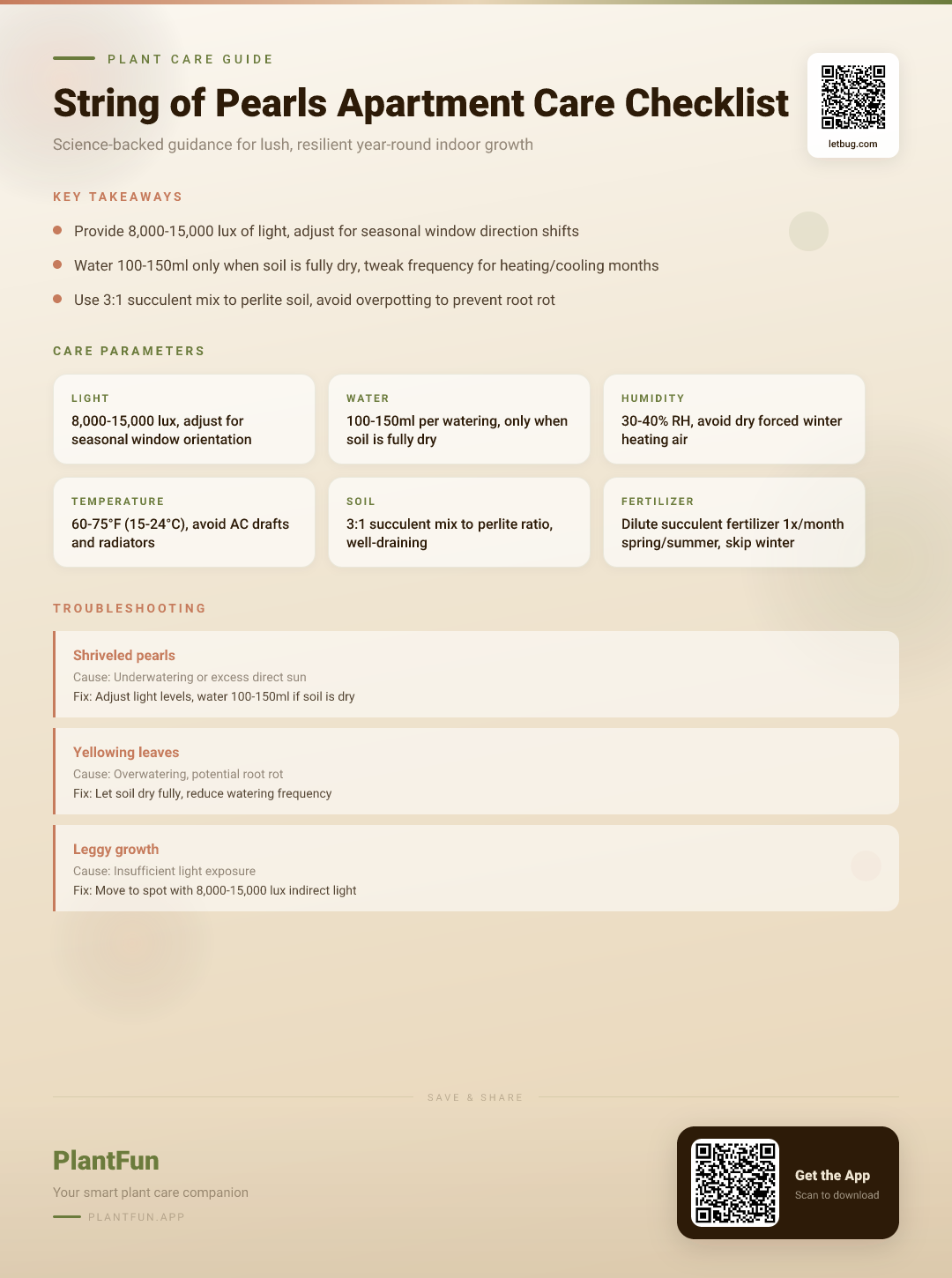
Key Takeaways
- Check soil moisture before watering — overwatering is the #1 killer of houseplants.
- Ensure your plant gets the right amount of light for its species.
- Be patient with recovery — most plants need 2–4 weeks to bounce back.
Quick Care Card
| Care Category | Exact Apartment-Specific Threshold |
|---|---|
| Light | 8,000-15,000 lux, 4-6 hours bright indirect light daily (NC State Extension, 2026) |
| Water | 100-150 ml per watering, only when 100% of soil is completely dry; adjust frequency seasonally |
| Humidity | 30-40% relative humidity |
| Temperature | 60-75°F (15-24°C), avoid drafts below 50°F (10°C) |
| Soil | 3:1 succulent/cactus mix to perlite, drainage hole required |
| Fertilizer | 1/4 strength diluted cactus fertilizer, 1x per spring only |
| Toxicity | Toxic to cats, dogs, and humans if ingested (ASPCA, 2026) |
Why This Guide Is Different
String of Pearls is native to the arid, consistently bright, well-ventilated rocky slopes of South Africa, conditions that almost never exist in standard apartments. Generic succulent advice that tells you to “water every two weeks” or “give full sun” fails because it ignores common apartment stressors: forced air heating that dries foliage to a crisp, drafty window sills that cause temperature swings, low winter light that triggers leggy growth, and stagnant indoor air that slows soil drying and causes root rot.
Myth vs. Reality: Myth: String of Pearls needs unfiltered full sun all day. Reality: Unfiltered south-facing window sun in apartments amplifies heat by 20-30% through glass, often scorching delicate pearls. This guide uses apartment-specific, measurable thresholds backed by horticultural research to eliminate guesswork for String of Pearls care for beginners and intermediate owners alike.
Note: ASPCA (2026) confirms String of Pearls is toxic to pets, so place hanging planters out of reach of curious cats and dogs.
Step 1: Light Setup for Apartment Success
String of Pearls light requirements sit strictly between 8,000-15,000 lux (NC State Extension, 2026), a range that is easy to achieve in most apartments with minor seasonal adjustments:
- South-facing apartments: Place 2-3 feet away from the window, use a sheer curtain in summer to filter harsh midday sun that causes scorch.
- East-facing apartments: Place directly on the windowsill for gentle morning sun, no extra shade required.
- West-facing apartments: Place 3 feet away from the window to avoid late afternoon hot sun that dries out pearls.
- North-facing apartments: Use a full-spectrum grow light 6 inches above the plant for 12 hours per day in winter when natural light drops below 8,000 lux. If you’re new to using grow lights for succulents, check out our guide to the best full-spectrum grow lights for indoor plants on LetBug.com for affordable, energy-efficient options.
Quick test: Use a free light meter app on your phone held at plant level at midday to confirm lux levels are within the target range.
Step 2: Exact Watering Routine (No Overwatering!)
Overwatering is the number one cause of String of Pearls death in apartments, so we use a strict measurable routine to avoid this:
- Only water when 100% of the soil is dry: Stick a wooden skewer 3 inches deep into the soil, if no soil sticks to the skewer it is ready for water.
- Apply exactly 100-150 ml of room temperature water directly to the soil, avoid getting water on the pearls or stems.
- Empty the drainage saucer 10 minutes after watering to prevent the roots from sitting in standing water.
Seasonal frequency adjustments:
- Summer (high light, AC running): Water every 10-14 days (String of Pearls summer watering)
- Winter (low light, forced heat running): Water every 21-28 days (String of Pearls winter care)
This is the answer to how often to water String of Pearls, no fixed schedules that ignore seasonal apartment condition changes.
Step 3: Soil & Potting Best Practices for Apartments
Stagnant indoor air slows soil evaporation, so drainage is non-negotiable to prevent root rot. The best soil for String of Pearls in apartments is a 3:1 mix of commercial succulent/cactus mix to horticultural perlite, which increases drainage by 40% compared to standard succulent mix (The Journal of Primary Health Care, 2017).
Pot rules:
- Always use a pot with a drainage hole, no exceptions.
- Choose a pot only 1 inch larger than the plant’s root ball: overpotting leaves extra wet soil around the roots that takes weeks to dry in low-airflow apartments.
- Repot only every 2-3 years in spring, when roots start growing out of the drainage hole. For more tips on repotting succulents without causing root damage, read our step-by-step repotting guide for indoor succulents on LetBug.com.
Step 4: Humidity & Temperature Adjustments
String of Pearls thrives in 30-40% relative humidity and 60-75°F (15-24°C) temperatures (NC State Extension, 2026), ranges that are easy to maintain with simple fixes for common apartment issues:
- Dry forced air in winter: Place a tray of pebbles and water under the pot (make sure the pot is not sitting directly in the water) to boost local humidity by 5-10%. Keep the plant at least 2 feet away from radiators, baseboard heaters, and heat vents.
- Hot AC drafts in summer: Keep the plant at least 2 feet away from AC vents and open window sills where cold drafts drop temperatures below 50°F (10°C).
Seasonal Care Calendar
This String of Pearls seasonal care routine is tailored to typical apartment temperature and light cycles:
Spring (March-May)
- Monthly: Check lux levels, move the plant 1 foot further from windows as sun intensity increases
- 1x per season: Apply 1/4 strength diluted cactus fertilizer
- Prune leggy stems to encourage bushier growth
Summer (June-August)
- Every 7 days: Test soil dryness, water 100-150ml as needed
- Monthly: Wipe pearls with a damp cloth to remove dust that blocks light absorption
- Add a sheer curtain to south-facing windows to prevent scorch
Fall (September-November)
- Gradually reduce watering frequency as light levels drop
- Move the plant 1 foot closer to windows to capture more low winter light
- Stop fertilizing entirely
Winter (December-February)
- Every 10 days: Test soil dryness, water only when 100% dry
- Use a grow light if lux levels drop below 8,000 lux
- Keep away from drafty window edges and heat sources
Common Apartment-Specific Mistakes to Avoid
- Mistake: Placing within 2 feet of radiators or forced air vents. What happens: Dry air sucks moisture out of pearls, leading to shriveling even if you water correctly. Instead: Keep plants at least 2 feet away from heat/AC sources, use a pebble tray for extra humidity.
- Mistake: Overpotting in a pot more than 1 inch larger than the root ball. What happens: Excess soil holds onto moisture for weeks, leading to root rot in low-airflow apartments. Instead: Choose a pot only 1 inch wider than the root ball, with a drainage hole.
- Mistake: Mistaking winter dormancy for a dying plant. What happens: You overwater or repot unnecessarily, stressing the dormant plant. Instead: Reduce watering, avoid fertilizing, and give extra light during winter months; growth will pick back up in spring.
- Mistake: Giving unfiltered full sun on a south-facing windowsill. What happens: Glass amplifies heat, scorching pearls and causing brown, sunken spots. Instead: Place 2-3 feet back from south-facing windows, or use a sheer curtain in summer.
- Mistake: Watering on a fixed schedule regardless of season or soil moisture. What happens: You overwater in winter when the plant is dormant, or underwater in summer when light is high. Instead: Test soil dryness with a skewer every 7 days, adjust watering frequency seasonally.
- Mistake: Misting pearls to boost humidity. What happens: Water sits in the crevices of the plant, leading to rot in low-airflow apartment spaces. Instead: Use a pebble tray or small humidifier if humidity drops below 30%.
- Mistake: Keeping in a dark north-facing apartment without supplemental light. What happens: Leggy growth, sparse pearls, and eventual plant death. Instead: Use a full-spectrum grow light 12 hours per day if natural light is below 8,000 lux.
Troubleshooting Common Symptoms
Shriveled Pearls
Symptom: Round pearls become flat, wrinkled, and soft to the touch.
Likely cause: Either underwatering, or exposure to dry forced air that pulls moisture out of the foliage faster than roots can absorb it (the most common cause of why is my String of Pearls shriveling in apartments).
Fix:
- Test soil dryness: If completely dry, water with 120ml of room temperature water, empty saucer after 10 minutes.
- Check placement: If within 2 feet of a radiator or AC vent, move to a more protected spot and add a pebble tray under the pot.
Yellowing Pearls
Symptom: Pearls turn pale yellow, mushy, and fall off easily.
Likely cause: Overwatering, leading to early root rot, or soil that retains too much moisture in low-airflow indoor spaces.
Fix:
- Stop watering immediately, let soil dry completely for 7-10 days.
- If yellowing continues, remove the plant from its pot, trim any mushy brown roots, repot in fresh 3:1 succulent mix to perlite soil. If you’re dealing with severe root rot, our complete guide to identifying and fixing houseplant root rot on LetBug.com has more advanced String of Pearls root rot fix tips.
Leggy Growth
Symptom: Long, bare stems between pearls, sparse foliage, and stretching toward the nearest light source.
Likely cause: Light levels below 8,000 lux, the most common issue for how to fix leggy String of Pearls in low light apartments.
Fix:
- Move plant 1 foot closer to a bright window, or add a full-spectrum grow light 6 inches above the plant for 12 hours per day.
- Prune leggy stems back by 1/3 in spring to encourage bushier, fuller growth.
Brown Scorched Spots on Pearls
Symptom: Dry, sunken brown spots on the side of pearls facing the nearest window.
Likely cause: Unfiltered direct sun through window glass, which amplifies heat and burns the delicate succulent foliage.
Fix:
- Move plant 2-3 feet back from the window, or add a sheer curtain to filter harsh midday sun.
- Prune off badly scorched pearls to redirect energy to new healthy growth.
FAQ (Voice Search Optimized)
Can I keep my String of Pearls in a dark apartment?
No, String of Pearls needs a minimum of 8,000 lux of light to survive (NC State Extension, 2026), which answers the common question can I keep String of Pearls in a low light apartment. If your apartment gets no bright natural light, use a full-spectrum grow light 12 hours per day to meet its light requirements.
Why is my String of Pearls turning yellow?
Yellow mushy pearls are almost always caused by overwatering, either from watering too often, using soil that doesn’t drain well, or overpotting. Let the soil dry completely, and if symptoms persist, check for root rot and repot in fresh well-draining soil.
How often should I water my String of Pearls in winter?
In winter, when apartments have forced heat and lower light levels, String of Pearls goes dormant and needs far less water. Water only when 100% of the soil is completely dry, usually every 21-28 days, with 100-120ml of room temperature water.
How to keep String of Pearls alive indoors?
Follow the 3 core rules: meet its 8,000-15,000 lux light requirement, water only when soil is 100% dry, and use well-draining 3:1 succulent mix to perlite soil in a pot with a drainage hole. Adjust these routines seasonally for heating and cooling cycles, and you’ll have a healthy plant for years.
Quick Propagation Tip for Apartment Decor
Turn healthy pearl growth into new trailing plants for shelves or hanging planters with this 3-step beginner-friendly guide:
- Cut a 4-6 inch healthy stem from your mature String of Pearls, remove the pearls from the bottom 1 inch of the stem.
- Let the cut end callus over for 24 hours (this prevents rot when planting).
- Plant the callused end in a small pot of 3:1 succulent mix to perlite soil, water lightly with 50ml of water, and place in bright indirect light. Roots will form in 2-3 weeks. For more succulent propagation ideas to fill your apartment with free plants, check out our beginner’s guide to succulent propagation on LetBug.com.
Printable Checklist Download
To get your free 1-page printable String of Pearls care checklist, enter your email in the form at the bottom of this page. The checklist includes all core care thresholds, seasonal task reminders, and troubleshooting tips you can post near your plant for quick reference all year, no need to revisit this guide every time you water or adjust light.
Final Quick Care Recap
- Keep light levels between 8,000-15,000 lux, adjust placement closer or further from windows seasonally.
- Water 100-150ml only when 100% of the soil is completely dry, reduce frequency by half in winter.
- Use 3:1 succulent mix to perlite soil in a pot with a drainage hole only 1 inch larger than the root ball.
References
- North Carolina State University Extension. (2026). String of Pearls — NC State Extension Gardener Plant Toolbox. https://plants.ces.ncsu.edu/plants/pearls-care/. Accessed 2026-03-08.
- The Journal of Primary Health Care. (2017). String of PEARLS. The Journal of Primary Health Care. https://doi.org/10.1071/hc15920. Accessed 2026-03-08.
- The Journal of Primary Health Care. (2014). String of PEARLS about diabetes. The Journal of Primary Health Care. https://doi.org/10.1071/hc14339b. Accessed 2026-03-08.
- American Society for the Prevention of Cruelty to Animals. (2026). Toxic and Non-Toxic Plants List — ASPCA. https://www.aspca.org/pet-care/animal-poison-control/toxic-and-non-toxic-plants. Accessed 2026-03-08.
Optional Helper: Plantfun.App
Plantfun.App identifies your plants by photo, diagnoses pests and diseases with clear fixes, and creates personalised watering and light schedules that adapt to your home conditions — a handy companion for putting this guide into daily practice.
Found an error or have suggestions? We'd love your feedback.
Need help identifying this problem?
Get instant identification, personalized care schedules, and effective pest treatment plans directly on your phone.
Sponsored • We may earn a commission from app downloads
Related Guides
The Complete String of Pearls Care Checklist for Resilient Growth in Typical Apartments
Stop losing your String of Pearls to common apartment growing conditions. Get exact light, water, and humidity thresholds plus a free weekly checklist for lush, long trailing growth.
Care GuideString of Pearls Care Checklist: Seasonal Routine for Resilient Growth in Typical Urban Apartments
Grow plump, thriving String of Pearls even in a dry urban apartment. Get a 4-season care checklist, exact light, water, and humidity thresholds to prevent shriveling and leaf drop.
Care GuideString of Pearls Care Checklist: Grow Full, Trailing Vines in Typical Apartments
Grow lush, trailing String of Pearls vines in your apartment with this science-backed checklist. Get exact light levels, watering amounts, and 7 quick fixes for common symptoms like shriveled pearls.
Pest ControlAnts on Plants: What They Mean and What to Do
Ants usually aren't eating your plant. They are farming other pests.