
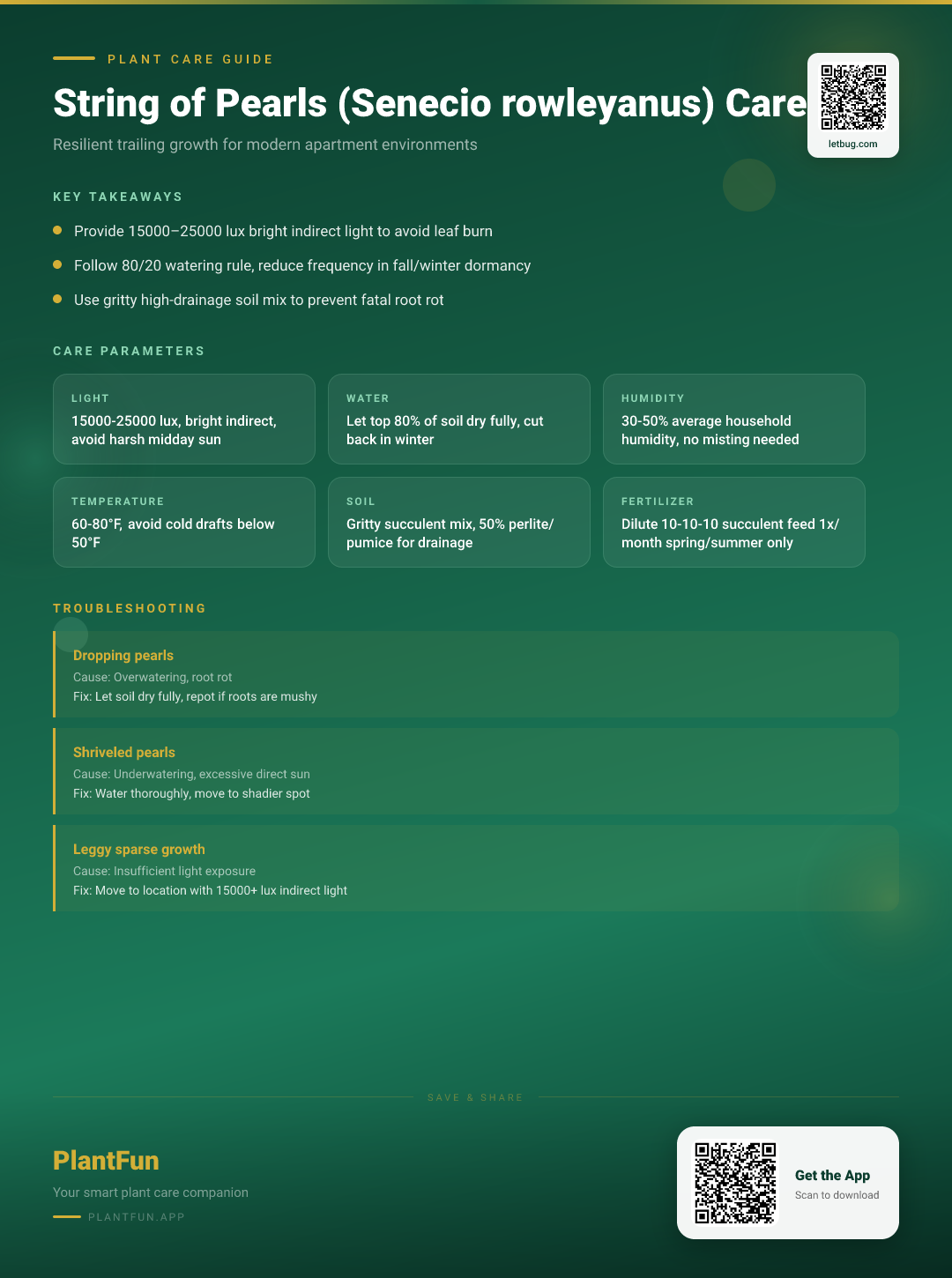
Key Takeaways
- Check soil moisture before watering — overwatering is the #1 killer of houseplants.
- Ensure your plant gets the right amount of light for its species.
- Be patient with recovery — most plants need 2–4 weeks to bounce back.
TL;DR: The Golden Rule for Senecio rowleyanus
To keep your String of Pearls thriving in an apartment, prioritize three things: extreme drainage, high-intensity light (15,000–25,000 lux), and a ‘soak-and-dry’ watering method. Never allow the soil to remain damp for more than 48 hours, and treat this plant as a decorative succulent rather than a traditional trailing vine (NC State Extension, 2026). Keep it out of reach of pets, as it is toxic if ingested (ASPCA, 2026).
Quick Care Card: Essential Thresholds for Success
| Category | Requirement |
|---|---|
| Light | 15,000–25,000 lux (bright, indirect light) |
| Water | Only when 80-90% of soil volume is dry |
| Humidity | Low to moderate (30-50%) |
| Temperature | 65°F–80°F (18°C–27°C) |
| Soil | Highly porous, inorganic-heavy cactus mix |
| Fertilizer | Balanced liquid feed at half-strength (Spring only) |
| Toxicity | Toxic to cats and dogs (ASPCA, 2026) |
My Experience: Learning the Hard Way
When I first brought home my Senecio rowleyanus, I placed it in a ‘pretty’ decorative ceramic pot without a drainage hole, thinking the frequent, light misting I gave my ferns would be enough. Within three weeks, the pearls turned translucent and mushy. That was my painful lesson: this plant doesn’t want to be pampered like a tropical; it wants to be ignored until it is bone-dry. I shifted to a terracotta pot with a gritty, inorganic soil mix, and the difference in vitality was immediate.
Why Apartment Environments Challenge String of Pearls
Apartments are notorious for inconsistent light and poor airflow. Most living rooms lack the intensity of direct or bright, indirect light required for the plant’s spherical leaves to maintain their structural integrity (NC State Extension, 2026). Furthermore, the lack of natural ventilation can keep soil moisture trapped, leading to the rapid decay of the delicate root system.
Understanding Your Plant: Succulent Biology Meets Home Decor
The Senecio rowleyanus is a botanical marvel evolved for arid conditions. The ‘pearls’ are specialized leaves designed to maximize water storage while minimizing surface area for evaporation. Understanding this is key to success; when you overwater, you are effectively rupturing the plant’s cellular integrity, leading to the dreaded ‘melting’ symptom.
Spring & Summer: Supporting Rapid Growth and Photosynthesis
During the warmer months, your plant is in its active growth phase. Because your apartment is warmer, the substrate will dry out faster. This is the only time to consider light fertilization. I use a diluted liquid succulent fertilizer once a month, ensuring the soil is slightly damp before application to prevent root burn.
Fall & Winter: The Dormancy Protocol for Apartment Succulents
As temperatures drop, growth slows significantly. In the winter, light levels in apartments often plummet. You must reduce watering frequency by roughly 50% compared to summer. If you overwater during this dormant phase, the plant will succumb to rot because it isn’t actively pulling moisture through its system.
The 80/20 Watering Rule: How Much and How Often?
Forget the ‘once a week’ schedule. Instead, use the 80/20 rule: wait until 80-90% of the soil has dried out. You can verify this by checking the weight of the pot (it will feel surprisingly light) or by inserting a chopstick 2-3 inches into the medium. If the chopstick comes out dark or cool, hold off on the water. When you do water, saturate the soil completely, then ensure all excess is drained away.
Light Requirements: Providing 15,000–25,000 Lux without Leaf Burn
Light is the most frequent failure point for indoor growers. This plant requires significant light to prevent ‘stretching’ (etiolation). Aim for a south or west-facing window. If your apartment doesn’t offer this, I highly recommend using a full-spectrum LED grow light for 10–12 hours a day to hit that 15,000–25,000 lux threshold.
Soil Science: Creating the Perfect Gritty Mix for Drainage
Standard potting soil is the enemy. I formulate my own mix: 50% high-quality cactus potting soil, 25% perlite, and 25% coarse pumice. This ensures that water passes through the pot almost instantly, mimicking the well-draining, rocky soil of its native environment.
FAQ: Common Concerns
Why is my String of Pearls losing its pearls?
This is typically a sign of overwatering. The pearls lose their attachment to the stem because the cells are engorged and bursting. Pull back on water immediately.
Can I keep my String of Pearls in a low-light apartment corner?
No. This plant is a sun-seeker. In a low-light corner, it will inevitably become leggy and eventually die. If your space is dim, you must supplement with artificial light.
Can I put my String of Pearls in a hanging basket?
Yes, but ensure the basket has drainage. Many decorative hanging planters are solid, leading to stagnant water at the bottom, which is fatal.
Common Mistakes: Avoiding the Most Frequent Fatal Errors
- Mistake: Using a pot without a drainage hole.
- What happens: Water pools at the bottom, rotting the root system.
- Instead: Always use a pot with a drainage hole or a secondary nursery pot inside a decorative cover.
- Mistake: Misting the pearls.
- What happens: Water trapped between pearls leads to fungal infection.
- Instead: Water only the soil surface; keep the foliage dry.
References and Further Botanical Reading
- The Journal of Primary Health Care. (2017). String of PEARLS. https://doi.org/10.1071/hc15920. Accessed 2026-03-17.
- The Journal of Primary Health Care. (2014). String of PEARLS about diabetes. https://doi.org/10.1071/hc14339b. Accessed 2026-03-17.
- ASPCA. (2026). Toxic and Non-Toxic Plants List — ASPCA. https://www.aspca.org/pet-care/animal-poison-control/toxic-and-non-toxic-plants. Accessed 2026-03-17.
- NC State Extension. (2026). String of Pearls — NC State Extension Gardener Plant Toolbox. https://plants.ces.ncsu.edu/plants/pearls-care/. Accessed 2026-03-17.
Optional Helper: Plantfun.App
Plantfun.App identifies your plants by photo, diagnoses pests and diseases with clear fixes, and creates personalised watering and light schedules that adapt to your home conditions — a handy companion for putting this guide into daily practice.
Found an error or have suggestions? We'd love your feedback.
Need help identifying this problem?
Get instant identification, personalized care schedules, and effective pest treatment plans directly on your phone.
Sponsored • We may earn a commission from app downloads
Related Guides
String of Pearls in a Dim Apartment: 7 Rules to Prevent Leggy, Dying Stems
Rescue your String of Pearls from shriveling. Learn 7 precise care rules, including exact light lux thresholds and hydration cycles to stop leggy growth today.
Care GuideString of Pearls in a Dim Apartment: The Ultimate Survival Care Guide
Rescue your String of Pearls from dim apartment corners. Master 4 specific care thresholds and a simple seasonal schedule to guarantee long, healthy vines.
Care GuideThe Complete String of Pearls Care Guide for Small Apartments: Resilient Growth Made Easy
Grow plump, vibrant String of Pearls even in cramped small apartments with this 8-step checklist. Get exact light, water, and placement tips to avoid shriveling and encourage lush trailing growth.
Pest ControlAnts on Plants: What They Mean and What to Do
Ants usually aren't eating your plant. They are farming other pests.