
Key Takeaways
- Check soil moisture before watering — overwatering is the #1 killer of houseplants.
- Ensure your plant gets the right amount of light for its species.
- Be patient with recovery — most plants need 2–4 weeks to bounce back.
TL;DR: Quick Survival Summary
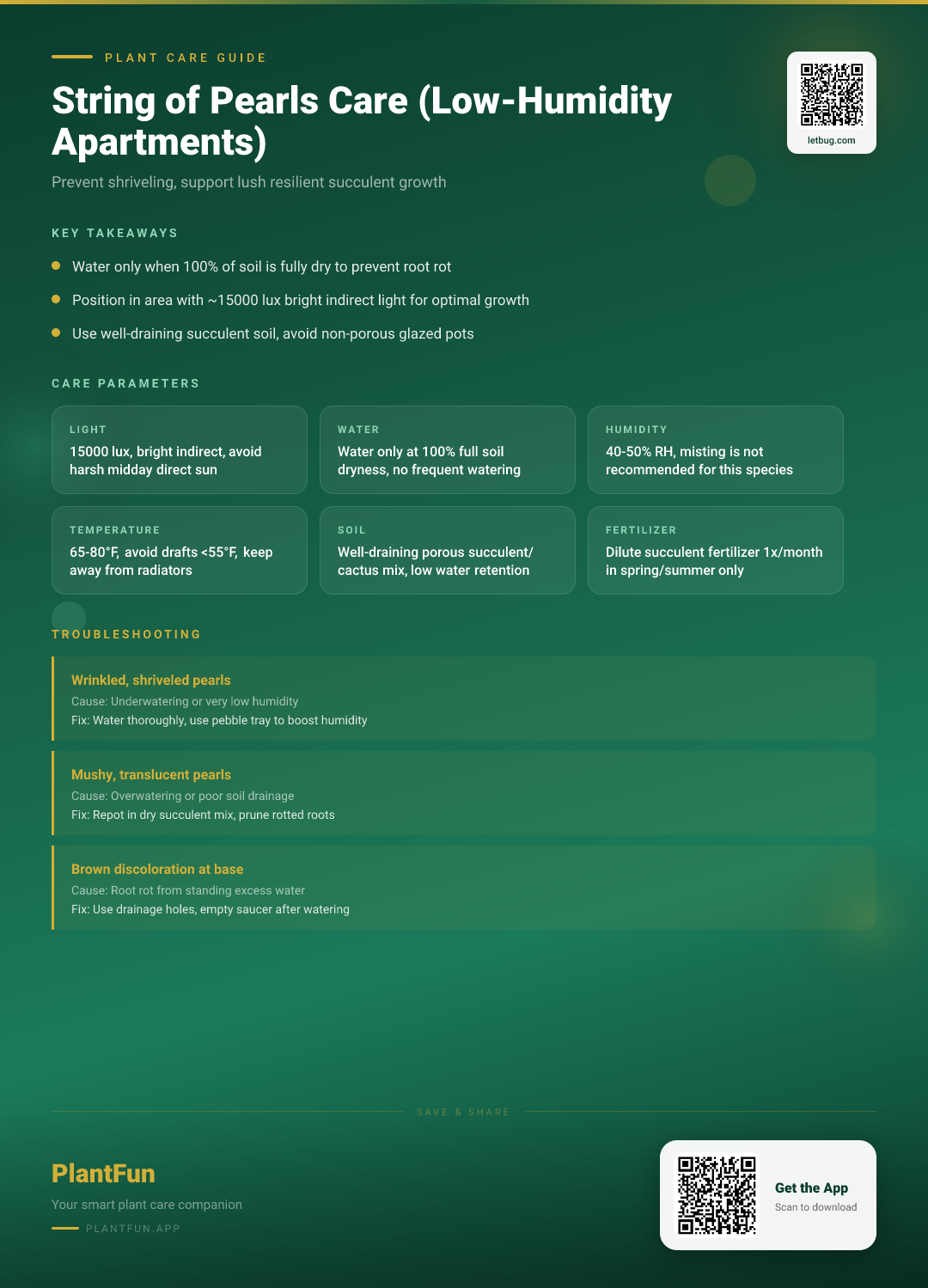
To keep your Senecio rowleyanus thriving, place it in bright, indirect light (aim for 15,000 lux). Water only when the soil is 100% dry (NC State Extension, 2026). Keep ambient humidity between 40-50%. If pearls shrivel, check for root rot before increasing water, as root damage often mimics thirst.
Quick Care Card: Essential Thresholds
| Feature | Requirement |
|---|---|
| Light | 15,000 lux (bright, indirect) |
| Humidity | 40% – 50% |
| Temperature | 65°F – 80°F |
| Watering | 100% soil dryness |
| Soil | Fast-draining succulent mix |
| Fertilizer | Balanced diluted succulent feed (monthly in summer) |
| Toxicity | Toxic to pets (ASPCA, 2026) |
My Experience with String of Pearls
When I first brought home my Senecio rowleyanus, I made the mistake of placing it in a low-light bathroom with high humidity. I thought because it was a succulent, it would thrive on ambient moisture. Instead, the lack of intense light caused the stems to stretch (etiolate), and the damp soil led to immediate root decay. I learned that this plant demands specific environmental ratios: it is a high-light, low-water enthusiast that requires distinct dry-out periods to remain turgid and healthy.
Why Your Apartment Is Stressing Out Your String of Pearls
Apartment living often creates a “Goldilocks” dilemma. Many units feature stagnant air, low light due to neighboring buildings, and erratic humidity caused by central heating. Senecio rowleyanus acts as a barometer for its environment. When humidity drops below 30% in winter, the plant loses moisture faster than the roots can uptake it, leading to a state of chronic desiccation, while the low light typical of many living rooms prevents the plant from utilizing its energy to heal (NC State Extension, 2026).
Identifying the Warning Signs: Wrinkling, Mushy Pearls, and Root Health
If you are asking, “Why is my String of Pearls shriveling?” it is crucial to perform a physical assessment:
- The “Thirsty” Wrinkle: Small, longitudinal lines on the pearls. This indicates the plant is pulling moisture from its own reserves.
- The “Rot” Mush: Pearls feel soft, translucent, or turn yellow/brown at the base. This is a symptom of overwatering or poor drainage (NC State Extension, 2026).
- The Root Check: If the stems are detaching from the soil with zero resistance, your root system has likely succumbed to fungal pathogens.
Root Cause Analysis: Why Humidity and Drainage Are Your Biggest Enemies
Botanically, these trailing succulents are adapted to environments with high airflow and rocky substrate. In a typical apartment pot, water collects at the bottom, creating an anaerobic (oxygen-free) zone. The lack of air movement combined with moisture leads to root death. Because the plant cannot signal its distress through wilting leaves like a Pothos, it simply drops its pearls (NC State Extension, 2026).
The 5-Step Rescue Strategy
- Assess the Soil: If the soil remains damp after 10 days, repot into a mix of 50% pumice and 50% high-quality potting soil to ensure drainage.
- Verify Light: Move the plant to a spot receiving at least 15,000 lux. If you lack natural light, use a dedicated LED grow lamp for 10-12 hours daily.
- Correct Watering: Only water when the pearls start to show very slight wrinkling and the soil is completely dry to the bottom.
- Air Circulation: Use a small oscillating fan nearby to mimic the natural airflow the plant expects.
- Placement: Avoid placement near radiator vents, which create localized dry heat spikes above 80°F.
Seasonal Adjustments: Managing Winter Radiator Heat vs. Summer Growth
In summer, your plant will be in an active growth phase and may require water every 14-21 days. In winter, growth slows dramatically. During this period, reduce your watering frequency by half. Keep the plant away from radiator heat, which sucks moisture from the pearls (NC State Extension, 2026).
Advanced Care Techniques: Bottom Watering and Pebble Tray Hacks
Bottom watering is the safest method for Senecio rowleyanus. Fill a basin with 2 inches of water and let the pot sit for 15 minutes. This ensures the roots get moisture without soaking the top-dressing or stems, which prevents base rot. Avoid misting; this is a common myth that increases humidity only for a few minutes while encouraging fungal growth on the leaves.
Common Mistakes to Avoid
- Mistake: Using a non-draining glazed ceramic pot. What happens: Water pools at the bottom, leading to root rot. Instead: Use an unglazed terracotta pot with a drainage hole.
- Mistake: Misting the plant daily. What happens: Water droplets sit in the crevices of the pearls, causing decay. Instead: Use a humidifier if the room is consistently below 30% humidity.
FAQ
Why is my String of Pearls turning brown at the base?
This is typically a sign of overwatering or soil that stays wet for too long (NC State Extension, 2026). Check if the stems are firm or mushy; if mushy, you need to repot in a drier, faster-draining mix.
Can I keep my String of Pearls on a bookshelf away from a window?
While it looks beautiful, a shelf away from a window rarely provides the 15,000 lux required for long-term health. Your plant will likely become leggy and eventually stop producing new pearls.
How do I know if I’m overwatering or underwatering?
Underwatering causes uniform, firm wrinkling across the vine. Overwatering causes yellowing, mushy, or translucent pearls, often starting at the base of the plant where it meets the soil (NC State Extension, 2026). Always check the soil moisture with a probe or your finger before adding water.
References and Botanical Resources
- The Journal of Primary Health Care. (2017). String of PEARLS. https://doi.org/10.1071/hc15920. Accessed 2026-03-10.
- The Journal of Primary Health Care. (2014). String of PEARLS about diabetes. https://doi.org/10.1071/hc14339b. Accessed 2026-03-10.
- ASPCA. (2026). Toxic and Non-Toxic Plants List — ASPCA. https://www.aspca.org/pet-care/animal-poison-control/toxic-and-non-toxic-plants. Accessed 2026-03-10.
- NC State Extension. (2026). String of Pearls — NC State Extension Gardener Plant Toolbox. https://plants.ces.ncsu.edu/plants/pearls-care/. Accessed 2026-03-10.
Optional Helper: Plantfun.App
Plantfun.App identifies your plants by photo, diagnoses pests and diseases with clear fixes, and creates personalised watering and light schedules that adapt to your home conditions — a handy companion for putting this guide into daily practice.
Found an error or have suggestions? We'd love your feedback.
Need help identifying this problem?
Get instant identification, personalized care schedules, and effective pest treatment plans directly on your phone.
Sponsored • We may earn a commission from app downloads
Related Guides
String of Pearls in a Typical Apartment: The Seasonal Care Checklist for Resilient Growth
Skip the generic String of Pearls care advice. Get our seasonal apartment-specific checklist with exact light, water, and humidity parameters to grow lush, long trailing vines year-round.
Care GuideThe Complete String of Pearls Care Guide for Small Apartments: Resilient Growth Made Easy
Grow plump, vibrant String of Pearls even in cramped small apartments with this 8-step checklist. Get exact light, water, and placement tips to avoid shriveling and encourage lush trailing growth.
Care GuideThe Complete String of Pearls Care Checklist for Resilient Growth in Typical Apartments
Stop losing your String of Pearls to common apartment growing conditions. Get exact light, water, and humidity thresholds plus a free weekly checklist for lush, long trailing growth.
Pest ControlAnts on Plants: What They Mean and What to Do
Ants usually aren't eating your plant. They are farming other pests.