
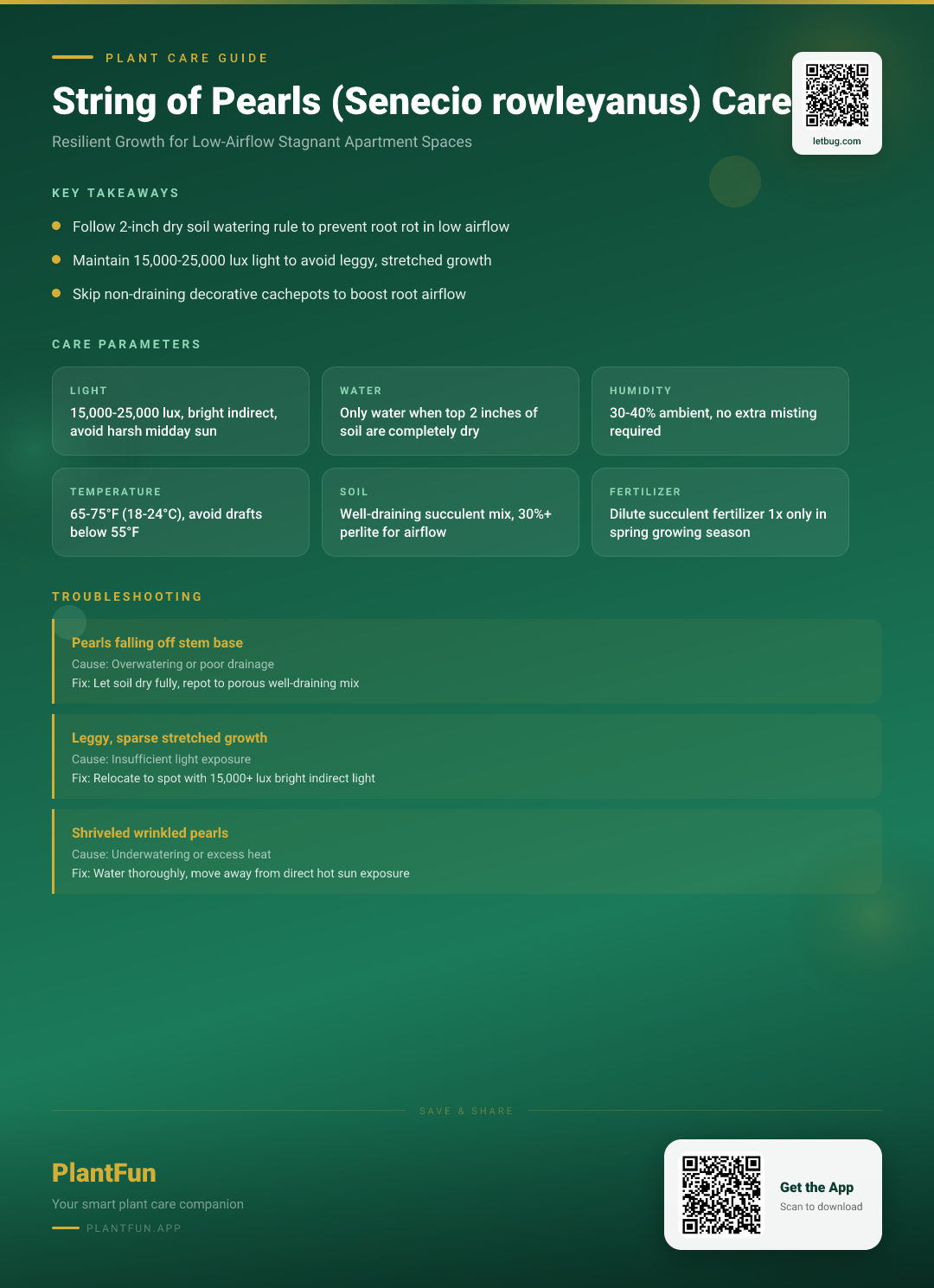
Key Takeaways
- Check soil moisture before watering — overwatering is the #1 killer of houseplants.
- Ensure your plant gets the right amount of light for its species.
- Be patient with recovery — most plants need 2–4 weeks to bounce back.
Quick Care Card
| Feature | Requirement |
|---|---|
| Light | 15,000–25,000 lux |
| Water | When top 2 inches of soil are dry |
| Humidity | 30–40% |
| Temperature | 65–75°F (18–24°C) |
| Soil | Fast-draining succulent mix (pumice/perlite base) |
| Fertilizer | Balanced liquid feed during growing season |
| Toxicity | Toxic to cats and dogs (ASPCA, 2026) |
TL;DR: The Apartment Reality Check for Senecio rowleyanus
Growing a String of Pearls in a small apartment often fails because of stagnant air and over-watering. To succeed, you must mimic an arid, breezy climate. Prioritize a terracotta pot for maximum aeration, ensure your plant receives 15,000–25,000 lux of light (NC State Extension, 2026), and resist the urge to water until the top 2 inches of soil are bone dry. When I first started keeping these in my studio, I made the mistake of using a plastic pot with poor drainage—it led to rot within weeks.
Why This Matters: Understanding the physiology of ‘pearls’ as specialized water-storage leaves
The String of Pearls (Senecio rowleyanus) has evolved spherical leaves to minimize surface area, which helps reduce water loss in its native habitat. These “pearls” function as biological water tanks. When you grow them in an apartment with poor airflow, the moisture in the soil takes longer to evaporate, which can lead to rapid rot if you aren’t careful. While some medical literature uses the term “String of Pearls” to describe various health concepts, in horticulture, this plant is a master of adaptation that requires specific environmental inputs to thrive (The Journal of Primary Health Care, 2017). Understanding that your plant is essentially a desert survivor helps you avoid the common trap of treating it like a typical tropical houseplant.
Step-by-Step Guide: Potting for Drainage and Airflow
- Choose the Right Vessel: Always use an unglazed terracotta pot. It is porous and wicks moisture away from the roots, which is vital for preventing root rot in succulents (NC State Extension, 2026).
- Select the Substrate: Use a mix consisting of 50% succulent potting soil and 50% inorganic drainage material like perlite or pumice.
- Repotting Technique: Gently remove the plant from its nursery container. Avoid burying the stems too deeply; you want the surface to stay dry to prevent stem rot.
The Watering Protocol: Avoiding the Common ‘Over-misting’ Trap
Many growers think they should mist their String of Pearls. Do not do this. Misting creates localized humidity that promotes fungal growth rather than health. Instead, use the “Finger Test”: insert your finger 2 inches into the soil. If you feel any dampness, wait another 3 days. When watering, saturate the soil thoroughly until water runs out the drainage hole, then discard all excess water from the saucer immediately. This mimics the rare but heavy rains of the succulent’s natural range.
Placement Science: Maximizing Lux in Compact Apartments
Light is the most difficult variable to control in a small space. Your plant needs 15,000–25,000 lux to maintain tight spacing between its pearls (NC State Extension, 2026). If you notice the stems looking “leggy” or thin, it is starving for light. I recommend placing your plant directly in an unobstructed south or west-facing window. If your apartment has low natural light, you must supplement with a full-spectrum LED grow light for 8–10 hours a day.
Seasonal Care Calendar: Adjusting for low-light winter months
- Spring/Summer: Growth phase. Water once every 10–14 days as temperatures rise.
- Autumn: Taper off watering as daylight hours decrease.
- Winter: Dormancy phase. Keep the soil significantly drier. Only water if you notice the pearls slightly shriveling, which is a visual indicator of thirst.
Can I keep my String of Pearls in a bedroom with no ceiling fan?
Yes, but you must be more disciplined with your watering. Since there is no air movement to assist in evaporation, the soil will stay wet longer. If your bedroom is also low-light, the combination of stagnant air and dim conditions is a recipe for disaster. If you must keep it there, place it near a window and consider adding a small desk fan to run for a few hours daily to keep the air moving around the foliage.
Why is my String of Pearls losing pearls near the base of the stems?
This is typically caused by moisture sitting against the stem, leading to “bottom rot.” Because the pearls are heavy, they can pull on the stem when the soil is soggy, causing the attachment point to decay. Ensure your soil is truly dry before the next watering and consider top-dressing the soil with coarse gravel to keep the stems off the damp earth.
How do I know if my plant is getting enough sun in my studio apartment?
The best indicator is the shape of the pearls. They should look like bright, taut spheres with a small, window-like “translucent stripe” (epidermal window) visible on the side. If they start looking elongated or oval, they are stretching for light. Additionally, if the plant is losing its vibrant green color and turning a dull pale shade, it needs more intensity.
Common Mistakes to Avoid: The Dangers of Decorative Cachepots
- Mistake: Dropping a nursery pot inside a solid decorative cachepot.
- What happens: The plant sits in a hidden pool of water that you cannot see or drain.
- Instead: Only use pots with drainage holes, or always remove the nursery pot to water it in the sink, letting it drip-dry completely before putting it back.
References
- American Society for the Prevention of Cruelty to Animals. (2026). Toxic and Non-Toxic Plants List — ASPCA. https://www.aspca.org/pet-care/animal-poison-control/toxic-and-non-toxic-plants. Accessed 2026-03-18.
- North Carolina State University Extension. (2026). String of Pearls — NC State Extension Gardener Plant Toolbox. https://plants.ces.ncsu.edu/plants/pearls-care/. Accessed 2026-03-18.
- The Journal of Primary Health Care. (2014). String of PEARLS about diabetes. The Journal of Primary Health Care. https://doi.org/10.1071/hc14339b. Accessed 2026-03-18.
- The Journal of Primary Health Care. (2017). String of PEARLS. The Journal of Primary Health Care. https://doi.org/10.1071/hc15920. Accessed 2026-03-18.
Optional Helper: Plantfun.App
Plantfun.App identifies your plants by photo, diagnoses pests and diseases with clear fixes, and creates personalised watering and light schedules that adapt to your home conditions — a handy companion for putting this guide into daily practice.
Found an error or have suggestions? We'd love your feedback.
Need help identifying this problem?
Get instant identification, personalized care schedules, and effective pest treatment plans directly on your phone.
Sponsored • We may earn a commission from app downloads
Related Guides
String of Pearls in a Low-Humidity Apartment: A 5-Step Survival and Growth Plan
Rescue your shriveled String of Pearls with our precise care guide. Learn the exact light, water, and humidity thresholds needed for lush, resilient growth.
Care GuideString of Pearls in a Dim Apartment: The Ultimate Care Guide for Resilient Growth
Master your String of Pearls in low-light apartments with this 5-step growth plan. Learn the exact light lux and watering schedules for long, healthy trailing stems.
Care GuideString of Pearls in a Dim Apartment: The Complete Guide to Resilient Indoor Growth
Revive your string of pearls with these exact care thresholds. Learn how to optimize dim apartment light and prevent root rot using our 3-step watering method.
Pest ControlAnts on Plants: What They Mean and What to Do
Ants usually aren't eating your plant. They are farming other pests.