
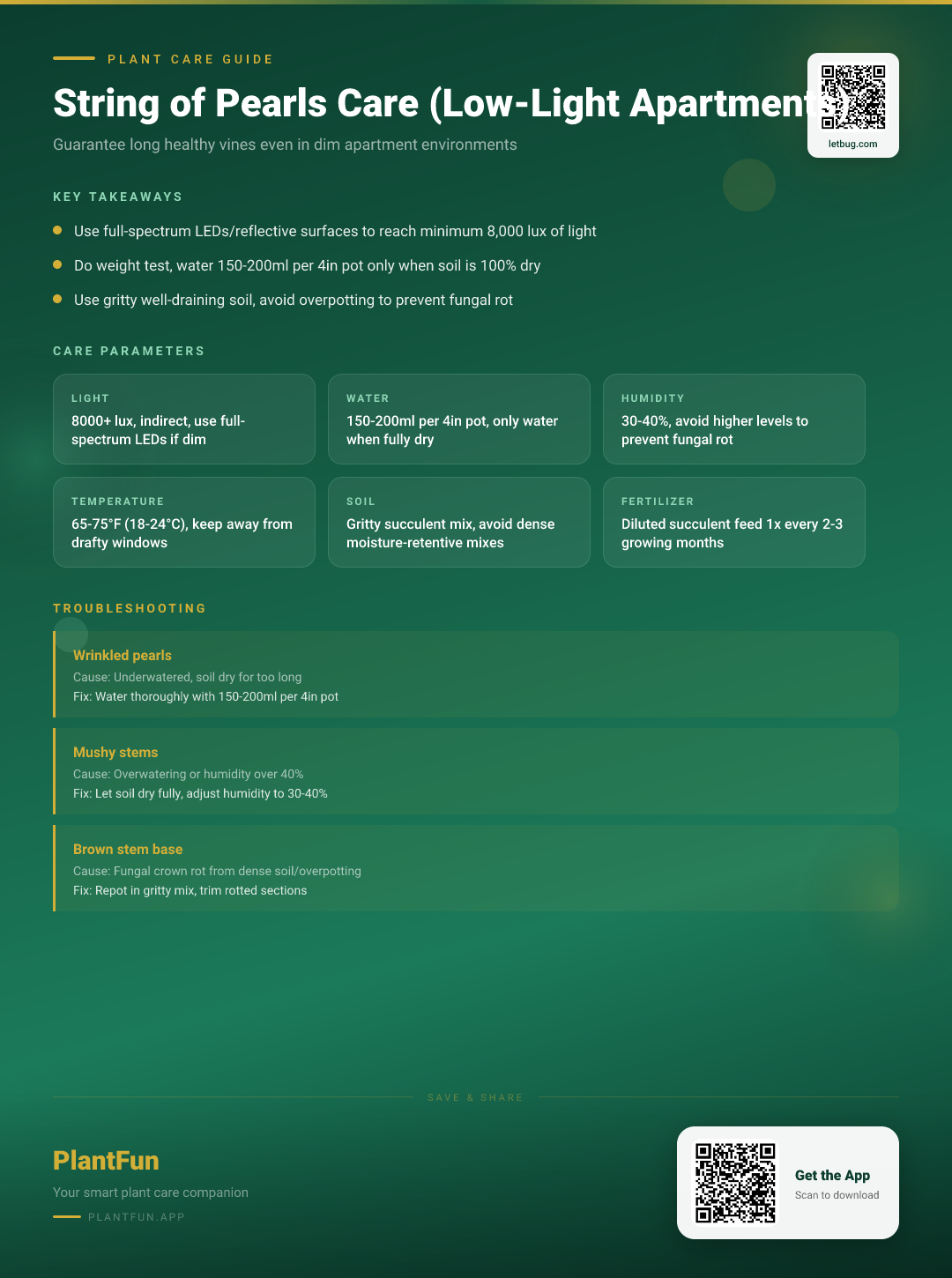
Key Takeaways
- Check soil moisture before watering — overwatering is the #1 killer of houseplants.
- Ensure your plant gets the right amount of light for its species.
- Be patient with recovery — most plants need 2–4 weeks to bounce back.
TL;DR: To keep your String of Pearls alive in a dim apartment, prioritize light exposure using supplemental LEDs to reach 8,000 lux, and strictly follow the ‘weight-test’ method: wait until the soil is 100% dry and the pot feels feather-light before watering with 150ml-200ml per 4-inch pot. Avoid overpotting and dense soils, as these are the leading causes of rot in indoor environments.
My Experience
When I first brought home my Senecio rowleyanus, I placed it on a beautiful mahogany bookshelf in the back of my living room. I thought it looked like a Victorian curiosity. Within three weeks, the vines became stringy, the pearls flattened out, and the base turned to mush. I had committed the classic apartment dweller mistake: assuming a succulent could adapt to the low-light aesthetic I desired. It took me months of trial and error with reflective mirrors and specialized light bulbs to finally stabilize my plant and get those iconic, plump beads back.
Quick Care Card: Essential Thresholds for Success
| Feature | Requirement |
|---|---|
| Light | 8,000+ Lux (Bright indirect) |
| Water | Only when pot is 100% dry |
| Humidity | 30-40% (Low to Moderate) |
| Temperature | 65-75°F (18-24°C) |
| Soil | Fast-draining succulent mix (Gritty) |
| Fertilizer | Diluted balanced liquid (Spring/Summer) |
| Toxicity | Toxic to cats/dogs (ASPCA, 2026) |
Why Your String of Pearls Struggles in Low-Light Apartments
Native to the arid regions of Southwest Africa, this succulent is biologically programmed for high-intensity, filtered sunlight (NC State Extension, 2026). In a typical urban apartment, light intensity drops exponentially as you move even a few feet away from a window. Without sufficient photon energy, the plant cannot photosynthesize effectively, leading to ‘etiolation’—where the plant stretches thin and weak, searching for light that isn’t there.
Identifying the Warning Signs: Wrinkled Pearls vs. Mushy Stems
Wrinkled Pearls
Symptom: The beads look slightly deflated, like a raisin.
Likely cause: Chronic underwatering or root system damage.
Fix:
- Check if the pot feels very light.
- Provide a thorough soak if the soil is bone dry.
Mushy Stems
Symptom: The vine is brown, translucent, or falling apart near the soil line.
Likely cause: Fungal root rot due to excessive moisture (NC State Extension, 2026).
Fix:
- Immediately cease all watering.
- Propagate healthy, non-mushy vines to start over.
Step 1: Optimizing Light - How to use reflective surfaces and budget LED full-spectrum bulbs to reach 8,000+ lux
If your apartment lacks south-facing windows, you must augment your light. Use a light meter app or a dedicated sensor to check your plant’s location. If it reads below 5,000 lux, it is in ‘survival mode.’ Place a full-spectrum LED desk lamp 6–10 inches above the plant for 12 hours a day. Using white surfaces or mirrors behind the pot can also increase the ambient lux reaching the top of the crown, where sunlight is needed to prevent bald spots.
Step 2: The ‘Weight-Test’ Watering Method: Why you need 150ml-200ml per 4-inch pot, waiting for 100% soil dryness
Most apartment failures occur because we water on a schedule rather than by need. For a 4-inch pot, use exactly 150ml-200ml of water, but only after the pot feels distinctly lighter than it did when watered. Stick your finger two inches deep; if there is any dampness, wait three more days.
Step 3: Humidity Management - Keeping levels at 30-40% to prevent fungal crown rot
While some indoor plants love high humidity, Senecio rowleyanus prefers moderate, steady levels. If your home humidity exceeds 50% for extended periods, air circulation becomes critical to prevent crown rot. Use a small oscillating fan nearby to ensure the pearls themselves dry quickly after any potential misting or condensation.
Step 4: Temperature Control - Maintaining a steady 65-75°F (18-24°C) away from drafty windows
Avoid placing your String of Pearls on windowsills during the winter if the glass gets icy or near vents that blow hot, dry air. Rapid temperature fluctuations cause physiological stress (NC State Extension, 2026).
Seasonal Care Calendar: Adjusting for the dark winter months
- Spring: Increase light; begin gentle fertilizing once growth resumes.
- Summer: Monitor for heat stress; ensure consistent, filtered light.
- Fall: Gradually reduce water frequency as daylight hours decrease.
- Winter: Keep cool and dry; supplemental light is non-negotiable.
Common Mistakes to Avoid: Overpotting and using improper, dense soil mixes
- Mistake: Using a pot too large for the root system. What happens: Excess soil holds water that the plant cannot reach, causing rot. Instead: Use a pot only slightly larger than the root ball.
- Mistake: Using standard potting soil. What happens: It stays too wet. Instead: Use a 50/50 mix of cactus soil and perlite.
FAQ
Why is my String of Pearls turning brown at the base?
This is almost always a sign of overwatering or soil that is too organic and moisture-retentive. The roots are suffocating (NC State Extension, 2026).
Can I place my String of Pearls on a high bookshelf away from the window?
Only if you use dedicated grow lights. Without them, the plant will inevitably etiolate and die back.
How do I tell if my plant is actually thirsty?
The ‘weight test’ is the gold standard. A thirsty String of Pearls will have slightly wrinkled beads, and the pot will feel remarkably light.
Expert Tips for Propagating Leggy Stems to Fill Out Your Pot
To fill out a bald crown, take a 3-inch cutting, remove the bottom two pearls, and lay the stem horizontally on moist succulent soil. Use a bent paperclip to pin the stem down. It will root at the nodes within 3-4 weeks.
References
- The Journal of Primary Health Care. (2017). String of PEARLS. https://doi.org/10.1071/hc15920. Accessed 2026-03-14.
- The Journal of Primary Health Care. (2014). String of PEARLS about diabetes. https://doi.org/10.1071/hc14339b. Accessed 2026-03-14.
- ASPCA. (2026). Toxic and Non-Toxic Plants List — ASPCA. https://www.aspca.org/pet-care/animal-poison-control/toxic-and-non-toxic-plants. Accessed 2026-03-14.
- NC State Extension. (2026). String of Pearls — NC State Extension Gardener Plant Toolbox. https://plants.ces.ncsu.edu/plants/pearls-care/. Accessed 2026-03-14.
Optional Helper: Plantfun.App
Plantfun.App identifies your plants by photo, diagnoses pests and diseases with clear fixes, and creates personalised watering and light schedules that adapt to your home conditions — a handy companion for putting this guide into daily practice.
Found an error or have suggestions? We'd love your feedback.
Need help identifying this problem?
Get instant identification, personalized care schedules, and effective pest treatment plans directly on your phone.
Sponsored • We may earn a commission from app downloads
Related Guides
String of Pearls in a Low-Humidity Apartment: A 5-Step Survival and Growth Plan
Rescue your shriveled String of Pearls with our precise care guide. Learn the exact light, water, and humidity thresholds needed for lush, resilient growth.
Care GuideString of Pearls in a Dim Apartment: 7 Rules to Prevent Leggy, Dying Stems
Rescue your String of Pearls from shriveling. Learn 7 precise care rules, including exact light lux thresholds and hydration cycles to stop leggy growth today.
Care GuideString of Pearls Care Checklist: Grow Full, Trailing Vines in Typical Apartments
Grow lush, trailing String of Pearls vines in your apartment with this science-backed checklist. Get exact light levels, watering amounts, and 7 quick fixes for common symptoms like shriveled pearls.
Pest ControlAnts on Plants: What They Mean and What to Do
Ants usually aren't eating your plant. They are farming other pests.