
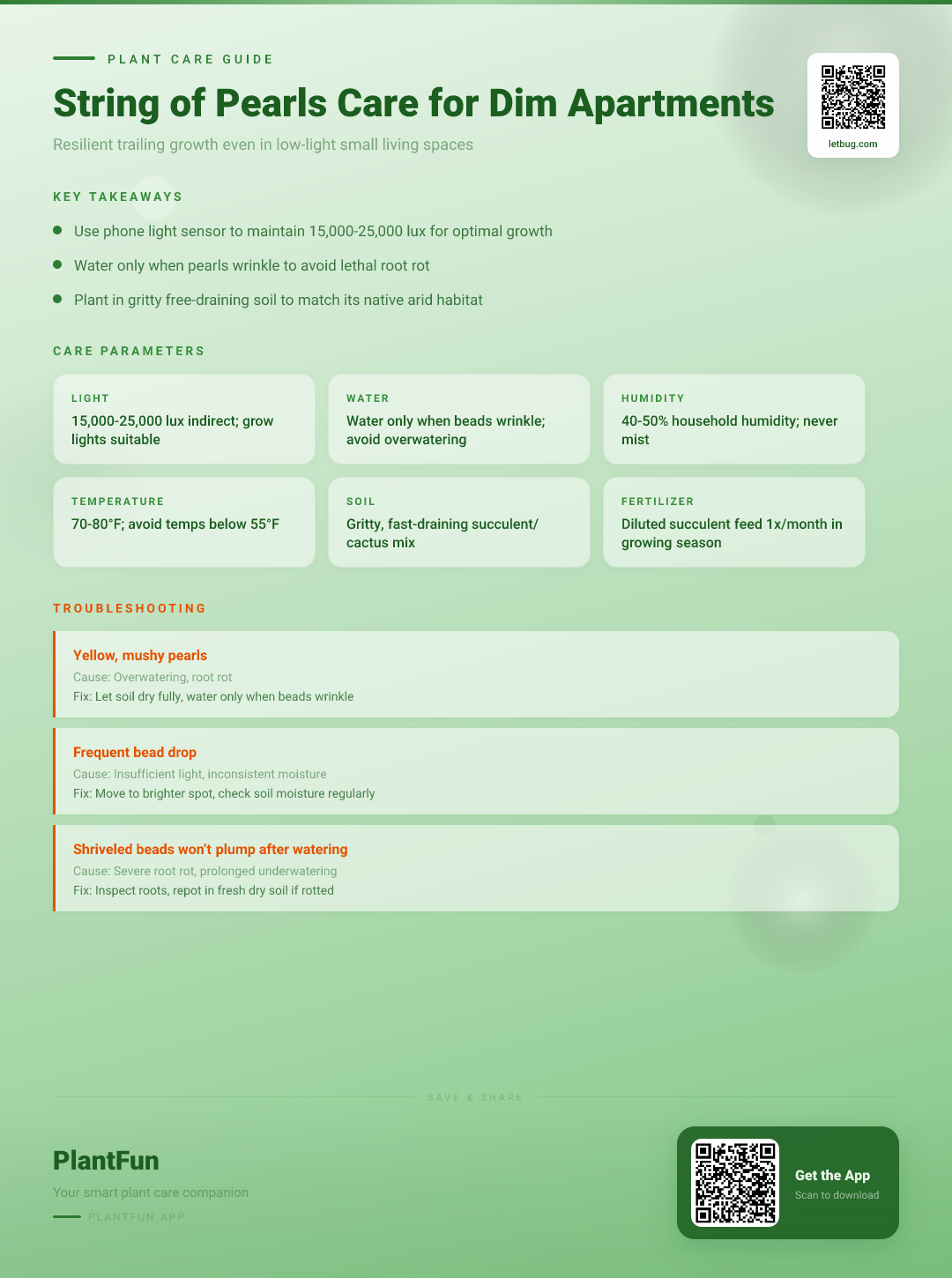
Key Takeaways
- Check soil moisture before watering — overwatering is the #1 killer of houseplants.
- Ensure your plant gets the right amount of light for its species.
- Be patient with recovery — most plants need 2–4 weeks to bounce back.
Quick Care Card: The TL;DR for your pearls
| Feature | Requirement |
|---|---|
| Light | 20,000+ lux (Bright, indirect) |
| Water | Only when beads wrinkle (approx. every 2-4 weeks) |
| Temp | 70-80°F (21-27°C) |
| Humidity | Low (30-50%) |
| Soil | Gritty, succulent-specific mix |
| Fertilizer | Diluted, balanced feed in spring/summer |
| Toxicity | Toxic to cats and dogs (ASPCA, 2026) |
The Apartment Dilemma: Why Senecio rowleyanus struggles in typical living spaces
When I first brought home my Senecio rowleyanus, I placed it in a “bright” kitchen corner, thinking it would thrive. Within weeks, the stems thinned out, and the pearls began to drop. I quickly learned that what looks like “bright light” to a human eye is often inadequate for a succulent native to the arid, high-altitude regions of South Africa. In an apartment, the primary enemies are low vertical light, lack of airflow, and improper substrate drainage (NC State Extension, 2026).
Understanding Your Light: How to measure 15,000-25,000 lux with a phone sensor for optimal growth
Most apartment windows don’t provide the direct sun these plants crave. To see real, compact growth, I treat light as a measurable metric rather than a feeling. Download a free light meter app and hold your phone at the level of the plant. If you aren’t hitting at least 15,000 lux, you will likely see “stretching” (etiolation). Aim for 20,000 to 25,000 lux for 10-12 hours a day to simulate their natural high-energy habitat.
The Watering Science: How to use the ‘bead-turgidity’ method to avoid lethal root rot
I never water on a calendar schedule. Instead, I observe the foliage. Senecio rowleyanus are succulents that store water in their spherical leaves.
- Check the beads: If they are round and firm, they are hydrated.
- Look for “windows”: If the bead surface appears slightly puckered or wrinkled, the plant is ready for water (NC State Extension, 2026).
- Thorough soak: When watering, ensure the soil is saturated, then allow all excess water to drain away completely. Never let the roots sit in a saucer of water, as this is the primary cause of root rot.
Soil Architecture: Creating a gritty, free-draining substrate that mimics rocky, arid cliffs
Standard potting soil is too moisture-retentive for a String of Pearls. In my experience, the secret is a “gritty” mix. I use a ratio of 50% high-quality potting soil to 50% inorganic drainage material like perlite, pumice, or fine-grit poultry gravel. This mimics the rocky, well-draining environment described by the NC State Extension (2026).
Space-Saving Support: Creative vertical mounting strategies for small-apartment airflow
In small apartments, horizontal space is a premium. I prefer using wall-mounted planters or macramé hangers that elevate the plant. This isn’t just aesthetic; it’s functional. Elevating the plant increases airflow around the stems, which prevents moisture from lingering in the soil and reduces the risk of fungal issues.
Seasonal Shift: Adjusting your care rhythm from high-energy summers to dormant winters
During the winter, the plant’s metabolism slows significantly. I reduce watering by nearly half during these months. If the apartment temperature dips below 65°F (18°C), the plant is at higher risk for rot, so I move it further from drafty windows (NC State Extension, 2026).
Why is my String of Pearls losing beads? Troubleshooting common moisture and light gaps
Overwatering Rot
Symptom: Beads turn mushy or brown, usually starting at the soil line.
Likely cause: Excess moisture in the root zone.
Fix:
- Remove damaged stems.
- Repot in fresh, dry, gritty substrate.
Light Starvation
Symptom: Long, “leggy” stems with large gaps between beads.
Likely cause: Insufficient light intensity.
Fix:
- Move the plant to a brighter window.
- Supplement with a dedicated grow light.
Dehydration
Symptom: Beads are severely shriveled and crispy.
Likely cause: Too much time between watering.
Fix:
- Give the pot a thorough soak.
- Check that the substrate hasn’t become hydrophobic.
Can I grow String of Pearls using only grow lights? The truth about artificial spectrums
Yes. In my experience, a full-spectrum LED grow light is often more reliable than a north-facing window. Place the light 6-10 inches from the foliage to ensure the intensity reaches the necessary 20,000+ lux range without causing heat burn.
How do I propagate my String of Pearls when I don’t have extra room? Compact nursery tips
To save space, I use a small shallow tray filled with damp sand. I coil a 3-inch cutting on top, ensuring the stem nodes are touching the medium. Keep it in a bright spot, and within a few weeks, roots will develop without the need for large pots.
Common Mistakes to Avoid: Why misting is the silent killer of your succulent
- Mistake: Misting the leaves.
What happens: Creates an environment for rot and leaf spotting.
Instead: Water the soil directly and keep the foliage dry.
FAQ
- Can I put my String of Pearls in the bathroom? Only if it has excellent ventilation and a bright window; otherwise, the high humidity will cause rot (ASPCA, 2026).
- How often to water String of Pearls? Forget the calendar. Water only when the beads wrinkle (NC State Extension, 2026).
- Is my plant safe for pets? No. The ASPCA (2026) lists Senecio rowleyanus as toxic to cats and dogs.
References
- American Society for the Prevention of Cruelty to Animals. (2026). Toxic and Non-Toxic Plants List — ASPCA. https://www.aspca.org/pet-care/animal-poison-control/toxic-and-non-toxic-plants. Accessed 2026-03-18.
- North Carolina State University Extension. (2026). String of Pearls — NC State Extension Gardener Plant Toolbox. https://plants.ces.ncsu.edu/plants/pearls-care/. Accessed 2026-03-18.
- The Journal of Primary Health Care. (2017). String of PEARLS. https://doi.org/10.1071/hc15920. Accessed 2026-03-18.
- The Journal of Primary Health Care. (2014). String of PEARLS about diabetes. https://doi.org/10.1071/hc14339b. Accessed 2026-03-18.
Optional Helper: Plantfun.App
Plantfun.App identifies your plants by photo, diagnoses pests and diseases with clear fixes, and creates personalised watering and light schedules that adapt to your home conditions — a handy companion for putting this guide into daily practice.
Found an error or have suggestions? We'd love your feedback.
Need help identifying this problem?
Get instant identification, personalized care schedules, and effective pest treatment plans directly on your phone.
Sponsored • We may earn a commission from app downloads
Related Guides
String of Pearls in a Low-Humidity Apartment: A 5-Step Survival and Growth Plan
Rescue your shriveled String of Pearls with our precise care guide. Learn the exact light, water, and humidity thresholds needed for lush, resilient growth.
Care GuideString of Pearls in a Dim Apartment: 7 Rules to Prevent Leggy, Dying Stems
Rescue your String of Pearls from shriveling. Learn 7 precise care rules, including exact light lux thresholds and hydration cycles to stop leggy growth today.
Care GuideString of Pearls Care Checklist: Grow Full, Trailing Vines in Typical Apartments
Grow lush, trailing String of Pearls vines in your apartment with this science-backed checklist. Get exact light levels, watering amounts, and 7 quick fixes for common symptoms like shriveled pearls.
Pest ControlAnts on Plants: What They Mean and What to Do
Ants usually aren't eating your plant. They are farming other pests.