
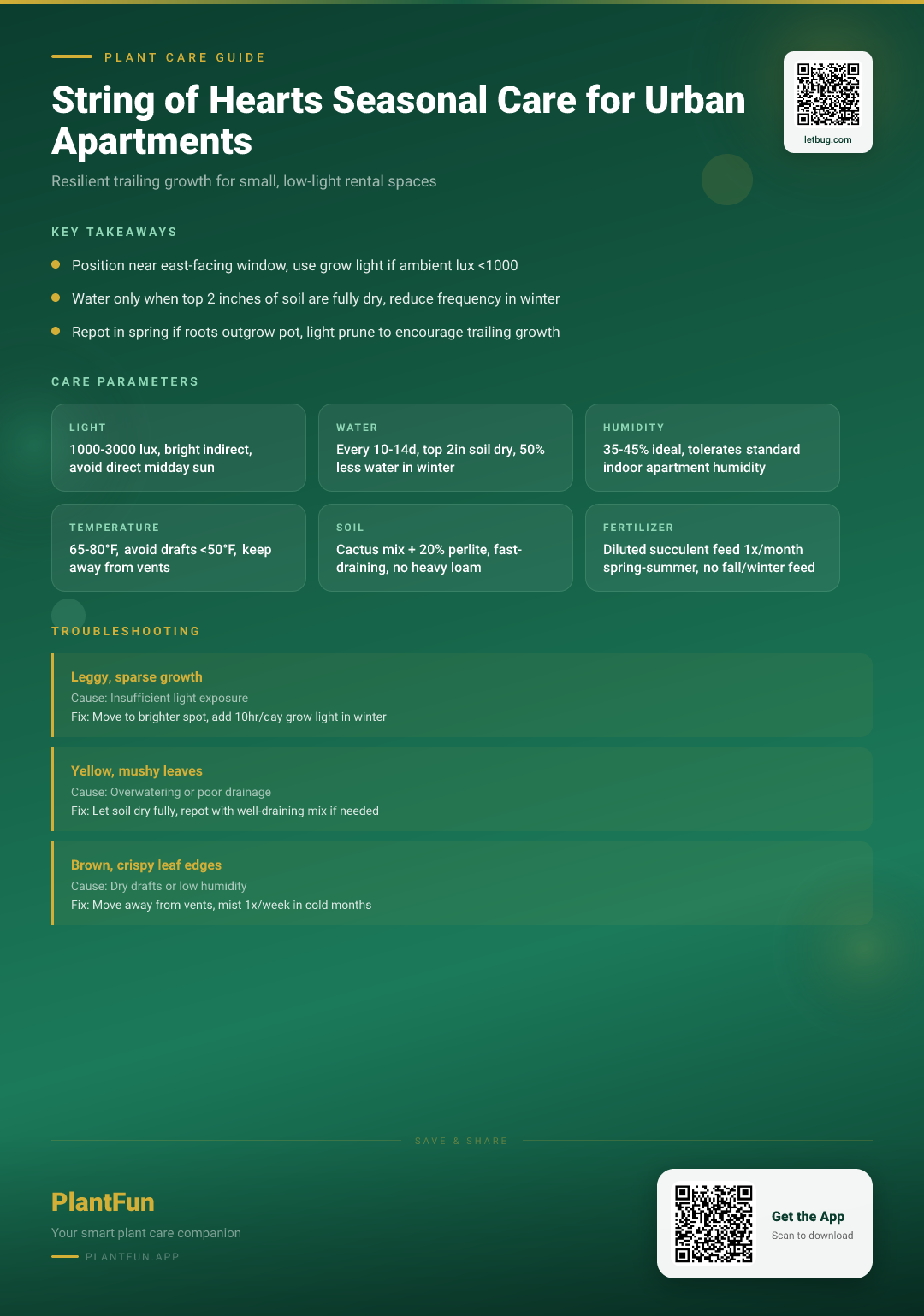
Key Takeaways
- Check soil moisture before watering — overwatering is the #1 killer of houseplants.
- Ensure your plant gets the right amount of light for its species.
- Be patient with recovery — most plants need 2–4 weeks to bounce back.
Quick Care Card: At-a-glance cheat sheet with all measurable care thresholds for busy plant owners
| Parameter | Threshold |
|---|---|
| Light | 10,000–20,000 lux; east-facing window ideal (NC State Extension, 2026) |
| Water | 100ml for 4-inch pots, 200ml for 6-inch pots, when top 2 inches of soil are completely dry |
| Humidity | 35–45% (matches standard urban apartment baseline, no humidifier needed) |
| Temperature | 60–85°F; avoid swings greater than 10°F |
| Soil | 2 parts succulent mix + 1 part perlite + 1 part orchid bark (fast-draining) |
| Fertilizer | 1/2 strength succulent fertilizer, twice per year only in spring |
| Toxicity | Non-toxic to cats, dogs, and humans (ASPCA, 2026) |
Why String of Hearts Struggles in Typical Small Urban Apartments
String of Hearts (Ceropegia woodii) is a hardy succulent vine, but it evolved in stable, warm, bright South African habitats that rarely match the fluctuating conditions of small urban apartments. Seasonal shifts in indoor environments, including 20–30% drops in humidity during winter heating season and 10–15°F temperature swings from inconsistent heating/cooling (SDRP Journal of Earth Sciences & Environmental Studies, 2017), trigger common issues like sparse growth, leaf drop, and root rot that generic care guides fail to address. Most apartment dwellers also face constraints like limited window space, no permission to drill drainage holes in pots, and low light during short winter days, all of which can derail String of Hearts health without targeted, renter-friendly adjustments.
Step 1: Light Placement for Apartment String of Hearts
String of Hearts light requirements sit at 10,000–20,000 lux (NC State Extension, 2026), which is easy to achieve even in small apartments with limited window access. The best spot is an east facing window String of Hearts will get 2–3 hours of gentle morning sun and bright indirect light for the rest of the day, eliminating risk of leaf burn. If you only have low-light north or west-facing windows, use a cheap $10 clip-on 10W LED grow light placed 12 inches above the plant for 8–10 hours per day, no specialized grow light setup required. Less than 8,000 lux of consistent light is the top answer to “why is my String of Hearts sparse,” as the vine stretches to reach light and produces fewer leaves along its stems.
Step 2: Exact Watering Schedule for 35-45% Humidity Apartments
For standard 35–45% apartment humidity, the answer to how often to water String of Hearts depends entirely on soil dryness, not a fixed weekly schedule. Use this quick test: stick your index finger 2 inches deep into the soil; if no soil sticks to your finger, it’s time to water. Follow these exact volume guidelines for common pot sizes:
- 4-inch pot: 100ml of room temperature water
- 6-inch pot: 200ml of room temperature water Adjust for HVAC use: add 50ml per watering if you run heating 24/7 in winter, subtract 25ml per watering if you run AC constantly in summer. Always empty the plant saucer 15 minutes after watering to avoid standing water that causes root rot.
Step 3: Soil & Pot Requirements for Drainage in Small Spaces
String of Hearts soil mix must be fast-draining to prevent root rot in compact apartment pots. Use this easy, low-cost mix: 2 parts standard succulent/cactus mix + 1 part perlite + 1 part orchid bark. String of Hearts prefers being root-bound, so only size up your pot 1 inch larger than the current root ball when repotting, which saves valuable windowsill space for small apartment String of Hearts tips. For renters who cannot drill drainage holes in decorative pots, use this no-drill hack: add a 1-inch layer of smooth pebbles at the bottom of the pot before adding soil, which catches excess water away from the root zone.
Seasonal Care Calendar: Spring Routine
Spring is the peak growing season for String of Hearts, so use this routine to encourage bushier trailing growth:
- Check for repotting cues: if roots are growing out the drainage holes, or the soil dries out completely in less than 24 hours after watering, repot in fresh soil mix in a 1-inch larger pot.
- Fertilize twice in spring (once in early spring, once in late spring) with 1/2 strength succulent fertilizer to support new growth. Skip fertilizing if your plant is less than 1 year old.
- Prune any dead, yellow, or leggy vines to encourage new leaf growth, and tuck the cut ends of healthy vines back into the top of the soil to root, which creates a fuller, bushier plant. This is one of the easiest answers to how to make String of Hearts grow faster.
Seasonal Care Calendar: Summer Routine
String of Hearts summer watering and care adjustments account for hotter, more humid apartment conditions:
- Increase watering frequency by 30% if indoor temperatures stay above 80°F, as soil will dry out faster. If indoor humidity rises above 60%, reduce watering volume by 25% to avoid root rot.
- Add a cheap sheer curtain 6 inches away from your east-facing window if midday sun starts hitting the plant, to prevent sunburn on delicate leaves.
- Hang trailing vines from a small adhesive hook above your windowsill to save counter space, as vines can grow up to 12 feet long with proper String of Hearts trailing care.
Seasonal Care Calendar: Fall Routine
As days shorten and temperatures cool, prepare your plant for dry winter forced air:
- Taper watering over 4 weeks, reducing the volume by 50% by late fall, as growth slows significantly.
- Stop fertilizing completely, as new growth will be sparse and the plant cannot absorb excess nutrients without risk of root burn.
- Move the plant 6 inches away from drafty window sills, and check for gaps around window frames that let in cold air; use cheap weather stripping to seal gaps if possible.
Seasonal Care Calendar: Winter Routine
String of Hearts winter care prevents leaf drop and stunted growth during short, dark, dry winter months:
- Reduce watering to once every 4–6 weeks, only watering when the top 3 inches of soil are completely dry. Winter indoor humidity can drop to 25% with forced air heating (Brahmanandhan et al., 2008), but overwatering is still a bigger risk than underwatering for this succulent.
- Keep the plant at least 1 foot away from heating vents, as direct forced air will dry out leaf edges and cause sudden leaf drop.
- Use your clip-on LED grow light for 10 hours per day to make up for short daylight hours, which prevents leggy sparse growth.
4 Most Common Apartment String of Hearts Mistakes to Avoid
- Mistake: Overwatering on a fixed weekly schedule, regardless of soil dryness. What happens: Root rot, yellow mushy leaves, widespread leaf drop. Instead: Use the 2-inch finger test to check soil moisture before every watering, and follow the exact ml per pot size guidelines.
- Mistake: Placing the plant in a low-light north-facing window with less than 8,000 lux of light, with no supplemental lighting. What happens: Sparse, leggy growth, faded purple leaf color, no new trailing vines. Instead: Move to an east-facing window, or use a cheap clip-on LED grow light for 8–10 hours per day.
- Mistake: Exposing the plant to drafts from heating vents, AC units, or leaky window frames. What happens: Sudden, unexplained leaf drop, stunted growth, crispy brown leaf edges. Instead: Keep the plant 1 foot away from all HVAC vents, and 6 inches away from drafty windows in winter.
- Mistake: Overfertilizing more than 2 times per year, or using full-strength fertilizer. What happens: Burned root tips, brown leaf tips, excess salt buildup in soil that prevents water absorption. Instead: Only fertilize twice per year in spring at half strength, and flush the soil with plain water once per year to remove salt buildup.
Voice Search FAQ
Can I keep my String of Hearts on an east-facing windowsill?
Yes, this is the ideal spot for String of Hearts apartment care (NC State Extension, 2026). East-facing windows provide 2–3 hours of gentle morning sun that won’t burn leaves, plus bright indirect light for the rest of the day, which perfectly matches the 10,000–20,000 lux light requirement for healthy growth.
Why is my String of Hearts dropping leaves?
The most common causes for apartment-grown String of Hearts are sudden temperature swings from drafts, overwatering leading to root rot, or insufficient light during short winter days (NC State Extension, 2026). First move the plant away from any vents or drafty windows, then test soil moisture: if it’s soggy, let it dry completely before watering again, or repot in fresh dry soil if root rot has set in.
How do I make my String of Hearts grow longer trails?
First ensure it gets consistent 10,000–20,000 lux of light (an east-facing window works perfectly), water only when the top 2 inches of soil are dry, and prune dead or leggy vines in spring to encourage new growth. Tuck the ends of healthy vines back into the top of the soil to root, which creates a denser base that supports longer trailing growth over time. Fertilizing twice per spring with half-strength succulent fertilizer will also speed up growth without risking root burn.
Printable Care Checklist Walkthrough
Our free 1-page seasonal String of Hearts care checklist is available for download to make care even easier, no fancy apps or tracking tools required. Print it out and stick it on your fridge for quick reference. The checklist includes:
- Pre-filled checkboxes for each season’s core tasks (spring repot check, summer watering adjustment, fall draft prep, winter light supplementation)
- Quick reference for water volumes per pot size and light requirements
- Troubleshooting cheat sheet for the 4 most common issues (sparse growth, leaf drop, root rot, sunburn) Mark off tasks as you complete them each season, and you’ll never have to look up generic care advice again.
References
- NC State Extension. (2026). String of Hearts Seasonal — NC State Extension Gardener Plant Toolbox. https://plants.ces.ncsu.edu/plants/hearts-care/. Accessed 2026-02-25.
- ASPCA. (2026). Toxic and Non-Toxic Plants List — ASPCA. https://www.aspca.org/pet-care/animal-poison-control/toxic-and-non-toxic-plants. Accessed 2026-02-25.
- SDRP Journal of Earth Sciences & Environmental Studies. (2017). Seasonal Impacts on Indoor Fungal Concentrations After Mold Remediation. SDRP Journal of Earth Sciences & Environmental Studies. https://doi.org/10.25177/jeses.2.1.3. Accessed 2026-02-25.
- Brahmanandhan, G.; Selvasekarapandian, S.; Malathi, J. (2008). Seasonal Variation of Indoor Gamma Dose and Radon, Thoron Measurement in the Dwellings around Kudankulam Nuclear Power Plant (Radhapuram Taluk, Tirunelveli District). Indoor and Built Environment. https://doi.org/10.1177/1420326x08094817. Accessed 2026-02-25.
Optional Helper: Plantfun.App
Plantfun.App identifies your plants by photo, diagnoses pests and diseases with clear fixes, and creates personalised watering and light schedules that adapt to your home conditions — a handy companion for putting this guide into daily practice.
Found an error or have suggestions? We'd love your feedback.
Need help identifying this problem?
Get instant identification, personalized care schedules, and effective pest treatment plans directly on your phone.
Sponsored • We may earn a commission from app downloads
Related Guides
The Complete String of Hearts Budget Care Guide for Small Urban Apartments for Resilient Trailing Growth
Grow lush, trailing String of Hearts in your small urban apartment on a $10 yearly budget. Get exact light, water, and soil parameters plus a free printable care checklist to avoid common mistakes.
Care GuideThe Budget-Friendly String of Hearts Care Checklist for Resilient Growth in Typical Apartments
Grow full, trailing String of Hearts vines in your apartment without buying fancy supplies. Get 7 actionable budget care steps, exact light/water thresholds, and a free printable checklist to track progress.
Care GuideThe Complete String of Hearts Care Checklist for Resilient Growth in Typical Apartments
Grab a foolproof String of Hearts care checklist tailored to typical apartment conditions, with exact light, water, and humidity levels to grow lush, trailing vines without frustrating leaf drop.
Pest ControlAnts on Plants: What They Mean and What to Do
Ants usually aren't eating your plant. They are farming other pests.