
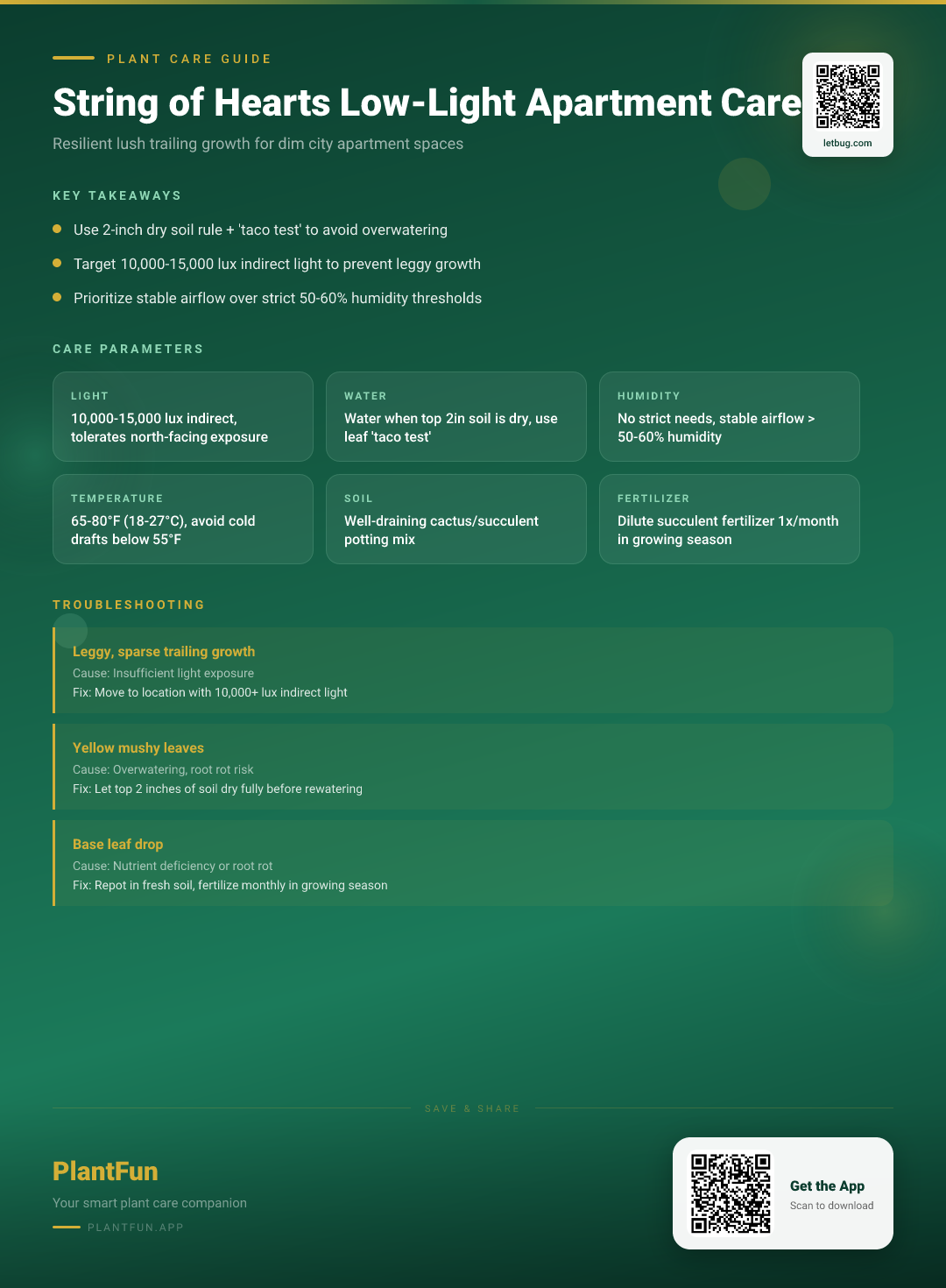
Key Takeaways
- Check soil moisture before watering — overwatering is the #1 killer of houseplants.
- Ensure your plant gets the right amount of light for its species.
- Be patient with recovery — most plants need 2–4 weeks to bounce back.
String of Hearts in Low-Light Apartments: The Ultimate Resilient Growth Care Guide
When I first brought home my Ceropegia woodii, I treated it like a typical desert cactus—placing it in the brightest window and ignoring it for weeks. The result? A string of bald, thin stems that looked nothing like the lush, heart-adorned vines I saw on social media. It took me years of experimenting in various apartment layouts to realize that Ceropegia woodii thrives not in harsh, direct desert sun, but in consistent, bright, indirect light.
Quick Care Card: Snapshot of Light, Water, Soil, and Temp
| Category | Requirement |
|---|---|
| Light | 10,000–15,000 lux (Bright, indirect) |
| Water | When 2 inches of soil are dry (Taco Test) |
| Humidity | 40–50% (Standard home levels) |
| Temperature | 65–80°F (18–27°C) |
| Soil | Well-draining cactus/succulent mix |
| Fertilizer | Balanced liquid feed, monthly in summer |
| Toxicity | Non-toxic (ASPCA, 2026) |
TL;DR: The 30-Second Summary for Busy Apartment Dwellers
To prevent leggy growth, keep your String of Hearts within 2 feet of a window, ensuring it receives 10,000–15,000 lux of light (NC State Extension, 2026). Water only when the leaves feel soft and flexible—the “Taco Test.” Avoid deep, dark corners, as these plants require consistent light to maintain leaf density. If you are in a north-facing unit, supplement with a full-spectrum grow light to maintain the plant’s health during shorter winter days.
Why String of Hearts Struggles in Typical Apartments
The primary culprit for thin, stretched vines is light insufficiency. Many apartments lack the high-intensity light levels found in natural, outdoor habitats. When the plant doesn’t get enough light, it stretches its internodes—the space between leaves—in a desperate search for energy. This creates that “sparse” look. If you are struggling with this, read more about choosing the right light for your indoor jungle to optimize your space.
Decoding the Habitat: Natural Adaptations vs. Indoor Realities
Ceropegia woodii is native to South Africa, where it grows in the shade of rocks or trees (NC State Extension, 2026). This means it is evolved to receive light that is filtered rather than direct. In your apartment, a south or east-facing window is ideal. It isn’t a true cactus that thrives on direct, scorching midday sun; rather, it is a trailing succulent that prefers bright, filtered intensity (NC State Extension, 2026).
Light Requirements: Targeting 10,000-15,000 lux (The Apartment Sweet Spot)
In my experience, measuring light makes all the difference. While “bright light” is subjective, 10,000–15,000 lux is measurable with a standard light meter app. At this level, the plant produces compact, variegated leaves. If your levels drop below 5,000 lux, your plant will eventually lose leaves at the base.
Watering Mastery: Using the ‘Taco Test’ and 2-inch Dry Rule
I never water on a schedule. Instead, I use two methods:
- The 2-inch rule: Stick your finger 2 inches into the soil. If it feels damp, wait.
- The Taco Test: Gently press the sides of a leaf. If it feels firm like a succulent, leave it. If it folds easily like a soft taco, it is thirsty (NC State Extension, 2026).
The 50-60% Humidity Myth: Why Stable Airflow Matters More
Many growers obsess over high humidity, but Ceropegia woodii prefers moderate household humidity (40–50%). High, stagnant humidity often leads to fungal issues. Instead, ensure your plant is in a location with good airflow to prevent moisture from settling on the tubers.
Temperature Control: Keeping it between 65-80°F (18-27°C)
These plants are sensitive to cold drafts. If your apartment window gets below 60°F in winter, move the plant a few feet back. Sudden temperature swings cause the delicate vines to drop leaves prematurely.
Common Mistakes: Stop Treating It Like a Desert Cactus
- Mistake: Putting it in direct midday sun.
- What happens: Scorched, bleached leaves.
- Instead: Use a sheer curtain to diffuse the light.
- Mistake: Letting it sit in wet soil for weeks.
- What happens: Root rot and mushy tubers.
- Instead: Use a well-draining soil mix with perlite or pumice (NC State Extension, 2026).
FAQ: Why is my String of Hearts losing leaves at the base?
This is usually due to poor light reaching the top of the pot. Ensure the crown of the plant is exposed to light, not hidden by deep hanging foliage.
FAQ: How do I make my String of Hearts grow faster in winter?
“Can I force growth in winter?” Generally, no. Winter is a dormancy period. Provide good light, but reduce water and fertilizer (NC State Extension, 2026).
FAQ: Can I grow a String of Hearts in a north-facing apartment?
“Can I put my String of Hearts in a north window?” Only if you supplement with a grow light. Without it, the plant will become leggy and eventually die back.
Seasonal Calendar: Adjusting for City Light Changes
- Spring/Summer: Peak growth. Increase water, provide consistent bright light.
- Autumn/Winter: Reduced growth. Let the soil dry completely; pull back on fertilization to match the lower light levels (Hoskins, 1998).
Troubleshooting Guide: Quick Fixes for Yellowing or Thinning
Yellowing Leaves at the Base
Symptom: The leaves near the soil turn yellow and drop.
Likely cause: Overwatering or water settling in the crown.
Fix:
- Check for soggy soil.
- Repot into a faster-draining mix if the soil stays wet for more than 4 days.
Stretched, Leggy Vines
Symptom: Long spaces between leaves.
Likely cause: Insufficient light.
Fix:
- Move the plant closer to the light source.
- Prune the long, leggy stems to encourage branching.
References
- ASPCA. (2026). Toxic and Non-Toxic Plants List — ASPCA. https://www.aspca.org/pet-care/animal-poison-control/toxic-and-non-toxic-plants. Accessed 2026-03-16.
- Hoskins, J. (1998). From ‘yocto’ to ‘Yotta’ and How Long Is a Piece of String. Indoor and Built Environment. https://doi.org/10.1177/1420326x9800700401. Accessed 2026-03-16.
- Hoskins, J. (1998). From ‘yocto’ to ‘Yotta’ andHow Long Is a Piece of String. Indoor and Built Environment. https://doi.org/10.1159/000024580. Accessed 2026-03-16.
- NC State Extension. (2026). String of Hearts — NC State Extension Gardener Plant Toolbox. https://plants.ces.ncsu.edu/plants/hearts-care/. Accessed 2026-03-16.
Optional Helper: Plantfun.App
Plantfun.App identifies your plants by photo, diagnoses pests and diseases with clear fixes, and creates personalised watering and light schedules that adapt to your home conditions — a handy companion for putting this guide into daily practice.
Found an error or have suggestions? We'd love your feedback.
Need help identifying this problem?
Get instant identification, personalized care schedules, and effective pest treatment plans directly on your phone.
Sponsored • We may earn a commission from app downloads
Related Guides
String of Hearts Seasonal Care Checklist for Resilient Growth in Small Urban Apartments
Grow lush, trailing String of Hearts vines in your small urban apartment with this seasonal care checklist. Get exact light, water, and humidity thresholds to avoid sparse growth and root rot year-round.
Care GuideThe Complete String of Hearts Care Checklist for Thriving Growth in Small City Apartments
Grow lush trailing String of Hearts in your apartment without fancy gear. Grab our free printable care checklist with exact light, water, and humidity thresholds for resilient, low-fuss, year-round growth.
Care GuideThe Complete String of Hearts Budget Care Guide for Small Urban Apartments for Resilient Trailing Growth
Grow lush, trailing String of Hearts in your small urban apartment on a $10 yearly budget. Get exact light, water, and soil parameters plus a free printable care checklist to avoid common mistakes.
Pest ControlAnts on Plants: What They Mean and What to Do
Ants usually aren't eating your plant. They are farming other pests.