
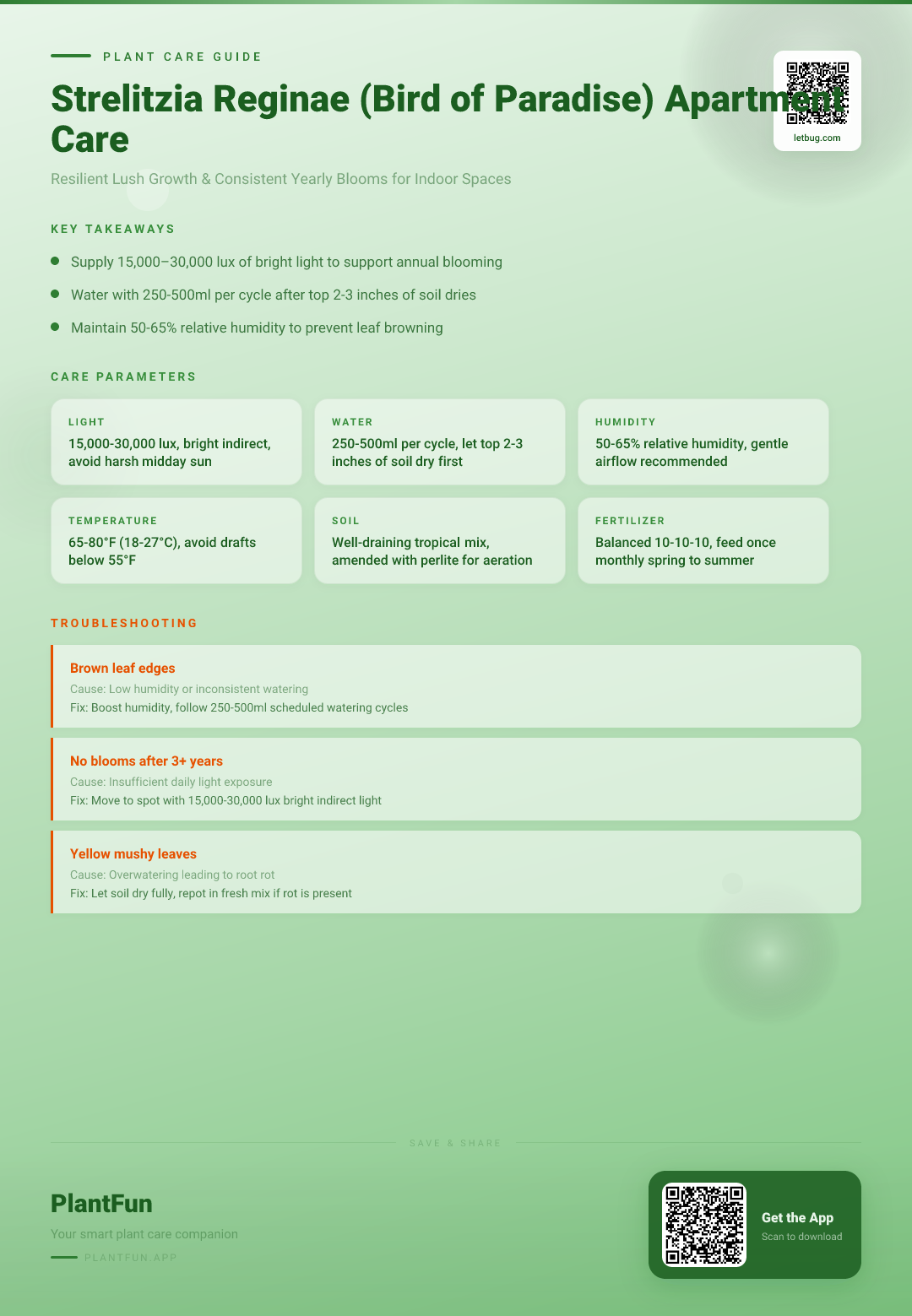
Key Takeaways
- Check soil moisture before watering — overwatering is the #1 killer of houseplants.
- Ensure your plant gets the right amount of light for its species.
- Be patient with recovery — most plants need 2–4 weeks to bounce back.
TL;DR: The Essentials
To keep a Strelitzia reginae thriving in an apartment, prioritize high light exposure (15,000–30,000 lux) and consistent but moderate watering (250-500ml per cycle). These plants are heavy feeders and require well-draining soil to prevent root rot. Always monitor for brown edges as a signal for low humidity or tap water sensitivity. Note that they are toxic to pets (ASPCA, 2026).
My Experience: The “Looming” Lesson
When I first brought my Strelitzia into my small city apartment, I placed it in a “bright” corner that turned out to be nothing more than ambient shadow. Within a month, the beautiful, stiff leaves began to droop, and the growth rate slowed to a crawl. I learned the hard way that a plant which thrives in the South African sun does not consider a dimly lit living room to be “bright.” Once I moved it to a direct southern exposure and adjusted my watering to a rigid 500ml schedule, it finally began pushing out new, healthy spikes.
Quick Care Card: The Bird of Paradise Cheat Sheet
| Category | Requirement |
|---|---|
| Light | 15,000–30,000 Lux (Direct/Bright Indirect) |
| Water | 250-500ml per cycle; dry top 2 inches |
| Humidity | 50-65% RH |
| Temperature | 65-80°F (18-27°C) |
| Soil | Well-draining, peat-based mix |
| Fertilizer | Balanced liquid feed monthly in spring/summer |
| Toxicity | Toxic to cats and dogs (ASPCA, 2026) |
Why Apartments Challenge the Bird of Paradise: Bridging the Gap
Native to the coastal regions of South Africa, the Strelitzia reginae is accustomed to intense UV radiation and constant, gentle ocean breezes (NC State Extension, 2026). Apartments frequently feature static air, lower light levels due to window orientation, and artificial heating that desiccates the foliage. To succeed, you must mimic the plant’s natural metabolic needs by maximizing light and ensuring that the lack of airflow does not lead to fungal pathogens, which can often be exacerbated by poor ventilation (Chase, 1987).
Light Requirements: Targeting 15,000–30,000 Lux for Structural Integrity
I measure light using a simple smartphone sensor to ensure my plants receive at least 15,000 lux. In an apartment, placing the plant more than 3 feet from a south-facing window typically drops light levels below this threshold. Without this intensity, the Strelitzia will not store enough energy to bloom.
Hydration Science: Why 250-500ml Watering Cycles Prevent Root Stress
I prefer the “measured cycle” method over “soak until it runs out.” By providing 250-500ml of water, I ensure the substrate stays moist but never saturated. Always perform the finger test: if the top 2 inches feel dry, it is time to irrigate.
Humidity & Airflow: Maintaining 50-65% Relative Humidity Indoors
Apartments are notorious for winter dry-air spikes. I use a humidifier to keep the zone around my plant at 50-65% relative humidity. This not only keeps the leaves vibrant but also helps prevent the physiological browning often confused with disease.
Temperature Control: Sustaining 65-80°F (18-27°C) for Optimal Metabolism
Keep your plant away from cold drafts near balcony doors or the dry, scorching heat of wall radiators. A consistent, moderate range is the sweet spot for maintaining a stable metabolism.
The 3 Most Common Apartment Mistakes (And How to Fix Them)
- Mistake: Using a pot without adequate drainage holes. What happens: Water accumulates at the base, leading to necrotic roots. Instead: Always use a container with drainage holes and an internal nursery pot.
- Mistake: Wiping leaves with tap water containing high fluoride/chlorine. What happens: Chemical buildup leads to leaf tip burn. Instead: Use distilled water or filtered water for leaf cleaning and irrigation.
- Mistake: Ignoring the “dust” layer on leaves. What happens: Photosynthetic efficiency drops significantly. Instead: Wipe leaves with a damp cloth every two weeks to ensure pores stay clear.
Can I keep my Bird of Paradise in a north-facing apartment living room?
Technically, it will survive, but it will not thrive or bloom. A north-facing window rarely reaches the 15,000 lux threshold required for this species. You would likely need to supplement with a full-spectrum LED grow light.
Why is my Bird of Paradise developing brown edges on its leaves?
Symptom: The margins of the leaves are turning crispy and brown.
Likely cause: Low humidity or salt buildup in the soil.
Fix:
- Increase local humidity with a humidifier.
- Flush the soil with distilled water to remove mineral deposits.
How do I know if my plant is getting enough light to eventually bloom?
Flowering is the ultimate indicator of success. If the plant is producing at least one new leaf every 6-8 weeks during the growing season and the petioles (leaf stalks) remain upright rather than stretching toward the light, you are on the right path (NC State Extension, 2026).
Seasonal Care Calendar: Adjusting for Winter Dormancy vs Summer Growth
- Spring/Summer: Increase watering and apply balanced fertilizer monthly.
- Fall/Winter: Reduce water by 30%; allow the soil to dry out slightly more between sessions as metabolism slows.
References
- Chase, A. (1987). Leaf Spot and Blight of Strelitzia reginae (Bird-of-Paradise) Caused by Xanthomonas campestris. Plant Disease. https://doi.org/10.1094/pd-71-0845. Accessed 2026-03-19.
- Omnes, D.; Xavier, J.; Suresh, A. (2024). Assessing Oral Acute Toxicity and Histopathological Effects of Strelitzia reginae Aiton Leaf Extracts in Zebrafish (Danio rerio Hamilton). Plant Science Today. https://doi.org/10.14719/pst.3092. Accessed 2026-03-19.
- ASPCA. (2026). Toxic and Non-Toxic Plants List — ASPCA. https://www.aspca.org/pet-care/animal-poison-control/toxic-and-non-toxic-plants. Accessed 2026-03-19.
- NC State Extension. (2026). Strelitzia reginae — NC State Extension Gardener Plant Toolbox. https://plants.ces.ncsu.edu/plants/paradise-care/. Accessed 2026-03-19.
Optional Helper: Plantfun.App
Plantfun.App identifies your plants by photo, diagnoses pests and diseases with clear fixes, and creates personalised watering and light schedules that adapt to your home conditions — a handy companion for putting this guide into daily practice.
Found an error or have suggestions? We'd love your feedback.
Need help identifying this problem?
Get instant identification, personalized care schedules, and effective pest treatment plans directly on your phone.
Sponsored • We may earn a commission from app downloads
Related Guides
The Complete Bird of Paradise Care Guide for Typical Apartments: Resilient Growth Tips That Work
Keep your Bird of Paradise thriving in even the dimmest typical apartment. Get exact light levels, water amounts, and a 2-minute weekly check to avoid yellow leaves and boost resilient growth.
Care GuideThe Budget Bird of Paradise Care Checklist for Resilient Growth in Small Urban Apartments
Grow a lush, full Bird of Paradise in your small urban apartment without overspending. Grab our free printable checklist, exact light/water thresholds, and zero fancy gear required to keep it thriving year-round.
Care GuideThe Complete Bird of Paradise Care Checklist for Resilient Growth in Standard Urban Apartments
Grow a lush, full Bird of Paradise in your standard urban apartment without yellow leaves or stunted growth. Get a printable checklist, exact care thresholds, and 7 common mistake fixes for resilient growth.
Pest ControlAnts on Plants: What They Mean and What to Do
Ants usually aren't eating your plant. They are farming other pests.