
Key Takeaways
- Check soil moisture before watering — overwatering is the #1 killer of houseplants.
- Ensure your plant gets the right amount of light for its species.
- Be patient with recovery — most plants need 2–4 weeks to bounce back.
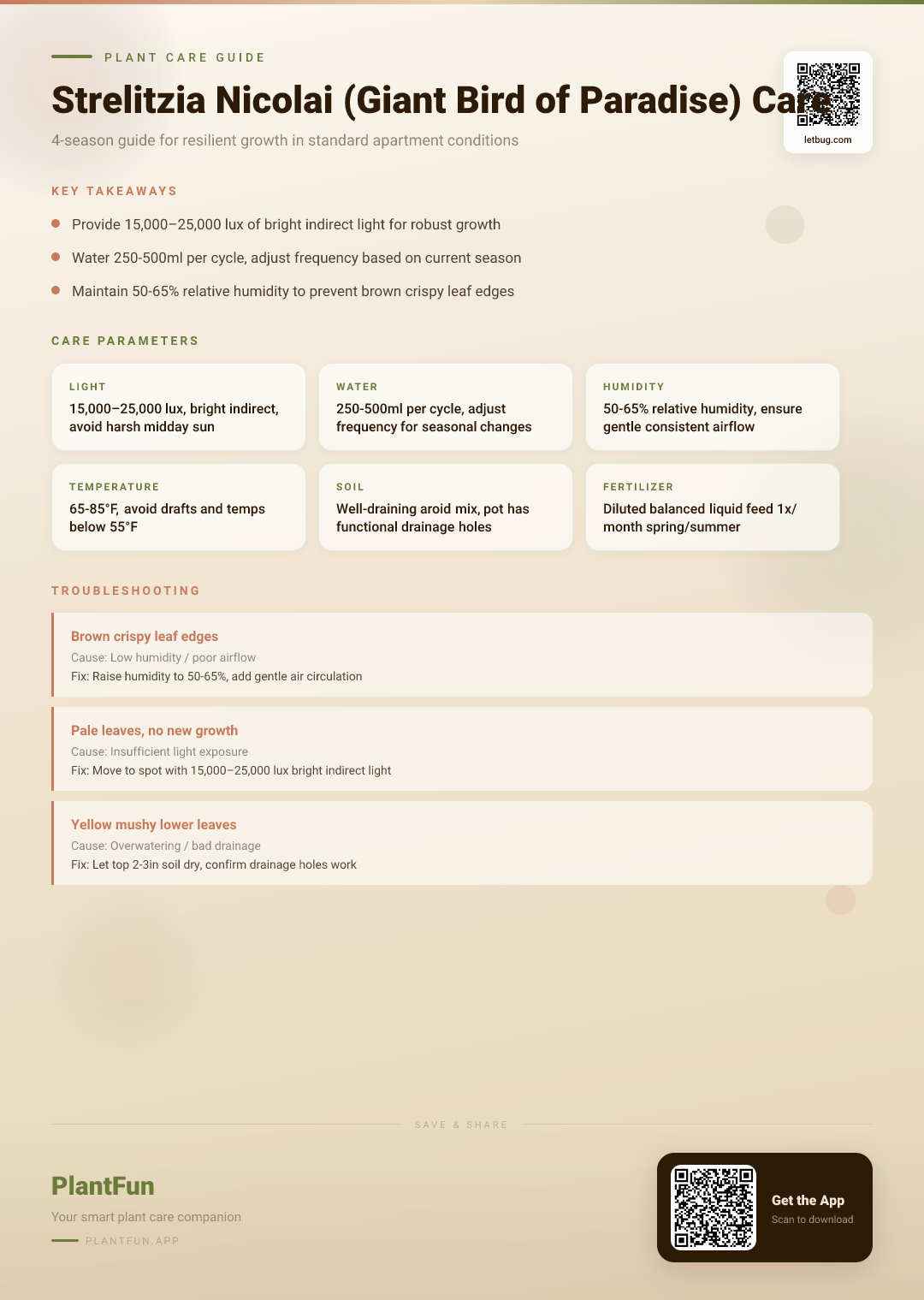
Quick Care Card: Measuring Light, Water, Humidity, and Temperature thresholds
| Feature | Requirement |
|---|---|
| Light | 15,000–25,000 lux (Bright, indirect to direct) |
| Water | 250-500ml per cycle; dry out top 2 inches |
| Humidity | 50–65% relative humidity |
| Temperature | 18°C – 27°C (65°F – 80°F) |
| Soil | Well-draining aroid mix with perlite |
| Fertilizer | Balanced NPK 20-20-20 during growing season |
| Toxicity | Toxic to cats and dogs (ASPCA, 2026) |
TL;DR: Why apartment conditions challenge the Giant Bird of Paradise
The Strelitzia nicolai is a high-energy plant that struggles in typical apartment environments due to light scarcity and stagnant, dry air. To succeed, you must replicate its natural tropical rhythm: intense light for structural integrity, precise watering cycles to prevent root rot, and steady humidity. Failing to adjust for winter dormancy often leads to the dreaded leggy, brown-edged foliage common in indoor setups.
My Experience: The “Too Little, Too Late” Lesson
When I first brought home my Strelitzia nicolai, I placed it in a dim corner, thinking it would “adapt.” Within three months, the leaves were bowing toward the window, and the stems became thin and weak—a clear case of etiolation (stretching). I learned the hard way that this plant doesn’t adapt; it demands intensity. I had to move it directly against my south-facing glass and invest in a circulation fan to mimic the airflow it desperately craves. I have since perfected this seasonal routine to keep mine standing tall.
Understanding the Light Equation: 15,000–25,000 lux requirements for indoor health
According to the NC State Extension (2026), Strelitzia nicolai thrives in full sun. In an apartment, you need to hit that 15,000–25,000 lux threshold. If your plant is leaning, it is begging for more photons. You can measure this easily with a smartphone light meter app; place the sensor at leaf level to see if your “bright” corner is actually bright enough.
The Watering Hierarchy: How to measure 250-500ml per cycle based on seasonal needs
I never water on a schedule. Instead, I use the finger test: if the top 2 inches of soil feel dry, it is time. For a standard 12-inch pot, I typically use 250-500ml of filtered water, ensuring it drains completely. Never let the plant sit in standing water, as this invites root rot (NC State Extension, 2026).
Humidity and Airflow: Maintaining 50-65% relative humidity for pristine foliage
Low humidity (below 40%) is the enemy. It causes the edges of those beautiful, iconic leaves to crisp. I keep a humidifier running nearby to maintain a 50-65% range. Furthermore, stagnant air is a breeding ground for pathogens; a small oscillating fan in your room can prevent the conditions that encourage bacterial leaf stripe (Seijo & Peres, 2011).
Step-by-Step Seasonal Calendar: What to adjust in Spring/Summer vs. Fall/Winter
- Spring/Summer (High Growth): Increase watering frequency and apply a balanced liquid fertilizer every 4 weeks. Rotate the pot 90 degrees every week to ensure even growth.
- Fall/Winter (Dormancy): Reduce watering by half. Stop fertilizing entirely to allow the plant to rest. Focus on keeping the leaves clean of dust to maximize photosynthesis.
Why is my Strelitzia nicolai developing brown, crispy leaf edges?
Brown edges are a diagnostic symptom of low humidity or underwatering. Since this plant has high transpiration rates, it requires consistent moisture in the air. If the air is dry, the leaf margins cannot sustain the plant’s metabolic demands, leading to tissue necrosis.
How do I know if my apartment has enough light for a Bird of Paradise?
If your plant produces leaves that are smaller than the previous ones or the petioles (leaf stalks) are exceptionally long, your light levels are too low. A healthy Strelitzia nicolai in an apartment should have compact, stiff growth.
Can I keep my Bird of Paradise in a room without a south-facing window?
If you lack a south-facing window, you will likely need supplemental LED grow lights. Without at least 6-8 hours of direct, high-intensity light, the plant will eventually fail to maintain its architectural structure.
Common Mistakes: Avoiding over-potting and poor drainage practices
- Mistake: Potting in a container that is too large. What happens: Excess soil holds too much water, leading to root rot. Instead: Only size up by 1-2 inches when roots are clearly circling the bottom.
- Mistake: Using dense, garden-variety soil. What happens: Poor aeration leads to suffocating roots. Instead: Use a well-draining aroid mix with heavy perlite and bark content.
Troubleshooting: Managing pests and leaf-splitting in low-airflow apartments
[Leaf Splitting]
Symptom: The leaves are shredding along the veins.
Likely cause: While natural in nature, excessive splitting indoors is often due to physical trauma or low humidity.
Fix:
- Increase ambient humidity to 60%.
- Keep the plant away from high-traffic hallways where people brush against the leaves.
[Yellowing Leaves]
Symptom: Lower, older leaves turning yellow.
Likely cause: Overwatering or natural senescence (aging).
Fix:
- Check soil moisture levels; if soggy, allow to dry out entirely.
- If the yellow leaf is old and the rest of the plant is vigorous, simply prune it off at the base.
References
- Seijo, T.; Peres, N. (2011). First Report of Acidovorax avenae subsp. avenae Causing Bacterial Leaf Stripe of Strelitzia nicolai. Plant Disease. https://doi.org/10.1094/pdis-03-11-0160. Accessed 2026-03-15.
- Dwarka, D.; Thaver, V.; Naidu, M. (2017). NEW INSIGHTS INTO THE PRESENCE OF BILIRUBIN IN A PLANT SPECIES STRELITZIA NICOLAI (STRELITZIACEAE). African Journal of Traditional, Complementary and Alternative medicines. https://doi.org/10.21010/ajtcam.v13i5.27. Accessed 2026-03-15.
- ASPCA. (2026). Toxic and Non-Toxic Plants List — ASPCA. https://www.aspca.org/pet-care/animal-poison-control/toxic-and-non-toxic-plants. Accessed 2026-03-15.
- NC State Extension. (2026). Strelitzia nicolai — NC State Extension Gardener Plant Toolbox. https://plants.ces.ncsu.edu/plants/strelitzia-nicolai/. Accessed 2026-03-15.
Optional Helper: Plantfun.App
Plantfun.App identifies your plants by photo, diagnoses pests and diseases with clear fixes, and creates personalised watering and light schedules that adapt to your home conditions — a handy companion for putting this guide into daily practice.
Found an error or have suggestions? We'd love your feedback.
Need help identifying this problem?
Get instant identification, personalized care schedules, and effective pest treatment plans directly on your phone.
Sponsored • We may earn a commission from app downloads
Related Guides
Strelitzia nicolai in Small Apartments: The Essential Care Guide for Resilient, Upward Growth
Master your Bird of Paradise care in small spaces. Follow these 4 essential thresholds and seasonal adjustments to grow healthy, split-free leaves every time.
Care GuideStrelitzia nicolai in a Low-Light Apartment: The Definitive Guide to Resilient Indoor Growth
Transform your Strelitzia nicolai into a thriving centerpiece. Learn precise watering volumes and light strategies to keep your Bird of Paradise lush indoors.
Care GuideStrelitzia nicolai in Apartments: The Only Resilient Care Guide You Will Ever Need
Transform your apartment into a tropical escape with our resilient Bird of Paradise care guide. Get precise light, watering, and soil hacks for 100% growth.
Pest ControlAnts on Plants: What They Mean and What to Do
Ants usually aren't eating your plant. They are farming other pests.