
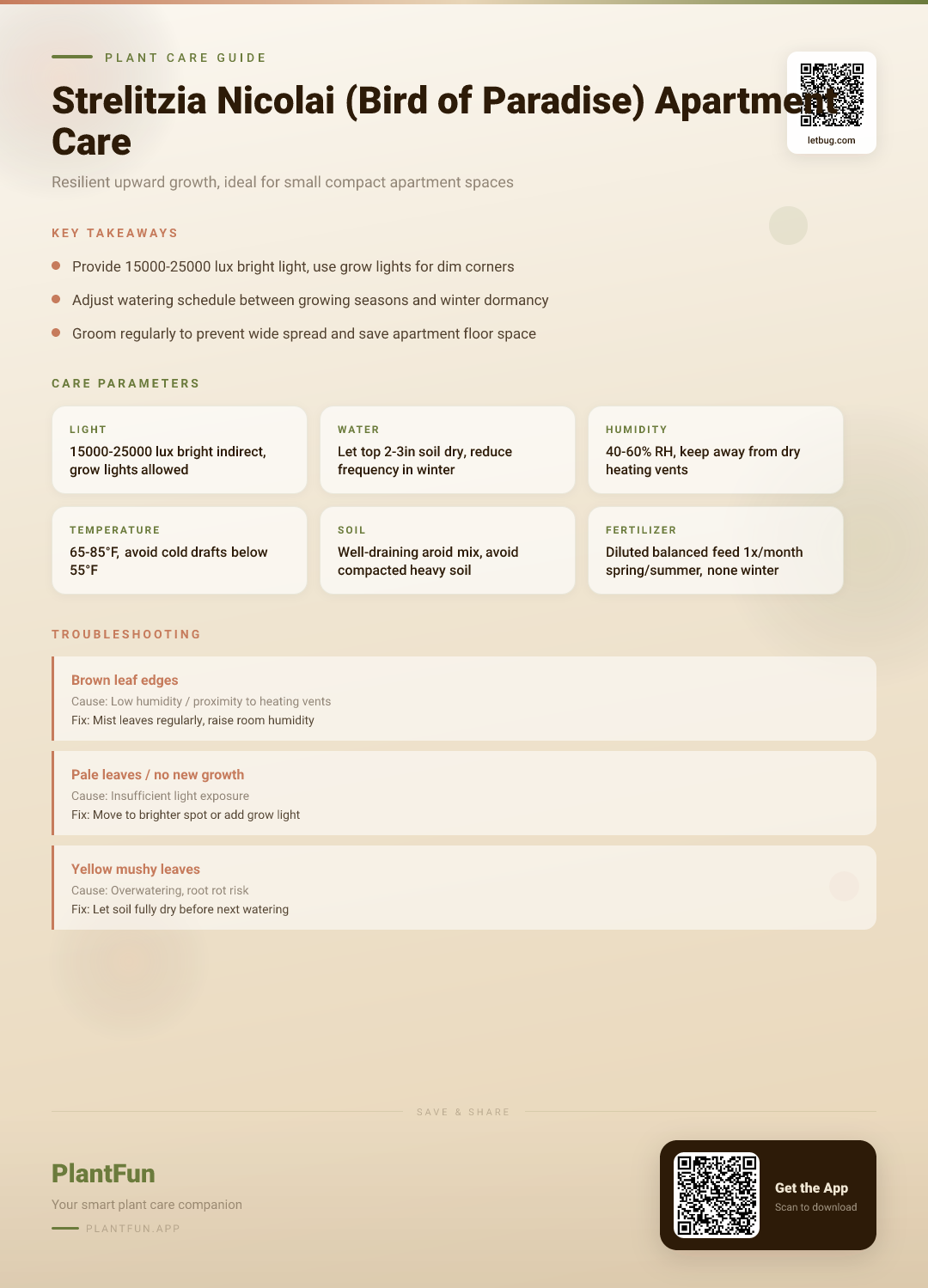
Key Takeaways
- Check soil moisture before watering — overwatering is the #1 killer of houseplants.
- Ensure your plant gets the right amount of light for its species.
- Be patient with recovery — most plants need 2–4 weeks to bounce back.
Quick Care Card: Essential Thresholds for Success
| Feature | Requirement |
|---|---|
| Light | 15,000–25,000 lux (bright, indirect light) |
| Water | Allow top 2-3 inches of soil to dry out |
| Humidity | 50%–60% relative humidity |
| Temperature | 65°F–80°F (18°C–27°C) |
| Soil | Well-draining aroid mix with bark and perlite |
| Fertilizer | Balanced liquid feed during active growth |
| Toxicity | Toxic to cats and dogs (ASPCA, 2026) |
TL;DR: The Reality of Keeping a Giant Strelitzia in a Studio
To keep a Strelitzia nicolai in a small apartment, you must simulate its tropical habitat through high-intensity light and consistent humidity. Success relies on preventing the plant from spreading outward by using vertical supports, ensuring the pot has drainage to prevent root rot, and accepting that it is a high-energy plant that cannot survive in dim corners.
Understanding Your Bird of Paradise: Natural Habitat vs. The Living Room Corner
When I first brought home my Strelitzia nicolai, I made the mistake of placing it in a “bright” corner that was actually shielded by a curtain. It immediately began to etiolate—stretching its stems desperately toward the window. In its native South Africa, this plant is an architectural giant that thrives in full sun (NC State Extension, 2026). When we move it into an apartment, we are essentially asking a skyscraper to live in a shed. Understanding this helps you realize that every leaf needs access to direct or near-direct light to stay upright and structurally sound.
Light Requirements: How to hit 15,000-25,000 lux with limited window space
If you want to avoid a sprawling, leggy plant, light is your most important variable. I measure my apartment’s light using a digital lux meter. A typical living room corner often hits only 2,000 lux, which is insufficient. To reach the 15,000–25,000 lux threshold, the plant must be within 3 feet of a south or west-facing window. If your windows are obstructed, supplemental full-spectrum LED lighting is non-negotiable.
Watering Strategy: Exactly how to measure hydration for non-draining indoor pots
Overwatering is the fastest way to kill a Strelitzia in a small space. Because apartments often have limited airflow compared to a greenhouse, soil stays wet longer.
The Finger Test: Insert your index finger 2 to 3 inches into the soil. If it feels damp, wait. If it is dry, irrigate until water runs through the drainage holes (ensure you have a saucer). Never let the plant sit in standing water, as this invites fungal pathogens (Seijo & Peres, 2011).
Humidity & Airflow: Why your apartment heating is the hidden enemy of leaf health
In winter, apartment radiators act as giant dehumidifiers, stripping the air of moisture. Strelitzia nicolai loves 50%–60% humidity. Low humidity causes crispy leaf edges. I keep a humidifier nearby, but more importantly, I ensure there is gentle air circulation to prevent fungal spots, which are common in stagnant, moist environments (Sanahuja et al., 2017).
The Structural Grooming Method: Preventing the ‘Wide Spread’ to save floor space
To prevent your plant from taking over your living room, you must train it to grow upward rather than outward.
- Use Soft Ties: Gather the petioles (leaf stalks) loosely with natural jute twine or soft plant tape.
- Pruning: As leaves naturally age and die, prune them at the base of the petiole to focus the plant’s energy on new, vertical growth.
- Pot Rotation: Rotate your pot 90 degrees every week to prevent the plant from leaning permanently toward the light source.
Seasonal Care Calendar: Modifying your routine from the active growing season to winter dormancy
- Spring/Summer (Active): Water thoroughly once the top 2 inches dry out; fertilize every 4 weeks with a balanced 20-20-20 fertilizer.
- Fall/Winter (Dormancy): Growth slows. Allow the top 4 inches of soil to dry. Cease fertilizing until the days lengthen in February.
Voice Search FAQ
Can I use a grow light to speed up growth in a dim corner? Yes, absolutely. A dedicated LED grow light (producing at least 2,000 lumens) placed 12-18 inches from the leaves can compensate for low natural light.
Why are the edges of my Bird of Paradise leaves turning brown? Brown tips usually indicate low humidity or inconsistent watering (NC State Extension, 2026). Check if your plant is near an AC vent or radiator.
Is the Bird of Paradise safe for my cat? No. According to the ASPCA (2026), the Strelitzia species is toxic to both cats and dogs if ingested.
Common Mistakes to Avoid
- Mistake: Using a pot without drainage. What happens: Root rot occurs rapidly. Instead: Always use a decorative cachepot with a nursery pot inside.
- Mistake: Wiping leaves with heavy oils. What happens: Clogs pores and attracts dust. Instead: Use a damp microfiber cloth once a month.
References and Botanical Resources
- ASPCA. (2026). Toxic and Non-Toxic Plants List — ASPCA. https://www.aspca.org/pet-care/animal-poison-control/toxic-and-non-toxic-plants. Accessed 2026-03-14.
- NC State Extension. (2026). Strelitzia nicolai — NC State Extension Gardener Plant Toolbox. https://plants.ces.ncsu.edu/plants/paradise-care/. Accessed 2026-03-14.
- Sanahuja, G., Lopez, P., & Chase, A. (2017). First Report of Bipolaris oryzae Causing Leaf Spot on Strelitzia nicolai in Florida. Plant Disease. https://doi.org/10.1094/pdis-08-16-1138-pdn. Accessed 2026-03-14.
- Seijo, T., & Peres, N. (2011). First Report of Acidovorax avenae subsp. avenae Causing Bacterial Leaf Stripe of Strelitzia nicolai. Plant Disease. https://doi.org/10.1094/pdis-03-11-0160. Accessed 2026-03-14.
Optional Helper: Plantfun.App
Plantfun.App identifies your plants by photo, diagnoses pests and diseases with clear fixes, and creates personalised watering and light schedules that adapt to your home conditions — a handy companion for putting this guide into daily practice.
Found an error or have suggestions? We'd love your feedback.
Need help identifying this problem?
Get instant identification, personalized care schedules, and effective pest treatment plans directly on your phone.
Sponsored • We may earn a commission from app downloads
Related Guides
Strelitzia nicolai in a Typical Apartment: The Complete Seasonal Care Guide for Resilient Growth
Transform your Strelitzia nicolai with a 4-season care plan. Discover exact light, water, and humidity levels to ensure robust growth in your apartment today.
Care GuideThe Complete Bird of Paradise Care Guide for Typical Apartments: Tips for Resilient, Lush Growth
Grow a lush, resilient Bird of Paradise even in a small standard apartment. Get exact light levels, watering amounts, and troubleshooting tips to avoid yellow leaves and stunted growth.
Care GuideStrelitzia nicolai in a Small Apartment: The Resilience-First Care Guide for Indoor Success
Transform your cramped apartment into a tropical oasis. Master Bird of Paradise care with 4 simple steps and a resilient watering schedule that prevents rot.
Pest ControlAnts on Plants: What They Mean and What to Do
Ants usually aren't eating your plant. They are farming other pests.