
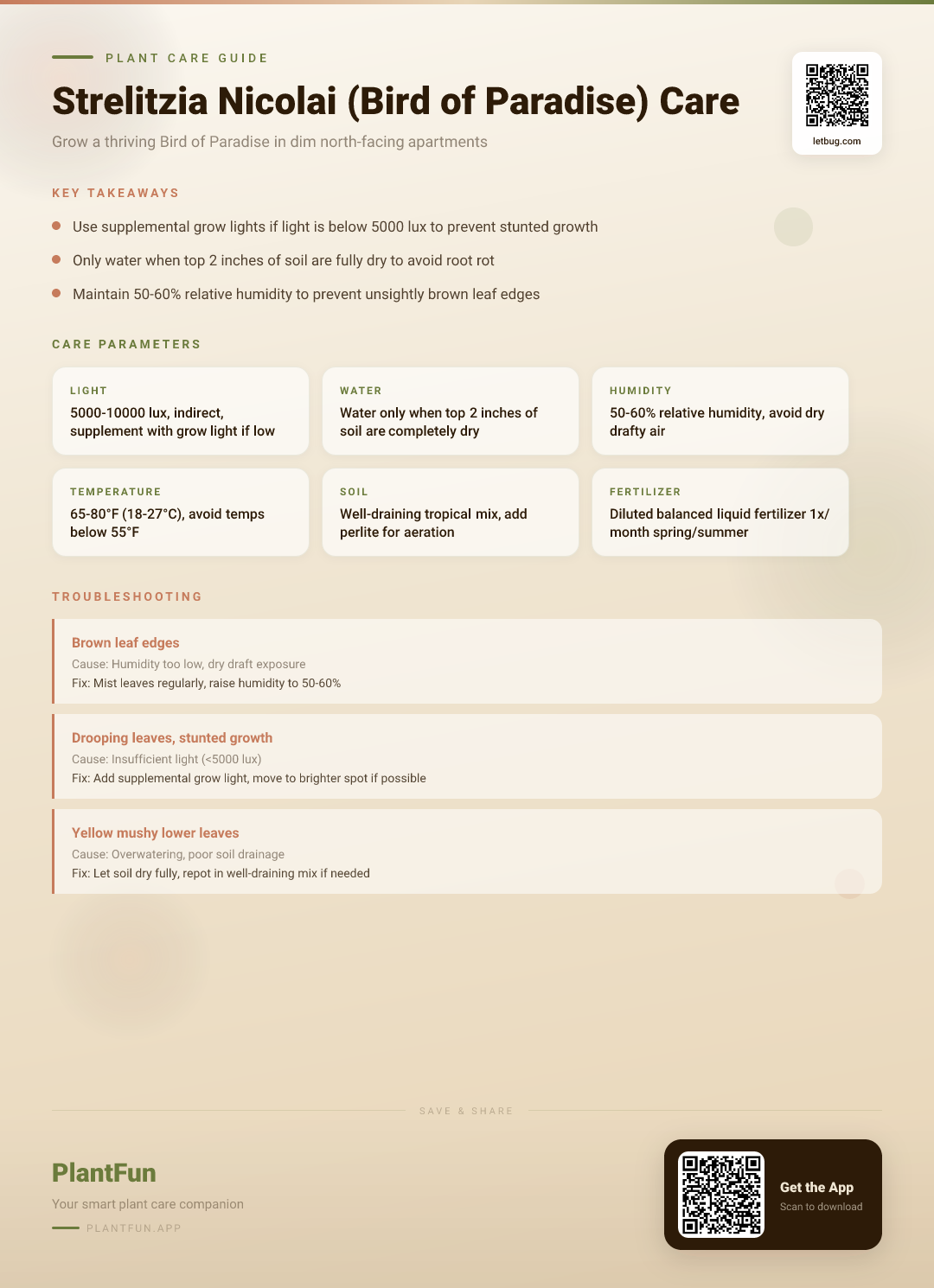
Key Takeaways
- Check soil moisture before watering — overwatering is the #1 killer of houseplants.
- Ensure your plant gets the right amount of light for its species.
- Be patient with recovery — most plants need 2–4 weeks to bounce back.
Quick Care Card: Vital metrics for indoor Strelitzia success
| Feature | Requirement |
|---|---|
| Light | Bright, indirect (5,000–10,000 lux) |
| Water | Allow top 2 inches of soil to dry out |
| Humidity | 50%–60% RH (Relative Humidity) |
| Temperature | 65°F–80°F (18°C–27°C) |
| Soil | Well-draining, peat-based aroid mix |
| Fertilizer | Balanced liquid feed monthly in spring/summer |
| Toxicity | Toxic to cats and dogs (ASPCA, 2026) |
TL;DR: The truth about Bird of Paradise in low-light apartments
Growing a Strelitzia nicolai in a north-facing apartment is entirely possible, but you must supplement its needs. It is not a low-light plant; it is a high-light plant that survives in low light. If you cannot provide supplemental grow lights, expect slow growth and potential leggy stems. Keep the soil slightly moist but never waterlogged, and maintain humidity above 50% to prevent unsightly leaf browning.
My Experience: The North-Facing Struggle
When I first moved into my current apartment, I was determined to place my giant Bird of Paradise in a north-facing nook. I made the mistake of assuming the foliage would adapt to the dim conditions. Within three months, the lower leaves turned yellow and the new growth was stunted. I learned the hard way that while these plants are hardy, they demand specific intensity levels to maintain their structural integrity (NC State Extension, 2026).
Understanding the Strelitzia nicolai: Why it struggles in north-facing rooms
In its natural habitat, Strelitzia nicolai thrives under intense, filtered sun. North-facing windows provide the most consistent but weakest light of any orientation. In these conditions, the plant struggles to perform photosynthesis at a rate sufficient to support its massive, paddle-shaped leaves. This can lead to localized stress, making the plant more susceptible to pathogens (Seijo & Peres, 2011).
Measuring Your Light: Maintaining 5,000-10,000 lux with supplemental help
To thrive, your plant needs roughly 5,000 to 10,000 lux. In a north-facing apartment, you are likely receiving less than 2,000 lux. I recommend using a simple light-meter app on your smartphone to measure the levels at the leaf surface. If you are consistently below 4,000 lux, you must use a full-spectrum LED grow light positioned 12–18 inches above the canopy for 10–12 hours a day.
Watering Mastery: Avoiding root rot with the 2-inch top-soil rule
Overwatering is the fastest way to kill a Strelitzia. Because growth slows in lower light, the plant’s metabolic demand for water drops.
- Use your finger to test the soil depth.
- If the top 2 inches feel dry, water thoroughly until liquid drains from the bottom.
- Empty the saucer immediately; never let the plant sit in standing water.
The Humidity Factor: Why 50-60% relative humidity prevents brown edges
Dry indoor air is the primary cause of crispy, brown leaf edges. Using a digital hygrometer, monitor your room’s humidity. If your level drops below 40%, use a humidifier to reach 50%–60%. This mimics the tropical environment the plant evolved in (Dwarka et al., 2017).
Temperature Control: Keeping the sweet spot between 65-80°F (18-27°C)
Avoid placing your Strelitzia near cold drafts from windows or direct heat from radiators. Rapid temperature fluctuations can trigger leaf drop and physiological shock.
Seasonal Care Calendar: Adjusting for low winter light levels
- Spring/Summer: Increase watering frequency as light levels rise.
- Fall/Winter: Reduce water and withhold fertilizer. The plant enters a semi-dormant state where it needs less fuel to survive (NC State Extension, 2026).
Common Mistakes to Avoid
- Mistake: Using a pot without drainage holes. What happens: Water pools at the bottom, leading to root rot. Instead: Use a nursery pot inside a decorative cachepot.
- Mistake: Neglecting to clean leaves. What happens: Dust inhibits light absorption. Instead: Wipe leaves with a damp cloth every two weeks.
FAQ: Why is my Bird of Paradise drooping in the living room?
Drooping is often a symptom of dehydration or root stress. Check if the soil is bone dry. If it is wet and drooping, it may be suffering from root rot caused by poor drainage (Seijo & Peres, 2011).
FAQ: Can I use a grow light to save my Strelitzia from dying?
Yes. Supplemental, high-quality full-spectrum LED lighting is the most effective way to save a struggling specimen in a north-facing apartment.
FAQ: How often should I fertilize my plant for resilient growth?
Apply a balanced liquid fertilizer once a month only during the active growing season (spring through early autumn). Over-fertilizing during winter will lead to weak, salt-stressed roots.
Troubleshooting Guide: Identifying early signs of light deficiency
Yellowing lower leaves
Symptom: Leaves closest to the base turn yellow and drop.
Likely cause: Insufficient light preventing the plant from supporting older foliage.
Fix:
- Check light levels with a meter.
- Supplement with a grow light.
Leggy, leaning growth
Symptom: Stems are excessively long and leaning toward the window.
Likely cause: Phototropism caused by extreme light deficiency.
Fix:
- Move the plant closer to the light source.
- Rotate the pot 90 degrees every week.
Brown, crispy leaf edges
Symptom: The margins of the leaves become brittle and brown.
Likely cause: Low humidity or inconsistent watering.
Fix:
- Increase humidity via a humidifier.
- Establish a consistent watering schedule.
References
- Seijo, T.; Peres, N. (2011). First Report of Acidovorax avenae subsp. avenae Causing Bacterial Leaf Stripe of Strelitzia nicolai. Plant Disease. https://doi.org/10.1094/pdis-03-11-0160. Accessed 2026-03-13.
- Dwarka, D.; Thaver, V.; Naidu, M. (2017). NEW INSIGHTS INTO THE PRESENCE OF BILIRUBIN IN A PLANT SPECIES STRELITZIA NICOLAI (STRELITZIACEAE). African Journal of Traditional, Complementary and Alternative medicines. https://doi.org/10.21010/ajtcam.v13i5.27. Accessed 2026-03-13.
- ASPCA. (2026). Toxic and Non-Toxic Plants List — ASPCA. https://www.aspca.org/pet-care/animal-poison-control/toxic-and-non-toxic-plants. Accessed 2026-03-13.
- NC State Extension. (2026). Strelitzia Nicolai — NC State Extension Gardener Plant Toolbox. https://plants.ces.ncsu.edu/plants/strelitzia-nicolai/. Accessed 2026-03-13.
Optional Helper: Plantfun.App
Plantfun.App identifies your plants by photo, diagnoses pests and diseases with clear fixes, and creates personalised watering and light schedules that adapt to your home conditions — a handy companion for putting this guide into daily practice.
Found an error or have suggestions? We'd love your feedback.
Need help identifying this problem?
Get instant identification, personalized care schedules, and effective pest treatment plans directly on your phone.
Sponsored • We may earn a commission from app downloads
Related Guides
The Complete Bird of Paradise Care Guide for Standard Apartments: Resilient Year-Round Growth
Grow a lush, thriving Bird of Paradise even in a small, low-humidity apartment. Get exact light, water, and humidity thresholds plus a 4-season care checklist for zero-fuss resilient growth.
Care GuideGiant Bird of Paradise in Typical Apartments: The Only Care Guide You’ll Ever Need
Grow a lush, towering Giant Bird of Paradise in your apartment with our seasonal care checklist, exact light, water, and humidity thresholds, and simple tips to keep growth strong year-round.
Care GuideThe Complete Bird of Paradise Care Guide for Typical Apartments: Resilient Growth Tips That Work
Keep your Bird of Paradise thriving in even the dimmest typical apartment. Get exact light levels, water amounts, and a 2-minute weekly check to avoid yellow leaves and boost resilient growth.
Pest ControlAnts on Plants: What They Mean and What to Do
Ants usually aren't eating your plant. They are farming other pests.