
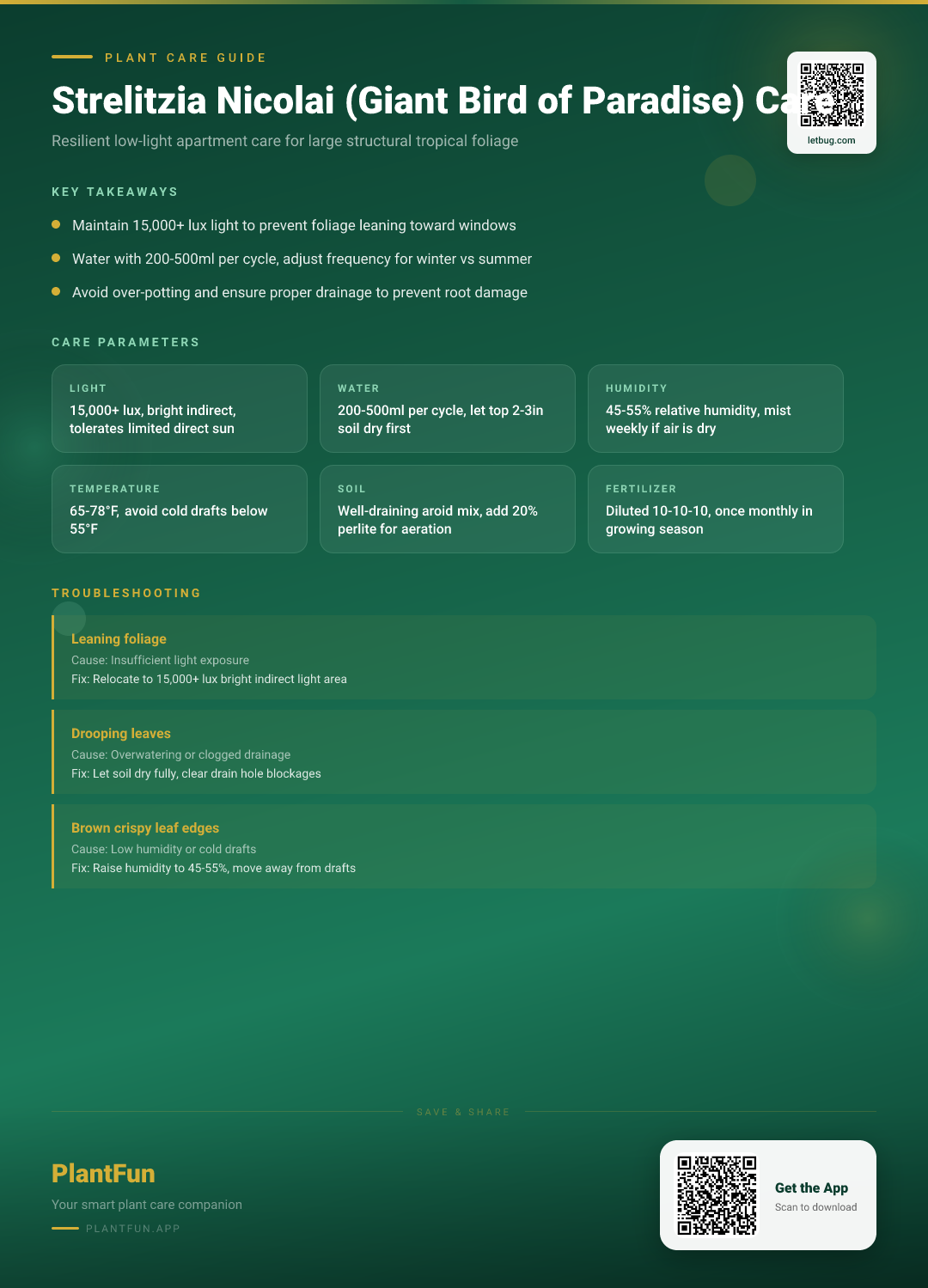
Key Takeaways
- Check soil moisture before watering — overwatering is the #1 killer of houseplants.
- Ensure your plant gets the right amount of light for its species.
- Be patient with recovery — most plants need 2–4 weeks to bounce back.
Quick Care Card: Essential Thresholds for Strelitzia nicolai
| Variable | Requirement |
|---|---|
| Light | 15,000+ Lux (Bright indirect) |
| Water | 200-500ml per cycle (Dry out 50%) |
| Humidity | 45-55% (Relative Humidity) |
| Temperature | 65-78°F (18-25°C) |
| Soil | Fast-draining, high-porosity mix |
| Fertilizer | Balanced liquid feed (Monthly, spring/summer) |
| Toxicity | Toxic to cats and dogs (ASPCA, 2026) |
TL;DR: The Reality of Keeping a Giant Bird of Paradise in an Apartment
Strelitzia nicolai is a high-energy plant that typically demands full sun, but you can maintain a healthy specimen in an apartment by strictly controlling its metabolic rate. By prioritizing high-intensity indirect light, moderate watering, and seasonal adjustments, you can prevent the leggy growth and structural collapse common in urban indoor settings. Success depends on stabilizing the environment rather than chasing maximum growth.
Why Light Is Your Primary Variable: Understanding LUX in Indoor Spaces
When I first brought my Strelitzia nicolai into my apartment, I made the mistake of placing it in a “bright” corner that was actually a light desert. In the wild, these plants thrive in high-intensity conditions. Indoors, we use LUX (the metric unit of illuminance) to measure how much usable light reaches the foliage.
Most living rooms provide 2,000 to 5,000 LUX, which is insufficient for this species. To sustain a healthy Giant Bird of Paradise, you need to provide at least 15,000 LUX. If you cannot reach this with windows alone, supplemental full-spectrum LEDs are mandatory for structural integrity (NC State Extension, 2026).
Step-by-Step Care: Watering, Soil Aeration, and Nutrient Cycling
- The Finger Test: Before watering, stick your finger 2 inches into the soil. If it is still damp, do not water. This helps prevent root rot.
- Controlled Irrigation: Apply 200-500ml of water slowly, ensuring the moisture reaches the bottom of the pot. Never leave the plant sitting in a drainage tray full of water.
- Soil Aeration: Use a wooden chopstick to gently poke holes in the top 3 inches of soil monthly. This prevents compaction, which is a common hidden cause of root suffocation.
- Nutrient Cycling: During active growth (spring/summer), feed with a balanced, water-soluble fertilizer at half-strength every 4-6 weeks. Discontinue entirely in late autumn.
The 4-Point Resilience Matrix: Lux (15,000+), Humidity (45-55%), Water (200-500ml), and Temperature (65-78°F)
This matrix is your baseline. If one variable drifts—like a temperature drop near a drafty window—you must compensate by reducing your water volume to slow the plant’s metabolic consumption. Maintaining these levels ensures the plant remains in a state of ‘maintenance’ rather than ‘stress’ while in your apartment (NC State Extension, 2026).
Diagnosing Leaf Splitting vs. Desiccation: What Your Plant is Telling You
[Structural Leaf Splitting]
Symptom: Natural tears appearing along the leaf veins.
Likely cause: Mature leaves naturally split to allow wind to pass through (an evolutionary adaptation).
Fix:
- This is normal; do not prune healthy, split leaves.
- Monitor the edges for browning, which indicates the split is not purely structural but environmental.
[Leaf Desiccation (Brown Tips)]
Symptom: Crisp, brown, or black leaf tips.
Likely cause: Low ambient humidity or erratic watering habits.
Fix:
- Increase humidity via a nearby humidifier to 45-55%.
- Establish a consistent watering routine to keep soil moisture even.
Seasonal Care Calendar: Why Your Winter Schedule Must Differ from Summer
In summer, your Strelitzia is photosynthetically active. In winter, light levels in your apartment drop by up to 80%. You must reduce water volume by half during winter to prevent the soil from remaining saturated, which invites pathogens like Acidovorax avenae (Seijo & Peres, 2011). Keep the plant away from radiator heat, which creates localized desiccation.
Myth-Busting: Do Birds of Paradise Need Direct Sun All Day?
Myth: They need 8 hours of scorching, direct sun to survive. Reality: While they thrive in such conditions outdoors, the intense heat magnification behind modern apartment glass can actually burn the foliage. They prefer consistent, high-intensity indirect light. Focus on the quality of light, not just direct exposure.
FAQ: Why is my Bird of Paradise drooping in my living room?
Drooping is usually a sign of dehydration or root stress. If the soil is bone dry, the plant is signaling for more water. If the soil is wet, the plant may be experiencing root rot; check the drainage holes immediately.
FAQ: Can I move my Bird of Paradise to a north-facing corner?
Generally, no. A north-facing corner will provide insufficient LUX, leading to rapid etiolation (stretching toward the light) and eventual structural failure.
Common Mistakes to Avoid: Over-potting and Drainage Neglect
-
Mistake: Using a pot 3+ inches larger than the root ball.
What happens: The soil stays wet for too long, leading to root rot.
Instead: Only up-pot by 1-2 inches. -
Mistake: Using a decorative pot without drainage holes.
What happens: Water collects at the bottom, creating an anaerobic environment.
Instead: Use a nursery pot inside the decorative one for proper drainage management.
References
- Seijo, T.; Peres, N. (2011). First Report of Acidovorax avenae subsp. avenae Causing Bacterial Leaf Stripe of Strelitzia nicolai. Plant Disease. https://doi.org/10.1094/pdis-03-11-0160. Accessed 2026-03-10.
- Dwarka, D.; Thaver, V.; Naidu, M. (2017). NEW INSIGHTS INTO THE PRESENCE OF BILIRUBIN IN A PLANT SPECIES STRELITZIA NICOLAI (STRELITZIACEAE). African Journal of Traditional, Complementary and Alternative medicines. https://doi.org/10.21010/ajtcam.v13i5.27. Accessed 2026-03-10.
- ASPCA. (2026). Toxic and Non-Toxic Plants List — ASPCA. https://www.aspca.org/pet-care/animal-poison-control/toxic-and-non-toxic-plants. Accessed 2026-03-10.
- NC State Extension. (2026). Strelitzia nicolai — NC State Extension Gardener Plant Toolbox. https://plants.ces.ncsu.edu/plants/strelitzia-nicolai/. Accessed 2026-03-10.
Optional Helper: Plantfun.App
Plantfun.App identifies your plants by photo, diagnoses pests and diseases with clear fixes, and creates personalised watering and light schedules that adapt to your home conditions — a handy companion for putting this guide into daily practice.
Found an error or have suggestions? We'd love your feedback.
Need help identifying this problem?
Get instant identification, personalized care schedules, and effective pest treatment plans directly on your phone.
Sponsored • We may earn a commission from app downloads
Related Guides
Strelitzia nicolai in Apartments: The Only Resilient Care Guide You Will Ever Need
Transform your apartment into a tropical escape with our resilient Bird of Paradise care guide. Get precise light, watering, and soil hacks for 100% growth.
Care GuideStrelitzia Nicolai in a North-Facing Apartment: The Only Bird of Paradise Care Guide You Need
Transform your dim north-facing apartment into a tropical oasis. Discover the exact light, water, and humidity thresholds needed for a thriving Bird of Paradise.
Care GuideStrelitzia nicolai in a Small Apartment: The Resilience-First Care Guide for Indoor Success
Transform your cramped apartment into a tropical oasis. Master Bird of Paradise care with 4 simple steps and a resilient watering schedule that prevents rot.
Pest ControlAnts on Plants: What They Mean and What to Do
Ants usually aren't eating your plant. They are farming other pests.