
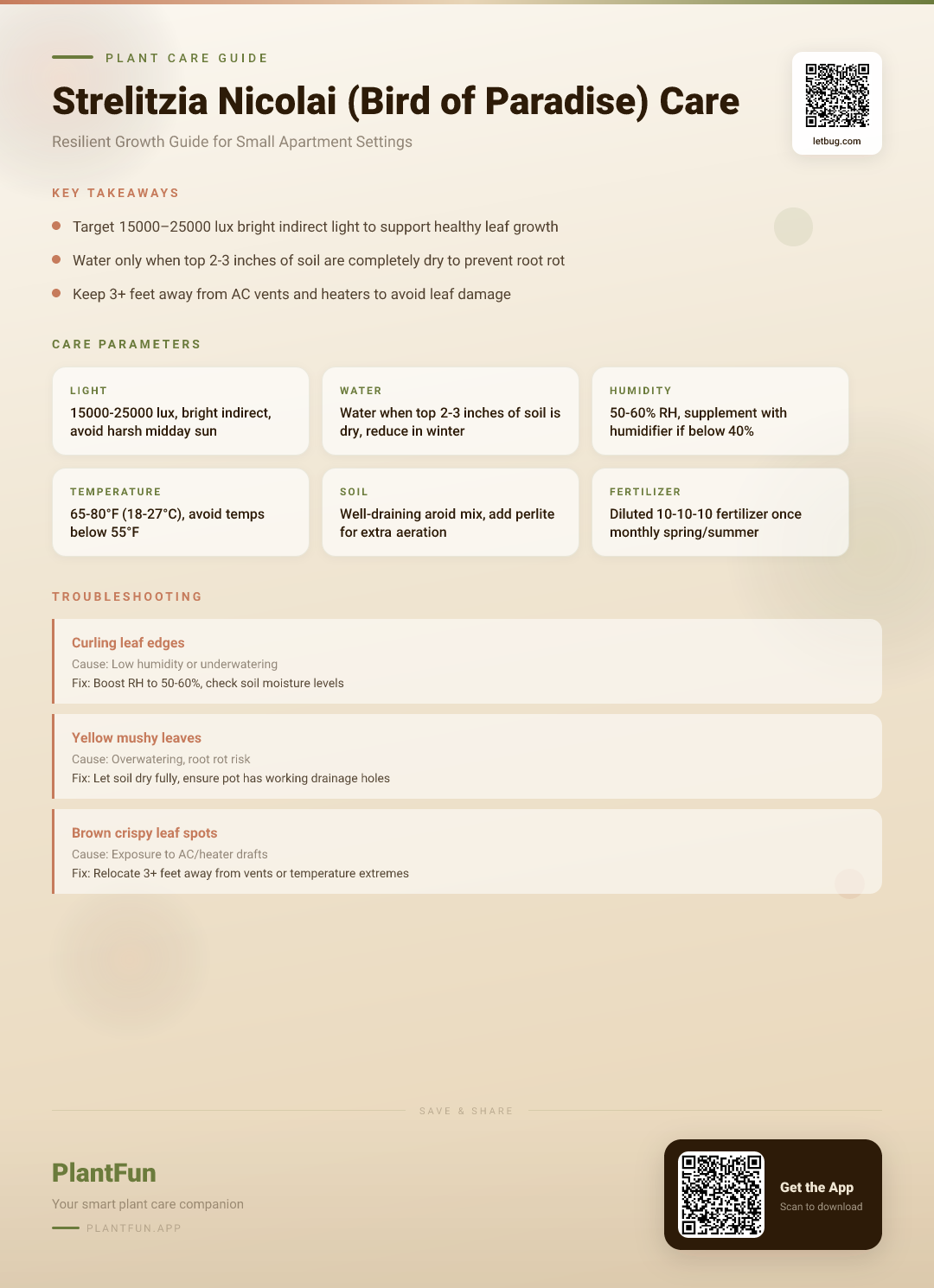
Key Takeaways
- Check soil moisture before watering — overwatering is the #1 killer of houseplants.
- Ensure your plant gets the right amount of light for its species.
- Be patient with recovery — most plants need 2–4 weeks to bounce back.
Quick Care Card: Essential Thresholds for Strelitzia Nicolai
| Category | Requirement |
|---|---|
| Light | 15,000–25,000 lux (Bright, indirect) |
| Watering | When top 2-3 inches of soil are dry |
| Humidity | 50-60% Relative Humidity |
| Temperature | 65-80°F (18-27°C) |
| Soil | Well-draining aroid mix (coarse, airy) |
| Fertilizer | Balanced liquid feed during growing season |
| Toxicity | Toxic to cats and dogs (ASPCA, 2026) |
TL;DR: The Bird of Paradise Reality Check for Apartment Living
Growing a Strelitzia nicolai in an apartment is entirely possible, provided you respect its tropical origins. Your primary goals are high light intensity and controlled moisture. If your plant is curling or browning, it is almost always telling you that it lacks either ambient humidity or consistent light. Maintain 15,000+ lux and a disciplined watering schedule, and this architectural giant will reward you with steady growth.
Why Your Apartment Environment Challenges Your Strelitzia
When I first brought home my Strelitzia nicolai, I placed it in a dim corner, assuming it was a “hardy” plant. It quickly developed brown tips. My mistake was ignoring the micro-climate shift. Apartments typically suffer from low air circulation and stagnant, dry air. Unlike a nursery greenhouse, which benefits from high-volume ventilation and solar gain, your living room acts as a heat sink that traps moisture poorly. According to the North Carolina State University Extension (2026), these plants thrive in full sun and high humidity; recreating this in an apartment requires intentional environmental management.
Decoding Light: Reaching the 15,000–25,000 lux Sweet Spot
Bird of Paradise light requirements are non-negotiable. While they are sold as “decorative foliage,” they are heliophilic (sun-loving) plants. In an apartment, your best friend is a light meter for beginners, which will reveal just how much light drops off even a few feet from a window. I aim for 15,000 to 25,000 lux. If you cannot place your plant directly in a South or West-facing window, you will need to supplement with full-spectrum grow lights.
Watering Protocols: Preventing Root Rot in Pot-Bound Specimens
I always tell beginners that it is better to underwater than overwater. When learning how often to water a Bird of Paradise, forget the calendar. Instead, use the “finger test”: push your index finger two inches into the soil. If it feels moist, wait. Because they are often sold in dense, peat-heavy soil, preventing root rot in Bird of Paradise is about ensuring the roots have access to oxygen (NC State Extension, 2026). If you notice standing water, your drainage is insufficient.
Humidity & Airflow: Maintaining 50-60% RH to Stop Crisp Leaf Edges
Indoor plant humidity for Strelitzia should never dip below 50%. In urban apartments, heaters and AC units strip moisture from the air, leading to the dreaded crispy leaf edges. I keep a humidifier running near mine. Furthermore, ensure there is gentle airflow. Stagnant air invites fungal issues, such as leaf spot (Sanahuja et al., 2017) or bacterial stripe (Seijo & Peres, 2011), both of which thrive in high-humidity, low-airflow environments.
Temperature Control: Why 65-80°F (18-27°C) is Your Target Range
These plants are sensitive to cold drafts. While they handle the 65-80°F (18-27°C) range perfectly, dropping below 55°F (13°C) can cause significant cellular stress. If your apartment has single-pane windows, pull the plant back slightly at night during winter months to avoid contact with cold glass.
Seasonal Care Calendar: Shifting Needs from Summer Peak to Winter Dormancy
- Spring/Summer (Growing Season): Increase water frequency and apply liquid fertilizer bi-weekly. This is when you maximize light exposure.
- Fall/Winter (Dormancy): Growth slows. Reduce watering significantly, as lower light levels mean the plant consumes less water. Fertilizer should be withheld entirely from November to February.
Common Mistakes: Stop These 3 Habits That Kill Apartment Strelitzias
- Mistake: Using standard potting soil without amendments. What happens: The soil compacts, suffocating roots and leading to rot. Instead: Use an aroid mix containing orchid bark, perlite, and charcoal.
- Mistake: Cleaning leaves with harsh chemicals. What happens: It clogs the stomata. Instead: Use a damp micro-fiber cloth to wipe dust off once a month.
- Mistake: Rotating the plant too often. What happens: The plant wastes energy re-orienting its leaves. Instead: Pick a spot with optimal light and leave it stationary.
FAQ: Voice-Search Optimized Solutions
How do I know if my Bird of Paradise is getting enough light in my apartment?
Look at the petiole (leaf stalk). If it is stretching (etiolation) and the leaves are smaller than usual, it is starving for light. Aim for a spot where the plant can “see” the sky.
Why are the leaves on my Bird of Paradise curling up at the edges?
This is a defense mechanism to reduce transpiration. It is almost always a sign that the ambient humidity is too low or the root system is struggling to uptake water due to soil issues.
Can I keep my Bird of Paradise near an air conditioning vent or heater?
No. Both cause rapid moisture loss and temperature spikes that will stress the plant, leading to premature leaf drop.
References
- Seijo, T.; Peres, N. (2011). First Report of Acidovorax avenae subsp. avenae Causing Bacterial Leaf Stripe of Strelitzia nicolai. Plant Disease. https://doi.org/10.1094/pdis-03-11-0160. Accessed 2026-03-16.
- Sanahuja, G.; Lopez, P.; Chase, A. (2017). First Report of Bipolaris oryzae Causing Leaf Spot on Strelitzia nicolai in Florida. Plant Disease. https://doi.org/10.1094/pdis-08-16-1138-pdn. Accessed 2026-03-16.
- ASPCA. (2026). Toxic and Non-Toxic Plants List — ASPCA. https://www.aspca.org/pet-care/animal-poison-control/toxic-and-non-toxic-plants. Accessed 2026-03-16.
- NC State Extension. (2026). Strelitzia Nicolai — NC State Extension Gardener Plant Toolbox. https://plants.ces.ncsu.edu/plants/nicolai-care/. Accessed 2026-03-16.
Optional Helper: Plantfun.App
Plantfun.App identifies your plants by photo, diagnoses pests and diseases with clear fixes, and creates personalised watering and light schedules that adapt to your home conditions — a handy companion for putting this guide into daily practice.
Found an error or have suggestions? We'd love your feedback.
Need help identifying this problem?
Get instant identification, personalized care schedules, and effective pest treatment plans directly on your phone.
Sponsored • We may earn a commission from app downloads
Related Guides
The Complete Giant Bird of Paradise Care Guide for Urban Apartments: Seasonal Tips for Resilient Growth
Grow a lush, resilient giant bird of paradise even in a small urban apartment. Get exact light levels, watering amounts, and a seasonal care calendar to avoid common growth problems.
Care GuideStrelitzia nicolai in Apartments: The Only Resilient Care Guide You Will Ever Need
Transform your apartment into a tropical escape with our resilient Bird of Paradise care guide. Get precise light, watering, and soil hacks for 100% growth.
Care GuideThe Complete Bird of Paradise Care Guide for Typical Apartments: Resilient Growth Tips That Work
Keep your Bird of Paradise thriving in even the dimmest typical apartment. Get exact light levels, water amounts, and a 2-minute weekly check to avoid yellow leaves and boost resilient growth.
Pest ControlAnts on Plants: What They Mean and What to Do
Ants usually aren't eating your plant. They are farming other pests.